 Calc
Harmonic Oscillator Energy Levels Calculator – E = (n + ½)hf
 Created by Yuki Tanaka · Physics Editor · Modern Physics · Last updated: November 2026
Use this free Quantum Harmonic Oscillator Calculator to list the allowed energy levels En = (n + ½)hf for n = 0 to 4. Unlike a classical spring, a quantum oscillator can never have zero energy — its lowest level already holds ½hf, the famous zero-point energy.
The quantum harmonic oscillator is the most important solved problem in physics — not because the world is made of tiny springs, but because everything behaves like one near equilibrium. A molecule vibrating about its bond length, an atom jiggling in a crystal, a light wave oscillating in a cavity: displace any of them slightly and the restoring force is proportional to the displacement, the potential is a parabola, and the allowed energies are the ladder this calculator lists, En = (n + ½)hf. Planck invented the ladder in 1900 to explain black-body radiation, smuggling the quantum into physics through exactly this formula; a century later it remains the first quantum system every student solves and the model every field quietly reuses.
Two features of the ladder defy classical intuition, and both are on display in the results table. First, the rungs are evenly spaced — every step costs the same hf, unlike the atom's levels, which crowd together, or a particle in a box, whose levels spread apart. Second, the ladder does not reach the floor: the lowest rung, n = 0, sits at ½hf above the bottom of the well. This zero-point energy is not a bookkeeping trick. The uncertainty principle forbids a particle from resting motionless at the potential's minimum — that would fix both its position and its momentum — so the ground state keeps a irreducible tremor of motion and energy forever, even at absolute zero.
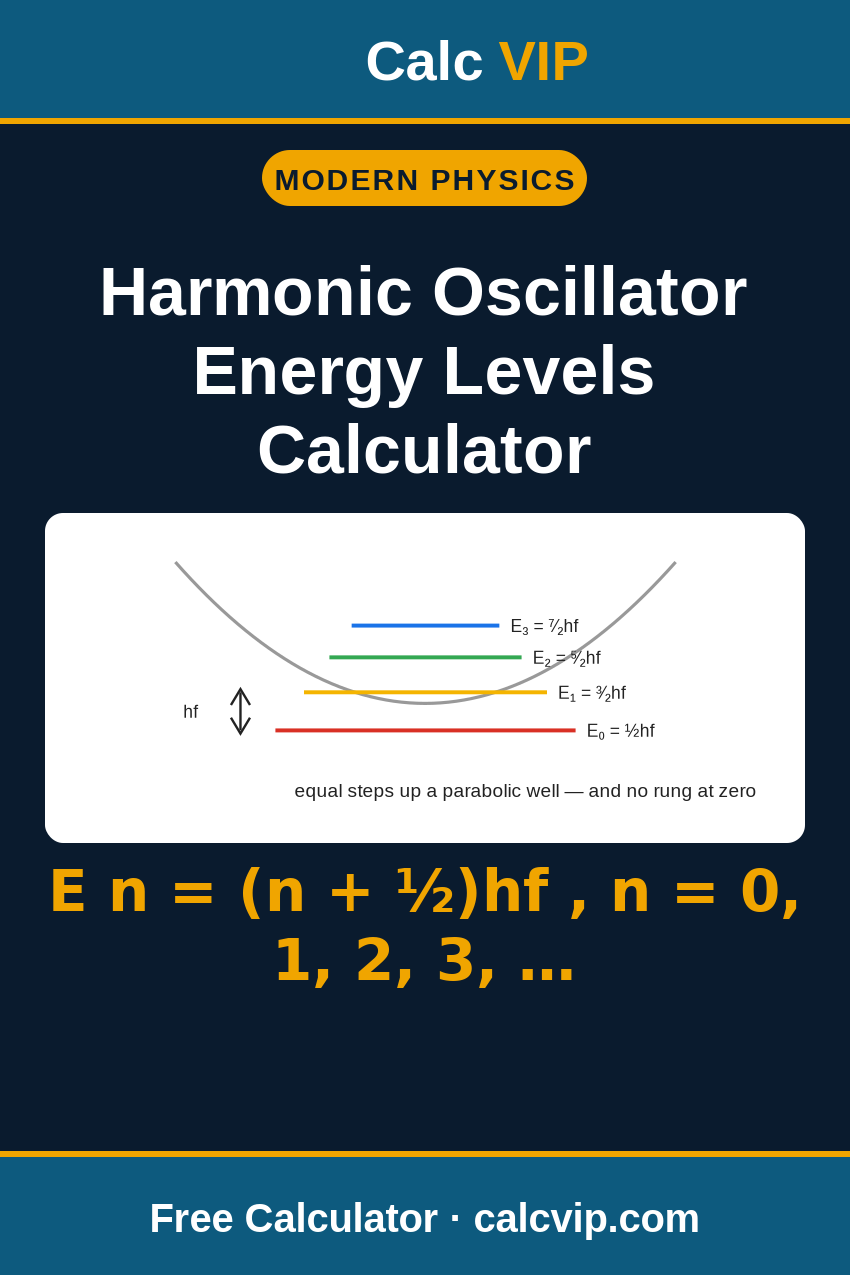
The single input, frequency, spans an enormous range of physics. A pendulum-scale oscillator at 1 Hz has an hf so small (6.626 × 10⁻³⁴ J) that its quantum steps are undetectable and the classical swing rules; a molecular bond at 10¹⁴ Hz has steps of tenths of an electronvolt, squarely in the infrared, which is why molecules announce their vibrations by absorbing IR light; and the modes of the electromagnetic field itself, at optical frequencies, have steps of whole electronvolts — their "excitations" are photons. Enter a frequency and this calculator returns the spacing hf and the first five levels, in joules and electronvolts, ready to compare against kT, photon energies or dissociation energies as your problem demands.
Formula
En = (n + ½)hf, n = 0, 1, 2, 3, … • step between neighbours ΔE = hf • zero-point energy E₀ = ½hf • h = 6.626 × 10⁻³⁴ J·s
The formula's inputs deserve respect. The frequency f is the oscillator's classical frequency — for a mass on a spring, f = (1/2π)√(k/m); for a molecular bond, f = (1/2π)√(k/μ) with μ the reduced mass of the two atoms and k the bond's stiffness — and quantum mechanics quantises the motion at that frequency without changing it. Spectroscopists quote wavenumber ν̃ in cm⁻¹ instead; convert with f = ν̃ × c = ν̃ × 2.998 × 10¹⁰ Hz before using this calculator (a 2,886 cm⁻¹ band is 8.652 × 10¹³ Hz). The rearrangements are trivial but mighty: a measured step gives f = ΔE/h, and the photon that climbs one rung has λ = c/f = hc/ΔE. One caution belongs to every use: the ladder is exact only for a perfect parabola. Real bonds soften as they stretch, so real ladders' rungs slowly converge — the depth section below quantifies the correction.
| Symbol | Meaning | Units |
|---|---|---|
| n | quantum number — counts the level, starting at 0 | 0, 1, 2, … |
| f | oscillator frequency (the classical vibration frequency) | Hz |
| hf | level spacing — the energy of one quantum of the vibration | J or eV |
| ½hf | zero-point energy — the ground state's irreducible energy | J or eV |
| k, μ | spring/bond stiffness and (reduced) mass, setting f = (1/2π)√(k/μ) | N/m, kg |
Zero-point energy: the tremor that never stops
The ½hf is the most consequential half in physics. Classically, cooling an oscillator should park it at the bottom of its well with no energy at all; quantum mechanically that state — exact position, exact zero momentum — is precisely what the uncertainty principle prohibits. The ground state compromises: it spreads the particle over a small region around the minimum and keeps ½hf of restless energy, half kinetic, half potential, on average. No refrigerator can remove it, because it is not heat; it is the energy of being confined at all. Multiply it by every oscillator in a material and the consequences become macroscopic. Liquid helium's atoms, light and weakly bound, carry so much zero-point motion that they refuse to solidify under their own vapour pressure even at absolute zero — helium is the only element that stays liquid to T = 0 unless squeezed. Chemists meet the same effect in isotope substitution: a carbon–deuterium bond vibrates more slowly than carbon–hydrogen (heavier μ, lower f), so its zero-point energy is lower, its effective bond stronger, and reactions that must break it run measurably slower — the kinetic isotope effect, a workhorse of mechanism studies, is ½hf doing bookkeeping.
The electromagnetic field gets the treatment too: each mode of the field is an oscillator, each carries ½hf of vacuum energy, and while the absolute total is a famous theoretical embarrassment, differences in zero-point energy are measurable — the Casimir force between two metal plates, which excludes long-wavelength modes from the gap and so lowers the zero-point energy inside it, pulls the plates together with a force measured to percent accuracy. The humble ½ in this calculator's formula is, on inspection, one of the deepest terms in physics.
How to use
- Enter the frequency f in hertz — scientific notation such as 1e14 is fine. If your source gives wavenumbers (cm⁻¹), multiply by 2.998 × 10¹⁰ first.
- Click "Calculate Energy Levels".
- Read the level spacing hf and zero-point energy, then the table of E₀ to E₄ in joules and electronvolts.
- Compare the spacing with the energy scales of your problem: if hf ≪ kT (0.0259 eV at 300 K), many levels are populated and the oscillator behaves classically; if hf ≫ kT, it sits in its ground state and only the zero-point energy matters until a photon of exactly hf arrives.
Worked examples
Example 1 — a molecular vibration at 10¹⁴ Hz. For a vibration with f = 1 × 10¹⁴ Hz (typical of a molecular bond):
hf = 6.626 × 10−34 × 1 × 10¹⁴ = 6.626 × 10⁻²⁰ J = 0.414 eV
E₀ = ½hf = 0.207 eV
E₁ = ³⁄₂hf = 0.620 eV, E₂ = 1.034 eV, E₃ = 1.448 eV, E₄ = 1.861 eV
Each step up costs exactly one "packet" of 0.414 eV — a photon of wavelength hc/hf ≈ 3.0 µm, in the mid-infrared.
Example 2 — the hydrogen chloride bond. HCl vibrates at 2,886 cm⁻¹, so f = 2,886 × 2.998 × 10¹⁰ = 8.652 × 10¹³ Hz:
hf = 5.733 × 10⁻²⁰ J = 0.3579 eV; E₀ = 0.1789 eV.
The 0 → 1 absorption photon has λ = c/f = 3.467 µm — HCl's fundamental infrared band, one of the textbook spectra of physical chemistry, and a worked demonstration that this calculator plus a wavenumber conversion is an infrared spectrometer on paper.
Example 3 — carbon dioxide's bending mode: the greenhouse vibration. CO₂ bends at 667 cm⁻¹, so f = 667 × 2.998 × 10¹⁰ ≈ 2.0 × 10¹³ Hz:
hf = 1.325 × 10⁻²⁰ J = 0.0827 eV; E₀ = 0.0414 eV.
The absorption wavelength is 1 ÷ 667 cm = 15.0 µm — squarely in the thermal infrared the Earth itself radiates to space. That coincidence, computed in two lines from this page's formula, is the molecular machinery of the greenhouse effect: CO₂'s ladder has a rung exactly where the planet's heat tries to leave.
Example 4 — the hydrogen molecule, stiffest common bond. H₂ vibrates at 4,401 cm⁻¹, so f = 1.319 × 10¹⁴ Hz:
hf = 8.740 × 10⁻²⁰ J = 0.5455 eV; E₀ = 0.2728 eV.
The zero-point energy alone is over a quarter of an electronvolt — about 6% of the bond's 4.5 eV dissociation energy, a correction no accurate H₂ energy budget may omit. (H₂'s vibration is infrared-inactive — the molecule has no changing dipole — so this ladder is probed by Raman scattering instead; the levels are the same.)
Example 5 — a macroscopic spring: where the ladder vanishes. Take f = 1 Hz, a gentle pendulum-scale oscillator:
hf = 6.626 × 10⁻³⁴ J = 4.136 × 10⁻¹⁵ eV.
Room-temperature thermal energy is kT = 4.143 × 10⁻²¹ J, which spans kT/hf ≈ 6.3 × 10¹² rungs of the ladder. With trillions of levels populated and the steps thirteen orders of magnitude below thermal noise, quantisation is undetectable — the oscillator is classical for all practical purposes, and Newton, not Planck, is its proper theorist.
Example 6 — a crystal phonon at 10¹³ Hz. Atoms in a solid vibrate collectively at around f = 10¹³ Hz:
hf = 6.626 × 10⁻²¹ J = 0.0414 eV; E₀ = 0.0207 eV.
Set against kT at 300 K (0.0259 eV), the spacing is the larger quantity — barely. Some rungs are thermally populated, most are not, and this marginal comparison is exactly why solids' heat capacities sag below the classical value as temperature falls: the oscillators freeze into their ground states one frequency at a time, Einstein's 1907 insight that first proved quanta existed outside radiation.
The harmonic oscillator in real life
Infrared spectroscopy. Every molecular vibration with a changing dipole absorbs at its hf. The pattern of a molecule's ladders — stretches, bends, their characteristic wavenumbers — is its infrared fingerprint, read by instruments in every chemistry laboratory, brewery, pharmaceutical plant and emissions monitor on Earth. Examples 2 and 3 are two lines of that universal table.
Climate physics. Greenhouse gases are precisely the molecules whose oscillator ladders have rungs in the thermal infrared and a dipole that lets them couple to light: CO₂'s 15 µm bend, methane's bands near 7.7 µm, water vapour's broad forest. N₂ and O₂, dipole-less, are transparent — the atmosphere's composition of absorbers is a list of allowed ladders.
Heat capacities of solids. Einstein modelled a solid as 3N independent oscillators; their quantised ladders explain why heat capacities plunge towards zero at low temperature (Debye's refinement uses a spectrum of f). Cryogenics, calorimetry and materials databases all descend from this calculation.
Laser cooling and quantum engineering. Trapped ions and optomechanical devices are cooled to the oscillator ground state — sideband cooling removes one hf at a time until only the ½hf tremor remains. Reaching E₀ on demand is a benchmark capability of modern quantum laboratories, and this formula is its scorecard.
Quantum optics. Each mode of the light field is an oscillator whose n counts photons: En = (n + ½)hf with n photons present. Lasers, single-photon sources and the whole theory of quantum information with light are this page's ladder with photons on the rungs.
Chemical kinetics. Zero-point energies shift reaction barriers: bonds to deuterium sit lower in their wells than bonds to hydrogen, changing reaction rates by factors of up to ~7 at room temperature. Kinetic isotope effects — measured with this arithmetic — are a standard tool for proving how a reaction proceeds.
Selection rules and anharmonicity: where the ideal ladder bends
Light interacts with the ladder under a strict rule: for a perfect harmonic oscillator, photons connect only neighbouring rungs, Δn = ±1. That is why molecular infrared spectra show essentially one fundamental band per vibration rather than a picket fence — every allowed absorption is the same hf step, repeated. Two real-world relaxations matter. First, the vibration must modulate the molecule's dipole moment to couple to light at all; symmetric molecules' symmetric stretches (and all vibrations of H₂, N₂, O₂) are infrared-silent and appear only in Raman spectra. Second, real bonds are not parabolas: they are Morse wells, steep on the compression side and flattening towards dissociation, so real rungs converge — En ≈ (n + ½)hf − (n + ½)²hf·xe with an anharmonicity constant xe of a percent or so. The convergence licenses weak overtone bands at slightly less than 2hf, 3hf (Δn = ±2, ±3), which near-infrared spectroscopy exploits, and it means the ladder ends: beyond a finite number of rungs the molecule falls apart, its dissociation energy being the well's true depth minus the ½hf it started with. The calculator's perfect ladder is the reference from which all these refinements are measured — learn it first, then bend it.
Quick reference: spacings and zero-point energies by frequency
| Frequency f | Spacing hf | Zero-point ½hf | Typical system |
|---|---|---|---|
| 1 Hz | 4.136 × 10⁻¹⁵ eV | 2.068 × 10⁻¹⁵ eV | pendulum, macroscopic spring |
| 10¹² Hz | 0.004136 eV | 0.002068 eV | lattice vibrations, far-IR |
| 10¹³ Hz | 0.04136 eV | 0.02068 eV | crystal phonons, molecular bends |
| 5 × 10¹³ Hz | 0.2068 eV | 0.1034 eV | many bond stretches |
| 10¹⁴ Hz | 0.4136 eV | 0.2068 eV | stiff bonds (C–H, O–H, H₂) |
| 5 × 10¹⁴ Hz | 2.068 eV | 1.034 eV | visible-light field modes (photons) |
| 10¹⁵ Hz | 4.136 eV | 2.068 eV | ultraviolet field modes |
Read the table against kT = 0.0259 eV at room temperature: systems below ~10¹³ Hz are thermally alive and quasi-classical; systems above it are frozen into their ground states awaiting a photon. One constant, hf, sorts the entire physical world into those two regimes.
Common mistakes
- Starting the count at n = 1. The oscillator's ladder starts at n = 0 — the ground state is E₀ = ½hf, not ³⁄₂hf. (The hydrogen atom is the system that starts at 1; confusing the two conventions is endemic.)
- Feeding wavenumbers in as hertz. A band at 2,886 cm⁻¹ is f = 8.652 × 10¹³ Hz. Typing "2886" into the frequency box understates every energy by ten orders of magnitude. Convert with f = ν̃ × 2.998 × 10¹⁰.
- Expecting the ground state to be zero at absolute zero. Cooling removes thermal excitation, not zero-point energy: at T = 0 the oscillator still holds ½hf. Any energy budget that parks it at zero has broken the uncertainty principle.
- Assuming every vibration absorbs infrared light. Only vibrations that change the molecular dipole couple to IR photons. H₂, N₂ and O₂ have ladders but no IR bands — a fact of obvious importance for the atmosphere — and are studied by Raman scattering instead.
- Extending the ladder forever. Real bonds dissociate: the rungs converge (anharmonicity) and end after a finite count. Extrapolating equal spacings to n = 20 for a real molecule overstates its high levels and can "predict" bound states beyond the dissociation limit that do not exist.
FAQ
What is zero-point energy?
The ½hf that remains even at absolute zero. The uncertainty principle forbids the oscillator from sitting perfectly still at the bottom of its well, so it always keeps this minimum motion and energy.
Why are the levels evenly spaced?
That is a special property of the parabolic (spring-like) potential. It is why molecular vibrations absorb infrared light in nearly equal steps, and why the oscillator is the most exactly solvable system in quantum mechanics.
Where is this model used?
Vibrating molecules (infrared spectroscopy), atoms in crystal lattices (phonons), and even the electromagnetic field itself — each light mode is treated as a harmonic oscillator whose excitations are photons.
Why is it called "harmonic"?
Because the motion is simple harmonic motion — the same sinusoid as a perfect spring or pendulum — generated by a restoring force proportional to displacement. "Harmonic" names the shape of the motion and of the parabola that produces it, not anything to do with musical harmonics, though the shared mathematics is no accident.
What sets the frequency of a molecular vibration?
The bond's stiffness k and the atoms' reduced mass μ, through f = (1/2π)√(k/μ). Stiff bonds and light atoms vibrate fast (H₂, 4,401 cm⁻¹); weak bonds and heavy atoms slowly (I₂ manages only 214 cm⁻¹). Isotopes shift f purely through μ — the basis of isotope-shift spectroscopy.
What is a phonon?
The quantum of a crystal's vibration — one hf step of a lattice oscillator, exactly as a photon is one step of a light mode. Saying "a phonon is absorbed" means a lattice oscillator climbed one rung of this calculator's ladder. Phonons carry heat and scatter electrons, so this formula underlies thermal and electrical conductivity alike.
Can zero-point energy be extracted as a power source?
No. It is the energy of the ground state — by definition there is no lower state for the oscillator to fall into, so no process can harvest it. Devices claiming otherwise misunderstand the term: the ½hf is real, measurable in its effects (Casimir forces, liquid helium), and permanently unburnable.
Why do heat capacities fall at low temperature?
Because thermal energy kT eventually drops below the rung spacing hf of a solid's oscillators, which then cannot be excited at all — they freeze into their ground states and stop storing heat. Einstein derived the first version of this fall in 1907 using exactly this ladder; it was early, decisive evidence that quantisation governed matter, not just light.
What are overtone bands?
Weak absorptions near 2hf, 3hf… arising because real (anharmonic) wells relax the Δn = ±1 selection rule. They sit slightly below exact multiples of the fundamental — the shortfall measures the anharmonicity — and near-infrared analysis of everything from grain moisture to pharmaceutical blends runs on them.
How does this connect to photons?
Directly: each mode of the electromagnetic field is one of these oscillators, and its level index n is the number of photons in the mode. Absorbing a photon is a field oscillator stepping down one rung while a matter oscillator steps up. The formula on this page is simultaneously the theory of springs, molecules and light itself.