 Calc
de Broglie Wavelength Calculator – λ = h/(mv) for Any Particle
 Created by Yuki Tanaka · Physics Editor · Modern Physics · Last updated: November 2026
Use this free de Broglie Wavelength Calculator to find the matter-wave wavelength of any moving particle, using λ = h / (m × v). Every moving object has a wavelength — this tool shows why it only matters for tiny particles like electrons.
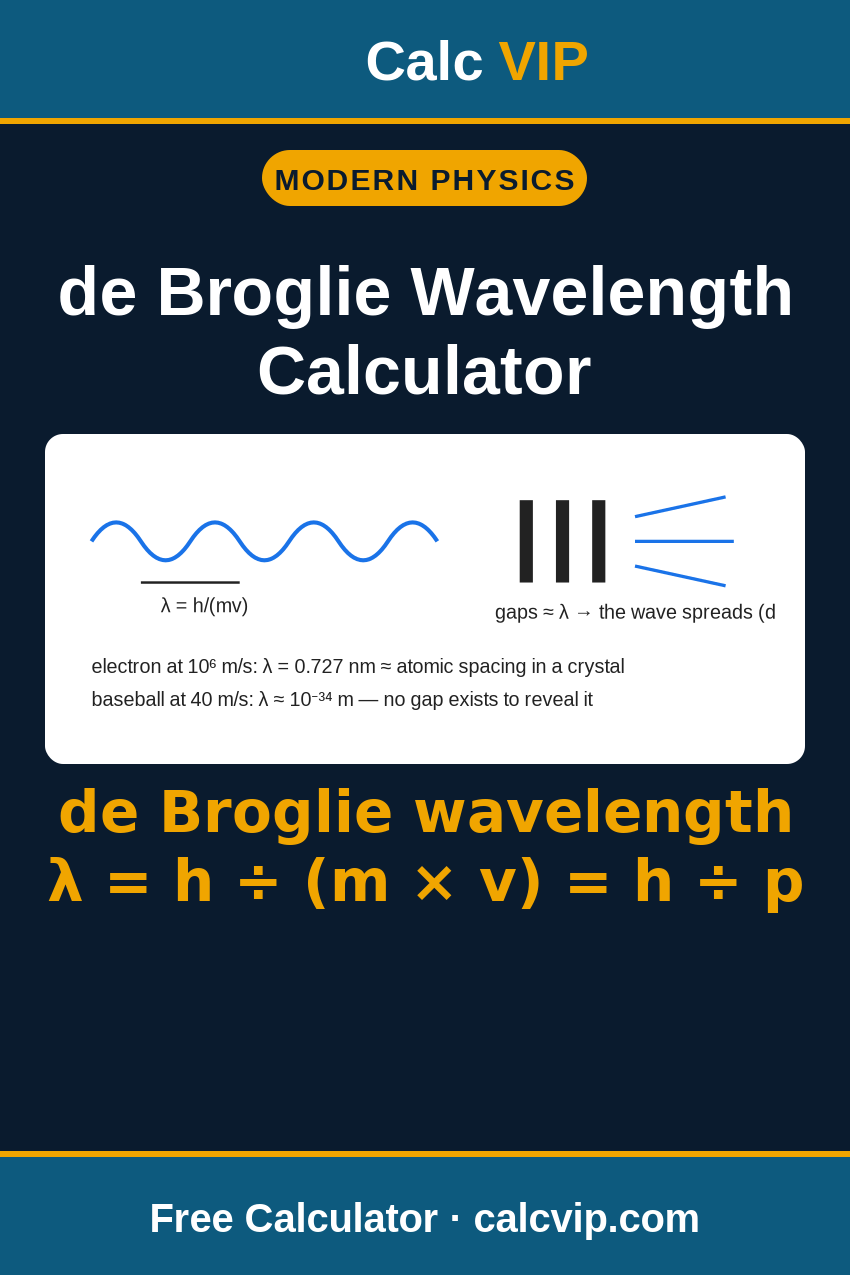
In 1924, Louis de Broglie made one of the boldest guesses in science: if light — supposedly a wave — can behave as particles, then particles should behave as waves. Every moving object, he proposed, has a wavelength given by λ = h/(mv): Planck's constant divided by the object's momentum. The formula is this entire calculator, and its audacity is easy to miss. It assigns a wavelength to electrons, atoms, baseballs and planets alike, and it predicts that the wave nature of matter shows itself only when the wavelength is comparable to the obstacles the object meets — which, given how small h is, means only for the very light and the very slow.
The numbers make the point starkly. An electron drifting at a million metres per second has λ = 0.727 nm — about the spacing between atoms in a crystal, which is why electrons diffract through crystals and why the electron microscope works. A baseball at 40 m/s has λ ≈ 10−34 m, a hundred billion billion times smaller than an atom; no aperture exists that could reveal its waviness, so baseballs fly as honest particles. The formula draws a precise border between the quantum world and the everyday one, and the border is set by the ratio h/(mv) compared with the sizes of the things around.
Within three years of the proposal, electrons were caught diffracting exactly as waves of this wavelength should — through nickel crystals in New York and through thin foils in Aberdeen — and de Broglie collected a Nobel Prize for an idea he had offered as a doctoral thesis. Today the same equation sizes the resolution of electron microscopes, designs neutron-scattering experiments that photograph the insides of materials, and explains why atoms themselves hold together: an electron confined in an atom is a standing wave wrapped around the nucleus, allowed only where the wave fits.
Formula
de Broglie wavelength λ = h ÷ (m × v) = h ÷ p • h = 6.626 × 10⁻³⁴ J·s, m in kilograms (kg), v in metres per second (m/s), p the momentum
The denominator is the particle's momentum, so the formula rearranges as p = h ÷ λ and v = h ÷ (m × λ). For the most common laboratory case — an electron accelerated from rest through a voltage V — the kinetic energy is eV and the wavelength becomes λ = h ÷ √(2 × me × e × V), which collapses to the engineer's rule λ (nm) ≈ 1.227 ÷ √V. Two disciplines govern the arithmetic: masses must be in kilograms (an electron is 9.11 × 10⁻³¹ kg, not 9.11), and the formula as written is the non-relativistic form — once a particle passes roughly a tenth of light speed, the momentum must be upgraded to p = γmv, as the last worked example shows.
| Symbol | Meaning | Units |
|---|---|---|
| λ | de Broglie (matter-wave) wavelength | m (often nm or pm) |
| h | Planck's constant, 6.626 × 10⁻³⁴ | J·s |
| m | mass of the particle | kg |
| v | speed of the particle | m/s |
| p | momentum, p = m × v | kg·m/s |
| γ | Lorentz factor (relativistic correction) | dimensionless |
A wavelength is only interesting if something matches it
Possessing a wavelength is not the same as behaving like a wave. Wave behaviour — diffraction, interference — appears only when a wave meets structures of about its own size. Ocean swells diffract through a harbour mouth tens of metres wide; they do not diffract around a mooring post. Matter waves obey the same rule with the scales shrunk by h. An electron with λ = 0.727 nm meets a crystal whose atomic layers are spaced by tenths of a nanometre, and the match is perfect: the crystal acts as a three-dimensional diffraction grating and the electron scatters into rings and spots. The baseball's 10−34 m wave meets doorways, bats and air molecules, all grotesquely larger than λ, so it simply travels straight. Nothing in the formula switches off for big objects; the universe just contains no gratings fine enough to interview them.
This matching rule is a design tool. To image a structure, choose a particle whose wavelength is at or below the feature size: electron microscopes accelerate electrons to wavelengths of picometres to resolve nanometre detail; neutron cameras tune slow neutrons to tenths of a nanometre to find hydrogen atoms inside metals, where X-rays are blind; crystallographers pick whichever probe's λ matches the lattice they study. Run the calculator backwards — fix the λ you need, then read off the speed or voltage that produces it — and you are doing the daily arithmetic of a dozen experimental sciences.
The wave nature is not limited to electrons, or even to small things. Neutron diffraction has been a workhorse of materials science since the 1940s — neutrons at thermal energies carry wavelengths near atomic spacings and, being neutral, probe deep inside samples that X-rays cannot penetrate. More startlingly, matter-wave interferometers have now split and recombined beams of entire molecules: buckminsterfullerene (C60, 720 atomic mass units) in 1999, and by 2019 organic molecules of some 2,000 atoms and 25,000 daltons, whose de Broglie wavelengths are mere picometres yet whose interference fringes are unmistakable. Each success pushes the same question further: how large can an object be before its wave nature becomes undetectable in practice? No boundary has been found — only the practical walls of isolation and coherence described above. The formula on this page has never yet met the object that refutes it.
How to use
- Pick the particle — electron or proton — from the menu, or choose "Custom mass" and type any mass in kilograms.
- Enter the particle's speed in metres per second; scientific notation such as 1e6 is accepted.
- Click "Calculate Wavelength" to get λ in metres and nanometres.
- Judge the result by comparison: near 0.01–1 nm the particle will diffract through crystals and can be used as a microscope probe; vastly smaller, and its wave nature is undetectable in practice.
Worked examples
Example 1 — the reference electron. An electron (m = 9.11 × 10⁻³¹ kg) moving at 1 × 10⁶ m/s:
λ = h ÷ (m × v) = 6.626 × 10⁻³⁴ ÷ (9.11 × 10−31 × 1 × 106) = 7.273 × 10⁻¹⁰ m = 0.727 nm. That is the size scale of atoms themselves — the reason this modest speed, a third of a percent of light speed, already puts the electron deep in wave territory.
Example 2 — the electron microscope's electron. Accelerate an electron through 100 V: its kinetic energy is 100 eV = 1.602 × 10⁻¹⁷ J, its speed √(2 × 1.602 × 10−17 ÷ 9.11 × 10⁻³¹) = 5.93 × 10⁶ m/s, and λ = 6.626 × 10⁻³⁴ ÷ √(2 × 9.11 × 10−31 × 1.602 × 10−17) = 0.123 nm — exactly the 1.227 ÷ √100 rule. Real microscopes use tens of thousands of volts and reach picometre wavelengths.
Example 3 — a proton at the same speed. A proton (1.673 × 10⁻²⁷ kg) at 1 × 10⁶ m/s: λ = 6.626 × 10⁻³⁴ ÷ (1.673 × 10−27 × 1 × 106) = 3.96 × 10⁻¹³ m = 0.396 pm. The proton is 1836 times heavier, so at equal speed its wavelength is 1836 times smaller — mass, not charge or identity, is what shrinks the wave.
Example 4 — a thermal neutron. Neutrons drifting at room-temperature speeds of 2200 m/s (m = 1.675 × 10⁻²⁷ kg): λ = 6.626 × 10⁻³⁴ ÷ (1.675 × 10−27 × 2200) = 1.80 × 10⁻¹⁰ m = 0.180 nm. Deliberately slowed ("thermalised") neutrons land right on atomic spacings, which is why neutron diffraction rivals X-ray diffraction for mapping crystal structures.
Example 5 — the baseball. A 0.145 kg baseball at 40 m/s: λ = 6.626 × 10⁻³⁴ ÷ (0.145 × 40) = 1.14 × 10⁻³⁴ m. To diffract, it would need a slit within a factor of a few of that width — about 1024 times narrower than an atom. The wave exists on paper and nowhere else.
Example 6 — when relativity corrects the answer. An electron at 0.1c (3 × 10⁷ m/s): the plain formula gives λ = 6.626 × 10⁻³⁴ ÷ (9.11 × 10−31 × 3 × 107) = 2.424 × 10⁻¹¹ m. With the relativistic momentum p = γmv and γ = 1.00504, λ = 2.412 × 10⁻¹¹ m — half a percent smaller. At 0.1c the correction is a refinement; by 0.9c it would be a factor of 2.3, and no accelerator physicist may ignore it.
Matter waves in real life
Electron microscopes. Resolution is capped by wavelength, so microscopes trade photons for electrons: at 100 kV the electron's λ is about 0.0037 nm (relativistically corrected), over 100,000 times finer than visible light, and atomic columns become directly visible. This calculator's voltage rule is the microscope's design equation.
Electron diffraction and crystallography. The same diffraction that confirmed de Broglie is now a routine probe: low-energy electron diffraction maps the surfaces of catalysts and semiconductors, reading atomic arrangements from the patterns the waves produce.
Neutron scattering. Thermal neutrons (Example 4) locate light atoms — especially hydrogen — inside heavy structures, guiding drug design and battery research. Their wavelength is tuned by temperature: cool the neutrons and λ stretches.
Atom interferometry. Whole atoms, and even large molecules of hundreds of atoms, have been diffracted through fabricated gratings, their wavelengths matching h/(mv) every time. These interferometers measure gravity and rotation with extraordinary precision.
The structure of atoms themselves. Bohr's atom survives in modern dress because of matter waves: an electron orbit is stable when its circumference fits a whole number of wavelengths — 2πr = nλ — turning de Broglie's formula into the quantisation rule that picks out the allowed shells.
Semiconductor engineering. In modern transistors, electrons cross regions only tens of nanometres wide — comparable to their wavelengths — so devices must be designed with wave mechanics, not billiard-ball mechanics. Quantum tunnelling, a direct cousin of the matter wave, both limits and enables the smallest chips.
Quick reference: electron wavelength vs accelerating voltage
| Voltage | Electron speed | λ (non-relativistic) |
|---|---|---|
| 1 V | 5.93 × 10⁵ m/s | 1.226 nm |
| 10 V | 1.875 × 10⁶ m/s | 0.388 nm |
| 54 V | 4.36 × 10⁶ m/s | 0.167 nm |
| 100 V | 5.93 × 10⁶ m/s | 0.123 nm |
| 1 kV | 1.875 × 10⁷ m/s | 0.0388 nm |
| 10 kV | 5.93 × 10⁷ m/s | 0.0123 nm |
The 54 V row is history: Davisson and Germer's 1927 experiment used electrons near this energy, and the 0.167 nm wavelength they inferred from the diffraction pattern matched the spacing of nickel's atomic planes — the first direct proof that matter waves are real. At the highest voltages the relativistic correction trims λ further (about 5% at 100 kV).
From wavelength to world-view: what the wave is
A natural question is what, physically, is waving. The modern answer is careful: the de Broglie wave is a wave of probability. Where the wave is strong, the particle is likely to be found; where it cancels, the particle never appears — and the diffraction patterns are probability patterns built up one particle at a time. In double-slit experiments with electrons sent singly, each electron lands as one dot, yet thousands of dots accumulate into interference fringes no particle-only picture can explain. The wavelength this calculator returns is therefore not a size or a vibration of the particle; it is the spacing of the pattern the particle's possibilities make. That strangeness is not decoration — it is the operating principle behind every quantum technology now being built.
Why does a picometre wavelength matter so much? Because resolution is rationed by wavelength: no microscope can distinguish detail much finer than the wavelength it images with (the Abbe limit, roughly λ/2). Visible light at 500 nm therefore stalls around 250 nm — too coarse for atoms. A 300 kV transmission electron microscope runs electrons whose relativistic wavelength is about 1.97 pm, a quarter-million times finer, which is why its theoretical resolution reaches into the picometres and its practical resolution, limited by magnetic lens aberrations rather than by the wave itself, still touches 50 pm — individual atomic columns, resolved. Every materials breakthrough that begins "we imaged the atoms and saw…" is this arithmetic, cashed.
Common mistakes
- Using the mass in grams or electron-volts. The formula wants kilograms. An electron is 9.11 × 10⁻³¹ kg; entering 9.11 inflates λ by 1031 and lands in fantasy.
- Expecting heavy or fast objects to show wave behaviour. Both mass and speed shrink λ. Wave effects need λ near the size of available gaps — for anything bigger than a molecule, that condition fails by dozens of orders of magnitude.
- Applying the simple formula near light speed. Above ~0.1c, momentum is γmv, not mv. Ignoring γ overstates λ — by a factor of 7 at 0.99c.
- Confusing the matter wave with an electromagnetic wave. The de Broglie wave is not light, carries no electric field, and travels at the particle's speed (its phase actually moves faster, harmlessly). It cannot be picked up by an aerial.
- Mixing up λ = h/(mv) with λ = h/√(2mE) sign errors. Both are the same formula — the second just substitutes E = ½mv². If the two disagree, a factor of 2 or a square root has gone missing.
FAQ
Does a moving car have a wavelength too?
Yes, in principle — but for a 1000 kg car at 30 m/s, λ ≈ 2 × 10⁻³⁸ m, far too small to ever detect. Wave behaviour only shows up at atomic scales.
How was this confirmed?
Electron diffraction experiments (Davisson–Germer, and G. P. Thomson) showed electrons producing interference patterns, exactly as waves with λ = h/mv should.
Is this formula valid near the speed of light?
For very fast particles you should use the relativistic momentum p = γmv. At everyday and typical lab speeds the simple form used here is accurate.
Why do electrons make better microscope probes than protons?
At a given voltage the electron's tiny mass gives it a long, convenient wavelength and it is easy to accelerate and focus with magnets. Protons at the same energy have wavelengths ~43 times shorter and are far harder to steer — overkill for imaging, and damaging to samples.
What wavelength does a slow, cold atom have?
A sodium atom (3.82 × 10⁻²⁶ kg) drifting at 1 m/s has λ = 6.626 × 10⁻³⁴ ÷ 3.82 × 10⁻²⁶ ≈ 1.7 × 10⁻⁸ m = 17 nm — large enough that laser-cooled atoms are routinely diffracted and interfered in research laboratories.
Does the wavelength depend on charge?
No. Only mass and speed enter. A neutral neutron and a charged proton of equal mass and speed have essentially the same λ — which is why neutrons, immune to electric fields, are such clean diffraction probes.
Can a particle's wavelength be larger than the particle itself?
Vastly. The electron's wavelength at low speeds is thousands of times any size ever attributed to it. The wavelength describes the spacing of its probability pattern, not the particle's physical extent — one of the clearest signs the wave is not a material ripple.
Why don't we diffract through doorways?
Your wavelength while walking is around 10−35 m, while a doorway is a metre wide — twenty-five orders of magnitude too coarse a grating. Diffraction needs aperture ≈ wavelength; for macroscopic objects no such aperture exists anywhere in the universe.
What did de Broglie himself use the idea for first?
To explain Bohr's atom: if the electron is a wave wrapped around the nucleus, only orbits whose circumference holds a whole number of wavelengths survive as standing waves. That single condition reproduces Bohr's allowed shells — the first hint that atomic structure is wave mechanics.
Is there any everyday technology that relies on matter waves?
Yes — the electron microscope images viruses, transistors and materials at atomic resolution in hospitals and factories worldwide, and it exists only because electron wavelengths can be made a hundred thousand times finer than light's.