 Calc
Continuity Equation Calculator – A1v1 = A2v2 Pipe Solver
 Created by Elena Petrova · Physics Editor · Fluids & Rotation · Last updated: November 2026
Use this free Continuity Equation Calculator to find how fast a fluid moves when a pipe changes size. Enter the diameter and speed in the wide section and the diameter of the narrow section — the calculator finds the new speed using A1v1 = A2v2.
The continuity equation is conservation of mass wearing a plumber's clothes. Fluid does not pile up inside a pipe and does not vanish from it: in steady flow, whatever volume enters one end each second must leave by the other, and must pass every slice in between. If one slice of the journey offers a smaller area, the fluid has only one way to honour the contract — it moves faster there. A1v1 = A2v2 is that contract written in symbols, and this calculator solves it for the speed in the second section of a round pipe.
You already own the intuition for this law; your thumb has done the experiment a hundred times. A garden hose left open dribbles; cover half the end with your thumb and the jet suddenly reaches the far flowerbed. Nothing about the supply changed — the same flow rate is simply escaping through half the area, so it must move twice as fast, and speed is what carries a jet across a garden. Rivers do it at landscape scale, running fast and shallow over narrow rocky sills and slow and deep in wide pools, and your blood does it in every capillary bed.
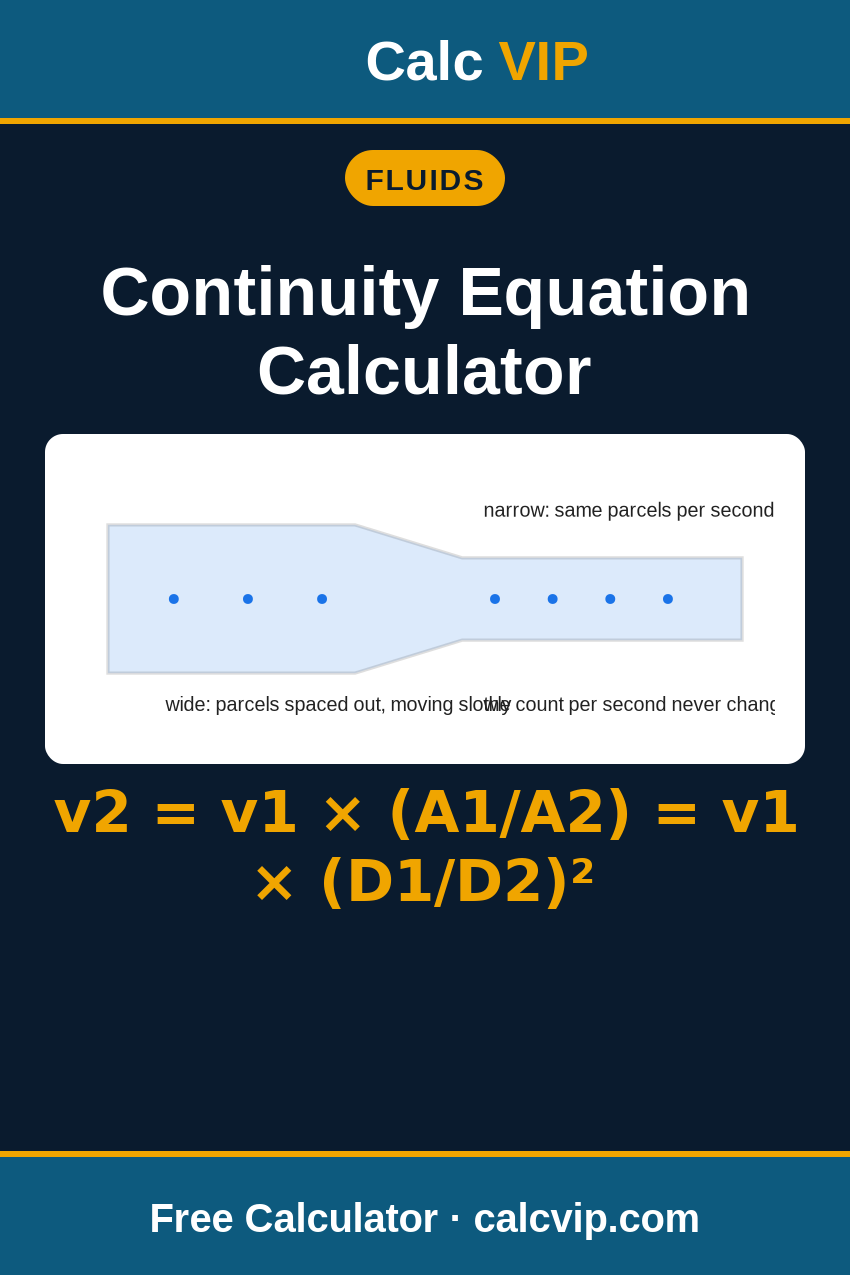
The catch — the thing that makes this calculator worth using rather than guessing — is the square hiding in the areas. Speed responds not to the diameter ratio but to its square: halve the diameter and the speed quadruples. Enter the wide section's diameter and speed and the narrow section's diameter, and you will get both areas, the new speed, and the flow rate Q that stays serenely unchanged through the whole transition — the quantity the rest of the system was designed around.
Formula
Continuity equation: A1 × v1 = A2 × v2 → v2 = v1 × (A1/A2) = v1 × (D1/D2)²
For round pipes A = π(D/2)², so the speed depends on the square of the diameter ratio: halve the diameter and the speed becomes four times bigger. The volume flow rate Q = A × v is the same at both points.
The general statement, valid even when density changes, is ρ1A1v1 = ρ2A2v2 — mass per second in equals mass per second out. For liquids ρ is constant and cancels, leaving the simple form above. The equation also runs backwards for design: to achieve a target speed v2 from a supply speed v1, the new diameter must be D2 = D1 × √(v1/v2). And it extends to branches: where a pipe splits, the flow divides so that Q = Qa + Qb, each branch still obeying Q = A × v within itself.
| Symbol | Meaning | Units |
|---|---|---|
| A1, A2 | cross-sectional areas at points 1 and 2 | m² |
| v1, v2 | average flow speeds at points 1 and 2 | m/s |
| D1, D2 | inside diameters at points 1 and 2 | m |
| Q | volume flow rate — identical at both points | m³/s |
| ρ | density (cancels for liquids) | kg/m³ |
Why the square? Following one second of water
Freeze the flow and follow a single second's worth of water. In the wide section it forms a slug of length v1 — the distance the stream travels in one second — with volume A1 × v1. That exact slug must squeeze through the narrow section within the same second (nothing may accumulate at the junction; the junction is just a shape, not a storage tank). In the narrow section the slug can only fit by stretching: same volume, smaller area, so its length — and therefore the distance travelled per second, the speed — must grow by the area ratio A1/A2. Areas of circles carry the square of diameter, so the stretching factor is (D1/D2)². The square is not a mathematical decoration; it is the geometry of a fixed volume reshaping itself to fit a round hole.
Two consequences follow immediately. First, the equation is a kinematic law: it says nothing about pressure or force, only about what speeds are compatible with mass conservation — Bernoulli's equation then prices the speed change in pressure. Second, it applies to any steady stream, not just pipes: a river's discharge, air through a valley gap, traffic through a road narrowing (where "density" of cars can change, which is why jams form), and blood from the aorta into the capillary forest, where the combined capillary area is so vast that the speed collapses to a crawl — a feature, not a bug, since slow passage is what lets exchange happen.
How to use
- Enter the diameter and the fluid speed in the first (usually wider) section of pipe.
- Enter the diameter in the second section.
- Click "Calculate Speed at Point 2" to see both areas, the new speed and the flow rate.
- The equation is symmetric — to solve a widening instead, just enter the narrow section as point 1 and the wide section as point 2.
Worked examples
Example 1 — the reference narrowing. Water flows at 1.5 m/s in a pipe of diameter 0.2 m (area A1 = π × 0.1² ≈ 0.0314 m²). The pipe narrows to 0.1 m (area A2 = π × 0.05² ≈ 0.00785 m²). v2 = 1.5 × (0.2/0.1)² = 1.5 × 4 = 6 m/s. The flow rate stays Q ≈ 0.0471 m³/s at both points — this is why a garden hose jet shoots out faster when you partly cover the end.
Example 2 — the hose nozzle. Water ambles at 1.2 m/s through a 15 mm hose and meets a 5 mm nozzle: v2 = 1.2 × (0.015/0.005)² = 1.2 × 9 = 10.8 m/s. Nine times the speed from a threefold narrowing — enough to throw a jet several metres, from a supply that barely trickled. Nozzle design is this example, engineered.
Example 3 — a modest step down. A 50 mm line carrying water at 0.8 m/s reduces to 25 mm for a final run: v2 = 0.8 × (0.05/0.025)² = 0.8 × 4 = 3.2 m/s, with Q = 0.001963 × 0.8 ≈ 0.00157 m³/s (1.57 L/s) throughout. Note the exit speed has left the quiet 0.5–2 m/s comfort band — a designer seeing 3.2 m/s expects noise and wear at the outlet and may step the size back up.
Example 4 — the widening diffuser. Run the equation the other way: water at 4 m/s in a 100 mm pipe expands into a 200 mm section: v2 = 4 × (0.1/0.2)² = 4 × 0.25 = 1 m/s. Slowing a flow down gently in a widening cone (a diffuser) also recovers pressure per Bernoulli — the working principle inside everything from ventilation ducts to the intake of a jet engine test cell.
Example 5 — a narrowed artery. Blood leaves the heart through an aorta of about 25 mm at an average 0.2 m/s. Where plaque narrows a vessel to 12.5 mm, continuity demands v2 = 0.2 × (0.025/0.0125)² = 0.8 m/s through the tight spot — and real stenoses narrow far more, producing the fast jets cardiologists measure with Doppler ultrasound and then grade with Bernoulli's ΔP ≈ 4v² rule. Two calculators on this site, one diagnosis.
Example 6 — a pipe that splits. A 100 mm main carrying water at 2 m/s (Q = 0.007854 × 2 ≈ 0.0157 m³/s) splits into two equal 70 mm branches. Each branch takes half the flow, 0.00785 m³/s, through an area of π × (0.035)² ≈ 0.00385 m², so each branch runs at v = 0.00785 ÷ 0.00385 ≈ 2.04 m/s. Manifold design — in plumbing, irrigation and the lung's airways alike — is this bookkeeping repeated at every fork.
The continuity equation in real life
Nozzles, jets and pressure washers. Every nozzle is a deliberate continuity violation of your thumb's comfort: area shrinks, speed soars, and the jet does the work — cutting, cleaning, propelling fire hoses and rocket exhausts alike (rockets add expansion physics, but the mass ledger still rules).
Rivers, rapids and floods. A river's discharge Q is fixed by its catchment; where the channel narrows or shallows, A falls and the water must speed up — the white water in a rocky gorge is continuity made visible. Flood engineers widen channels precisely to buy area, letting the same Q pass more slowly and lower.
Wind between buildings. City wind tunnels are continuity accidents: air moving along a street is funnelled between towers into a fraction of its former area and accelerates in proportion, which is why certain corners in every windy city are reliably miserable and others, metres away, are calm.
The circulation system. The aorta's ~5 L/min spreads into billions of capillaries whose combined area is roughly a thousand times larger, so blood slows to about a millimetre per second there — slow enough for oxygen and nutrients to diffuse across the walls. Continuity is the circulatory system's pacing mechanism.
Venturi meters and carburettors. Pair continuity with Bernoulli: narrow the pipe (continuity raises v), and the pressure falls by a measurable amount (Bernoulli prices it). Read the pressure dip and you have inferred the flow — the venturi meter, and the carburettor throat that uses the dip to draw fuel.
Irrigation and drip lines. A main line feeds many laterals; each fork divides Q, and emitter rates are set by tiny areas. Getting uniform watering from a long lateral is a fight against the pressure losses that accumulate as continuity redistributes the flow — solved by sizing pipes with exactly these area ratios.
When density joins in: the full form
The simple A1v1 = A2v2 assumes the fluid's density is the same at both points — superb for liquids, approximate for gases at low speed. The complete statement conserves mass: ρ1A1v1 = ρ2A2v2. In a jet engine or a long gas pipeline, pressure changes squeeze the gas, ρ changes along the way, and volume flow is no longer conserved even though mass flow is. This is also why "the same Q" needs care in compressed-air systems: a cubic metre per second at the compressor's inlet is a much smaller volume — though the same mass — at 8 bar in the receiver. For everything on this page's scale — water, oil, blood, slow air — the simple form is the right tool, and the density version waits politely for the day you design a gas line.
Quick reference: speed multipliers for diameter changes
| Diameter change | Area ratio | Speed multiplier |
|---|---|---|
| D2 = D1 (no change) | 1 | × 1 |
| D2 = D1 ÷ 2 | 1/4 | × 4 |
| D2 = D1 ÷ 3 | 1/9 | × 9 |
| D2 = D1 ÷ 4 | 1/16 | × 16 |
| D2 = 2 × D1 | 4 | × 0.25 |
| D2 = 3 × D1 | 9 | × 0.111 |
Commit the ÷2 → ×4 line to memory and most hose, nozzle and pipe questions can be estimated in your head before the calculator confirms them.
What continuity does not tell you: separation and the vena contracta
Continuity guarantees the average speed through each section; it is silent about how gracefully the flow rearranges itself between sections, and two classic phenomena live in that silence. Push flow through a sudden widening, or a diffuser whose walls flare faster than a gentle total angle of about 7°, and the stream cannot follow the walls: it separates, hugging the centre as a jet while recirculating eddies fill the corners. The average speed still obeys A1v1 = A2v2 exactly, but the pressure recovery Bernoulli promised largely evaporates into turbulence and heat — which is why diffusers in wind tunnels and ventilation systems are long and shallow, buying area slowly.
The mirror phenomenon appears at sharp entrances and orifices: a stream passing a sharp-edged hole cannot turn the corner instantly, so the jet continues to narrow for a short distance beyond the hole, reaching a minimum area — the vena contracta — of only about 0.61 times the hole's area for a sharp edge. Flow meters built on orifice plates live or die by this coefficient: the geometric area says one thing, the effective area the fluid actually uses says 0.61 of it, and calibration bridges the two. Continuity is never wrong in these cases; it is simply keeping its books on the area the flow truly occupies, not the area the draughtsman drew. Whenever a real device under-delivers against the clean equation, look first for the places where the stream quietly renegotiated its cross-section.
Common mistakes
- Using the diameter ratio instead of its square. Halving the diameter quadruples the speed, not doubles it. The single most common error with this equation — check whether you squared.
- Swapping which section is which. v2 belongs to D2. Entering the narrow diameter as D1 inverts the ratio and turns a ×4 speed-up into a ×0.25 slow-down. Label the points before calculating.
- Expecting Q to change at the junction. In steady flow it cannot — that is the whole content of the law. If a calculation shows Q1 ≠ Q2 for a liquid, an arithmetic slip is hiding somewhere.
- Applying the simple form to fast gas flow. Above roughly a third of the speed of sound, density changes between sections and ρ1A1v1 = ρ2A2v2 must be used instead.
- Forgetting branches. At a fork, continuity reads Q = Qa + Qb, not Q = Qa = Qb. Treating each branch as if it carried the full flow overstates every branch speed.
FAQ
Why does the fluid speed up in a narrow pipe?
The same volume of fluid must pass through every cross-section each second. A smaller area means the fluid has to move faster to get the same volume through — mass is conserved.
Does the continuity equation work for gases?
Only approximately, and only for slow flows. Gases are compressible, so for fast gas flow the density changes and the full form ρ1A1v1 = ρ2A2v2 must be used.
What happens to the pressure where the speed increases?
By Bernoulli's principle, the pressure falls where the speed rises — the two effects (continuity + Bernoulli) together explain most pipe-flow behaviour.
Is the speed uniform across the pipe?
No — friction holds the layer at the wall nearly still and the centre moves fastest. The v in this equation is the cross-section average, which is the value the volume flow actually sees.
Can the speed grow without limit as the pipe narrows?
No. Friction losses climb steeply with speed, the pressure needed to drive the flow rises, and in liquids cavitation begins when Bernoulli drives the local pressure to vapour pressure. Real narrowings choke long before the mathematics diverges.
What if the pipe splits into unequal branches?
Continuity only fixes the sum: Qa + Qb = Q. How the flow divides between unequal branches is decided by their resistances — the branch offering less friction takes the larger share, which is why balancing valves exist in heating systems.
Does continuity apply to rivers and open channels?
Yes, with the channel's cross-section (width × depth) as A. It is how hydrologists turn a depth measurement and a surveyed channel profile into a discharge figure.
Why does a shower jet feel stronger through a partly blocked shower head?
Blocked holes reduce the total exit area; the same Q through less area means higher speed per jet (and the pump or header pressure rises to sustain it). Continuity, delivered at face height.
How is this related to the flow-rate formula Q = A × v?
Continuity is the statement that Q = A × v evaluates to the same number at every section. The Flow Rate Calculator computes Q at one section; this one enforces its constancy across two.
What happens during start-up, before the flow is steady?
Continuity in this form assumes steady flow. During start-up, fluid can briefly accumulate (compressing air pockets, stretching hoses, filling branches), so inlet and outlet flows differ until the system settles — the equation describes the settled state it always reaches.