 Calc
Length Contraction Calculator – L = L₀/γ at Relativistic Speeds
 Created by Yuki Tanaka · Physics Editor · Modern Physics · Last updated: November 2026
Use this free Length Contraction Calculator to find how much shorter a fast-moving object measures along its direction of travel, using L = L₀ / γ from Einstein's special relativity.
If moving clocks tick slowly, moving rulers shrink — along their direction of motion only. Length contraction, this calculator's subject, says that an object of rest length L₀ measures L = L₀/γ when it moves past you, with the same Lorentz factor γ that governs time dilation. A 100 m starship coasting at 0.8c measures 60 m long to the observers it passes. Nothing has squeezed it; no force acts on it; its crew notices nothing at all. Length, like time, turns out to be something observers on different paths measure differently — and when they later compare measurements, they agree that the numbers differ, because the numbers are records of different measurement procedures performed in different frames.
The effect is the spatial twin of time dilation and the two are inseparable: the muon that reaches the ground can be explained either by its lifetime stretching (Earth's view) or by the atmosphere's depth contracting from 10 km to 632 m (the muon's view) — and both explanations must agree, because they describe the same events. This calculator is therefore also the muon calculator, read from the other side. It shares time dilation's scale: invisible at road speeds (a car's length contracts by less than the width of a proton), overwhelming near light speed, where γ's climb to infinity would compress any journey's distance toward zero for the traveller.
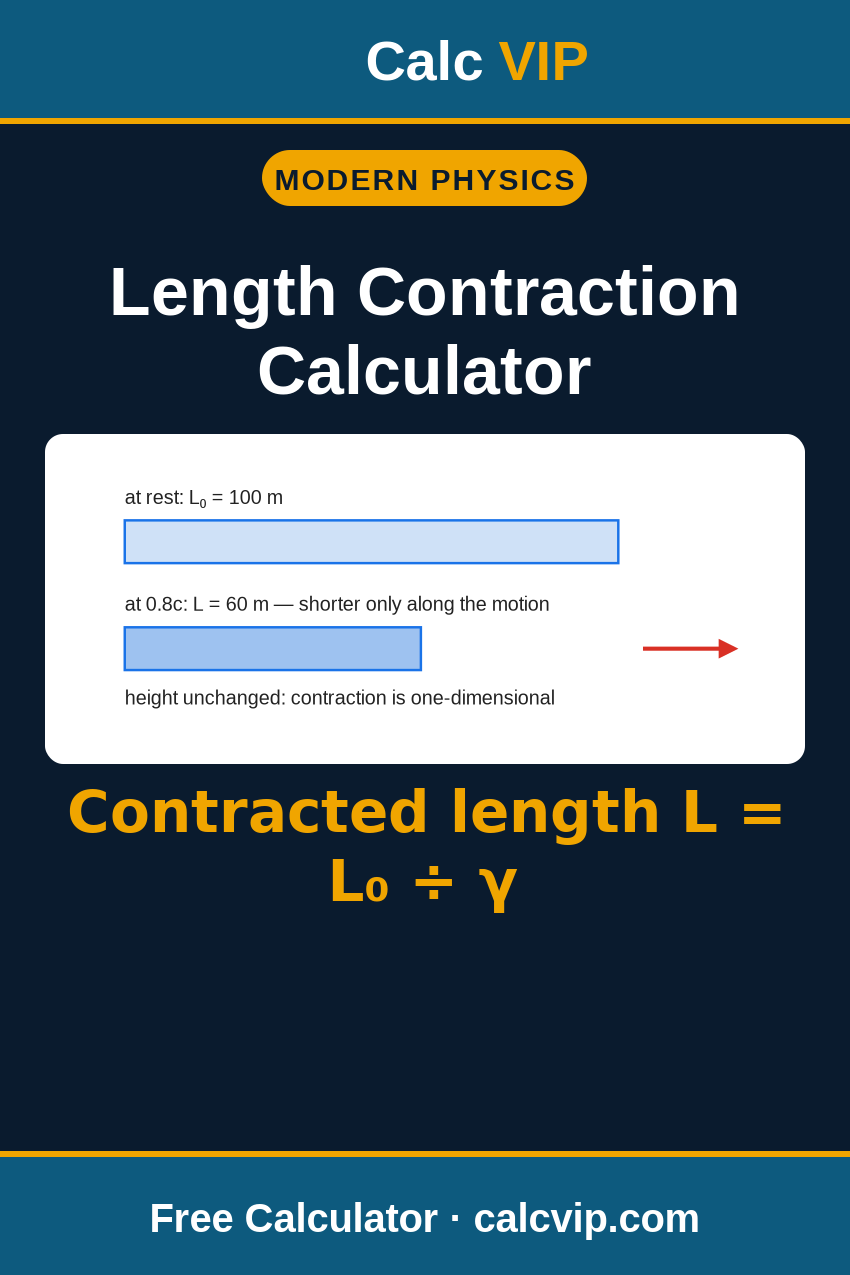
One restriction deserves emphasis, because it prevents a famous confusion: only the dimension parallel to the motion contracts. Widths and heights are untouched — a moving sphere becomes an oblate spheroid, a pancake, not a smaller ball. (What it would look like is a subtler question involving light travel time, which rotates its appearance rather than simply flattening it — see the depth section.) Lengths are also frame-dependent in a symmetric way while two observers coast: each measures the other's rulers contracted. As with clocks, the symmetry breaks only when paths are compared after a turnaround, and the experimental record — from accelerator physics to cosmic rays — is uniformly on the formula's side.
Formula
Contracted length L = L₀ ÷ γ • Lorentz factor γ = 1 ÷ √(1 − v²/c²) • L₀ the proper length, measured in the object's own rest frame
The formula rearranges to L₀ = γ × L (recover the rest length from a moving measurement) and, solving for speed, β = √(1 − (L/L₀)²) — handy when a problem states the contraction and asks the velocity: a ship measured at 87% of its rest length is travelling at β = √(1 − 0.87²) ≈ 0.49. At low speeds the approximation L ≈ L₀ × (1 − β²/2) suffices and shows how hopeless everyday detection is: β²/2 for a jet aircraft is about 3.5 × 10⁻¹³. The unit discipline is trivial but vital — L₀ and L share whatever unit you choose (the γ factor is dimensionless), while β must be a pure fraction of c, never a speed in m/s.
| Symbol | Meaning | Units |
|---|---|---|
| L₀ | proper length — length in the object's rest frame | m, km, ly — any length unit |
| L | length measured in the frame it moves through | same unit as L₀ |
| γ | Lorentz factor, always ≥ 1 | dimensionless |
| β | speed as a fraction of light speed, v/c | dimensionless, 0 ≤ β < 1 |
| c | speed of light, 3 × 10⁸ | m/s |
Why measurement, not squashing — and why it must happen
To measure a moving object's length you must note the positions of its two ends at the same instant — and "at the same instant" is exactly what relativity makes frame-dependent. Two events (marking the nose, marking the tail) that are simultaneous for you are not simultaneous for the crew, and that disagreement, worked through with the constancy of light speed, yields precisely L₀/γ. The contraction is therefore as real as any measurement can be, while involving no material compression whatsoever: the object's atoms are not closer together in its own frame, its chemistry is unaffected, and it feels nothing. Squeezing would require forces and would be visible to the crew; contraction requires only motion and is invisible to them.
It is also compulsory, not optional. Suppose lengths did not contract: then the muon's Earth-frame explanation (time dilation alone) and its own frame's account would disagree about whether it reaches the ground — and nature does not permit frame-dependent facts about a detector clicking. Length contraction is the price of consistency between frames, the spatial half of a single spacetime bookkeeping. That is why the same γ appears in both calculators: one factor, two faces, and any experiment confirming one side (muon lifetimes) automatically confirms the other.
How to use
- Enter the proper length L₀ — the object's length measured at rest — in any unit (metres, kilometres, light-years); the answer returns in the same unit.
- Enter the speed as a fraction of light speed: 0.8 means 0.8c, and it must be less than 1.
- Click "Calculate Contracted Length" to see γ and the contracted length L, with the percentage shortening.
- For journeys, remember the traveller's trick: the distance to the destination is a length in the home frame, so it contracts too — enter the Earth-frame distance as L₀ and read off the distance the traveller actually experiences.
Worked examples
Example 1 — the reference case. L₀ = 100 at 0.8c: γ = 1.667, so L = 100 ÷ 1.667 = 60 — a 40% shortening. A 100 m ship, a 100 m track section, a 100 light-year journey: all measure 60 in the moving frame, because γ cares about speed alone.
Example 2 — a starship at 0.99c. A 100 m vessel at 0.99c (γ = 7.089): L = 100 ÷ 7.089 = 14.1 m as measured from the dock it streaks past. Its crew, measuring at leisure in their own frame, still find 100 m of ship around them — both measurements are correct, and the discrepancy is the price of their relative motion, paid in simultaneity.
Example 3 — the journey to Proxima Centauri. The nearest star is 4.246 light-years away in Earth's frame. Aboard a ship at 0.99c, that distance is a moving length: L = 4.246 ÷ 7.089 = 0.599 ly. The crossing therefore takes 0.599 ÷ 0.99 ≈ 0.61 years of ship time, against 4.29 years on Earth — the same answer the time-dilation calculator gives from the clock side, as it must be.
Example 4 — the muon's atmosphere. At 0.998c, γ = 15.82. In the muon's frame the 10 km atmosphere is L = 10,000 ÷ 15.82 = 632 m thick, crossed in 632 ÷ (0.998 × 3 × 108) = 2.11 µs — just inside the muon's 2.2 µs proper lifetime. Earth explains the arrival by the lifetime stretching; the muon explains it by the journey shrinking; the detector clicks either way.
Example 5 — a metre stick at half light speed. L₀ = 1 m at 0.5c (γ = 1.155): L = 1 ÷ 1.155 = 0.866 m. Note how modest this is: half the speed of light — 150,000 km per second — buys only a 13% shortening. Contraction, like dilation, is a phenomenon of the last few percent of β.
Example 6 — the LHC proton's view of its ring. A 6.5 TeV proton has γ ≈ 6917. In its frame, the LHC's 27 km circumference — a length in the laboratory frame, rushing toward it — contracts to 27,000 ÷ 6917 ≈ 3.9 m. The proton experiences the world's largest machine as a hoop a few metres around, which it nonetheless takes 89 µs of laboratory time to circle, because its own clock is dilated by the same factor.
Length contraction in real life
Cosmic-ray muons. The standing demonstration (Example 4): without contraction, the muon's own account of reaching sea level fails; with it, both frames agree. Every cosmic-ray detector on Earth is quietly verifying this calculator.
Heavy-ion collisions. At RHIC and the LHC, gold and lead nuclei accelerated to γ of hundreds or thousands collide as flattened discs — Lorentz-contracted pancakes whose shape determines the geometry of the quark–gluon plasma they create. Nuclear physicists plan around the contraction daily.
Free-electron lasers and accelerators. Electron bunches in accelerators are contracted in the lab frame, and the electromagnetic fields of fast particles flatten into transverse pancakes too — an effect (the field's own contraction) that engineers must include when designing beam optics and undulators.
Interstellar mission design. Contraction is the traveller's friend: it shortens the road, not just the clock. Studies of relativistic probes compute both effects from the same γ — at 0.999999c, the 2.5 million light-years to Andromeda contract to about 3,500 light-years of experienced distance.
Relativistic beaming and astrophysics. Jets from black holes and gamma-ray bursts move at γ of tens to hundreds; their observed structure, brightness and apparent faster-than-light motion are all computed with contraction and its companion effects built in.
Precision metrology's null result. Modern versions of the Michelson–Morley experiment — the test that would have detected contraction's absence as Earth moves — now constrain any violation to parts in 1017, making the invariance behind this formula among the best-tested facts in physics.
The barn and the pole: a paradox that isn't
A 10 m pole, carried by a runner at 0.87c (γ = 2), contracts to 5 m — short enough to fit inside a 6 m barn. The farmer slams both doors shut with the pole entirely inside: has it been trapped? From the runner's frame the barn is the moving object, contracted to 3 m, and the 10 m pole can never fit. Both are right, because "both doors shut at the same time" is frame-dependent: in the runner's frame the far door shuts and reopens before the near door closes, letting the pole through in sequence. No contradiction, no crushed pole — just simultaneity dissolving under scrutiny, which is the real lesson: length contraction and the relativity of simultaneity are one package, and accepting the second makes the first obvious.
Bell's spaceships: when contraction meets a thread
Two spaceships, initially at rest and joined by a fragile thread, accelerate identically — same programme, same thrust — so that in the launch frame their separation never changes. Does the thread break? In the launch frame the thread, now moving fast, "wants" to contract while its endpoints are held at the original separation, so it is stretched until it snaps. In the ships' frame the story is told differently (the acceleration programme itself is not simultaneous there), but the conclusion is the same: the thread breaks. This is Bell's spaceship paradox, and its moral sharpens the lesson of this page: length contraction is not an illusion that careful thinking dissolves. When a physical constraint (a thread, a barn door, a detector) engages with the geometry, the geometry wins and the thread pays. Contraction is what frames measure — and measurements, in the end, are what physics is made of.
What you would actually see: Terrell rotation
A camera would not record a simply flattened object. Light from the far side of a moving sphere left earlier and travelled farther, so by the time the image forms, the object has moved — the net effect, worked out by Terrell and Penrose, is that a passing sphere appears rotated rather than contracted, its far side swinging into view. The contraction is what careful measurement with synchronised detectors yields; the photograph is that measurement convolved with light's travel time. Both descriptions are correct answers to different questions — a distinction worth remembering whenever relativity seems to contradict a picture.
Rotation exposes the idea's one genuine subtlety, in the Ehrenfest paradox: spin a disc up toward relativistic rim speeds and its circumference — measured along the motion — should contract, while its radius, perpendicular to the motion, should not, apparently warping the ancient ratio C = 2πr. The resolution is that a perfectly rigid disc cannot be spun up at all (rigidity itself is a classical fiction relativity forbids, since it would transmit pushes instantly), and a real disc's geometry in its own rotating frame is genuinely non-Euclidean: its inhabitants measure C > 2πr with honest rulers. Length contraction survives the paradox, as it survives the barn and the thread, by being precise about whose measurement is under discussion — the habit of mind that every section of this page has been quietly teaching.
Common mistakes
- Contracting every dimension. Only the length parallel to the motion shrinks. A moving cube becomes a slab, not a smaller cube; heights, widths and volumes' other axes are untouched.
- Thinking the object is physically crushed. No stress, no force, no change aboard. Contraction is a relation between frames' measurements — real in its consequences (collision geometry, muon journeys) without being a material deformation.
- Using the object's own frame length wrongly. L₀ must be the rest length. Feeding in a length already measured in the moving frame and dividing by γ again double-counts the effect.
- Entering speed in m/s or km/h. The calculator wants β, a fraction of c. A train's 30 m/s is β = 10−7 — its 4.5 m carriage contracts by about 2.3 × 10⁻¹⁴ m, far less than an atom's width.
- Expecting to photograph the contraction directly. A camera records Terrell rotation (see above); the contraction is what synchronised length measurements give. Citing a photograph as disproof misunderstands both.
FAQ
Does the object really get squashed?
It is not crushed by any force — it is how length is measured in a frame where the object moves. In the object's own frame nothing changes at all.
Does the height shrink too?
No. Only lengths parallel to the direction of motion contract. A moving sphere looks like a flattened disc, never a smaller sphere.
Has length contraction been observed?
Indirectly, yes: heavy-ion collisions at particle accelerators behave as if the colliding nuclei are flattened into discs, exactly as relativity predicts.
Why can't we just photograph a contracted spacecraft?
Because the photograph mixes contraction with light travel time: light from different parts of the craft left at different times. The result (Terrell rotation) looks like a rotation. Contraction is what you get from measurement with synchronised clocks and rulers, not from a snapshot.
Does contraction apply to the distance between two stars?
Yes — that is exactly how Example 3 works. Empty space itself is not a substance that shrinks; rather, the distance between two points, measured in a frame moving relative to them, is shorter by γ. The traveller experiences a genuinely shorter journey.
What happens to density when an object contracts?
In the frame where it moves, its volume (one dimension down by γ) shrinks while its energy rises by γ, so its energy density rises steeply. This matters in heavy-ion physics, where contracted nuclei collide with enormous effective densities.
If both observers see the other's ruler contracted, who is right?
Both — because each measurement uses simultaneity in its own frame, and simultaneity is frame-dependent. The disagreement dissolves when the rulers are brought together and compared at rest, whereupon they agree exactly.
How short can something get?
As β → 1, L → 0 without limit — but reaching β = 1 is forbidden for anything with mass, so every real object keeps a nonzero length in every frame. In practice the largest γ achieved, ~104 for accelerator protons and ~1011 for the most extreme cosmic rays, still leaves lengths perfectly well defined.
Is length contraction connected to time dilation?
Inseparably: both come from the Lorentz transformation and share the same γ. Any experiment verifying one (muon lifetimes, GPS clocks) supports the other, and the muon's journey needs both descriptions to agree — which they do, exactly.
Did FitzGerald and Lorentz invent this before Einstein?
They proposed the contraction in the 1890s as an ad-hoc fix for the Michelson–Morley null result, imagining matter physically compressed by motion through the ether. Einstein's 1905 version kept the formula but changed its meaning entirely: a consequence of how space and time measurements work, no ether required.