 Calc
Drag Force Calculator – Air Resistance F = ½ρv²CdA
 Created by James Carter · Physics Writer · Forces & Motion · Last updated: November 2026
Use this free Drag Force Calculator to find the air (or water) resistance on a moving object using F = ½ρv²CdA. Enter the fluid density, the speed, the drag coefficient and the frontal area, and the calculator returns the drag force in newtons.
Push through air and the air pushes back. That push-back — drag — is negligible at walking pace, noticeable on a bicycle, dominant in a fast car, and the entire story for a parachute. It is the tax every moving thing pays to the fluid it displaces, and its formula contains the most consequential square in everyday physics: drag grows with the square of speed. Double your speed and the air resists four times as hard; the power needed to keep pushing grows eightfold. Speed limits, fuel bills, cycling positions and the shape of every car on the road are negotiations with that square.
The formula's other ingredients each carry a clear meaning. ρ (rho) is the fluid's density — how much mass each cubic metre of the way-clearing costs. A is the frontal area — the size of the hole you punch in the air. And Cd, the drag coefficient, is the shape's report card: a dimensionless number, measured in wind tunnels, that says how gracefully the object and its wake handle the flow — about 0.3 for a sleek car, near 0.5 for a smooth sphere, 1.28 for a flat plate held square to the wind, which is nature's way of saying "as badly as possible".
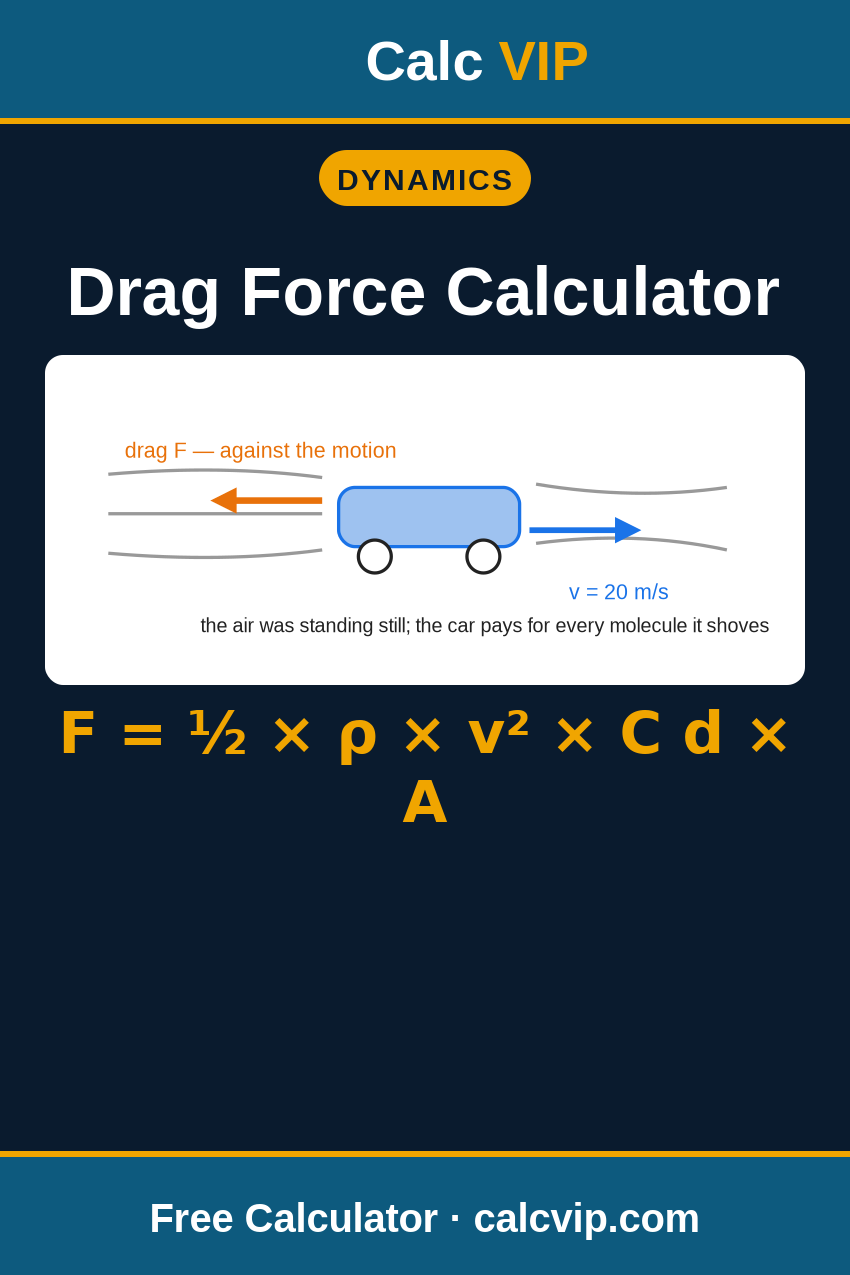
Enter the four numbers and the calculator returns the drag force. Run it at two speeds and watch the square at work; run it for air and then water (ρ ≈ 1,000) and discover why boats are slow and why swimmers care about streamlining a hundred times more than cyclists do.
Formula
Drag force: F = ½ × ρ × v² × Cd × A • Terminal velocity: vt = √(2mg ÷ (ρ Cd A)) • Power to overcome drag: P = F × v = ½ρCdA v³
The ½ is not decoration: ½ρv² is the kinetic energy carried by each cubic metre of oncoming fluid (its dynamic pressure), so the formula reads "drag = dynamic pressure × area × a shape factor" — pressure times area is force, and Cd confesses how much of that theoretical pressure the wake actually converts into push-back. The terminal-velocity form comes from setting drag equal to weight: a falling object accelerates until ½ρv²CdA = mg, then falls at the constant vt forever. Rearranged for design, the area a parachute needs for a chosen descent speed is A = 2mg ÷ (ρ Cd v²). Everything is SI: ρ in kg/m³, v in m/s, A in m², F in newtons — and v must be speed relative to the fluid, so a headwind adds to a car's v and a tailwind subtracts.
| Symbol | Meaning | Units |
|---|---|---|
| F | drag force opposing the motion | newtons (N) |
| ρ | fluid density (air ≈ 1.225, water ≈ 1,000) | kg/m³ |
| v | speed relative to the fluid | m/s |
| Cd | drag coefficient — the shape's slipperiness score | dimensionless |
| A | frontal (reference) area facing the flow | m² |
Why the square? Two multiplications hiding in one
The v² surprises everyone until it is unpacked, and then it seems inevitable. Move twice as fast through air and two separate things double. First, you meet twice as many air molecules per second — the volume you sweep per second is A × v. Second, each molecule must be shoved aside twice as violently — the momentum each collision carries also scales with v. Twice the collisions, each twice as hard: the force quadruples. Drag is not one effect growing; it is two effects multiplying, and any formula for it must contain v². The power law follows grimly: power is force × speed, so the engine's bill grows with v³ — eight times the power for twice the speed — which is why top speed is the most expensive specification a vehicle has.
Cd is where shape lives. A flat plate (Cd ≈ 1.28) stops the flow dead and leaves a turbulent, low-pressure wake sucking it backwards; a teardrop (Cd as low as 0.04) keeps the flow attached, guiding it around and closing the wake gently. Most of a bluff object's drag is that wake — pressure drag — not skin friction, which is why the back of a vehicle matters more than the front: a car is a shape the air must be persuaded to leave politely. Cd is measured, not calculated, for real shapes, and it can drift with speed (the famous "drag crisis" of spheres near certain Reynolds numbers), but for the estimates that govern design choices it behaves as a constant of the shape.
Density is the quiet multiplier with the loudest consequences. Water is about 816 times denser than air, so the same shape at the same speed meets roughly 816 times the drag — swimmers fight forces cyclists never meet, and a ship's hull form is worth more than its engine. Altitude runs the same dial the other way: air at cruising height is a quarter as dense as at sea level, which is a large part of why airliners climb to go fast economically.
Because Cd and A always appear multiplied together, engineers habitually quote the pair as one number, CdA — the object's "drag area". It is the fairest single comparison between unlike things: a modern car posts about 0.6 m², a tucked racing cyclist about 0.2 m², an upright commuter cyclist 0.5 m² or more. Two designs with the same CdA meet the same drag at the same speed whatever their shapes, and every aerodynamic improvement — smoother, smaller, or both — is a reduction in this one product. When a specification brags about Cd alone, ask for the area; the product is where the truth lives.
How to use
- Enter the fluid density ρ: 1.225 kg/m³ for air at sea level, 1,000 for fresh water.
- Enter the speed v in m/s relative to the fluid (km/h ÷ 3.6; add a headwind, subtract a tailwind).
- Enter the drag coefficient Cd for the shape (car ≈ 0.3, cyclist ≈ 0.6–0.9 with area, flat plate ≈ 1.28, parachute ≈ 1.4).
- Enter the frontal area A in m² and click "Calculate" for the drag force in newtons.
Worked examples
Example 1 — the reference case. An object with Cd = 0.5 and frontal area 0.6 m² moving at 20 m/s through air (ρ = 1.225): F = ½ × 1.225 × 20² × 0.5 × 0.6 = 0.5 × 1.225 × 400 × 0.3 = 73.5 N. About the weight of a 7.5 kg suitcase, pressing backwards — at a speed a decent cyclist or a slow car knows well.
Example 2 — a car at motorway speed. A car with Cd = 0.3 and frontal area 2.2 m² at 30 m/s (108 km/h): F = ½ × 1.225 × 900 × 0.3 × 2.2 = 363.83 N. The power spent purely on air is P = F × v = 363.83 × 30 = 10,915 W — about 11 kW, or 15 horsepower, before rolling resistance gets its share. Slow to 15 m/s and the drag falls to a quarter (91 N) and the air-power to an eighth — the arithmetic behind every fuel-economy tip that begins "slow down".
Example 3 — a cyclist. A rider at 12 m/s (43 km/h) with Cd = 0.6 and A = 0.5 m² (so CdA = 0.3): F = ½ × 1.225 × 144 × 0.6 × 0.5 = 26.46 N. Small in newtons, decisive in racing: at that speed over 90% of a cyclist's effort fights drag, which is why riders tuck, shave, and wear the helmet shapes they do — CdA is the whole arms race.
Example 4 — the skydiver's terminal velocity. An 80 kg skydiver (weight 784.8 N) falling belly-to-earth with Cd ≈ 1.0 and A ≈ 0.7 m²: vt = √(2 × 784.8 ÷ (1.225 × 1.0 × 0.7)) = √(1,569.6 ÷ 0.8575) = √1,830.5 = 42.78 m/s — about 154 km/h, the famous terminal velocity. Tuck into a head-down dive (A falls, Cd falls) and the same formula returns 70–90 m/s: the diver is a drag calculator being operated by posture.
Example 5 — the same formula in water. A swimmer at 2 m/s with Cd = 0.5 and A = 0.1 m² in water (ρ = 1,000): F = ½ × 1,000 × 4 × 0.5 × 0.1 = 100 N — more drag than the car-shaped object of Example 1 met in air at ten times the speed. Elite swimmers' obsession with body position is this example, lived professionally.
Example 6 — sizing a parachute. A parachute with Cd = 1.4 and canopy area 40 m² descending at 5.5 m/s: F = ½ × 1.225 × 5.5² × 1.4 × 40 = 1,037.58 N. For a 100 kg jumper-plus-kit (weight 981 N), drag at 5.5 m/s already exceeds weight, so the descent settles where they tie: vt = √(2 × 981 ÷ (1.225 × 1.4 × 40)) = √(1,962 ÷ 68.6) = 5.35 m/s — the speed of jumping off a one-and-a-half-metre wall, which is exactly the landing a parachute is hired to deliver.
Drag in real life
Car design and fuel. The drag formula is the car industry's second bible: Cd has fallen from ~0.5 (1970s boxes) to ~0.23 on the slipperiest production cars, each hundredth worth measurable fuel and electric range. Roof boxes, open windows and bike racks are CdA vandalism their owners pay for at the pump.
Aircraft economics. An airliner's cruise is a truce with drag: altitude thins ρ, the wing's shape minimises Cd, and speed is capped where the v³ power law meets the fuel tanks. Winglets, smooth rivets and even paint finish are drag accounting.
Cycling and speed sports. Time-trial positions, skinsuits, deep-section wheels; speed skaters' suits; bobsled cowls — all are CdA reductions bought with wind-tunnel hours. At elite level the athlete is the engine and the drag formula is the opponent.
Ships and submarines. In water, drag's density multiplier rules everything: hulls are lengthened (a longer hull of the same volume has less wave-making and friction per tonne), speeds stay modest, and a fouled, weed-grown hull can add 30% to the fuel bill — Cd written in barnacles.
Falling and safety. Terminal velocity sets the stakes of every fall: a human's ~43 m/s belly-first, a cat's lower figure (small mass, relatively large area), a raindrop's gentle 9 m/s or so. Parachutes, drogue chutes on race cars and spacecraft heat-shield sizing all begin from vt.
Buildings and bridges. Wind load on a tower or a bridge deck is drag with the fluid moving instead of the object — the formula is identical with v as the wind's speed, which is why storm forces quadruple when the wind doubles, and why the Tacoma Narrows story is taught wherever structures meet air.
The cube law: why top speed is so expensive
Force grows with v², but the bill that engines, motors and legs actually pay is power — force × speed — and that grows with v³. The consequences structure whole industries. A car needing 11 kW to fight air at 108 km/h needs about 88 kW at 216 km/h: eight times the power for twice the speed, before any other resistance grows. Land-speed records are therefore mostly power records. Electric vehicles quote their range at gentle speeds because the cube law taxes motorway pace so heavily. And cyclists live the cube law in their legs: the jump from 30 to 40 km/h — a third faster — costs about 2.4 times the power, which is why amateur speeds cluster where the cube becomes unpayable. Whenever a speed looks stubbornly hard to raise, the cube is the reason.
Quick reference: typical drag coefficients
| Object | Cd | Note |
|---|---|---|
| streamlined teardrop | 0.04 | the practical ideal |
| modern slippery car | 0.23–0.30 | best production shapes |
| typical car | 0.30–0.35 | SUVs higher, ~0.35–0.45 |
| smooth sphere | 0.47 | drops sharply in the "drag crisis" |
| cyclist | 0.5–0.9 | posture decides |
| skydiver (belly-first) | ≈ 1.0 | a human parachute, unopened |
| flat plate facing the flow | 1.28 | the bluff-body benchmark |
| parachute canopy | ≈ 1.4 | drag as a product, sold by the m² |
Cd never travels alone — the force needs Cd × A — but as a ranking of shapes it is the most honest league table in engineering.
Common mistakes
- Using ground speed in a wind. Drag answers the speed through the fluid. A car at 25 m/s into a 10 m/s headwind meets 35 m/s of air — nearly double the drag of the calm case. Cyclists learn this in their legs; calculators must be told.
- Guessing A as the object's total surface area. A is the frontal area — the silhouette facing the flow. A car's is about 2–2.5 m², not the tens of square metres of its skin.
- Forgetting the ½. F = ½ρv²CdA. Dropping the half doubles every answer — the most common arithmetic slip in this topic, and invisible unless you sanity-check against a known case like Example 1.
- Expecting drag to matter at terminal velocity calculations for dense objects in air. A falling stone's terminal velocity is enormous because mg is large and CdA small; drag formulas must be run, not assumed — feathers and stones differ by the ratio mg ÷ (CdA), not by folklore.
- Treating Cd as a property of the material. It belongs to the shape and its orientation. The same sheet of metal is a 1.28 plate face-on and a near-teardrop edge-on in a fairing; rotate the object and you change the coefficient.
FAQ
Why does drag depend on v²?
Faster motion means hitting more air molecules per second, and each collision is harder. The two effects multiply, giving the v² dependence — and the power needed grows with v³.
What is a typical drag coefficient?
A streamlined car is around 0.25–0.35, a cyclist about 0.5–0.9 depending on posture, a flat plate facing the flow about 1.28, and a smooth sphere about 0.47.
How is drag related to terminal velocity?
A falling object speeds up until drag equals its weight; after that the net force is zero and it falls at a constant terminal velocity.
Why do dimples on a golf ball reduce drag?
Counter-intuitively, dimples trip the airflow into a thin turbulent layer that clings longer to the ball's surface, shrinking the wake. The ball's Cd roughly halves (the sphere's "drag crisis"), and the ball flies far further — roughness, correctly placed, is a streamlining tool.
Is drag always a bad thing?
No — parachutes, brakes on gliders, drogue chutes and re-entering spacecraft are drag employed. Even cars use it: spoilers trade a little drag for downforce. Drag is a tool; unintentional drag is the waste.
How is Cd measured?
In wind tunnels, by mounting the object (or a model) on a force balance in a controlled airstream, or increasingly by computational fluid dynamics checked against tunnel data. Full-scale coast-down tests — timing how a car slows with the engine off — measure CdA for real vehicles on real roads.
What speed do raindrops reach?
Terminal velocity for a typical large raindrop is about 9 m/s — set by exactly the balance in Example 4, at a tiny scale. It is why rain stings but does not injure: the drag formula is the sky's speed limiter.
Does drag exist in space?
Essentially no — there is almost no fluid. Satellites in low orbit do meet the faintest upper atmosphere, and that whisper of drag (newtons in the millionths) is enough to decay orbits over months, which is why the space station needs periodic reboosts.
Why are trucks fitted with roof deflectors?
The deflector smooths the airflow over the gap between cab and trailer, cutting the combination's CdA. At motorway speeds the saving repays the deflector's cost in weeks of fuel — drag reduction is one of the few vehicle modifications with a guaranteed payback.
Can drag be calculated for a person walking?
Yes, and the answer explains itself: at 1.4 m/s with CdA ≈ 0.5 m², F = ½ × 1.225 × 1.96 × 0.5 ≈ 0.6 N — utterly negligible, which is why you only notice air resistance on a bicycle and above. The formula's silence at low speed is also information.