 Calc
Friction Coefficient Calculator – μ from Force or Angle of Repose
 Created by James Carter · Physics Writer · Forces & Motion · Last updated: November 2026
Use this free Friction Coefficient Calculator to find μ (mu) two ways — from a measured friction force and normal force, or from the angle of repose, the slope angle at which an object just begins to slide.
Friction is the most used and least loved force in physics. It stops your car, lets you walk, wears out every machine ever built — and it refuses to follow a tidy law of its own. What it does follow, remarkably well, is a ratio: the friction force between two surfaces is proportional to how hard they are pressed together, and the constant of proportionality, μ, is a fingerprint of the pair of materials and their condition. Measure the force, divide by the pressing force, and you have the number that engineers look up, argue about and design around. This calculator finds μ from a force measurement, or from the elegant shortcut of tilting the surface until the object slips: at that angle, μs = tan θ, no force meter required.
The coefficient compresses a messy microscopic reality — surfaces are landscapes of interlocking peaks, cold-welding junctions and trapped films of water, oil and dirt — into a single usable number. It is dimensionless, it usually lies between about 0.03 (ice on ice) and 1.0 (rubber on dry concrete), and it can exceed 1 when surfaces are soft, clean and grippy enough to bite into each other. It also comes in two personalities: the static coefficient μs, which governs the force needed to start sliding, and the usually smaller kinetic coefficient μk, which governs the force needed to keep sliding — the reason a stuck drawer lurches once it breaks free.
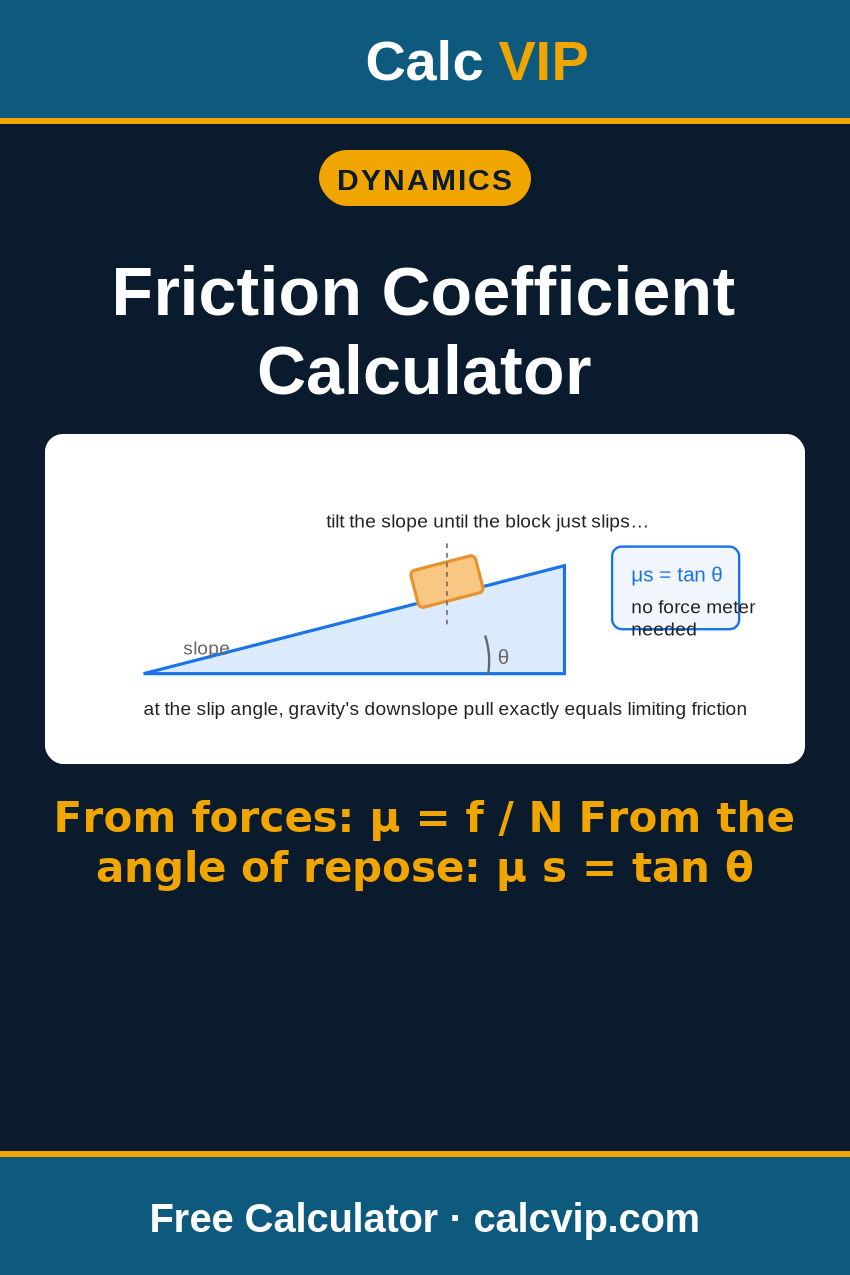
Both measurement routes in this calculator are real laboratory methods. The force method — drag the object with a spring balance at the point of slipping, divide by its weight — is the school-lab standard. The angle-of-repose method is older and in some ways cleverer: gravity itself supplies and splits the forces, the tangent of the slip angle hands you μs directly, and the same test, applied to a heap of grain or sand rather than a block, tells farmers and civil engineers the steepest angle at which a pile of material will stand. Two routes, one ratio.
Formula
From forces: μ = f / N
From the angle of repose: μs = tan θ, where θ is the angle at which sliding just starts.
The force form sits inside the friction law itself, f = μN, which rearranges to give the force from a known coefficient — the direction most design work runs in. On a slope, the same law produces the repose result: the block's weight splits into a component pressing it to the surface, N = mg cos θ, and a component pulling it downhill, mg sin θ. At the point of slipping those stand in the friction ratio, mg sin θ = μs mg cos θ, and the mass and g cancel to leave μs = tan θ. Note what the law does not contain: the area of contact and the sliding speed appear nowhere — to a good first approximation, friction depends on the materials and the load, and on nothing else.
| Symbol | Meaning | Units |
|---|---|---|
| μ | coefficient of friction for the surface pair | none (a ratio) |
| μs / μk | static (starting) and kinetic (sliding) coefficients | none |
| f | friction force (limiting value, for μs) | N |
| N | normal force pressing the surfaces together | N |
| θ | angle of repose — slope angle at the point of slipping | degrees (°) |
Why friction is proportional to load — and why area does not matter
Press two apparently flat surfaces together and they touch only at the tips of microscopic peaks — the real contact area may be a ten-thousandth of the apparent area. Push harder and those peaks squash, growing the true contact area in direct proportion to the load; the junctions that form resist shearing in proportion to their total area. That is the microscopic origin of f = μN: friction tracks the real contact area, the real contact area tracks the load, and the apparent area — the size of the block's face — drops out entirely. A brick slides with the same friction on its face, its side or its end, a result that surprises everyone the first time and that every school laboratory can verify in five minutes.
The static/kinetic split has a microscopic story too. Resting junctions have time to settle, creep and bond more strongly; sliding junctions are torn apart before they mature, so the kinetic coefficient runs lower — often 70–90% of the static value. The gap between them is what makes brakes squeal, violins sing and earthquakes happen: a system pulled steadily stores energy while static friction holds, then lurches forward under the weaker kinetic friction, sticks, and repeats. Engineers call it stick-slip; geologists call it a fault doing what faults do, with μs and μk measured on rock instead of wood.
How to use
- Choose the method: measured forces, or the angle of repose from a tilting-slope test.
- Enter the values — the friction force is the maximum (limiting) friction just before sliding for μs.
- Click "Calculate" to get the coefficient of friction.
- Sanity-check the result against the familiar range: below 0.1 is ice-like, 0.3–0.5 is wood-like, 0.7–1.0 is tyre-like. A value far outside 0–1.5 usually means the two forces were swapped.
Worked examples
Example 1 — the crate. A crate needs a friction force of 40 N to just start moving, and its normal force on the floor is 200 N.
μs = 40 / 200 = 0.2.
Angle-of-repose check: the same surfaces would start to slide on a slope of tan⁻¹(0.2) ≈ 11.3° — and a slope of 30° would mean μs = tan 30° = 0.58.
Example 2 — a tyre on dry asphalt. One loaded tyre presses the road with a normal force of 500 N in a scaled test rig, and the limiting friction measures 350 N: μs = 350 / 500 = 0.7. That 0.7 is the entire budget for braking and cornering — a car braking at the limit decelerates at μg ≈ 0.7 × 9.81 ≈ 6.9 m/s², which is why stopping distances are what they are.
Example 3 — ice on steel. A curling stone's running band on polished ice: the measured friction is just 15 N against a normal force of 500 N in an equivalent rig — μ = 15 / 500 = 0.03. At three hundredths, friction is nearly an absence: the stone glides tens of metres, and the sweepers' real job is polishing the ice to shave μ lower still.
Example 4 — the sand pile. Dry sand poured into a cone stands with sides at 34° before avalanching: μs = tan 34° = 0.67. No force meter, no block — just a protractor against a pile. The same measurement, repeated for grain, gravel or soil, sets the design of hoppers, stockpiles and embankments.
Example 5 — wood on wood. A wooden block on a wooden bench needs 120 N of pull to start moving under a normal force of 300 N: μs = 120 / 300 = 0.4, squarely in the textbook 0.3–0.5 band for timber. Wax the bench and the same test drops towards 0.2 — the coefficient belongs to the pair and its treatment, never to one material alone.
Example 6 — a ski on snow. A waxed ski slides with a friction force of 24 N under a skier's normal force of 600 N: μk = 24 / 600 = 0.04. This is a kinetic value, measured in motion — and it depends on the thin meltwater film the ski's pressure and friction generate, which is why ski wax is chosen for the day's temperature.
Friction coefficients in real life
Braking distances. A car's shortest stop is set by μ between tyre and road: dry asphalt's ~0.7 becomes ~0.3 on a wet road and ~0.1 on ice, and stopping distance grows in inverse proportion. ABS exists to keep the tyre at the static peak of friction rather than the lower kinetic value of a locked, sliding wheel.
Climbing and ropes. A climber's shoe rubber on rock runs at μ near or above 1, and friction hitches and capstans multiply a small holding force into a load-bearing one by wrapping rope around a post — the same physics as the coefficient, compounded by geometry.
Conveyor belts and hoppers. A belt can only carry material up an incline below the material's angle of repose, and a hopper's walls must be steeper than the repose angle of its contents or the contents bridge and refuse to flow. Factory design is full of tan θ calculations identical to this page's.
Walking, running and footwear. Every step plants a foot that would slide without friction; the μ demanded rises with pace and slope. Ice grips, crampons and cleats are all technologies for raising the effective coefficient — by interlocking mechanically where surfaces alone cannot grip.
Machinery losses. In engines and gearboxes the fight runs the other way: lubricants insert a fluid film to collapse μ from ~0.1 (dry metal) to ~0.001–0.01, and the difference is the machine's efficiency, heat and working life. Tribology — the science of friction and wear — is an industry unto itself.
Earthquake mechanics. Faults obey friction laws strikingly like this page's: rock surfaces with a static coefficient around 0.6–0.85 lock for centuries while stress accumulates, then slip under a lower kinetic value. The angle-of-repose mathematics of a sand pile scales up to the mechanics of a continent's edge.
Measuring μ honestly: why published values disagree
Open three textbooks and the same surface pair shows three different coefficients. The disagreement is honest: μ is not a constant of nature but a summary of a system. Surface finish, cleanliness, humidity, temperature, the presence of a third substance — dust, water, oil, wear debris — and even how long the surfaces have rested in contact all move the number. The professional habit is therefore to treat tabulated values as a starting range, to design with the pessimistic end of the range (the lowest μ when friction is your friend, the highest when it is your enemy), and to measure the actual pair whenever the design truly depends on it — with exactly the two methods in this calculator. For safety-critical grip — brakes, tyres, climbing gear — the measurement is repeated wet, dirty and worn, because that is the condition in which it will one day be needed.
Quick reference: typical coefficients of friction
| Surface pair | μs (approx.) | Angle of repose |
|---|---|---|
| ice on ice / steel on ice | 0.03 | ≈ 1.7° |
| waxed ski on snow (kinetic) | 0.04 | ≈ 2.3° |
| crate on floor (Example 1) | 0.20 | ≈ 11.3° |
| wood on wood | 0.3–0.5 | ≈ 17–27° |
| dry sand (a pile) | 0.67 | 34° |
| rubber tyre on dry concrete | 0.7–1.0 | ≈ 35–45° |
| gravel (a pile) | 0.84 | 40° |
The repose column is the coefficient wearing a protractor: any pair's μs can be read off a tilting board, and any pile's steepness is a friction measurement that nature performs for free.
Friction on a slope: the same coefficient, doing guard duty
The repose result generalises to every object resting on every incline. A block on a slope of angle θ stays put while tan θ ≤ μs, because gravity's downhill pull, mg sin θ, has not yet reached the limiting friction μs mg cos θ. This single inequality quietly governs parked cars on hills, roofs shedding snow, landslides waiting for rain to lower the soil's effective μ, and the maximum grade a railway can climb on steel wheels — a few percent at most, since steel on steel offers μ around 0.1–0.2 even before leaves and drizzle intervene. It also sets the engineer's safety question: not "will it slip on the design day?" but "how far is tan θ below μ on the worst day?" — a margin this calculator lets you put a number on in seconds.
Common mistakes
- Using the sliding force instead of the limiting force for μs. The static coefficient needs the force at the point of slipping. A force measured mid-slide gives μk — a different, smaller number.
- Assuming μ depends on contact area. It does not (to first approximation): a wide block and a narrow block of the same materials and weight share the same μ. Area cancels because real contact area is set by load, not by footprint.
- Quoting μ for a single material. There is no "coefficient of friction of steel" — only of steel on something, in some condition. Steel on ice is 0.03; steel on dry steel is around 0.5–0.8.
- Assuming μ cannot exceed 1. It can: clean, soft, interlocking surfaces — racing tyres, climbing rubber, gecko-inspired adhesives — pass 1 comfortably. tan θ has no ceiling at 45° either; gravel stands at 40° and some materials steeper.
- Taking the normal force as mg on a slope. On an incline the pressing force is mg cos θ, not mg. Using the full weight understates μ in force-method tests done on slopes — and the repose method exists precisely to sidestep that bookkeeping.
FAQ
What are typical values of μ?
Ice on ice ≈ 0.03, wood on wood ≈ 0.3–0.5, rubber tyres on dry concrete ≈ 0.7–1.0. Values above 1 are possible for very grippy surfaces.
What is the angle of repose used for?
It is the steepest angle at which a pile of material (grain, sand, soil) stays stable — important in farming, mining and civil engineering, and a quick lab method for measuring μs.
Is μ the same for static and moving friction?
Usually not: the static coefficient μs is a little larger than the kinetic coefficient μk, which is why things need a bigger push to start than to keep sliding.
Why does the friction force not depend on speed?
In the simple model it does not — but reality adds footnotes: at high sliding speeds, heating, melting and hydrodynamic films can raise or lower friction substantially. The constant-μ model is a good servant within ordinary speeds and loads, and engineers re-measure outside them.
How can I measure μ at home?
Lay the two materials on a board, put an object on top and tilt the board slowly until the object just slides. Measure the angle and take its tangent. That is the angle-of-repose method — a complete friction laboratory with no instruments but a protractor.
Does a heavier object have a higher coefficient?
No. Doubling the weight doubles the normal force and doubles the friction force, leaving their ratio — μ — unchanged. Heavier things are harder to push because the friction force grew, not because the coefficient did.
Why do brakes and tyres get less grippy when wet?
Water inserts a lubricating film between the surfaces, separating the microscopic peaks whose interlocking is friction. The pair becomes tyre-on-water-on-road, with a much lower μ — the extreme case being aquaplaning, where the film carries the whole load and friction nearly vanishes.
What is the friction angle?
Another name for the angle of repose, φ = tan⁻¹ μs, used heavily in soil mechanics. It is the angle at which the total reaction from a surface can tilt away from the normal before slipping occurs — the same geometry as this calculator's slope test.
Can friction ever be helpful in machines?
Constantly: belt drives, brakes, clutches, tyres, knots, screws and nails all work because of friction. Engineering is not the abolition of friction but its placement — minimised in bearings, maximised at the contact patch.
Why did my measured μ differ from the table?
Because μ describes your exact surfaces in their exact condition. Cleanliness, polish, moisture and wear move it easily by tens of percent. Your measurement is the right one for your surfaces; the table is a guide to what to expect.