 Calc
Friction Calculator – Static & Kinetic Friction Force
 Created by James Carter · Physics Writer · Forces & Motion · Last updated: November 2026
Use this free Friction Calculator to find the maximum static friction and the kinetic (sliding) friction between two surfaces. Enter the two coefficients of friction and the normal force pressing the surfaces together — and, optionally, the force you are applying, to see whether the object stays put or slides.
Friction is the force that lives at every contact. It is why a parked car stays parked on a hill, why a dropped phone stops sliding across the table, and why you can walk across a room at all. It acts parallel to the surfaces, always opposing the sliding — or the attempted sliding — between them. Unlike gravity or a spring, friction has no fixed size of its own. It supplies exactly as much force as the situation demands, up to a ceiling set by the surfaces themselves, and that ceiling is what this calculator computes.
The model is disarmingly simple: the friction force is the normal force — how hard the surfaces are pressed together — multiplied by a number called the coefficient of friction, μ, which summarises everything about the pair of materials: their roughness, stickiness and finish. Press twice as hard and friction doubles. Swap ice for asphalt and μ, and with it the friction, can change twenty-fold. Two versions of the coefficient matter: μs for static friction, which holds objects still, and μk for kinetic friction, which resists them once they are moving. Static is almost always the stronger of the two, which is why things lurch when they finally break free.
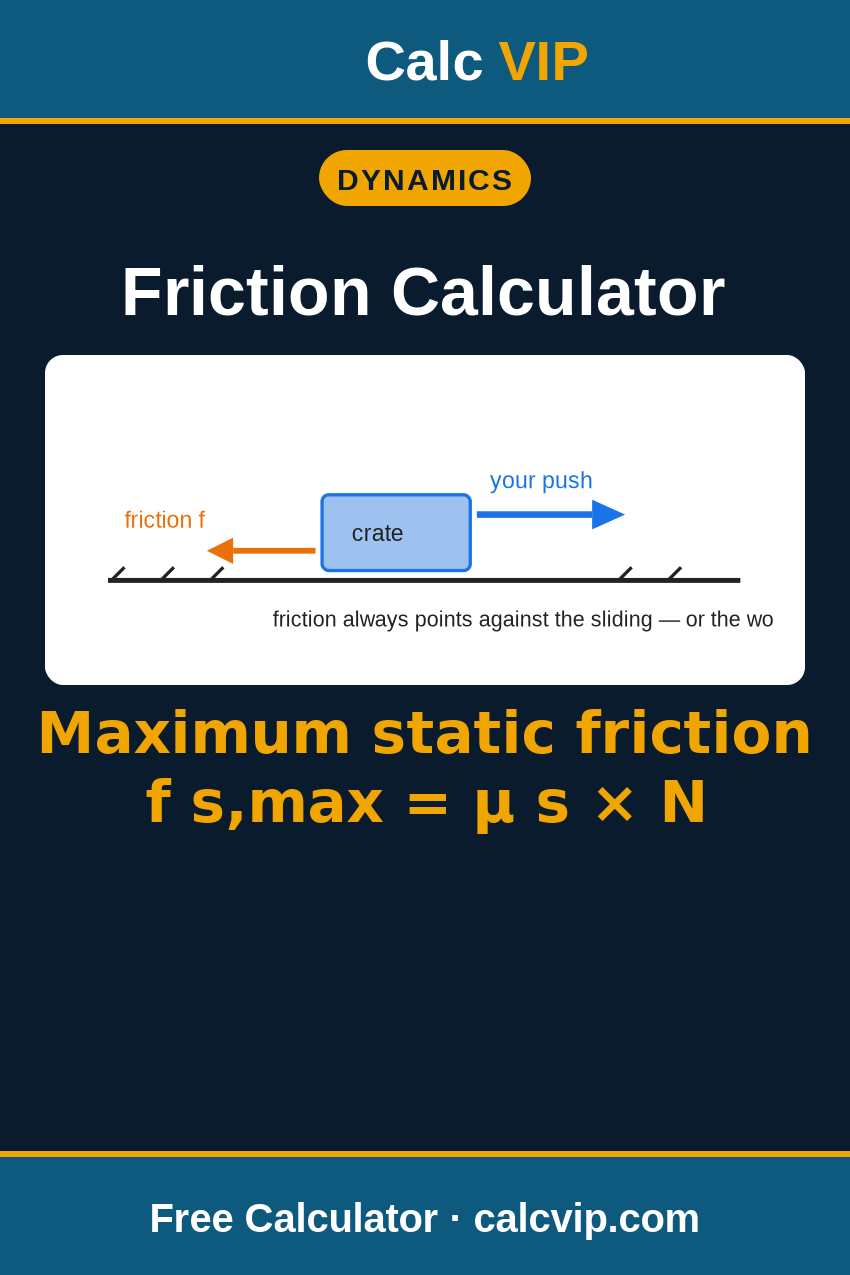
Enter μs, μk and the normal force (for a flat surface, simply the object's weight, mg) and the calculator returns the static ceiling fs,max and the sliding value fk. Add your applied force and it will tell you the verdict engineers actually need: does it hold, or does it slide — and if it slides, with what friction opposing you?
Formula
Maximum static friction fs,max = μs × N • Kinetic friction fk = μk × N • N in newtons, μ dimensionless
The two formulas look identical because they are the same law in two regimes. Static friction is a range, not a value: it can be anything from zero up to μsN, matching the applied force exactly until the ceiling is reached. Kinetic friction is a value: once sliding, fk = μkN opposes the motion at roughly constant size regardless of speed. Rearranged, the formulas answer design questions: the normal force needed to guarantee a grip of F is N = F ÷ μ, and the coefficient a surface pair must have to hold a load F under normal force N is μ = F ÷ N. There are no units to convert — μ is a pure ratio of two forces, which is why a single number can travel between a shoe sole and a ship's hull.
| Symbol | Meaning | Units |
|---|---|---|
| fs,max | largest static friction available before slipping | newtons (N) |
| fk | kinetic (sliding) friction | newtons (N) |
| μs, μk | coefficients of static / kinetic friction | dimensionless |
| N | normal force pressing the surfaces together | newtons (N) |
Static friction: the force that waits
The most misunderstood thing about friction is that the static value is usually not μsN. Push a heavy wardrobe with 20 N and it does not move — because static friction is pushing back with exactly 20 N, no more. Push with 50 N, friction answers 50 N. Static friction is a mirror: it reflects your effort precisely, up to the ceiling μsN. Only when your push exceeds the ceiling does the mirror break, the object lurch, and kinetic friction take over at its lower, steady value. The calculator's optional applied-force input exists to expose exactly this: compare your push with fs,max, not with fk, to learn whether the object will move at all.
Physically, the ceiling exists because surfaces are never smooth. Under a microscope, two "flat" solids touch only at scattered microscopic peaks, which cold-weld, interlock and deform. At rest, those junctions settle and strengthen with time — one reason a box left overnight can be harder to start than the same box an hour later. Sliding keeps the junctions young and brief, so the resistance drops to the kinetic level. Engineers call the whole phenomenon stick-slip, and it is responsible for everything from squealing brakes to earthquakes: tectonic plates are just static friction's ceiling and kinetic friction's drop, played out over centuries.
Kinetic friction has its own quiet virtue: predictability. Once an object slides, the resisting force barely depends on speed (in the simple model, not at all), so the deceleration it causes is constant — a sliding object loses speed at a steady rate, fk ÷ m. That constancy is what lets accident investigators work backwards from skid marks to speeds, and what this page's third example uses.
The ceiling also explains a familiar frustration: starting is the hardest part. A car stuck in mud, a train on frosty rails, a jar lid that has sat for a year — all are stuck at the static ceiling, and all become manageable the moment motion begins and the weaker kinetic value takes over. Techniques for freeing stuck things are really ceiling-avoidance strategies: rocking a car alternates the load so momentum helps at the ceiling, sand under a tyre raises μs itself, and a sharp jerk exploits the fact that a brief force can exceed the ceiling before the junctions fully engage. Once you see friction as two numbers with a gap between them, a dozen everyday tricks reorganise themselves into one idea.
How to use
- Enter the coefficient of static friction μs for your surface pair (rubber on asphalt ≈ 0.7, wood on wood ≈ 0.3–0.5, steel on ice ≈ 0.03).
- Enter the coefficient of kinetic friction μk — usually a little smaller than μs for the same surfaces.
- Enter the normal force N in newtons. On flat ground this is the object's weight, m × 9.81.
- Optionally, enter the force you plan to apply. Click "Calculate": if your force is below f_s,max the object stays put; above it, the object slides against f_k.
Worked examples
Example 1 — the standard check. A surface pair has μs = 0.4 and μk = 0.3, with a normal force of 200 N.
fs,max = 0.4 × 200 = 80 N — any push up to 80 N is matched and the object stays still.
fk = 0.3 × 200 = 60 N — once sliding, 60 N opposes the motion. Note the drop of 20 N at the moment of slipping: that is the lurch you feel when furniture finally gives way.
Example 2 — will the crate move? A 25 kg crate rests on a warehouse floor, so N = 25 × 9.81 = 245.25 N. With μs = 0.5, the static ceiling is 0.5 × 245.25 = 122.62 N. A worker pushing with 100 N achieves nothing — static friction matches the 100 N and the crate stays. The push must exceed 122.62 N before the crate moves at all, which is why experienced movers rock heavy objects or get a second pair of hands rather than pushing harder alone.
Example 3 — the skater's glide. A 60 kg skater glides on ice with μk = 0.15 against the skate's normal force of 60 × 9.81 = 588.6 N (a deliberately rough rink; polished ice is lower still). fk = 0.15 × 588.6 = 88.29 N, causing a deceleration of 88.29 ÷ 60 = 1.47 m/s² — the same as μk × g, since the mass cancels. Low μ is why ice sports glide; even this modest coefficient stops the skater in a few seconds.
Example 4 — the tyre's budget. A 1,000 kg car rests on its four tyres with N = 9,810 N in total and μs ≈ 0.7 for rubber on dry asphalt. The road can supply at most 0.7 × 9,810 = 6,867 N of friction — the entire budget for accelerating, braking and cornering combined. The fastest possible acceleration is therefore 6,867 ÷ 1,000 = 6.87 m/s², no matter how powerful the engine. More power than grip simply spins the wheels, converting static grip into weaker kinetic sliding.
Example 5 — a gentle case. A block pressed to a surface with N = 50 N, μs = 0.3 and μk = 0.2: fs,max = 0.3 × 50 = 15 N and fk = 0.2 × 50 = 10 N. A 12 N push fails to move it (12 < 15), but a 16 N push succeeds — and the instant it moves, the resistance falls to 10 N, leaving 6 N of net force to accelerate the block.
Example 6 — the angle of slip. Tilt a surface slowly and the object on it slips when the slope's pull, mg sin θ, reaches the static ceiling μs mg cos θ — that is, when tan θ = μs. For μs = 0.4 the slip angle is arctan(0.4) = 21.8°. This tilt test is how coefficients are actually measured in school laboratories, and why a roof, ramp or conveyor rated for one material can betray you with another: the angle, not the force, is what the surface pair decides.
Friction in real life
Walking. Every step is a friction transaction: your foot pushes backwards on the ground, static friction pushes your foot — and you — forwards. On ice the ceiling collapses and the transaction fails, which is why winter falls happen at the push-off moment, not mid-stride.
Brakes. A brake pad's whole job is to convert motion into heat through kinetic friction at a controlled rate. Brake materials are chosen for a high, stable μk that survives heat; a pad whose coefficient fades as it warms is a pad that stops working exactly when it is worked hardest.
Climbing. Rock shoes use soft, sticky rubber with μ against rock above 1 in good conditions — coefficients can exceed 1 when surfaces genuinely adhere — letting climbers stand on footholds that geometry alone would never allow. Chalk keeps the interface dry, because a film of sweat or water can halve μ.
Machinery. Inside engines and gearboxes friction is the enemy, and lubricants are μ-reducers: a film of oil can drop the coefficient between steel parts from ~0.5 dry to ~0.05, which is most of why engines last. The same machine may deliberately use friction a metre away — in its belt drives and its brakes.
Winter tyres and chains. Soft winter compounds and siped treads raise μ on cold, wet and icy roads; chains go further, replacing the friction model with mechanical interlocking altogether. The difference between μ = 0.1 and μ = 0.3 on ice is the difference between a 90 m and a 30 m stopping distance from town speeds.
Everyday fasteners. Screws, knots, nails and climbing ropes all hold by friction. A knot is friction organised by geometry; a screw thread is an inclined plane whose friction ceiling keeps it from unwinding under load. Remove friction and civilisation's joinery quietly comes apart.
Where μ comes from — and when the simple model breaks
Coefficients of friction are measured, not derived: no formula predicts μ for a new pair of materials, so engineers consult tables built from experiments, then add safety margins because real surfaces arrive dirty, wet, worn and hot. The simple model — friction proportional to N, independent of contact area and speed — is a superb approximation for dry, rigid surfaces at ordinary loads, which is why it has survived since Leonardo sketched it. It breaks at the extremes: very soft materials (a racing tyre's grip does grow with contact patch), very high speeds, lubricated contacts (where fluid friction follows different laws), and atomically clean surfaces in vacuum, which can weld outright. Knowing the model's limits is part of using it well: inside its territory, as the examples show, it is accurate enough to reconstruct road accidents and size machinery.
Quick reference: typical coefficients
| Surface pair | μs | μk |
|---|---|---|
| steel on ice | 0.03 | 0.02 |
| wood on wood | 0.4 | 0.2 |
| steel on steel (dry) | 0.6 | 0.4 |
| rubber on dry asphalt | 0.7–0.9 | 0.5–0.7 |
| rubber on wet asphalt | 0.4 | 0.3 |
| rubber on ice | 0.15 | 0.1 |
| Teflon on steel | 0.04 | 0.04 |
Treat every table value as a starting estimate: polish, contamination and temperature routinely shift a real coefficient by a third or more.
Common mistakes
- Using f = μN as the actual static friction. That product is the ceiling, not the current value. A resting object pushed with 20 N experiences 20 N of static friction even if the ceiling is 80 N.
- Using μk to decide whether something moves. The start-or-stay question is settled by μs. Kinetic friction only takes over after slipping begins — mixing them up reverses verdicts near the boundary.
- Using mass instead of normal force. Friction multiplies N, and N equals mg only on flat, unaccelerated ground. On a slope N = mg cos θ; in a lift it changes with acceleration; a downward push adds to it.
- Assuming friction always opposes motion. It opposes slipping at the contact. The friction on a driven tyre points forwards and propels the car; friction on a walking foot points forwards too.
- Expecting wider contact to grip more. In the standard model area cancels out — a wider tyre at the same load and pressure per area has the same ceiling. (Real racing tyres cheat the model with soft, adhesive rubber, not with width alone.)
FAQ
Why is static friction usually bigger than kinetic friction?
At rest, surface bumps settle into each other and grip more strongly. Once sliding starts, the bumps have less time to lock together, so μk is normally smaller than μs.
Does friction depend on the contact area?
In the standard model, no — friction depends only on μ and the normal force, not on how wide the contact patch is.
What is the actual static friction if I push gently?
Static friction matches your push exactly (up to its maximum). Push with 20 N and friction pushes back with 20 N; it only reaches fs,max at the point of slipping.
Can the coefficient of friction be greater than 1?
Yes. μ is a ratio, not a fraction of anything, and adhesive pairs — drag-racing tyres, climbing-shoe rubber, gecko-inspired pads — exceed 1, sometimes reaching 1.5 or more. Values above 1 simply mean friction can exceed the normal force.
How can I find μ for my own surfaces?
Tilt test: raise one surface until the object just slips and take μs = tan θ at that angle. Or pull the object with a spring balance: μs = (force at first movement) ÷ weight, μk = (steady pulling force) ÷ weight.
Why do things get harder to stop once they start sliding?
They do not — they get easier to keep moving but the friction drops, so a sliding object accelerates if your push stays at the break-free level. The danger is the reverse: stopping distance grows because kinetic friction, the only kind available to a locked, skidding wheel, is weaker than static.
Does friction depend on speed?
In the school model, no. In reality kinetic friction drifts modestly with speed and can fall noticeably at high sliding speeds or rise with heat — one reason brake fade and tyre behaviour are engineering subjects, not just formulas.
Why is there no friction in space problems?
There is no contact. Friction needs two surfaces pressed together; a spacecraft coasts because nothing touches it. (Thin upper-atmosphere drag exists, but it is air resistance, not contact friction.)
What is rolling friction?
The much smaller resistance a wheel or ball meets as it rolls — technically rolling resistance, with effective coefficients around 0.001–0.01 for a train wheel on rail. It is why wheels conquered transport: rolling cuts the resisting force by one to two orders of magnitude versus dragging.
How does friction produce heat?
The microscopic junctions at the contact are continually formed, stretched and torn as surfaces slide; the work done against friction becomes disordered molecular motion — heat. Rubbing hands together is the pocket demonstration; brake discs glowing on a mountain descent are the industrial one.