 Calc
Explosion Calculator – Fragment Velocity When an Object Splits
 Created by James Carter · Physics Writer · Forces & Motion · Last updated: November 2026
Use this free Explosion Calculator for an object at rest that splits into two fragments. Total momentum stays zero, so if you know one fragment's mass and velocity, the other's velocity is fixed — the lighter piece flies off faster.
Explosion Into Two Fragments (From Rest)
An explosion is a collision read backwards. Where a collision takes moving objects and spends their kinetic energy, an explosion starts from stillness and creates kinetic energy, paying for it from energy stored inside the object — chemical, spring, nuclear. Yet one law governs both directions with perfect indifference: momentum is conserved. For an object at rest the total momentum is zero before the burst and must be zero after it, so the two fragments' momenta are locked into an equal-and-opposite embrace. Measure one fragment — its mass and velocity — and the other's velocity is not a matter of opinion or of the explosive's details. It is arithmetic. That is what this calculator does.
The result has a built-in drama: because the momenta must match in size, the lighter fragment is condemned to the higher speed, in exact inverse proportion to its mass. A fragment a third the mass flies three times as fast. And because kinetic energy grows with velocity squared, the light fragment does not merely go faster — it carries away the larger share of the released energy, a share equal to the other fragment's fraction of the total mass. This is why shrapnel, not the heavy casing, is the danger of a burst, and why the recoil of a light gas is what pushes a rocket.
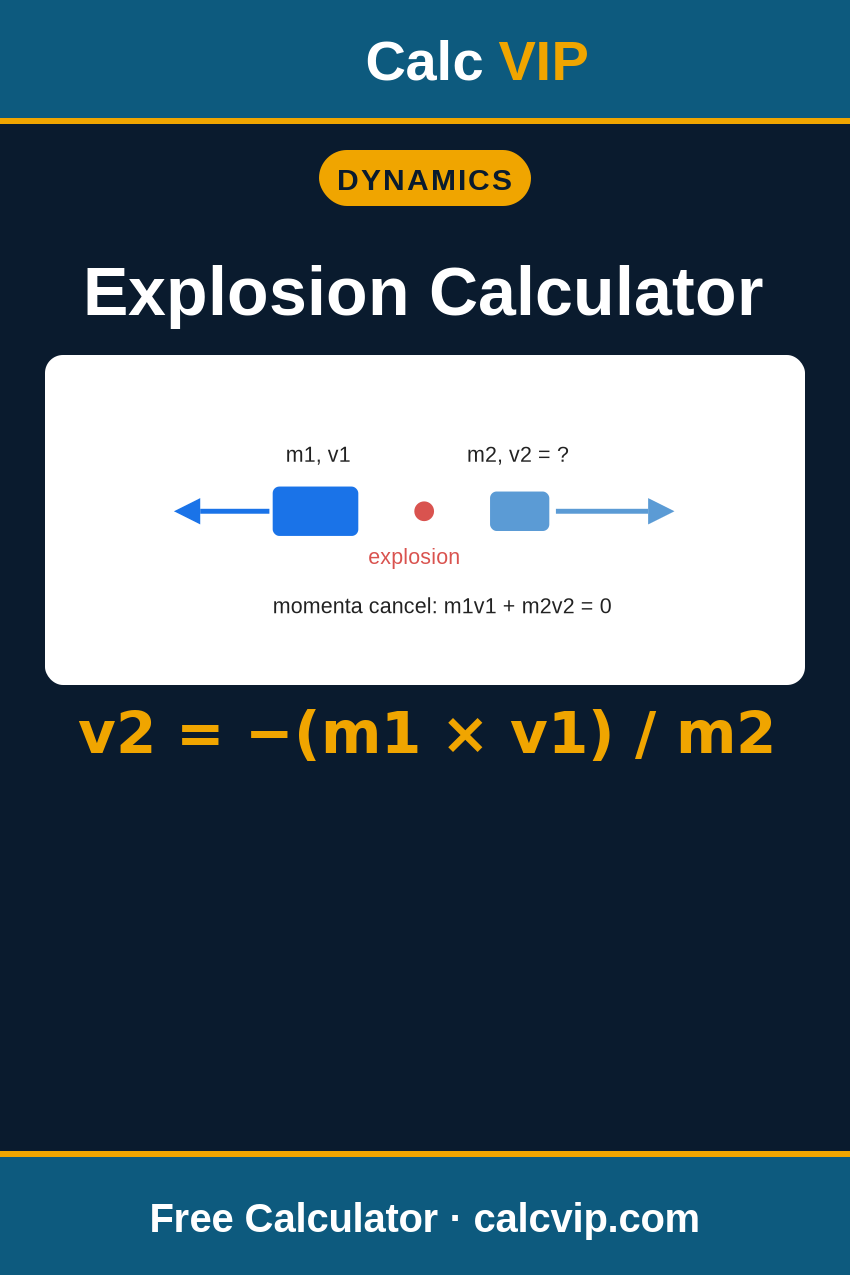
The model here is deliberately the clean one: a single object, initially at rest, splitting into exactly two fragments along a line. Real bursts scatter into many pieces in three dimensions, and the depth section shows how the same bookkeeping extends — the centre of mass never budges, and a moving parent passes its velocity down to both children. But the two-fragment case is the skeleton every forensic reconstruction, textbook problem and fireworks calculation is built on, and it is fully solved by the one formula below.
Formula
v2 = −(m1 × v1) / m2 — from conservation of momentum: m1v1 + m2v2 = 0 because the object started at rest. The minus sign means fragment 2 moves in the opposite direction to fragment 1. Unlike collisions, kinetic energy increases — it comes from the stored (chemical or spring) energy released.
The equation rearranges for the other unknowns: an unknown fragment mass from two measured velocities, m2 = −m1v1 / v2, or the first fragment's velocity if the second was the one tracked, by symmetry. The energy released follows as KE = ½ m1v1² + ½ m2v2², and it divides between the fragments in a fixed pattern worth memorising: fragment 2's share of the kinetic energy is m1 / (m1 + m2) — the partner's mass fraction. Equal masses split the energy evenly; a fragment one tenth of the pair's mass, bursting away from a partner nine times heavier, takes nine tenths of the energy with it. Both results — the velocity ratio and the energy split — are the same inverse-mass law seen from two sides, and both are special cases of KE = p² / (2m) with the momentum p shared equally.
| Symbol | Meaning | Units |
|---|---|---|
| m1, m2 | masses of the two fragments | kg |
| v1 | velocity of fragment 1 (measured, signed) | m/s |
| v2 | velocity of fragment 2 (the answer; opposite sign) | m/s |
| KE released | total kinetic energy after the burst (= stored energy released) | joules (J) |
A collision in reverse — with an energy source inside
Run a perfectly inelastic collision backwards in your mind and you get an explosion: one object at rest becomes two moving apart. The momentum bookkeeping is identical in both directions, which is why the same conservation law solves both. The difference is the energy ledger's sign. In the collision, the relative motion's kinetic energy is spent into heat and deformation; in the explosion, stored energy is minted into relative motion. Something must hold that store before the event: a chemical explosive's bonds, a compressed spring between laboratory carts, the muscles of two skaters about to push off, or the nuclear binding energy released in a radioactive decay. An "explosion" with no store is impossible — if a calculation produces kinetic energy from nothing, a store has been smuggled in or an error has.
Through the whole event, one point refuses to participate: the centre of mass. It was at rest before the burst and it is at rest after, not because the fragments are gentle but because internal forces cannot move it, full stop. Track a bursting shell on high-speed film and mark the fragments' centre of mass frame by frame: it sits at the burst point while the debris flies, and if the parent was moving, it sails on along the original trajectory as though the explosion were a rumour. Forensic analysts and astronomers both exploit this — the centre of mass is the fixed point from which a chaotic event can be reconstructed.
How to use
- Enter the mass and measured velocity of the fragment you know, and the mass of the other fragment.
- The original object must have been at rest — if it was moving, use a collision calculator instead, or work in the parent's rest frame and add its velocity back afterwards (see the depth section).
- Click "Calculate Fragment 2 Velocity" to get the second fragment's speed and direction, plus the kinetic energy released.
- Read the sign: a negative v2 simply means "opposite to fragment 1". The speed is its magnitude — and it should exceed v1 whenever fragment 2 is the lighter one.
Worked examples
Example 1 — the bursting shell. A stationary 4 kg shell bursts into a 3 kg fragment moving at 4 m/s and a 1 kg fragment.
v2 = −(3 × 4) / 1 = −12 m/s — the 1 kg piece flies off at 12 m/s in the opposite direction.
Kinetic energy after = ½ × 3 × 4² + ½ × 1 × 12² = 24 + 72 = 96 J, all supplied by the explosion (it was 0 J before). Note the split: the light fragment, with a quarter of the mass, carries three quarters of the energy.
Example 2 — the firework's equal halves. A firework shell at the top of its flight, momentarily at rest, splits into two 0.4 kg halves; one is seen moving at 15 m/s. Equal masses share everything equally: v2 = −(0.4 × 15) / 0.4 = −15 m/s, and the released energy is ½ × 0.4 × 15² + ½ × 0.4 × 15² = 90 J. The symmetric star-burst of a good firework is this example painted on the sky — equal fragments, equal speeds, a sphere of light expanding around the unmoved centre.
Example 3 — the spring-apart carts. Two laboratory carts, 0.5 kg and 1.0 kg, are released from rest with a compressed spring between them. The 0.5 kg cart is measured at 1.2 m/s. v2 = −(0.5 × 1.2) / 1.0 = −0.6 m/s. Released energy = ½ × 0.5 × 1.2² + ½ × 1.0 × 0.6² = 0.36 + 0.18 = 0.54 J — the spring's stored energy, now visible as motion. This is the gentlest explosion there is, and the one students use to verify the momentum books balance.
Example 4 — a heavier burst. A stationary object splits into 4 kg and 2 kg fragments; the 4 kg piece moves at 9 m/s. v2 = −(4 × 9) / 2 = −18 m/s. Energy released = ½ × 4 × 81 + ½ × 2 × 324 = 162 + 324 = 486 J. The 2 kg fragment, half its partner's mass, moves twice as fast and carries twice its partner's kinetic energy — the inverse-mass law twice over.
Example 5 — skaters pushing off. Two skaters at rest on ice, 50 kg and 75 kg, push against each other and separate. The 50 kg skater glides off at 2 m/s. v2 = −(50 × 2) / 75 ≈ −1.33 m/s. Energy released = ½ × 50 × 2² + ½ × 75 × 1.33² ≈ 100 + 66.7 ≈ 166.7 J, supplied by their muscles. An explosion does not need explosives — it needs a store of energy and a sudden release, and a push-off qualifies completely.
Example 6 — an atomic explosion: alpha decay. A radium-226 nucleus at rest ejects an alpha particle of 4 mass units at about 1.5 × 10⁷ m/s, leaving a radon-222 nucleus of 222 units. The recoiling nucleus takes v2 = −(4 × 1.5 × 10⁷) / 222 ≈ −2.70 × 10⁵ m/s. The alpha's kinetic energy is about 4.66 MeV; the heavy nucleus's recoil is only about 0.084 MeV — the light fragment taking about 98% of the energy, exactly as the mass-share rule predicts (222/226 of it). Nuclear physicists read this split directly off decay spectra.
Explosions in real life
Fireworks. A display shell is timed to burst near rest at the top of its arc so the star pattern expands symmetrically around the stationary centre of mass. The colours fly at speeds set by this page's inverse-mass rule — which is why the pattern's edge is made of the smallest, lightest stars.
Radioactive decay. Alpha decay is a two-fragment explosion at atomic scale, and its bookkeeping is exact enough that the alpha particle's energy identifies the parent nucleus like a fingerprint. The tiny recoil of the daughter nucleus, computed exactly as here, is a measurable correction in precision spectroscopy.
Spring-apart demonstrations. Physics classrooms verify momentum conservation with carts and a spring — the one explosion gentle enough to watch. The measured velocities always satisfy m1v1 = −m2v2 to within friction's small theft, a tabletop proof of the law.
Supernovae. A dying star ejects its outer layers in the largest explosions known, while the core collapses inward. The ejecta's momenta sum to the star's original (near-zero) momentum, and the compact remnant is often found hurtling away — a "kick" of hundreds of km/s that is nothing but fragment 2 of a cosmic burst, balancing the asymmetric flight of the rest.
Push-offs in orbit. Astronauts separating from a spacecraft, or two docked vehicles parting, exchange momentum exactly as the skaters do. Mission planners compute both resulting velocities from this formula, because in orbit there is no friction to tidy up an error.
Jet and rocket propulsion. A squid jets water backwards and recoils forwards; a rocket does the same with gas, continuously. Slice the burn into instants and each is a small explosion in which the exhaust is fragment 2 — the rocket equation is this page's formula integrated over a shrinking mass.
What if the parent was moving?
The calculator's contract is a parent at rest, but the extension is simple and worth owning: solve the burst in the parent's rest frame, then add the parent's velocity to both answers. Suppose a 10 kg shell travelling at 50 m/s bursts into 6 kg and 4 kg pieces, and in the shell's own frame the 6 kg piece gains +10 m/s. Momentum in that frame gives the 4 kg piece −(6 × 10) / 4 = −15 m/s. Back in the ground frame: the pieces move at 50 + 10 = 60 m/s and 50 − 15 = 35 m/s — both still travelling forward, yet flying apart at 25 m/s relative to each other. The energy minted by the burst, judged in the centre-of-mass frame, is ½ × 6 × 10² + ½ × 4 × 15² = 300 + 450 = 750 J. This is why "the fragments flew in opposite directions" is a statement about frames: opposite in the parent's frame, merely separated in the ground's.
Quick reference: how a burst splits its energy
| Mass split (m1 : m2) | Speed ratio v2 / v1 | KE share of the lighter piece |
|---|---|---|
| 1 : 1 (equal) | 1× | 50% |
| 3 : 1 | 3× | 75% |
| 4 : 2 (2 : 1) | 2× | 67% |
| 9 : 1 | 9× | 90% |
| alpha decay (222 : 4) | ≈ 55× | ≈ 98% |
Both columns are the same law — with equal momenta, speed and energy share both scale inversely with mass. It is the reason the danger of any burst lives in its smallest fragments, and the reason a rocket's exhaust, the lightest "fragment" of all, carries away the overwhelming share of the energy while the massive rocket keeps the momentum balance.
Common mistakes
- Losing the minus sign — or misreading it. v2 must be opposite in direction to v1 when the parent was at rest. Dropping the sign predicts both fragments flying the same way, which would conjure momentum from nothing; the negative sign is the conservation law's signature, not an error flag.
- Assuming the energy splits evenly. Momentum splits evenly; energy splits by inverse mass. Expecting the heavy fragment to carry most of the energy inverts the physics — it is the light fragment that leaves rich.
- Applying the formula to a moving parent. v2 = −m1v1 / m2 assumes the total momentum is zero. For a moving parent, transform into its rest frame first (or use momentum conservation in full: m1v1 + m2v2 = M × V_parent). Skipping this is the most common explosion error after the sign.
- Expecting two fragments to be the whole story. Real bursts make many fragments, and with three or more, momentum conservation alone cannot fix every velocity — the directions and the energy share must also be known. This calculator solves the two-fragment skeleton, not a full debris field.
- Forgetting the energy needs a source. If a problem's numbers imply a huge KE release from a passive object, check for the store — explosive, spring, muscle, nucleus. Kinetic energy appearing with no store named is a sign the problem (or the arithmetic) is about a collision instead.
FAQ
Why does the lighter fragment move faster?
Both fragments carry equal and opposite momentum (m1v1 = m2v2 in size). With less mass, fragment 2 needs more velocity to carry the same momentum — and it also takes the larger share of the kinetic energy.
Is momentum really conserved in an explosion?
Yes. The explosive forces are internal to the system, so they cannot change the total momentum — it stays at whatever it was before, here zero.
What if the object was moving before it split?
Then the total momentum is the original momentum, not zero, and the fragments' momenta must add up to that instead. The centre of mass keeps moving exactly as before.
Where does the extra kinetic energy come from?
From energy stored inside the object before the burst — chemical energy in an explosive, elastic energy in a spring, muscular work in a push-off, nuclear binding energy in a decay. The explosion converts the store into motion; it never creates energy from nothing.
Can both fragments fly off in the same direction?
In the parent's rest frame, never — their momenta must cancel, so their directions oppose. In the ground frame, if the parent was moving fast enough, both fragments can indeed travel the same way (the depth section's 60 m/s and 35 m/s pieces) while still separating from each other.
What if the object splits into three or more fragments?
Momentum conservation still holds — the fragments' momenta sum vectorially to the original total — but it no longer fixes each velocity uniquely. You would need each fragment's direction and the energy released as well. The two-fragment case is special precisely because it is fully determined.
Why does the lighter fragment take more of the energy?
Because with equal momenta p, kinetic energy is p² / (2m) — inversely proportional to mass. Halve the mass and the same momentum costs twice the energy. The light fragment's energy share is exactly the heavy partner's share of the total mass.
Does the centre of mass of the fragments move after the burst?
No. It remains wherever the parent's centre of mass was, moving however it was moving — at rest for this calculator's case. The fragments scatter symmetrically around it in momentum terms, however lopsided their speeds and energies look.
How is an explosion different from a collision, formally?
An explosion is a single system becoming several with increased kinetic energy, funded by an internal store; a collision is several (or two) systems interacting with kinetic energy constant (elastic) or decreased (inelastic). Momentum conservation governs both — it is the energy ledger that changes sign.
How do investigators reconstruct a burst from one fragment?
Exactly with this calculator: identify a fragment's mass and estimate its velocity from its range, penetration or crater, then infer the partner's velocity from momentum conservation, and the released energy from the kinetic energy total. It is how shell bursts, tank ruptures and even supernova remnants are reverse-engineered.