 Calc
Elastic Collision Calculator – Final Velocities in 1D
 Created by James Carter · Physics Writer · Forces & Motion · Last updated: November 2026
Use this free Elastic Collision Calculator to find the final velocities of two objects after a perfectly elastic collision in one dimension. In an elastic collision both momentum and kinetic energy are conserved — like billiard balls clicking apart.
Elastic Collision (1D)
A collision is called elastic when the objects bounce apart with no kinetic energy lost along the way — nothing is permanently bent, heated or sounded away. That double conservation is what makes the elastic collision special: momentum conservation alone can only pin down one shared outcome, but momentum and energy together are two equations, and two equations can solve for two unknowns — the two final velocities this calculator returns. Feed in the two masses and the two starting velocities, with signs for direction, and the complete outcome is already determined. Nothing about the details of the impact — how hard the surfaces were, how long contact lasted — matters at all.
Perfectly elastic collisions are an idealisation, but a surprisingly useful one. Steel billiard balls, glass marbles, air-track gliders on a cushion of air and atoms bouncing off each other in a gas all come close enough that the elastic formulas predict their behaviour to within a few percent. At the other extreme, a lump of clay hitting the floor is as inelastic as a collision can be. Most real impacts live between the two poles, and the elastic case is the benchmark that defines one end of the scale: the maximum bounce, the minimum loss.
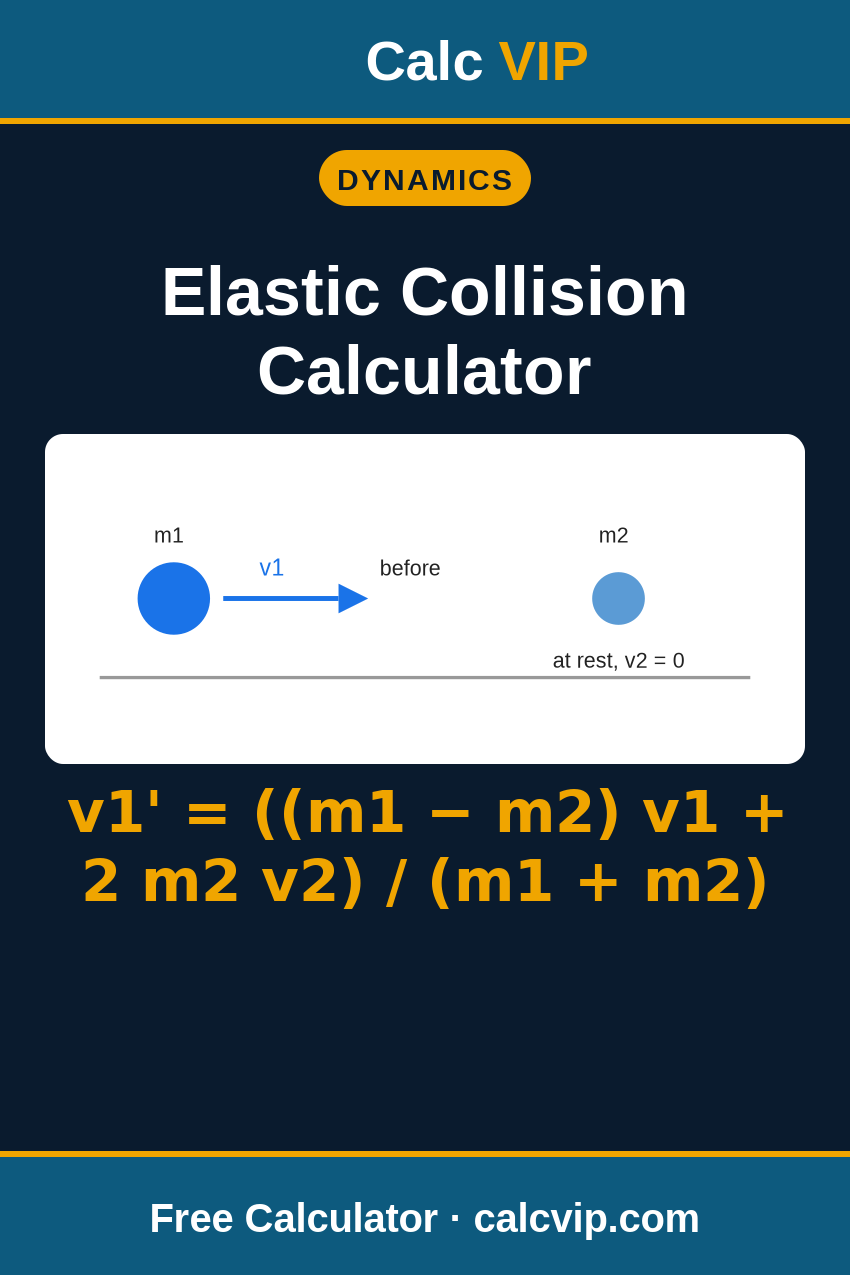
The results often defy first intuition. A heavy object striking a light stationary one can send the light object away at nearly twice the incoming speed, while barely slowing down itself. Two equal masses simply swap velocities, which is why a snooker ball striking a dead-centre shot stops dead and hands its whole motion to the target ball. And a light object bouncing off a heavy one rebounds at almost its full incoming speed, reversed. All three behaviours fall out of the same two formulas below — they are worth meeting in the worked examples, because once you have seen them you will recognise them everywhere from Newton's cradle to nuclear reactors.
Formula
v1' = ((m1 − m2) v1 + 2 m2 v2) / (m1 + m2) • v2' = ((m2 − m1) v2 + 2 m1 v1) / (m1 + m2)
The two formulas are the simultaneous solution of the two conservation laws: momentum, m1v1 + m2v2 = m1v1' + m2v2', and kinetic energy, ½m1v1² + ½m2v2² = ½m1v1'² + ½m2v2'². When the target is at rest (v2 = 0) they simplify to v1' = (m1 − m2) v1 / (m1 + m2) and v2' = 2 m1 v1 / (m1 + m2) — the two forms worth memorising, because most textbook and laboratory collisions are arranged exactly that way. Notice what is absent: no force, no contact time, no spring constant. Conservation laws leapfrog the entire messy instant of impact and connect the "before" directly to the "after", which is precisely their power. The one piece of bookkeeping that cannot be skipped is the sign convention: pick a positive direction, give velocities towards it a plus sign and velocities against it a minus sign, and the formulas will return correctly signed answers.
| Symbol | Meaning | Units |
|---|---|---|
| m1, m2 | masses of the two objects | kg |
| v1, v2 | velocities before the collision (signed) | m/s |
| v1', v2' | velocities after the collision (signed) | m/s |
| p | momentum, p = mv (conserved) | kg·m/s |
| KE | kinetic energy, KE = ½mv² (conserved) | joules (J) |
Two conservation laws, two unknowns — and three famous special cases
Why does an elastic collision have exactly one possible outcome, while an ordinary collision could end a hundred ways? Because each conservation law removes one degree of freedom. Momentum conservation alone is a single equation linking v1' and v2' — infinitely many pairs satisfy it, from the pair sticking together to either one stopping. Energy conservation is a second, independent equation, and two equations in two unknowns generally have a single solution (the other mathematical root is the "no collision happened" case, where both objects keep their starting velocities). Physically, the energy equation is what forbids the objects from sticking: stuck together they would move at the momentum-only speed, and that state always holds less kinetic energy than the pair started with. Elasticity is the demand that the energy books balance exactly, and the formulas above are simply that demand, solved.
Three special cases are worth learning by sight. Equal masses (m1 = m2): the two objects exchange velocities outright — v1' = v2 and v2' = v1 — whatever the starting speeds, even head-on. Heavy hits light (m1 much larger than m2, target at rest): the heavy object ploughs on at nearly its original speed while the light one is launched at nearly twice that speed — the factor 2 m1/(m1 + m2) approaches 2. Light hits heavy (m1 much smaller than m2): the light object rebounds at nearly its full incoming speed, reversed, like a ball off a wall, while the heavy one barely creeps. Between these poles, the mass ratio slides the outcome smoothly from swap, to share, to bounce.
How to use
- Enter both masses in kg and both starting velocities in m/s.
- Use a negative velocity for an object moving in the opposite direction (for example, −5 m/s for one moving left) — the signs carry the geometry.
- Click "Calculate Final Velocities" to see each object's velocity after the collision.
- Check the kinetic-energy line: in a perfectly elastic collision the energy before and after must match exactly. If you are testing real data and they do not match, the collision was not perfectly elastic — and the size of the gap measures how inelastic it was.
Worked examples
Example 1 — the standard case. A ball of mass 2 kg rolling at 10 m/s hits a stationary ball of mass 1 kg elastically.
v1' = ((2 − 1) × 10 + 0) / 3 = 3.33 m/s
v2' = (0 + 2 × 2 × 10) / 3 = 13.33 m/s
Energy check: KE before = ½ × 2 × 10² = 100 J; KE after = ½ × 2 × 3.33² + ½ × 1 × 13.33² = 100 J — energy is conserved, as it must be in an elastic collision. Note the light ball leaving faster (13.33 m/s) than the incoming ball arrived (10 m/s).
Example 2 — equal masses, head-on. Two identical 1 kg gliders approach each other, one at 6 m/s, the other at −2 m/s. Equal masses swap velocities: v1' = −2 m/s and v2' = 6 m/s. KE before = ½ × 1 × 36 + ½ × 1 × 4 = 20 J; KE after = ½ × 1 × 4 + ½ × 1 × 36 = 20 J. Each glider leaves with the other's motion, as if they had passed through each other — except their identities have traded places.
Example 3 — light hits heavy, and bounces. A 1 kg ball at 8 m/s strikes a stationary 4 kg block elastically. v1' = ((1 − 4) × 8) / 5 = −4.8 m/s — the ball rebounds at 4.8 m/s. v2' = (2 × 1 × 8) / 5 = 3.2 m/s. KE before = ½ × 1 × 64 = 32 J; KE after = ½ × 1 × 4.8² + ½ × 4 × 3.2² = 11.52 + 20.48 = 32 J. The negative sign on v1' is the whole story: direction reversed.
Example 4 — heavy hits light: the near-double launch. A 5 kg mass at 4 m/s hits a stationary 0.5 kg mass. v1' = ((5 − 0.5) × 4) / 5.5 = 3.27 m/s — the heavy mass keeps 82% of its speed. v2' = (2 × 5 × 4) / 5.5 = 7.27 m/s — the light mass leaves at 1.8 times the incoming speed, closing on the theoretical maximum of 2×. KE before = ½ × 5 × 16 = 40 J; KE after = ½ × 5 × 3.27² + ½ × 0.5 × 7.27² = 26.78 + 13.22 = 40 J.
Example 5 — a rear-end collision, both moving. A 3 kg cart at 12 m/s catches up and strikes a 2 kg cart moving the same way at 5 m/s. v1' = ((3 − 2) × 12 + 2 × 2 × 5) / 5 = (12 + 20) / 5 = 6.4 m/s. v2' = ((2 − 3) × 5 + 2 × 3 × 12) / 5 = (−5 + 72) / 5 = 13.4 m/s. KE before = ½ × 3 × 144 + ½ × 2 × 25 = 216 + 25 = 241 J; KE after = ½ × 3 × 6.4² + ½ × 2 × 13.4² = 61.44 + 179.56 = 241 J. The struck cart leaves faster than the striker arrived — energy has been handed forward.
Example 6 — air-track gliders in the lab. A 0.4 kg glider at 1.5 m/s meets a 0.2 kg glider coming the other way at −0.5 m/s, with spring bumpers making the collision nearly elastic. v1' = ((0.4 − 0.2) × 1.5 + 2 × 0.2 × (−0.5)) / 0.6 = (0.3 − 0.2) / 0.6 = 0.17 m/s. v2' = ((0.2 − 0.4) × (−0.5) + 2 × 0.4 × 1.5) / 0.6 = (0.1 + 1.2) / 0.6 = 2.17 m/s. KE before = ½ × 0.4 × 2.25 + ½ × 0.2 × 0.25 = 0.475 J; KE after = ½ × 0.4 × 0.17² + ½ × 0.2 × 2.17² ≈ 0.475 J. Small numbers, same laws — and in a real lab this is exactly the agreement students are asked to demonstrate.
Elastic collisions in real life
Billiards and snooker. The break shot is Example 2 staged nightly: a dead-centre hit on an equal-mass ball stops the cue ball and sends the object ball away at the cue ball's speed. Every follow-through and stun shot is a player quietly exploiting — or fighting — the velocity swap.
Newton's cradle. The desk toy works because steel balls are highly elastic and equal in mass: the velocity of the incoming ball is passed hand-to-hand down the row, emerging only at the far end. The click you hear is the small energy tax that makes it "nearly" rather than perfectly elastic — which is why the cradle eventually winds down.
Slowing neutrons in a reactor. A fission neutron must be slowed from about 2 million m/s to thermal speeds before it can efficiently split another nucleus, and it slows by elastic collisions. The formulas explain the choice of moderator: against heavy nuclei a neutron bounces off at nearly full speed (light hits heavy), but against hydrogen — whose nucleus has almost the neutron's own mass — each collision can hand over most of its energy, the equal-mass swap. Water and graphite are in reactors precisely because of this page's arithmetic.
Curling stones. Granite stones of equal mass sliding on ice collide almost elastically, so a take-out shot transfers the shooter's stone's motion to the target stone — the swap again, played at championship level.
The ideal gas. Kinetic theory models gas molecules as point masses colliding elastically with each other and the container walls. Pressure itself is the accumulated drumbeat of those elastic rebounds — the light-hits-heavy wall bounce, repeated 10²³ times a second.
Gravity assists, the elastic collision in disguise. A spacecraft swinging past a moving planet gains up to twice the planet's orbital speed in the planet's frame — the same factor-of-two ceiling as Example 4, because mathematically the flyby is an elastic collision with an enormous mass. Voyager's grand tour was powered by this page's formulas.
The relative-speed shortcut
Buried inside the two formulas is a pattern elegant enough to use on its own: in an elastic collision, the speed of approach equals the speed of separation — v1 − v2 = v2' − v1'. Before Example 1, the balls close at 10 − 0 = 10 m/s; after, they separate at 13.33 − 3.33 = 10 m/s. This is not a third conservation law but the two laws combined and simplified, and it gives a fast cross-check on any elastic calculation: if the separation speed does not equal the approach speed, an arithmetic slip has crept in. It also powers a slicker solution method — transform into the centre-of-mass frame, where an elastic collision simply reverses each object's velocity, then transform back. Physicists reach for that frame constantly, because in it the whole collision becomes a mirror flip.
Quick reference: elastic outcomes with the target at rest
| Case | v1' (striker) | v2' (target) |
|---|---|---|
| equal masses, m1 = m2 | 0 — stops dead | v1 — takes the full speed |
| m1 = 2 × m2 | v1 / 3 | 4v1 / 3 |
| m1 = 3 × m2 | v1 / 2 | 3v1 / 2 |
| m1 much heavier than m2 | ≈ v1 — barely slows | ≈ 2v1 — the maximum launch |
| m1 much lighter than m2 | ≈ −v1 — bounces back | ≈ 0 — barely creeps |
Read the middle rows as a dial: as the striker's mass advantage grows, its retained speed climbs from zero towards full, while the target's launch speed climbs from v1 towards the 2v1 ceiling. No elastic arrangement can launch a stationary target faster than twice the striker's speed — that ceiling is one of the most useful sanity checks in all of collision physics.
Common mistakes
- Dropping the sign convention. Head-on velocities must carry opposite signs. Enter both speeds as positive and the formulas describe a rear-end collision instead — a completely different event with completely different answers.
- Swapping which formula belongs to which object. v1' is built from (m1 − m2); v2' from (m2 − m1). Mixing them up typically shows up as an answer where the light object stops and the heavy one flies off — physically backwards.
- Assuming the incoming object always stops. That happens only for equal masses. With any other mass ratio the striker keeps some velocity — or rebounds — and assuming a stop silently breaks both conservation laws.
- Applying elastic formulas to sticky or crumpling collisions. If the objects deform, stick, or lose energy to sound and heat, kinetic energy is not conserved and these formulas overstate the rebound speeds. Cars crumple; billiard balls (nearly) do not.
- Checking only momentum and calling it verified. Many wrong answers still conserve momentum, because the sticking outcome does too. The elastic answer must pass both checks — momentum and kinetic energy — and the relative-speed shortcut gives a third check for free.
FAQ
What makes a collision "elastic"?
No kinetic energy is lost to heat, sound or deformation. Momentum and kinetic energy are both conserved. Real collisions are only approximately elastic — billiard balls and air-track gliders come close.
What happens when the two masses are equal?
They simply swap velocities: the moving object stops and the stationary one moves off at the first object's speed. This is easy to see in the formulas with m1 = m2.
Can a lighter object end up moving faster than the incoming one?
Yes. When a heavy object hits a light stationary one elastically, the light object can leave at up to twice the incoming speed — in the example above, 13.33 m/s from a 10 m/s hit.
Why does (m1 + m2) appear underneath both formulas?
Because both conservation laws involve the pair as a system. The total mass sets the scale of the shared motion — it is the same denominator that appears in the centre-of-mass velocity, around which the elastic collision simply reverses each object's motion.
What is the relative-speed rule?
In an elastic collision the speed at which the objects approach each other before impact equals the speed at which they separate afterwards: v1 − v2 = v2' − v1'. It follows from the two conservation laws and is a quick way to check any elastic answer.
Is Newton's cradle really elastic?
Very nearly. Its steel balls lose a small fraction of energy to sound (the click) and internal heating with each hit, so the motion slowly decays. Over a single collision, though, the elastic formulas describe it to within a percent or so.
What happens if the target is a wall — an enormously heavy object?
Let m2 grow without limit: v1' tends to −v1 and v2' tends to zero. The light object rebounds at its full incoming speed, reversed, and the wall absorbs the momentum without visibly moving — the limiting case of "light hits heavy".
Can the two objects move off together after an elastic collision?
No. Moving together is the perfectly inelastic outcome, which always carries less kinetic energy than the pair started with. An elastic collision requires the energy to survive intact, and that is only possible if the objects separate.
Does friction with the ground spoil the conservation laws here?
During the brief instant of impact, external impulses like friction are usually negligible next to the huge internal collision forces, so momentum conservation holds to good accuracy. Friction matters before and after — slowing the objects as they roll — rather than during the collision itself.
How can I check an elastic-collision answer?
Three independent checks: total momentum before equals total momentum after; total kinetic energy before equals total kinetic energy after; and the separation speed equals the approach speed. An answer that passes all three is right; one that fails any of them is not.