 Calc
Weight on Other Planets Calculator – Weight from Surface Gravity
 Created by James Carter · Physics Writer · Forces & Motion · Last updated: November 2026
Use this free Weight on Other Planets Calculator to find what a mass would weigh on Mercury, Venus, the Moon, Mars, Jupiter, Saturn, Uranus or Neptune — or on any world where you know the surface gravity. Enter the mass, pick the planet, and read the weight in newtons.
Mass and weight sound like synonyms until you leave Earth. Your mass — the amount of you — is a property you carry everywhere, measured in kilograms, utterly indifferent to location. Your weight is a force: the pull of the particular planet beneath you, measured in newtons, and it changes the moment the planet does. Stand on the Moon and your weight falls to a sixth; on Jupiter it would rise two and a half times, if Jupiter had a surface to stand on. Same person, same mass, three different weights — the calculator on this page performs that comparison for the whole solar system.
The only input the universe needs is each world's surface gravity, g: the strength of its gravitational pull at ground level. Weight is then W = m × g, the simplest formula in this entire collection. The interesting content hides inside g itself — why giant Jupiter manages only 2.5 times Earth's pull, why Mars and Mercury, utterly different in size, tie at 3.7 m/s² — and the concept section below unpacks it: g is set by a planet's mass and its radius together, g = GM/R², and the radius usually wins arguments.
Choose a planet or type a custom g — for a moon of Saturn, a favourite exoplanet, or a school project — and the calculator converts any mass into its local weight instantly. It is a toy with a serious core: every lander, rover and spacesuit ever designed began with this multiplication.
Formula
Weight: W = m × g • Surface gravity: g = G × M ÷ R² • W in newtons, m in kg, g in m/s² (G = 6.674 × 10⁻¹¹ N m²/kg²)
The first formula is the definition of weight; the second explains the g you feed it. A planet's surface gravity grows in direct proportion to its mass M, but falls with the square of its radius R — because standing on the surface means standing R from the centre, and gravity obeys an inverse-square law. That square is the great leveller of the solar system: Jupiter has 318 times Earth's mass but 11 times its radius, and 318 ÷ 11² = 318 ÷ 121 ≈ 2.6 — close to the measured 2.53 (the small difference is Jupiter's fast rotation and squashed shape). Rearranged, the weight formula converts back, m = W ÷ g — the calculation a scale performs, valid only where g is the one the scale was calibrated for, as Example 1's Mars reading shows.
| Symbol | Meaning | Units |
|---|---|---|
| W | weight — the planet's gravitational pull on the mass | newtons (N) |
| m | mass (the same everywhere) | kilograms (kg) |
| g | surface gravity of the chosen world | m/s² |
| M, R | the planet's mass and radius (inside g = GM/R²) | kg; m |
Why the giants underwhelm and the dwarfs punch above their size
The solar system's surface gravities hold a surprise for everyone who meets them: they span barely a factor of seven, from Mercury's 3.70 to Jupiter's 24.79, while the planets' masses span a factor of millions. The inverse-square law is the censor. A planet that doubles its mass by growing uniformly also grows its radius, pushing its surface farther from its centre and taxing back most of the gain. Truly enormous g needs mass packed tightly — which is why the champions of surface gravity are not planets at all but neutron stars, stellar corpses with more than the Sun's mass in a city-sized ball, where g reaches a hundred billion times Earth's and "weight" stops being a friendly concept.
Density, it turns out, is the destiny: for a planet of uniform density, g at the surface is proportional to density × radius, so a small dense world can match a large fluffy one. That is the Mars–Mercury tie — Mercury is far smaller but made disproportionately of iron, Mars larger but rockier — and it is why Saturn, the least dense planet (it would float in a big enough ocean), has a surface gravity barely above Earth's despite 95 times the mass. When you run this calculator across the planet list, you are reading each world's density and size negotiated into a single number.
One more refinement, because the calculator's g values quietly include it: rotation. A spinning planet's equator is being flung gently outwards, which refunds a little gravity — about 0.3% on Earth, but a striking 2 m/s² or so at Jupiter's equator, where a day lasts ten hours. The tabulated g values are the standard averages; stand on Jupiter's equator and your weight would be a few percent lighter than this page's figure, stand at its pole a few percent heavier. Even "the weight on a planet" is, on close inspection, a local address rather than a planetary constant.
How to use
- Enter the mass in kilograms — a person, a rover, a bag of rice; mass is the same on every world.
- Pick a planet or body from the list; its surface gravity g fills in automatically.
- Or choose "Custom g" and type any surface gravity — for Titan (1.35), Europa (1.31) or an exoplanet from the news.
- Click "Calculate" to see the weight in newtons on that world.
Worked examples
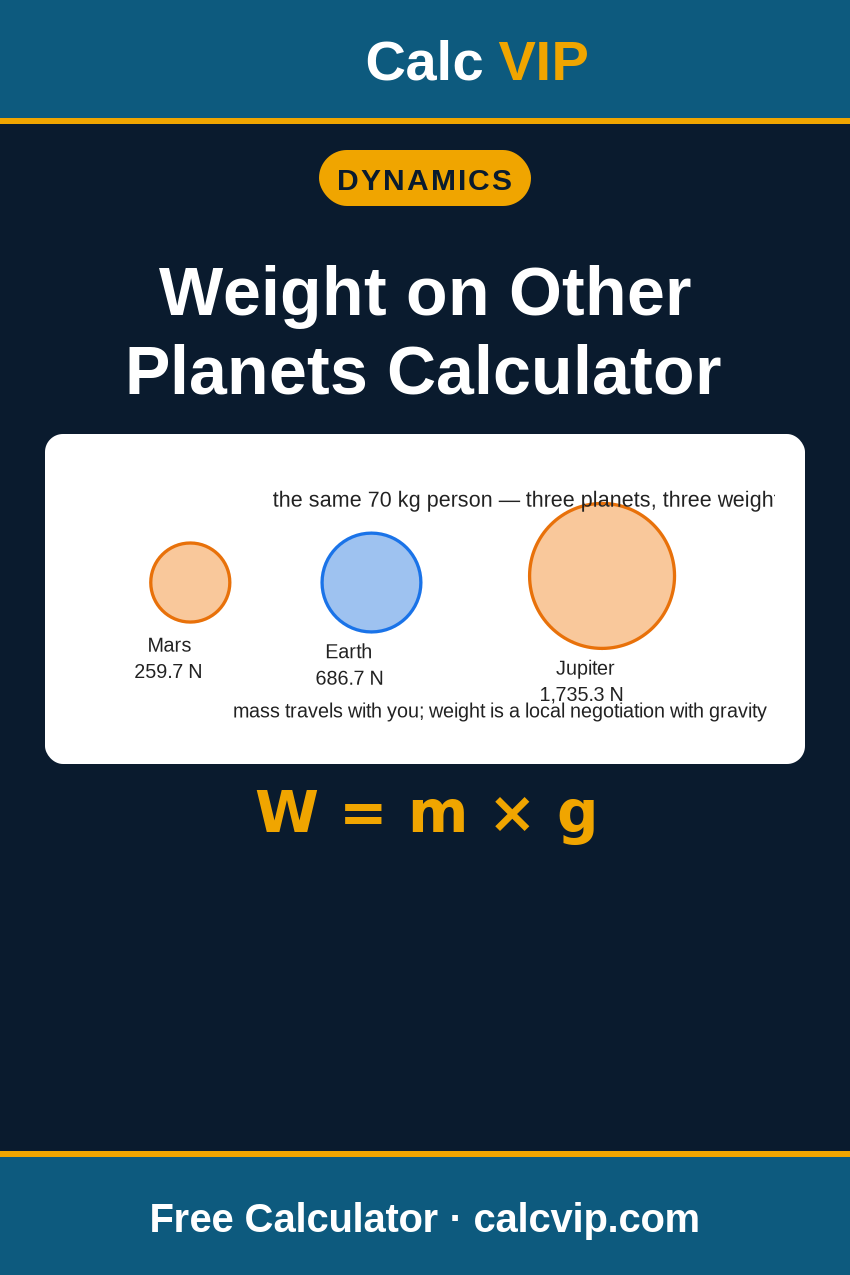
Example 1 — one person, three planets. A 70 kg person: on Earth, W = 70 × 9.81 = 686.7 N. On Mars (g = 3.71): W = 70 × 3.71 = 259.7 N. On Jupiter (g = 24.79): W = 70 × 24.79 = 1,735.3 N. An Earth bathroom scale taken to Mars would measure 259.7 N and, dividing by Earth's 9.81 as it was built to do, display 26.5 "kg" — a polite lie the FAQ revisits. The person, throughout, is 70 kg of person.
Example 2 — the Moon. The same 70 kg on the Moon (g = 1.62): W = 70 × 1.62 = 113.4 N — about the Earth-weight of an 11.6 kg mass. Apollo astronauts in 100 kg of suit and backpack weighed, in total, about what a slim adult weighs on Earth, which is why they could hop: the suit's mass still resisted every turn (inertia does not care about planets), but its weight had gone on holiday.
Example 3 — the near-Earths. Venus (g = 8.87): W = 70 × 8.87 = 620.9 N — barely 10% lighter than Earth, Venus being Earth's near-twin in size and mass. Neptune (g = 11.15): W = 70 × 11.15 = 780.5 N — only 14% heavier than Earth despite 17 Earth masses, the radius tax again: Neptune's cloud tops are just under four Earth radii from its centre, and 17 ÷ 15 ≈ 1.13 of the pull survives at the "surface" a visitor would float at.
Example 4 — a bag of rice, exported. A 5 kg bag: Earth W = 5 × 9.81 = 49.05 N; Mars W = 5 × 3.71 = 18.55 N; Jupiter W = 5 × 24.79 = 123.95 N. Groceries are the honest way to feel these numbers — everyone knows what a 5 kg bag asks of an arm on Earth, and the other figures are that ask, rescaled by each planet's g.
Example 5 — the suited astronaut. An astronaut plus suit totalling 90 kg: on Earth, W = 90 × 9.81 = 882.9 N (which is why suited training in full gravity needs cranes and water tanks). On the Moon: W = 90 × 1.62 = 145.8 N. The training problem inverts on arrival: the suit that was nearly unliftable in Houston becomes a light backpack on the Sea of Tranquillity — though its 90 kg of inertia still makes stopping and turning deliberate work.
Example 6 — a custom world: Titan. Saturn's moon Titan has g = 1.35 m/s². Our 70 kg person: W = 70 × 1.35 = 94.5 N — lighter even than the Moon, on a world with a thick atmosphere. The combination is so forgiving that engineers have noted a human with strap-on wings could fly on Titan: low weight, dense air. The custom-g box exists for exactly these excursions.
Planetary weight in real life
Spacecraft and landers. Every lander is designed against this multiplication: legs, crushable struts and descent engines must handle the craft's weight on the target world — a 900 kg rover weighs 8,829 N on Earth (where it is tested, with offloading rigs) but only 3,339 N on Mars, where it must actually land. Getting the local g wrong by a factor is the most expensive arithmetic error in the space business.
Astronaut health and training. Long missions plan around weight's absence and return: bones and muscles sized by Earth's g decondition in orbit's weightlessness, and Mars crews will re-enter a 0.38 g world after months at zero. Exercise regimes and artificial-gravity studies are attempts to keep the body's oldest assumption — W = mg, daily — from lapsing.
Planetary science. Surface gravity is a world-detective's first clue: measured from an orbiter's tracking, g (with radius) yields density, and density sketches the interior — iron heart or icy mantle — before any lander drills. The calculator's planet table is a compressed geology course.
Sport, reimagined. The high-jump world record would stretch absurdly on the Moon (the jumper's centre of mass could rise roughly six times higher against weight, suit permitting) and collapse on Jupiter, where merely standing is a 2.5× squat held forever. Weight, not mass, is what athletes train against — which is why altitude and gravity gags are physicists' favourite sports hypotheticals.
Scales, trade and calibration. Precision weighing is local: g varies by about 0.5% across Earth's own surface (poles versus equator, altitude, geology), and legal-for-trade scales are calibrated where they will work. The planet calculator is the dramatic version of a calibration certificate's fine print.
Exoplanet headlines. When news reports a "super-Earth" of 5 Earth masses, the interesting question is its surface gravity — which needs the radius too. A 5 M⊕ planet at 1.5 R⊕ has g = 5 ÷ 2.25 ≈ 2.2 × Earth's: heavy, but imaginable. The formula on this page is the one behind every "could we stand there?" paragraph in science journalism.
Earth's own g is not constant either
Before exporting scales to other planets, note that they misbehave at home. Earth's g is about 9.83 m/s² at the poles and 9.78 at the equator — rotation's refund plus the equatorial bulge — a 0.5% spread that moves a 70 kg person's weight between roughly 684.6 N and 688.1 N depending on latitude. Altitude taxes it further (about 0.03% per kilometre up), and dense rock beneath a city can add a measurable whisper. None of this matters to a bathroom, all of it matters to a gravimeter — instruments that map g's tiny variations to find oil, minerals and hidden caverns. The single "9.81" in every textbook is a planetary average wearing a crown; this page's planet list is the same convention, applied honestly, world by world.
Quick reference: weight of a 70 kg mass across the solar system
| World | g (m/s²) | Weight of 70 kg |
|---|---|---|
| Moon | 1.62 | 113.4 N |
| Mercury | 3.70 | 259.0 N |
| Mars | 3.71 | 259.7 N |
| Venus | 8.87 | 620.9 N |
| Uranus | 8.69 | 608.3 N |
| Earth | 9.81 | 686.7 N |
| Saturn | 10.44 | 730.8 N |
| Neptune | 11.15 | 780.5 N |
| Jupiter | 24.79 | 1,735.3 N |
The table's quiet marvel is its narrowness: from the Moon to Jupiter is a factor of fifteen, on worlds whose masses differ by millions. The inverse-square law is the solar system's great compressor of extremes.
Common mistakes
- Reporting weight in kilograms. Kilograms measure mass. Weight is a force and belongs in newtons; the "kg" a scale shows is a conversion performed with Earth's g, valid only on Earth.
- Assuming the biggest planet has crushing gravity. Radius taxes mass quadratically. Saturn outweighs Earth 95-fold and its surface gravity is 1.06 × Earth's; always run W = mg with the actual g rather than ranking by size.
- Thinking astronauts are "beyond gravity". Orbit is gravity at nearly full strength, experienced as free fall. The weight this calculator computes for the ISS's altitude would still be about 89% of the surface figure — apparent weight, not true weight, is what vanishes there.
- Confusing surface gravity with escape velocity or orbital behaviour. g describes standing still on the surface. Leaving a planet is a different (energy) question; a world can have gentle g and still hold its moons tightly, as Neptune does.
- Forgetting gas giants have no surface. Jupiter's, Saturn's, Uranus's and Neptune's g values are quoted at the 1-bar pressure level — the altitude where their atmospheres reach Earth-like pressure — the conventional "surface" for a world made of weather.
FAQ
What is the difference between mass and weight?
Mass (kg) measures how much matter an object contains and never changes. Weight (N) is the force of gravity on that mass, so it changes from planet to planet.
Why is Jupiter's gravity "only" about 2.5× Earth's?
Jupiter is far more massive, but it is also much bigger, so its surface is farther from its centre. Surface gravity depends on both mass and radius: g = GM/R².
Would a scale show my weight in kg on Mars?
A bathroom scale really measures force and converts it assuming Earth's g, so on Mars it would read 259.7 ÷ 9.81 ≈ 26.5 "kg" — your true mass is still 70 kg.
Where in the solar system would I weigh the most?
Of the places with anything like a surface, Jupiter, at 24.79 m/s². The Sun's surface gravity is 274 m/s² — 28 times Earth's — but its "surface" is plasma at 5,500 °C. Neutron stars outdo everything at ~10¹¹ m/s², where a human would be flattened to a film; weight records belong to worlds no one can visit.
Would I weigh the same at the top of Everest?
Slightly less — by about 0.25% versus sea level, counting both the extra distance from Earth's centre and local geology. Your mass, of course, is unmoved; and the climb itself will have changed it far more than the altitude changes your weight.
Why does the Moon's gravity feel even weaker than 1/6?
Partly the missing atmosphere and the springy suit, mostly expectation: your muscles calibrate effort against mass (unchanged) while your balance organs calibrate against weight (one-sixth). The mismatch — heavy inertia, light weight — is what produced the astronauts' loping, kangaroo gait.
Can surface gravity be measured from space?
Yes — an orbiter's radio signal is Doppler-tracked as the planet's gravity tugs it around; variations in g map mass concentrations below the surface. That is how we know about the Moon's mascons and Mars's buried basins without landing.
What is my weight in deep space, far from any planet?
Effectively zero — not because mass vanished, but because the nearest g is negligible. Weight is a relationship between a mass and a world; remove the world and the number dissolves, which is the final proof it was never a property of you.
Do heavier objects fall faster on other planets?
No — the same mass-blindness holds everywhere: in vacuum, all objects accelerate at the local g together. Apollo 15's commander demonstrated it on the Moon with a hammer and a feather, and the footage remains the most charming experimental verification in physics.
How does weight affect a planet's own moons and rings?
Surface gravity is only the ground floor of a world's gravity story; the same GM that sets g also holds moons and shapes rings (Saturn's rings exist where tidal gravity out-pulls the particles' own cohesion). But for anything standing on the surface, W = mg with the tabulated g is the complete and sufficient truth.