 Calc
Electric Potential Calculator – V = kQ/r for One or Two Charges
 Created by Thomas Becker · Physics Writer · Electricity & Magnetism · Last updated: November 2026
Use this free Electric Potential Calculator to find the electric potential (voltage) at a point near a point charge. Potential is a scalar, so for two charges the potentials simply add. Charges are tiny, so you can type them in scientific notation — for example 1e-6 means one microcoulomb (0.000001 C).
Electric potential is the landscape of the electric world. Where the electric field tells you which way a charge would be pushed and how hard, the potential tells you how much energy is at stake in being at a point at all: it is the work, per unit of charge, needed to carry a charge to that point from infinitely far away, moving slowly so nothing is wasted on speed. Its unit is the volt, and one volt is exactly one joule per coulomb. Every battery rating, every mains socket and every lightning bolt is a statement about this quantity — yet near a single point charge it comes from one of the shortest formulas in physics, V = kQ/r.
The simplicity hides two pleasant surprises. The first is the 1/r fall-off: the potential fades with distance far more gently than the field does (the field drops as 1/r²), so the influence of a charge, measured in volts, reaches a long way. A single microcoulomb still produces nearly 9,000 V at a distance of a full metre, and a detectable 899 V at ten metres. The second surprise is that potential is a scalar — a plain number with a sign, no direction. Potentials from many charges simply add, like temperatures blending, while fields must be added as arrows that can fight each other. Much of electrostatics is done in volts precisely because the arithmetic is kind.
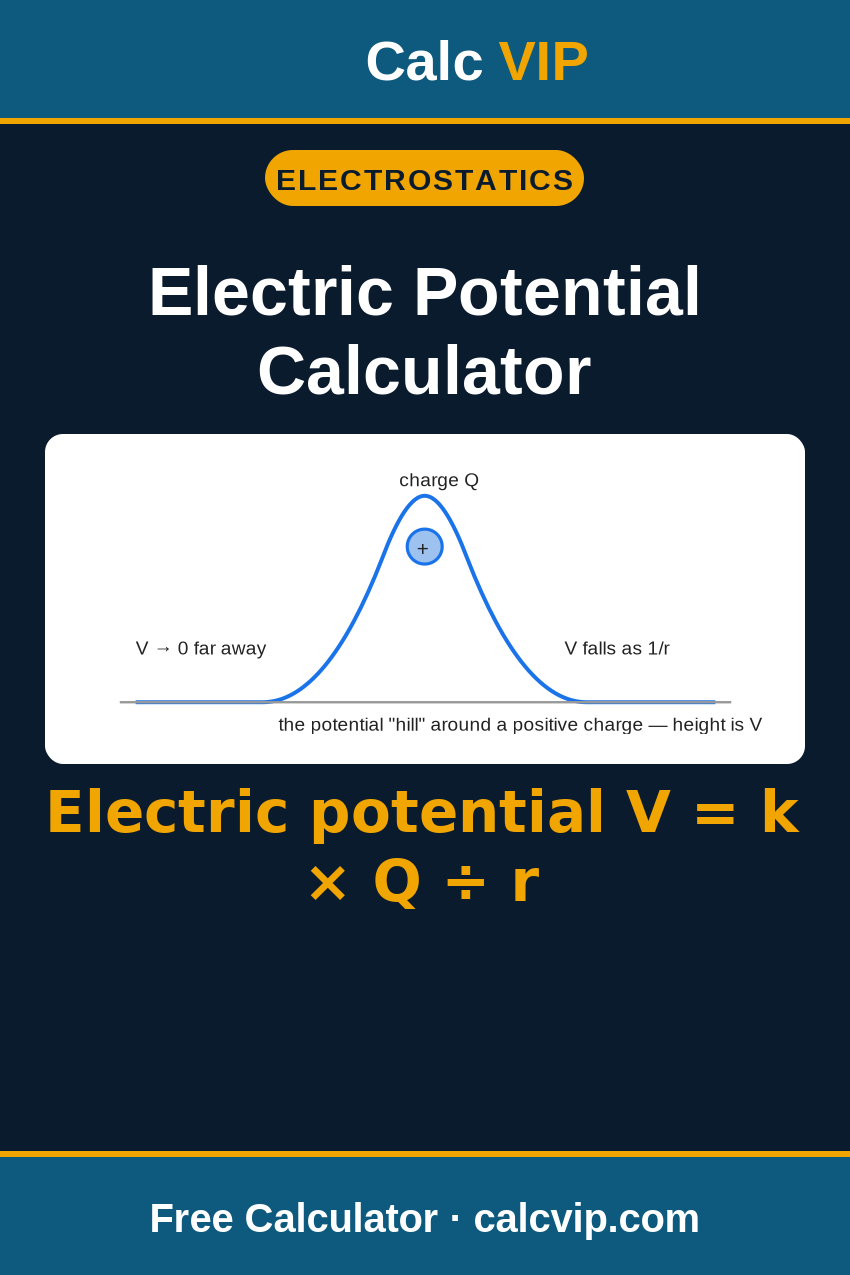
Because the zero of potential is set at infinity, the sign of V is information, not bookkeeping. A positive charge raises a hill of positive potential around itself, down which positive test charges roll away; a negative charge digs a well of negative potential into which they fall. Put both signs nearby and the hills and wells merge into a single landscape that can pass through zero — places where the potential is exactly nothing even though charges are close by and the field is strong. This calculator finds the height of that landscape at any point, for one charge or for two.
Formula
Electric potential V = k × Q ÷ r • V in volts (V), Q in coulombs (C), r in metres (m), k = 8.99 × 10⁹ N·m²/C²
For several charges the potentials add as signed numbers: V = k (q1/r1 + q2/r2 + …). The formula rearranges to Q = V × r ÷ k if you know the potential a charge produces and want the charge, and to r = k × Q ÷ V if you want the distance at which a charge produces a given voltage — for example, the surface of a charged sphere sits everywhere at the potential its centre formula gives. Two linked quantities complete the picture: the potential energy of a charge placed at the point is U = q × V, and the field is the steepness of the potential landscape, E ≈ −(change in V) ÷ (change in position), which is why field units can be written as volts per metre. Note that r is measured from the charge itself, never from a surface or another charge.
| Symbol | Meaning | Units |
|---|---|---|
| V | electric potential — energy per unit charge at the point | volts (V) = J/C |
| Q | the source charge creating the potential | coulombs (C) |
| r | distance from the charge to the point | metres (m) |
| k | Coulomb constant, 8.99 × 10⁹ | N·m²/C² |
| U | potential energy of a charge q placed there, U = qV | joules (J) |
Potential is a landscape, the field is its slope
The most reliable mental picture is height. Potential is the height of the terrain at a point; the electric field is how steeply the ground falls away and in which direction. A positive charge is a hill, a negative charge a pit, and a test charge is a ball that rolls downhill — away from hills, into pits — with a force set by the steepness, not the height. This is why a point can sit at a high potential yet feel no force (a flat plateau on top of a high hill: V large, E zero) and why another point can sit at zero potential on a steep slope and feel a violent push. Voltage alone never tells you the force; only differences in voltage across a distance do.
The landscape picture also explains equipotential surfaces — the contour lines of the terrain. Around a single charge they are spheres, each one a shell of constant V, and moving anywhere on a shell costs no work at all, exactly as walking a contour line on a hillside costs no climbing. Field lines always cross these shells at right angles, pointing straight downhill. Inside a hollow conductor the terrain is perfectly flat — one single potential everywhere — which is why the interior of a metal box is electrically calm even in a thunderstorm, a fact your car exploits every time lightning strikes nearby.
One more feature of the landscape is worth noticing: it is built by addition. Every charge in the neighbourhood contributes its own smooth kq/r hill or well, and the real terrain is the sum of them all, point by point. That is why two-charge mode exists on this calculator, and why the same idea extends to any crowd of charges — three, thirty or the 10²³ of a real charged object, where the sum becomes a smooth surface no single charge dominates. Potential is where electrostatics turns from geometry into arithmetic, and arithmetic is what makes the subject solvable.
How to use
- Choose one-charge mode for V = kQ/r, or two-charge mode when a second charge also contributes to the potential at your point.
- Enter each charge in coulombs — scientific notation like 5e-6 works fine, and a minus sign marks a negative charge.
- Enter the distance from each charge to the point where you want the potential, in metres. In two-charge mode each charge has its own distance.
- Click "Calculate" to get each contribution and the total potential in volts (V).
- Sanity-check the sign: the total must be positive near a dominant positive charge, negative near a dominant negative one, and smaller when you move the point farther away.
Worked examples
Example 1 — one charge. A charge Q = 5 × 10⁻⁶ C — what is the potential at a point 0.3 m away?
V = 8.99 × 10⁹ × 5 × 10⁻⁶ ÷ 0.3 = 44,950 ÷ 0.3 = 149,833 V (about 1.498 × 10⁵ V). Five microcoulombs is a modest static charge, yet a third of a metre away the potential is already that of a respectable power line — volts are cheap when coulombs are scarce, because V is energy per coulomb.
Example 2 — two charges add. In two-charge mode the potentials add: q1 = 4 × 10⁻⁶ C at 0.2 m contributes 8.99 × 10⁹ × 4 × 10⁻⁶ ÷ 0.2 = 179,800 V, and q2 = 1 × 10⁻⁶ C at 0.5 m contributes 17,980 V, giving V = 197,780 V. No angles, no components — the scalar sum is the whole job.
Example 3 — a negative charge digs a well. Q = −3 × 10⁻⁶ C, at r = 0.15 m: V = 8.99 × 10⁹ × (−3 × 10⁻⁶) ÷ 0.15 = −179,800 V. A positive test charge placed there would have negative potential energy — it is bound, and you would have to do work to drag it away to zero.
Example 4 — the atomic scale. Shrink the distance to the world of atoms: a proton (Q = 1.602 × 10⁻¹⁹ C) at a distance of 1 nanometre gives V = 8.99 × 10⁹ × 1.602 × 10⁻¹⁹ ÷ 10⁻⁹ = 1.44 V. At the Bohr radius of hydrogen, 5.29 × 10⁻¹¹ m, it gives 27.2 V — a number atomic physicists meet constantly, because an electron sitting there holds −27.2 eV of potential energy.
Example 5 — potentials that cancel. Put a point 0.4 m from +4 × 10⁻⁶ C (V = +89,900 V) and 0.2 m from −2 × 10⁻⁶ C (V = −89,900 V). The total is 0 V — yet the field at that point is anything but zero, since both charges push a test charge in related directions. Zero potential never means "nothing happening"; it means the hills and wells balance.
Example 6 — static electricity's party trick. A rubbed balloon might carry just 2 × 10⁻⁹ C — two nanocoulombs. One centimetre from its surface: V = 8.99 × 10⁹ × 2 × 10⁻⁹ ÷ 0.01 = 1,798 V. Nearly two thousand volts from a charge too small to measure on a kitchen scale is why static shocks come with kilovolt labels yet cannot hurt you: the voltage is huge, the charge — and so the total energy — is minuscule.
Electric potential in real life
Van de Graaff generators. A school Van de Graaff dome of radius 0.25 m charged to 200,000 V carries Q = Vr/k = 200,000 × 0.25 ÷ 8.99 × 10⁹ ≈ 5.6 × 10⁻⁶ C — a few microcoulombs is all it takes to make hair stand on end, and this calculator run backwards is exactly how the charge is found.
Lightning. Before a strike, the potential between cloud and ground reaches hundreds of millions of volts. Air breaks down near 3 × 10⁶ V/m, so the voltage and the gap together decide when the landscape finally collapses into a spark.
Defibrillators and capacitors. A capacitor's plates sit at a set potential difference, and the stored charge is Q = CV. Knowing the potential at the plates is the first step to knowing the energy ½CV² that a defibrillator delivers.
Electron microscopes and X-ray tubes. Electrons are accelerated through potentials of thousands to hundreds of thousands of volts; the potential they fall through, multiplied by their charge, is precisely their kinetic energy — 1 V of fall means 1 eV of energy.
Power transmission. Engineers quote lines in kilovolts because potential is what insulation must withstand. The 149,833 V of Example 1 is in the range of real transmission voltages — produced there by vastly more charge, spread over kilometres of cable.
The heart's electrical map. An ECG measures millivolt potential differences on the skin created by the heart's moving charges. The signals are tiny — a thousandth of a volt — yet this same V = kQ/r physics, summed over millions of cells, writes the trace.
Why potential is measured from infinity
Every height needs a sea level, and for electric potential the sea level is infinity — a point so far from every charge that V has faded to zero. This is a convention, but a natural one: kQ/r slides smoothly to zero as r grows, so no arbitrary reference sphere is needed. What it means practically is that only differences of potential do physical work. Carry a charge from point A to point B and the work is q × (VB − VA), whatever zero you chose. Circuit engineers make a different choice — they call the earth, or a chassis, "zero volts" — and every voltage in electronics is secretly a difference against that local sea level. The physics is identical; only the bookkeeping origin moves.
High voltage is not high energy
The most common misunderstanding this calculator can cure is the fear of big volt numbers. Potential is energy per coulomb; multiply by the actual charge involved to get energy. Example 6's balloon sits at 1,798 V but its whole charge could deliver only about ½ × 2 × 10⁻⁹ × 1,798 ≈ 1.8 × 10⁻⁶ J — a microjoule spark. A car battery, at a humble 12 V, can push hundreds of coulombs and deliver hundreds of thousands of joules. Voltage tells you the height of the hill; energy depends on how much charge rolls down it. That is why this page's formula deserves its place next to U = qV: together they separate the landscape from the traffic on it.
Quick reference: potential of a 1 µC charge
| Distance r | Potential V = kQ/r |
|---|---|
| 0.1 m | 89,900 V |
| 0.25 m | 35,960 V |
| 0.5 m | 17,980 V |
| 1 m | 8,990 V |
| 2 m | 4,495 V |
| 10 m | 899 V |
Scale by charge: double Q and every entry doubles; use a negative charge and every entry flips sign. The table is also a measuring tool — a voltmeter reading near a small charged object, plus this 1/r pattern, lets you work backwards to the charge itself.
Common mistakes
- Adding potentials as vectors. Potential is a scalar. Two charges contribute kq1/r1 and kq2/r2, added as signed numbers — never with components, angles or Pythagoras.
- Using 1/r². That is the field's fall-off. Potential falls as 1/r: at double the distance you get half the volts, not a quarter.
- Dropping the sign of the charge. A negative charge makes negative potential everywhere around it. Entering 3e-6 instead of −3e-6 turns a well into a hill and reverses every conclusion.
- Confusing V with U. V (volts) belongs to the point; U = qV (joules) belongs to a charge placed at the point. Comparing a voltage in one problem with an energy in another mixes the two.
- Reading r from the wrong place. r is the distance from the point charge to your point. For a charged sphere, outside it, r is measured from the centre — the sphere behaves exactly like a point charge at its centre.
FAQ
FAQ
What is electric potential, in simple words?
It is the energy needed to bring one coulomb of charge to that point from far away. Its unit is the volt, and 1 V = 1 joule per coulomb.
Can electric potential be negative?
Yes. A negative charge makes a negative potential around it. When charges of both signs are present, their potentials add with their signs — they can partly or fully cancel.
How is potential different from potential energy?
Potential (V) is per unit charge — it belongs to the point in space. Potential energy (U = qV) also depends on the charge you place there.
Is electric potential the same as voltage?
Yes, in this context: "voltage" is the everyday name for electric potential (or, in circuits, for a potential difference). A point's potential in volts is what this calculator returns.
Why does potential use 1/r when the field uses 1/r²?
Because potential is accumulated work. Moving away from a charge, the field weakens as 1/r², but adding up its effect over the whole journey from infinity leaves a 1/r total — the same reason a 1/r² force (gravity) gives a 1/r potential energy.
What is the potential inside a charged hollow sphere?
Constant, and equal to the value on its surface, kQ/R. No work is needed to move around inside, so the field there is zero even though V is large — a plateau on the hill.
Can two charges produce zero potential at a point where the field is not zero?
Yes — Example 5 is exactly that case. Potentials cancel because they are signed numbers; fields cancel only when equal arrows point in opposite directions, a stricter condition.
How much charge sits on a sphere at a known voltage?
Rearrange the formula: Q = V × R ÷ k. A 0.5 m sphere at 179,800 V holds Q = 179,800 × 0.5 ÷ 8.99 × 10⁹ = 1 × 10⁻⁵ C.
Does the potential depend on the path taken to the point?
No. Electrostatic potential is path-independent: spiral in or walk straight, the work per unit charge is the same. That is what makes V a property of the point rather than of the journey.
Why are the voltages near tiny charges so enormous?
Because k is huge (8.99 × 10⁹) and V is per-coulomb. Microcoulombs at centimetre distances routinely give kilovolts — but the total energy stays small because the charge itself is small.