 Calc
Electron-Volt Calculator – Energy of a Charge Through a Voltage
 Created by Thomas Becker · Physics Writer · Electricity & Magnetism · Last updated: November 2026
Use this free Electron-Volt Calculator to find the energy a charge gains when it moves through a voltage. The energy is shown in joules and in electron-volts (eV) — the unit physicists use for atoms and particles. Pick the electron in the list and you also get the speed it reaches. Charges are tiny, so you can type them in scientific notation — for example 1.602e-19 for one electron's charge.
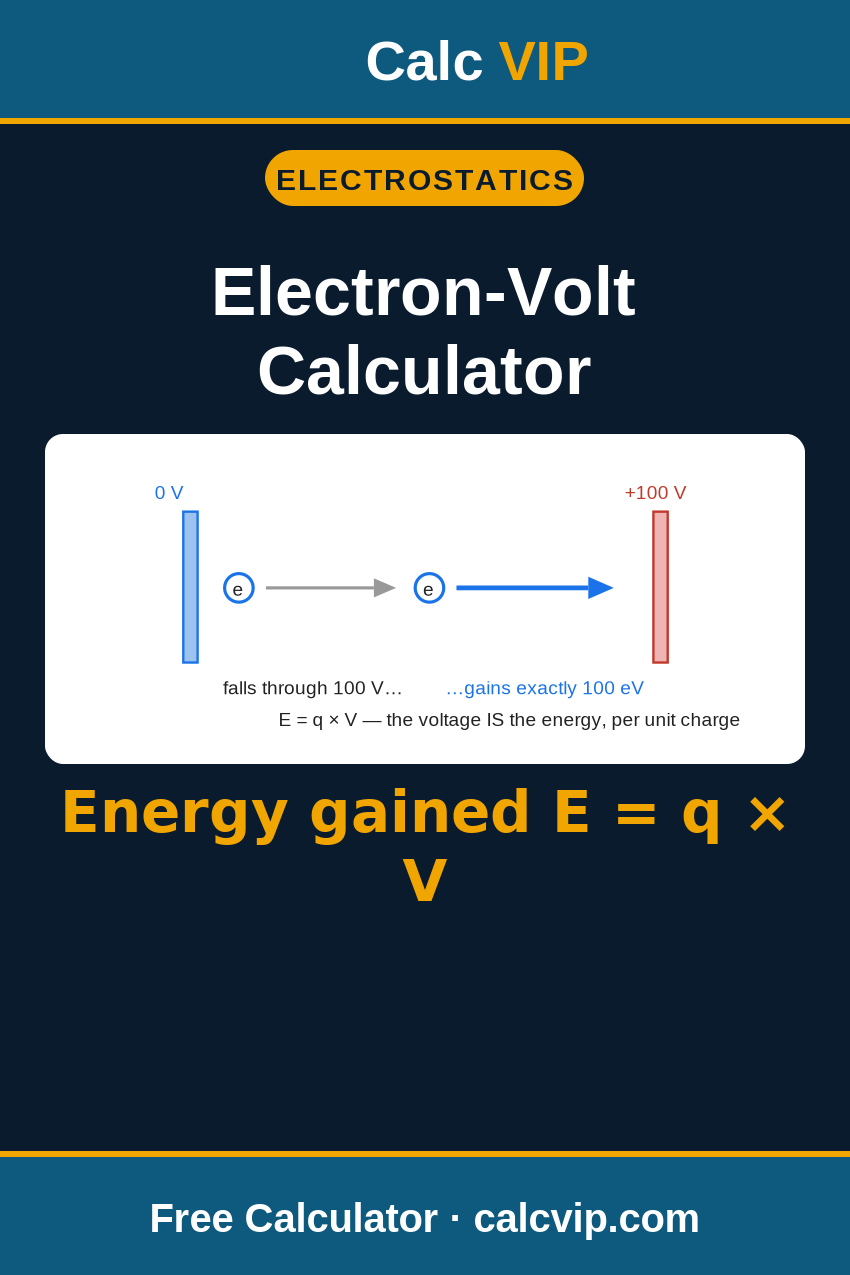
The electron-volt is the natural currency of the small. A joule is a human-scale unit — the energy of an apple falling a metre — but an electron crossing a battery's terminals deals in amounts a quintillion times smaller, and writing 0.0000000000000000016 J for the thousandth time helps no one. So physicists defined a unit tailored to the transaction itself: one electron-volt is the kinetic energy a single electron (or proton, or any particle carrying one elementary charge) gains by falling through a potential difference of exactly one volt. Energy becomes charge × voltage, E = qV, and for the particles of atomic physics the numbers land in the friendly range of ones, tens and thousands.
The definition hides a lovely shortcut. Because the eV is built from the electron's own charge, the conversion is automatic: a particle with charge e falling through V volts gains exactly V electron-volts. Through 100 V, 100 eV; through the 25,000 V of an old television tube, 25 keV; through a hospital linac's millions of volts, MeV. Double the charge — an alpha particle carries 2e — and the same voltage pays double: 2V electron-volts. The unit also smuggles in the speed question this calculator answers: energy alone does not fix speed, because ½mv² = qV means the same energy moves a light electron fast and a heavy proton slowly.
Electron-volts reach far beyond accelerator halls. Chemical bonds hold a few eV per atom; visible-light photons carry 1.6–3.3 eV; ionising an atom costs roughly 10 eV; X-rays run to tens of keV; nuclear reactions deal in MeV. One unit strides from chemistry to nuclear physics because all of those processes are, underneath, charges moving through voltages. This calculator converts any charge-through-voltage trip into joules and electron-volts, and for electrons and protons reports the speed the energy buys.
Formula
Energy gained E = q × V • E in joules (J), q in coulombs (C), V in volts (V). One electron-volt: 1 eV = 1.602 × 10⁻¹⁹ J
The formula rearranges to V = E ÷ q (the voltage needed to hand a charge a chosen energy) and q = E ÷ V. If the particle starts from rest and all the energy becomes motion, ½mv² = qV gives the speed v = √(2qV ÷ m) — the calculator's third answer for electrons and protons. The multiples do the heavy lifting in practice: 1 keV = 10³ eV, 1 MeV = 10⁶ eV, 1 GeV = 10⁹ eV, 1 TeV = 10¹² eV, each step a thousandfold. A useful companion conversion: dividing an energy in eV by Boltzmann's constant expresses it as a temperature, 1 eV ≈ 11,600 K — which is why plasma physicists quote temperatures in electron-volts and mean it literally.
| Symbol | Meaning | Units |
|---|---|---|
| E | energy gained by the charge | joules (J) or electron-volts (eV) |
| q | charge moved (electron/proton: 1.602 × 10⁻¹⁹ C) | coulombs (C) |
| V | potential difference moved through | volts (V) |
| m | particle mass (needed only for the speed) | kilograms (kg) |
| v | final speed from rest, v = √(2qV/m) | m/s |
Energy is shared equally; speed is not
Run an electron and a proton through the same 100 V and both bank exactly 100 eV — the energy depends on charge and voltage alone. But the electron, 1,836 times lighter, converts that energy into a speed about √1836 ≈ 43 times greater: 5.93 × 10⁶ m/s against the proton's 1.38 × 10⁵ m/s. This asymmetry shapes technology. Electron devices (TV tubes, electron microscopes, X-ray tubes) reach useful speeds with modest voltages because electrons are light; proton machines need either patience or enormous voltages, and ion thrusters on spacecraft exploit exactly this trade — heavy ions, expelled slowly per volt, deliver more thrust per particle.
The speed formula also carries its own expiry date. v = √(2qV/m) is Newtonian, and as the computed speed approaches the speed of light it begins to lie, always overestimating. An electron through 20,000 V: the classical formula says 8.39 × 10⁷ m/s (0.280c), while relativity's corrected answer is 0.272c — close, but measurably different, and the gap widens brutally at higher voltages. The energy bookkeeping E = qV never fails — energy is energy — but above roughly 50 kV for electrons, the speed must be computed from the relativistic kinetic energy, (γ − 1)mc² = qV. The calculator's speeds are the classical ones; treat them as exact below a few kilovolts and as good estimates up to tens of kilovolts.
It is worth pausing on why the energy side never fails. E = qV is not an approximation or a model; it is the definition of potential difference applied to one particle. Voltage was invented to measure exactly this — the work the field does per unit charge — so multiplying back by the charge returns the work with no assumptions about paths, fields or speeds. The shape of the accelerator, the strength of its fields, the time the journey takes: none of it enters. A particle that falls through 100 V in a nanometre-scale gap inside a chip and one that drifts through 100 V across a metre of vacuum tubing bank identical energy. Only the speed step, where Newton is swapped for Einstein at high energy, ever needs care.
How to use
- Pick the electron or proton from the list — the calculator fills in its charge (and mass) for you — or choose "Custom charge" and type any charge in coulombs (scientific notation like 3.204e-19 works fine).
- Enter the voltage the charge moves through, in volts. For a particle falling from a negative plate to a positive one, this is the full potential difference between them.
- Click "Calculate" to get the energy in joules and electron-volts — plus the final speed for the electron and proton choices.
- Read the eV answer with the shortcut in mind: a singly-charged particle through V volts gains V electron-volts, so the eV figure should echo your voltage; a doubly-charged one doubles it.
- For speeds at high voltage (electrons above ~50,000 V), remember the classical formula overestimates — the true speed is a little lower, capped always below light speed.
Worked examples
Example 1 — the defining trip. An electron (q = 1.602 × 10⁻¹⁹ C) is accelerated through 100 V.
E = qV = 1.602 × 10⁻¹⁹ × 100 = 1.602 × 10⁻¹⁷ J — which is exactly 100 eV, by the definition of the electron-volt.
Starting from rest, its speed is v = √(2E/m) = √(2 × 1.602 × 10⁻¹⁷ ÷ 9.109 × 10⁻³¹) = 5.93 × 10⁶ m/s — about 2% of the speed of light.
Example 2 — the same trip for a proton. A proton through 100 V also gains 100 eV = 1.602 × 10⁻¹⁷ J, but its speed is only v = √(2 × 1.602 × 10⁻¹⁷ ÷ 1.673 × 10⁻²⁷) = 1.38 × 10⁵ m/s. Identical energy, 43 times less speed — the mass ratio √1836 made visible.
Example 3 — a doubly-charged particle. Choose "Custom charge" with q = 3.204 × 10⁻¹⁹ C (an alpha particle's charge, 2e) through 100 V: E = 3.204 × 10⁻¹⁹ × 100 = 3.204 × 10⁻¹⁷ J = 200 eV. Charge is the multiplier: two elementary charges collect two electron-volts per volt.
Example 4 — the television tube. Old CRT televisions accelerated electrons through about 20,000 V. Each electron arrives at the screen with 20 keV = 3.204 × 10⁻¹⁵ J, at a classical speed of 8.39 × 10⁷ m/s — relativity trims the true figure to 0.272c, about 8.15 × 10⁷ m/s. That arrival energy, dumped into phosphor, is the picture's brightness; dumped into shielding when it stops suddenly, a whisper of it becomes X-rays, which is why old TV glass contained lead.
Example 5 — one volt, one electron-volt. An electron through a single volt gains exactly 1 eV = 1.602 × 10⁻¹⁹ J and reaches v = √(2 × 1.602 × 10⁻¹⁹ ÷ 9.109 × 10⁻³¹) = 5.93 × 10⁵ m/s. Even the humblest battery terminal moves electrons at hundreds of kilometres per second — thermal motion at room temperature is far slower, which is why a mere volt or two runs all of electronics.
Example 6 — the X-ray tube. A dental X-ray set runs near 50,000 V. Each electron strikes the target with 50 keV = 50,000 × 1.602 × 10⁻¹⁹ = 8.01 × 10⁻¹⁵ J, and the X-ray photons it produces can carry at most that same 50 keV — the voltage dial on the machine is, quite literally, an energy dial in electron-volts.
Electron-volts in real life
Chemistry's energy scale. Breaking a chemical bond costs a few eV per molecule; the 13.6 eV needed to ionise hydrogen and the ~4 eV of a strong covalent bond are quoted in eV because joules would need eighteen zeros of small talk before the digits start.
Light itself. A photon's energy is quoted in eV: red light ≈ 1.8 eV, blue ≈ 2.8 eV, ultraviolet beyond 3.3 eV — which is why UV, starting around the energies that break bonds, is the part of sunlight that burns skin and fades paint.
Semiconductors. Silicon's band gap is 1.1 eV: an electron needs that much energy to become a conductor. Solar cells, LEDs and every chip are designed around eV-scale gaps, and an LED's colour is its band gap read out in photons.
Medical accelerators. Radiotherapy linacs accelerate electrons through millions of volts to 4–25 MeV. The treatment plan's "6 MV beam" and the physicist's "6 MeV electrons" are the same sentence in two dialects — this page's formula is the translation.
Nuclear and particle physics. Fusion reactions release MeV per event (the proton–proton chain pays out about 26.7 MeV per helium nucleus), and colliders quote TeV. The eV ladder — eV, keV, MeV, GeV, TeV — is the single staircase from chemistry to the LHC.
Plasma temperatures. A plasma at "10 keV" has particles whose typical kinetic energy is 10,000 eV — a temperature of about 1.16 × 10⁸ K. Fusion scientists live in eV because the conversion is one multiplication by 11,600.
The electron-volt's second life: weighing particles
Einstein's E = mc² lets any energy be expressed as a mass, and particle physicists took the hint: masses are quoted in eV/c². The electron weighs 511 keV/c², the proton 938 MeV/c² — numbers computed from exactly the constants on this page (mc² ÷ e). The habit is more than shorthand. When a collider announces a new particle "at 125 GeV", it means the collision energy, counted in electron-volts gained through imaginary voltages, was converted into the mass of something new. The humble unit defined by one electron crossing one volt scales, unbroken, to the heaviest objects humans have ever made.
The same trick runs in reverse in the laboratory: measure a particle's energy in eV and you have weighed it. Mass spectrometers, time-of-flight detectors and calorimeters all ultimately report energies, and the conversion to mass is this page's arithmetic wearing a c². Even the lightest known massive particles join in — neutrino masses are bounded in fractions of an eV, weighed not on any balance but by the tiny energy deficits they leave in nuclear decays.
Quick reference: electron speeds from rest
| Voltage | Energy | Electron speed |
|---|---|---|
| 1 V | 1 eV | 5.93 × 10⁵ m/s |
| 10 V | 10 eV | 1.88 × 10⁶ m/s |
| 100 V | 100 eV | 5.93 × 10⁶ m/s |
| 1,000 V | 1 keV | 1.88 × 10⁷ m/s |
| 10,000 V | 10 keV | 5.93 × 10⁷ m/s |
The pattern is √V: each hundredfold increase in voltage buys a tenfold increase in speed. Protons at the same voltages move 43 times slower — at 1,000 V a proton manages 4.38 × 10⁵ m/s — which the companion Charged Particle Acceleration calculator explores for several particle types. Keep the table's boundary in mind, though: the last row is already at a fifth of light speed, and from there upwards Einstein's correction, not Newton's formula, owns the answer.
Common mistakes
- Treating eV as a unit of voltage or charge. The electron-volt is energy. It is built from a charge times a voltage, but once built it measures joules' worth of energy, nothing else.
- Converting with the wrong power of ten. 1 eV = 1.602 × 10⁻¹⁹ J — the exponent is −19, matching the elementary charge. Slipping to 10⁻¹⁶ inflates every energy a thousandfold.
- Assuming equal voltage means equal speed. Equal voltage gives equal energy per charge; speed depends on mass through v = √(2qV/m). The proton in Example 2 is the standing warning.
- Forgetting double charges. An alpha particle or a doubly-ionised atom gains 2 eV per volt. The "volts = electron-volts" shortcut holds only for singly-charged particles.
- Trusting classical speeds at high voltage. Beyond ~50 kV for electrons, √(2qV/m) overstates the speed; the energy E = qV stays exact, but the speed needs relativity's correction.
FAQ
FAQ
What exactly is an electron-volt?
It is a small unit of energy: the kinetic energy one electron (or proton) gains by moving through a potential difference of 1 volt. 1 eV = 1.602 × 10⁻¹⁹ joules.
Why do physicists use eV instead of joules?
Atomic energies are absurdly small in joules — an electron in a TV tube has about 20,000 eV, which is only 3.2 × 10⁻¹⁵ J. Electron-volts keep the numbers friendly.
Does a heavier particle gain more energy through the same voltage?
No — the energy qV depends only on charge and voltage, not mass. A proton through 100 V also gains 100 eV; it just ends up moving more slowly than an electron with the same energy.
How many joules is 1 keV, 1 MeV, 1 GeV?
Multiply the eV value by 1.602 × 10⁻¹⁹: 1 keV = 1.602 × 10⁻¹⁶ J, 1 MeV = 1.602 × 10⁻¹³ J, 1 GeV = 1.602 × 10⁻¹⁰ J. Even a GeV is a ten-billionth of a joule — these units serve single particles, not power stations.
Why does the calculator ask for the particle at all, if E = qV needs only charge?
For the speed. Energy needs charge and voltage; speed additionally needs mass, which is why the electron and proton presets carry their masses and the custom mode reports energy only.
Can a particle gain eV without a literal battery?
Yes — any potential difference counts: the field of a nucleus, a plasma wave, a laser's oscillating field. "Falling through V volts" is shorthand for losing qV of potential energy, however the landscape is made.
What does it mean when a photon is said to have 2 eV?
Photons are not accelerated through voltages, but their energy can be measured on the same scale: a 2 eV photon carries 3.204 × 10⁻¹⁹ J — greenish light. The eV is a universal small-energy ruler, whatever carries the energy.
Is the electron-volt an SI unit?
Not officially — the joule is the SI unit — but the eV is accepted for use alongside SI and is defined exactly through the elementary charge. In atomic and particle physics it is effectively the native unit.
How fast is an electron at 1 MeV?
Classical physics would say 5.93 × 10⁸ m/s — faster than light, which is the formula announcing its own failure. Relativity gives 0.941c. At MeV energies the classical speed from this calculator must not be used; the energy, 1 MeV = 1.602 × 10⁻¹³ J, remains exact.
Why 1.602 × 10⁻¹⁹ keeps appearing?
It is the elementary charge e in coulombs — the charge of one proton, and the magnitude of one electron's. The eV is defined from it, so it threads through every conversion on this page. Since 2019 it has been an exactly defined constant of the SI system itself.