 Calc
Electric Field Energy Density Calculator – u = ½ε0E² and Total Stored Energy
 Created by Thomas Becker · Physics Writer · Electricity & Magnetism · Last updated: November 2026
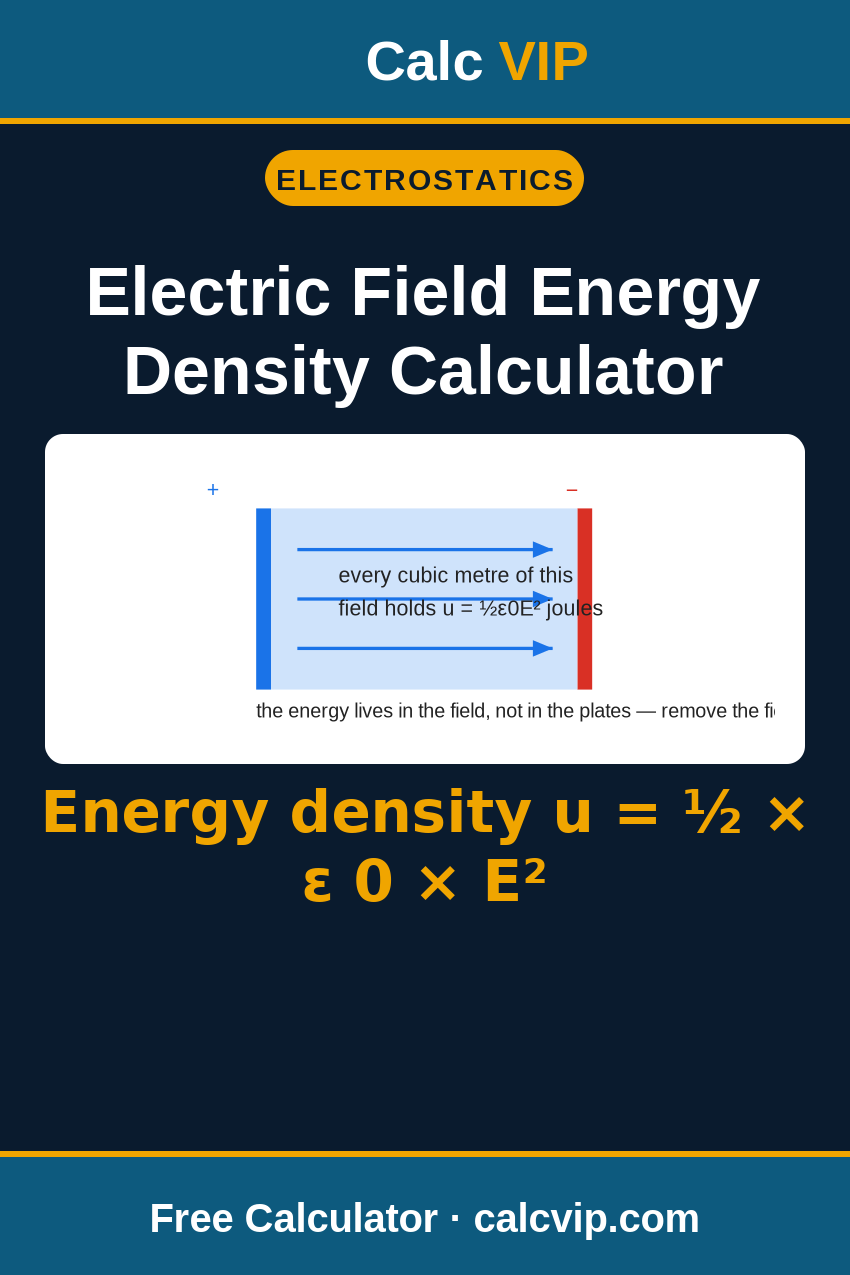
Use this free Electric Field Energy Density Calculator to find how much energy is stored in each cubic metre of an electric field, u = ½ε0E². An electric field is not just a pattern of forces — it holds real energy. Add a volume and the calculator also gives the total stored energy in that region. This is the energy density inside a capacitor, spread through the space between its plates.
An electric field is not merely a pattern of arrows — it is a reservoir. Charge a capacitor and the energy you spend does not sit in the metal plates; it lives in the field between them, at a density of u = ½ε0E² joules in every cubic metre the field occupies. This calculator evaluates that density for any field strength, and, if you give it a volume, multiplies up to the total stored energy. It is the formula that explains sparks, sizes pulsed-power machines, and quietly underlies every radio wave ever sent, since a travelling wave is field energy on the move.
The square law is the personality to absorb. Double the field and the energy density quadruples, because doubling E means the plates hold twice the charge and twice the voltage — energy, being roughly charge × voltage, picks up both factors. The practical consequences run both ways: fields near breakdown are surprisingly energy-rich for their volume (air at its 3 × 10⁶ N/C limit stores about 39.8 J/m³), while the huge, weak fields of thunderstorms are energy-poor per cubic metre (at 1 × 10⁵ N/C, a mere 0.044 J/m³) and owe their drama to the cubic kilometres they fill.
The formula as given is for vacuum, and air is close enough that the numbers hold. Inside a dielectric, ε0 is replaced by ε = ε0εr, multiplying the density by εr at the same field — one of the two reasons dielectrics make capacitors store more (the other being that they let the plates sit closer). The depth section shows the formula earning its keep: apply it to the volume between a capacitor's plates and out pops ½CV², exactly. When two independent routes agree to the last digit, you are looking at one fact of nature, not two.
Formula
Energy density u = ½ × ε0 × E² • Total energy U = u × Volume • Field from density E = √(2u ÷ ε0) • u in J/m³, E in N/C, ε0 = 8.854 × 10⁻¹²
The rearrangement E = √(2u/ε0) sets a memorable benchmark: storing 1 J/m³ in vacuum needs E = √(2 ÷ 8.854 × 10⁻¹²) = 475,275 N/C — nearly half a million newtons per coulomb for one joule per cubic metre. Electric fields are, by volume, feeble energy stores compared with fuels or even springs; their virtue is speed, releasing everything in nanoseconds when asked. In a dielectric, replace ε0 by ε0εr throughout: the same field stores εr times the energy, which is the deep reason high-εr materials are hunted for pulsed-power capacitors.
| Symbol | Meaning | Units |
|---|---|---|
| u | energy stored per cubic metre of field | J/m³ |
| E | field strength | N/C (= V/m) |
| ε0 | permittivity of free space | 8.854 × 10⁻¹² |
| U | total energy in the given volume | joules (J) |
The capacitor proof: two routes, one answer
Scepticism about "energy in empty space" is healthy, so here is the formula audited against a capacitor you can also compute directly. Take plates of area A = 0.01 m² separated by d = 1 mm of air. The capacitance is C = ε0A/d = 8.854 × 10⁻¹² × 0.01 ÷ 0.001 = 8.854 × 10⁻¹¹ F (88.5 pF). Charge it to 1,000 V and the circuit formula gives U = ½CV² = ½ × 8.854 × 10⁻¹¹ × 10⁶ = 4.427 × 10⁻⁵ J. Now the field route: E = ΔV/d = 1,000 ÷ 0.001 = 1 × 10⁶ N/C, so u = ½ε0E² = 4.427 J/m³, and the volume between the plates is A × d = 1 × 10⁻⁵ m³, giving U = 4.427 × 10⁻⁵ J. Identical — because the field formula is not an analogy for the capacitor's energy; it is where the energy demonstrably is.
The square law also explains a design tension. Raising a capacitor's voltage raises u with E², so energy density begs for high fields; but the field is capped by dielectric breakdown, and the cap is a material property. The entire technology of energy-storage capacitors is a search for materials that push the E ceiling — high breakdown strength and high εr — because u = ½εE² rewards both, multiplicatively.
How to use
- Enter the field strength E in N/C — from a measurement, or from one of the field calculators (point charge, plates, conductor surface).
- Optionally enter a volume in cubic metres if you want the total energy in that region, not just the density. Leave it blank for density alone.
- Click "Calculate" and read u (and U, if a volume was given).
- Sanity-check with the square law: doubling E must quadruple u. If it doesn't, an exponent slipped.
- For fields inside a dielectric, multiply the vacuum answer by the material's εr — the calculator's formula is the vacuum/air case.
Worked examples
Example 1 — the reference field. E = 1 × 10⁶ N/C.
u = ½ × 8.854 × 10⁻¹² × (10⁶)² = 4.43 J/m³. In a volume of 0.01 m³ the total is U = 4.427 × 0.01 = 0.0443 J — a fortieth of a joule in ten litres of million-volt-per-metre field. Respectable fields, modest joules: that ratio is the subject of this page.
Example 2 — a thunderstorm's field. Near the ground under a storm, E ≈ 1 × 10⁵ N/C.
u = ½ × 8.854 × 10⁻¹² × 10¹⁰ = 0.0443 J/m³. One hundredth of Example 1's density — the square law's toll for a tenfold weaker field. A lightning bolt's energy comes from the sheer volume of cloud field collapsing, not from any richness per cubic metre.
Example 3 — air at its limit. E = 3 × 10⁶ N/C, the breakdown ceiling.
u = ½ × 8.854 × 10⁻¹² × 9 × 10¹² = 39.8 J/m³ — the most energy a cubic metre of air-filled field can hold before it sparks itself empty. Every air-insulated energy store lives under this ceiling.
Example 4 — the capacitor audit. The plates of the concept section: A = 0.01 m², d = 1 mm, V = 1,000 V, so E = 1 × 10⁶ N/C and u = 4.427 J/m³ in a volume of 1 × 10⁻⁵ m³.
U = 4.43 × 10⁻⁵ J, matching ½CV² for C = 88.5 pF exactly. Run both routes for any capacitor you meet; agreement is guaranteed, and it converts "energy in the field" from slogan to bookkeeping.
Example 5 — a strong radio field. Near a transmitter, E = 1 × 10³ N/C.
u = ½ × 8.854 × 10⁻¹² × 10⁶ = 4.43 × 10⁻⁶ J/m³. Radio waves carry this density (electric and magnetic halves together) at light speed — the flux is respectable even though the density is a whisper, because the volume delivered per second is enormous.
Example 6 — a pulsed-power volume. A discharge chamber sustains E = 2 × 10⁶ N/C through 0.5 m³.
u = ½ × 8.854 × 10⁻¹² × 4 × 10¹² = 17.7 J/m³, so U = 17.7 × 0.5 = 8.85 J. Released in a microsecond, that is nearly 9 MW of pulse power — the whole point of storing energy in fields: nothing else lets go so fast.
Field energy in real life
Pulsed power. Defibrillators, radar modulators, laser drivers and railgun supplies all bank energy in capacitor fields and dump it in microseconds. The energy-density formula sizes the bank: needed joules divided by u at the working field gives the field volume, hence the capacitor's physical bulk.
Lightning's budget. A storm's field stores only ~0.04 J/m³, but over a cloud volume of cubic kilometres that is 10⁸–10⁹ J — a lightning flash's energy is the integral of this page's u over a sky-sized volume.
Radio and light. An electromagnetic wave carries energy density u (electric) plus an equal magnetic share, streaming at c. Sunlight arrives with a total density of about 10⁻⁵ J/m³ in flight — small, but delivered over every sunlit square metre, every second, for free.
Why charged equipment stays dangerous. Switch off a high-voltage capacitor bank and the field — the energy — remains until bled away. The stored joules computed here are what discharge resistors exist to remove, and what safety procedures wait for.
Electrostatic generators. A Van de Graaff's terminal stores energy in the field around its dome; u integrated over the surrounding air gives the spark's budget when it discharges — the longer and louder the spark, the more field volume collapsed.
Energy harvesting limits. Schemes to harvest ambient fields meet this formula's cold arithmetic: at everyday field strengths u is microjoules per cubic metre, so useful energy needs either breakdown-level fields or building-sized volumes. The formula is the feasibility test such proposals must pass.
Inside a real dielectric: the εr multiplier at work
The vacuum formula is the floor, not the ceiling, because a dielectric's polarisation adds its own contribution to the stored energy. Swap ε0 for ε0εr and the same field stores εr times as much: a material of εr = 4 at E = 1 × 10⁶ N/C holds u = 4 × 4.427 = 17.7 J/m³ — matching, without any extra field, what vacuum needs 2 × 10⁶ N/C to achieve. Ceramic dielectrics push εr into the hundreds and thousands, which is how a capacitor the size of a thumbnail stores joules that would need litres of air-spaced field. The trade is that high-εr materials usually break down at lower fields, and u depends on both factors at once — ½ε0εrE² with E capped by the material's own strength. The search for the perfect energy-storage dielectric is a search for a material that refuses to compromise on either factor, and the formula tells you exactly how much any candidate is worth the moment its two numbers are measured.
The magnetic twin, and waves that carry both
Electric fields do not hold the energy monopoly. A magnetic field stores uB = B² ÷ (2μ0) — the same architecture, with μ0 in the denominator where ε0 sits in the numerator's place. An inductor's energy, ½LI², is that density integrated over the field's volume, just as a capacitor's is here. In an electromagnetic wave the two densities are exactly equal at every point, the energy sloshing in step as the wave travels — which is why sunlight, radio and X-rays can be discussed purely as energy transport. Compare the ceilings: a 1 tesla magnetic field stores about 4 × 10⁵ J/m³, ten thousand times the best an air-spaced electric field can do, which is why compact energy storage dreams magnetic — and why superconducting magnets, not capacitors, hold the records for field energy banked in a device. At 10 tesla, the working field of a serious superconducting magnet, the density rises with B² to about 4 × 10⁷ J/m³ — fuel-like numbers, held in nothing but shaped emptiness and current.
Quick reference: energy density by field strength
| Field E | Energy density u | Context |
|---|---|---|
| 100 N/C | 4.43 × 10⁻⁸ J/m³ | fair-weather atmosphere |
| 10,000 N/C | 4.43 × 10⁻⁴ J/m³ | near charged machinery |
| 100,000 N/C | 0.0443 J/m³ | thunderstorm ground field |
| 1,000,000 N/C | 4.43 J/m³ | strong capacitor fields |
| 3,000,000 N/C | 39.8 J/m³ | air breakdown — the ceiling |
Each tenfold rise in E multiplies u a hundredfold. There is no cheaper way to see the square law than to read down this table — or to run a single doubling through the calculator and watch the density quadruple.
Common mistakes
- Forgetting the square. u = ½ε0E², not ½ε0E. A linear estimate at 10⁶ N/C undershoots by a factor of a million — the square is not a detail.
- Confusing density with total. u is per cubic metre. A vast weak field and a tiny strong one can hold the same total energy; multiply by the actual volume before comparing with joules from other sources.
- Using ε0 inside a dielectric. In a material, u = ½ε0εrE². Omitting εr understates the stored energy of real capacitors by factors of 2–10 (and far more for high-εr ceramics).
- Feeding in MV/m as N/C. A field quoted as 2 MV/m is 2 × 10⁶ N/C. Entered as 2, the density collapses by 10¹². Convert field units before squaring anything.
- Imagining the energy sits on the plates. The plates hold charge; the field holds energy. Discharge a capacitor and it is the field's collapse that delivers the joules — which is why a capacitor with its plates shorted by a wire through the field region gives up everything, while the metal alone never had it.
FAQ
Where is a capacitor's energy actually stored?
In the electric field between its plates — not in the plates themselves. The formula u = ½ε0E² multiplied by the volume between the plates gives exactly the familiar ½CV².
Why does the energy grow with E²?
Doubling the field means double the charge on the plates and double the voltage — and since energy is charge × voltage (roughly), it grows four times. The same square law appears in springs (½kx²) and inductors (½LI²).
Does this only work in a vacuum or air?
The formula u = ½ε0E² is for vacuum (and is a good approximation for air). Inside a dielectric material, replace ε0 with ε = ε0εr, which is why dielectrics raise a capacitor's stored energy.
How much energy is in the field of a lightning cloud, in total?
Order-of-magnitude: u ≈ 0.044 J/m³ at 10⁵ N/C, over a charged volume of perhaps 10¹⁰ m³, gives ~10⁸–10⁹ J stored, of which a single flash releases a fraction. The estimate is rough — fields and volumes vary — but it shows the mechanism: trivial density, astronomical volume.
Does the formula work for non-uniform fields?
Yes, point by point: u at each location depends on the local E, and the total is the integral of u over the volume. For a point charge's field the integral outside a sphere reproduces the sphere's stored energy exactly — another of this formula's consistency checks.
Why is there a ½ in the formula?
The same ½ as in ½CV², and for the same reason: the field is built up progressively, each increment of charge arriving against the field the previous increments made. Averaging the build-up contributes the half.
Can field energy be extracted directly, without a capacitor?
In principle the field itself is the store; in practice you always need electrodes to establish and discharge it — a capacitor is precisely "a field with terminals". Antennas do extract travelling field energy directly, which is the same idea for waves.
How does u compare with a battery's energy density?
Brutally: a lithium cell stores ~10⁹ J/m³, against ~40 J/m³ for the best air field and perhaps 10⁵–10⁶ J/m³ inside heroic dielectric capacitors. Fields lose on density and win on speed and cycle life — different sports entirely.
What field would store 1 J in a litre?
A litre is 10⁻³ m³, so u must be 1,000 J/m³, needing E = √(2 × 1,000 ÷ ε0) ≈ 1.5 × 10⁷ N/C in vacuum — beyond air breakdown, achievable only inside a good dielectric. The calculation is the fastest feasibility test in energy storage.
Is the energy really in the space, or is that a manner of speaking?
It is as real as energy gets: it can be localised, transported (waves carry it at c), and recovered as work or heat on discharge. When a charged capacitor is dismantled with its plates kept apart, the energy demonstrably travels with the field configuration, not with any particular lump of metal.