 Calc
Charged Particle Acceleration Calculator – Speed from Voltage (½mv² = qV)
 Created by Thomas Becker · Physics Writer · Electricity & Magnetism · Last updated: November 2026
Use this free Charged Particle Acceleration Calculator to find the speed a particle reaches when a voltage accelerates it from rest — the physics inside electron guns, old TV tubes and particle accelerators. The voltage hands the particle kinetic energy ½mv² = qV, and the calculator solves for v. For a custom particle you can type charge and mass in scientific notation, like 3.204e-19 and 6.645e-27.
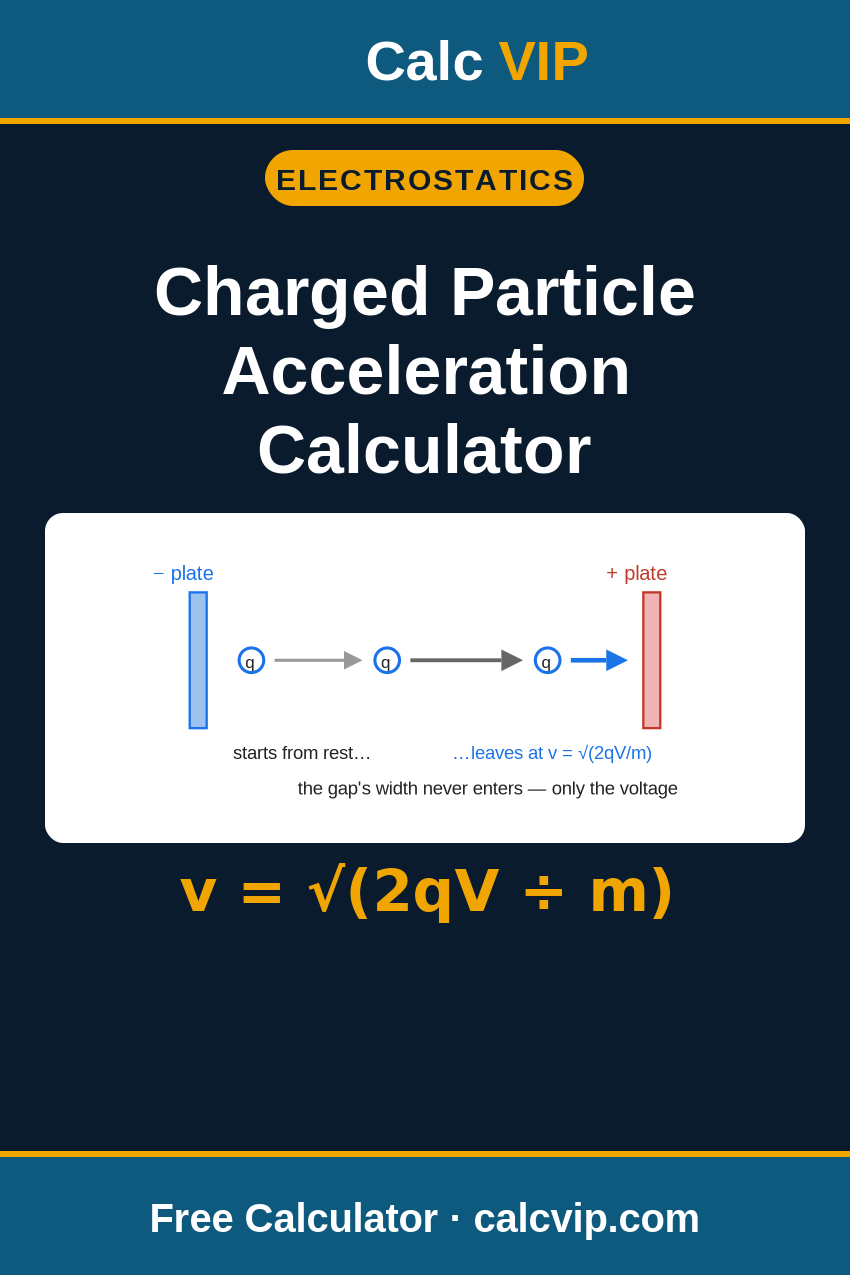
Every accelerator ever built, from a TV tube to the Large Hadron Collider, runs on one transaction: a charge falls through a voltage and banks the fall as speed. The bookkeeping is energy conservation in its purest form. The field does work qV on the particle; the particle, starting from rest, has nowhere to put it but kinetic energy; so ½mv² = qV, and the speed is v = √(2qV/m). Nothing about the journey matters — not the gap's width, not the field's shape, not the time taken. Only the total voltage and the particle's charge-to-mass ratio decide the outcome, which is why a desktop electron gun and a synchrotron are, at heart, the same device at different scales of V.
The formula's two variables pull in opposite directions, and the tension designs real machines. Raise the voltage and everything speeds up — but only as √V, so each doubling of speed costs four times the volts. Lower the mass and speed rises as 1/√m, which is why electrons, 1,836 times lighter than protons, are the sprinters of the accelerator world: through 1,000 V an electron reaches 1.88 × 10⁷ m/s while a proton manages 4.38 × 10⁵ m/s, 43 times slower on identical energy. Heavy particles are not worse — they carry more momentum per volt, which ion thrusters and implanters exploit — but for raw speed per volt, lightness wins.
There is a ceiling the formula cannot see: light speed. √(2qV/m) is Newton's bookkeeping, and it begins to overstate speeds once a particle passes a few percent of c — for electrons, beyond roughly ten thousand volts. The energy statement qV never fails, but the speed must then come from relativity's version, and at the LHC's 6.8 TeV per proton the classical formula would predict a speed 120 times light's — a reductio ad absurdum that marks the border of Newton's world. This calculator gives the classical speed, exact for the kilovolt world of guns, tubes and small machines, and the sections below show where its warranty expires.
Formula
½ × m × v² = q × V → v = √(2qV ÷ m) • v in m/s, q in coulombs (C), V in volts (V), m in kilograms (kg)
The kinetic energy gained is qV joules — for a particle with one elementary charge, simply V electron-volts (1 eV = 1.602 × 10⁻¹⁹ J). The relations rearrange to V = m × v² ÷ (2q) (the voltage needed to bring a particle to a target speed — the design equation of every electron gun) and q ÷ m = v² ÷ (2V), the charge-to-mass ratio, which is what mass spectrometers actually measure: accelerate an unknown ion through a known V, measure v (or the radius of its curved path), and q/m falls out. The formula assumes the particle starts from rest; give it an initial speed u and the energy statement becomes ½mv² = ½mu² + qV. It also assumes the full voltage is fallen through once — multi-stage machines simply add their stages' voltages.
| Symbol | Meaning | Units |
|---|---|---|
| v | final speed (from rest) | m/s |
| q | particle's charge (electron/proton: 1.602 × 10⁻¹⁹ C) | coulombs (C) |
| V | accelerating potential difference | volts (V) |
| m | particle's mass | kilograms (kg) |
| KE | kinetic energy gained, = qV | joules (J) or eV |
Why only the voltage matters — the shape-independence of qV
It surprises everyone the first time: squeeze the accelerating gap from a metre to a millimetre, keeping the same voltage, and the exit speed is unchanged. The narrow gap has a fiercer field (E = V/d) and accelerates harder, but for a proportionally shorter distance and time; the wide gap accelerates gently for longer. Work is force times distance, the two effects cancel exactly, and the energy — the only thing the exit speed reads — is qV either way. This is the conservative nature of the electrostatic field doing bookkeeping: potential difference is defined as work per charge, so the answer was built into the definition of the volt.
The practical consequence is freedom of design. Engineers shape accelerator gaps for other reasons — beam focus, breakdown avoidance, timing — knowing the energy is guaranteed by the power supply's voltage alone. It is also why "electron-volts" are the field's native energy unit (the Electron-Volt page's whole subject): an accelerator physicist who says "a 5 MeV beam" has told you the total voltage the beam fell through, summed over every stage, without describing a single electrode.
The same independence hides a warning about time. Although the exit speed is fixed by V, the transit time is not: a wide, gentle gap lets the particle dawdle, a narrow fierce one hurries it through. Machines that bunch particles — synchrotrons, linacs, time-of-flight spectrometers — live and die by that timing, and their designers choose gap geometry for the clock while the energy looks after itself. Two machines with identical beams on paper can behave entirely differently in time, and this formula, silent about duration, will not warn you.
How to use
- Pick the electron, proton or alpha particle from the list — charge and mass are filled in for you — or choose "Custom" and type any charge and mass (scientific notation works fine).
- Enter the voltage the particle is accelerated through, in volts — the total potential difference fallen through, summed over stages if there are several.
- Click "Calculate" to get the final speed, plus the kinetic energy in joules and electron-volts.
- Sanity-check the energy first: a singly-charged particle through V volts must show exactly V eV; an alpha (charge 2e) must show 2V eV.
- Check the speed against light: if the result is a sizeable fraction of 3 × 10⁸ m/s, treat it as an overestimate — relativity's correction, discussed below, is due. No result at or above light speed can ever be right.
Worked examples
Example 1 — the proton reference. A proton starts from rest and is accelerated through 1000 V.
Kinetic energy = qV = 1.602 × 10⁻¹⁹ × 1000 = 1.602 × 10⁻¹⁶ J (= 1000 eV).
v = √(2 × 1.602 × 10⁻¹⁶ ÷ 1.673 × 10⁻²⁷) = 4.376 × 10⁵ m/s — about 438 km every second.
Example 2 — the electron through the same kilovolt. An electron through 1,000 V banks the same 1,000 eV but reaches v = √(2 × 1.602 × 10⁻¹⁶ ÷ 9.109 × 10⁻³¹) = 1.875 × 10⁷ m/s — 43 times the proton's speed, exactly √1836, and already 6% of light speed, where the classical formula is still accurate to better than half a percent.
Example 3 — the alpha particle. An alpha (q = 3.204 × 10⁻¹⁹ C, m = 6.645 × 10⁻²⁷ kg) through 1,000 V gains KE = 3.204 × 10⁻¹⁶ J = 2,000 eV and reaches v = √(2 × 3.204 × 10⁻¹⁶ ÷ 6.645 × 10⁻²⁷) = 3.105 × 10⁵ m/s. Double the proton's energy, yet slower — its fourfold mass outruns its twofold charge in the √.
Example 4 — a gentle 50 V. An electron through just 50 V: v = √(2 × 1.602 × 10⁻¹⁹ × 50 ÷ 9.109 × 10⁻³¹) = 4.19 × 10⁶ m/s. Even toy voltages produce megametre-per-second electrons, which is why vacuum tubes worked at all — and why "low voltage" never meant "slow electrons" in the valve era.
Example 5 — the million-volt proton. A proton through 1 MV (a Van de Graaff's home turf) gains 1 MeV and reaches v = √(2 × 1.602 × 10⁻¹³ ÷ 1.673 × 10⁻²⁷) = 1.384 × 10⁷ m/s, 4.6% of light speed. Protons stay Newtonian far longer than electrons because their rest energy (938 MeV) dwarfs the MeV-scale gains — the classical formula errs by barely 0.1% here.
Example 6 — where the formula breaks. Feed the LHC's 6.8 TeV proton to the classical formula and it returns v = √(2 × 6.8 × 10¹² × 1.602 × 10⁻¹⁹ ÷ 1.673 × 10⁻²⁷) = 3.61 × 10¹⁰ m/s — 120 times the speed of light, an impossibility that indicts the formula, not the accelerator. The true speed is 0.99999999c, delivered by relativity's bookkeeping, (γ − 1)mc² = qV, in which added energy buys ever less speed and ever more momentum. Example 6 is the most instructive on the page: it shows a great formula meeting its border and failing honestly, by absurdity.
Particle acceleration in real life
Electron guns everywhere. CRT displays, electron microscopes, X-ray tubes, microwave-oven magnetrons and welding guns all begin with this calculation: choose the beam energy, set V, and the cathode-anode gap delivers electrons at √(2eV/m) — 5.93 × 10⁵ m/s per square-root-of-volt scaling.
Mass spectrometry. Ions accelerated through a fixed V fly at speeds set by q/m; timing their flight (or timing this calculator's v) identifies molecules from insulin to explosives residue at airports.
Ion thrusters. Spacecraft engines accelerate xenon ions through ~1,000–2,000 V. The ions leave at tens of km/s — the proton row of the quick table, scaled by xenon's mass — and the feeble but tireless thrust has carried probes across the solar system.
Medical linacs and proton therapy. Radiotherapy electrons are accelerated to 4–25 MeV; proton-therapy cyclotrons reach ~230 MeV, chosen so the protons stop inside the tumour. Every treatment plan starts from qV bookkeeping summed over the machine's stages.
Ion implantation. Semiconductor fabs shoot dopant ions through tens to hundreds of kilovolts so they bury themselves at a controlled depth in silicon — the depth is set by the energy, the energy by V, the chips by both.
The great colliders. The LHC's protons fall through an effective 6.8 trillion volts in stages — RF cavities adding their voltages lap after lap, the shape-independence of qV exploited six hundred million times per fill.
The relativistic correction, honestly stated
Relativity replaces ½mv² with (γ − 1)mc², where γ = 1 ÷ √(1 − v²/c²). Set that equal to qV and solve for v: the result reduces to Newton's formula when qV is much smaller than the rest energy mc², and saturates at c when qV is much larger. The practical border: the classical speed overestimates by about 1% when qV reaches 2% of mc² — for electrons (mc² = 511 keV) at roughly 10 kV, for protons (mc² = 938 MeV) not until roughly 20 MV. Below those voltages this calculator's speeds are engineering-grade; above them, use the energy (always exact) and convert with Einstein. The original FAQ's "50,000 V" warning for electrons corresponds to a ~7% speed error — noticeable to a metrologist, invisible to a television.
Notice the deep reason the border sits where it does: mc² is the particle's price of existing, and qV is the tip you add. While the tip is small change next to the price, Newton — who effectively assumed infinite price — is nearly right. As the tip rivals the price, the particle's inertia itself grows (that is what γ tracks), each further volt buys less speed, and the curve bends towards c. Energy keeps flowing in without limit; speed simply stops being where most of it goes. Momentum, not velocity, becomes the honest measure of a relativistic beam — which is why collider physicists quote beam momentum as readily as energy.
Quick reference: speeds from rest
| Voltage | Electron speed | Proton speed |
|---|---|---|
| 1 V | 5.93 × 10⁵ m/s | 1.38 × 10⁴ m/s |
| 100 V | 5.93 × 10⁶ m/s | 1.38 × 10⁵ m/s |
| 1,000 V | 1.88 × 10⁷ m/s | 4.38 × 10⁵ m/s |
| 10,000 V | 5.93 × 10⁷ m/s | 1.38 × 10⁶ m/s |
| 1,000,000 V | (relativity required) | 1.38 × 10⁷ m/s |
The columns differ everywhere by the constant factor √1836 ≈ 43 — the mass ratio's square root — until relativity bends the electron column away. Learn one column and you own both. The electron row at 1 V is worth memorising on its own: about 600 km/s per volt's square root is the exchange rate behind every cathode-ray device ever built.
Common mistakes
- Forgetting the particle starts from rest. The formula gives the speed gained from rest. A particle entering with speed u obeys ½mv² = ½mu² + qV — add the energies, not the speeds.
- Using the atomic mass unit or grams for m. The formula wants kilograms. An electron is 9.109 × 10⁻³¹ kg; entering 9.109e-28 (its mass in grams) understates every speed by √1000 ≈ 32.
- Giving the alpha particle charge e. An alpha carries 2e = 3.204 × 10⁻¹⁹ C. Halving its q halves its energy and cuts its speed by √2 (Example 3).
- Trusting the speed past its relativistic border. Electrons above ~10–50 kV and any particle whose computed v nears c need Einstein's version. The energy qV, however, is always right.
- Thinking a wider gap at the same voltage means a faster exit. It does not — the energy is qV whatever the geometry. Gap width changes the field and the transit time, never the final speed.
FAQ
FAQ
Why does the electron end up so much faster than the proton at the same voltage?
Both gain the same energy per unit charge, but the electron is about 1,836 times lighter. Speed grows as 1/√m, so the electron goes roughly 43 times faster.
When does this formula stop being accurate?
At very high voltages the particle approaches the speed of light and relativity takes over — an electron past about 50,000 V is already noticeably relativistic, and the true speed is a little less than this formula gives.
Does the shape of the accelerator matter?
No — only the total voltage matters. Whether the drop happens across a millimetre gap or a long tube, the energy gained is qV either way.
What voltage brings an electron to 10% of light speed?
Classically, V = mv²/(2e) with v = 3 × 10⁷ m/s gives about 2,560 V. Relativity asks for a touch more — roughly 2,575 V — because at 0.1c the true kinetic energy already exceeds ½mv² by about half a percent. Either way, a few kilovolts suffice — electrons are that light.
How do multi-stage accelerators add up?
By voltage. A linac's cavities or a cyclotron's laps each contribute their qV, and the total energy is q times the summed voltage — the reason "6.8 TeV" can be stated as a single number for a machine with thousands of stages.
Does the particle's path through the gap matter?
No — only the endpoints' potential difference. Spiral, straight or reflected paths through the same V gain the same energy; path-independence is the electrostatic field's defining convenience.
What if the particle is negatively charged, like an electron?
It accelerates towards the positive plate — the opposite direction to a proton — but the energy and speed magnitudes follow the same formula with |q|. The calculator uses charge magnitudes for the speed, as the worked examples do.
Why do ion engines prefer heavy ions if light ones go faster?
Thrust is momentum per second, and momentum at fixed energy grows as √m. Heavy xenon ions at modest speed push harder per particle and per watt than electrons ever could; speed is not the only currency.
Can this formula find the voltage from a measured speed?
Yes — V = mv²/(2q). That inversion is a working instrument: electron spectrometers infer energies from speeds and flight times using exactly this rearrangement.
What happens if the voltage is reversed?
The particle decelerates: it is a retarding potential. Send a fast electron into a reversed V and it stops when qV has eaten its kinetic energy — the principle of the retarding-field energy analyser, and the reason a few volts of reverse bias can switch off a beam that kilovolts created.