 Calc
Midpoint Electric Field Calculator – Net Field Between Two Charges
 Created by Thomas Becker · Physics Writer · Electricity & Magnetism · Last updated: November 2026
Use this free Midpoint Electric Field Calculator to find the net electric field exactly halfway between two point charges on a straight line. Each charge makes its own field at the midpoint, and the two fields add — or partly cancel. Charges are tiny, so you can type them in scientific notation — for example 4e-6 means four microcoulombs.
The midpoint between two charges is the fairest test of superposition — the principle that fields add. Each charge fills all of space with its own field, falling as 1/r², pointing away from itself if positive and towards itself if negative. At the exact centre of the pair, the two distances are equal, so the contest is decided purely by the charges themselves and by a subtlety beginners miss: the directions. At the midpoint the two fields always lie along the line joining the charges, but they may point the same way or opposite ways depending on the signs — and that, more than the sizes, decides whether the centre is a place of violent field or of perfect calm.
For two positive charges, the midpoint is a battlefield: the left charge's field pushes a test charge rightwards, the right charge's pushes it leftwards, and the net is the difference of two large numbers. Equal charges produce the most dramatic result in elementary electrostatics — two fields of hundreds of thousands of newtons per coulomb annihilating each other to exactly zero. Change one sign, though, and the same point becomes a place where the fields conspire: a positive and a negative charge both drive the field from the positive towards the negative, and at the midpoint their contributions add to double strength.
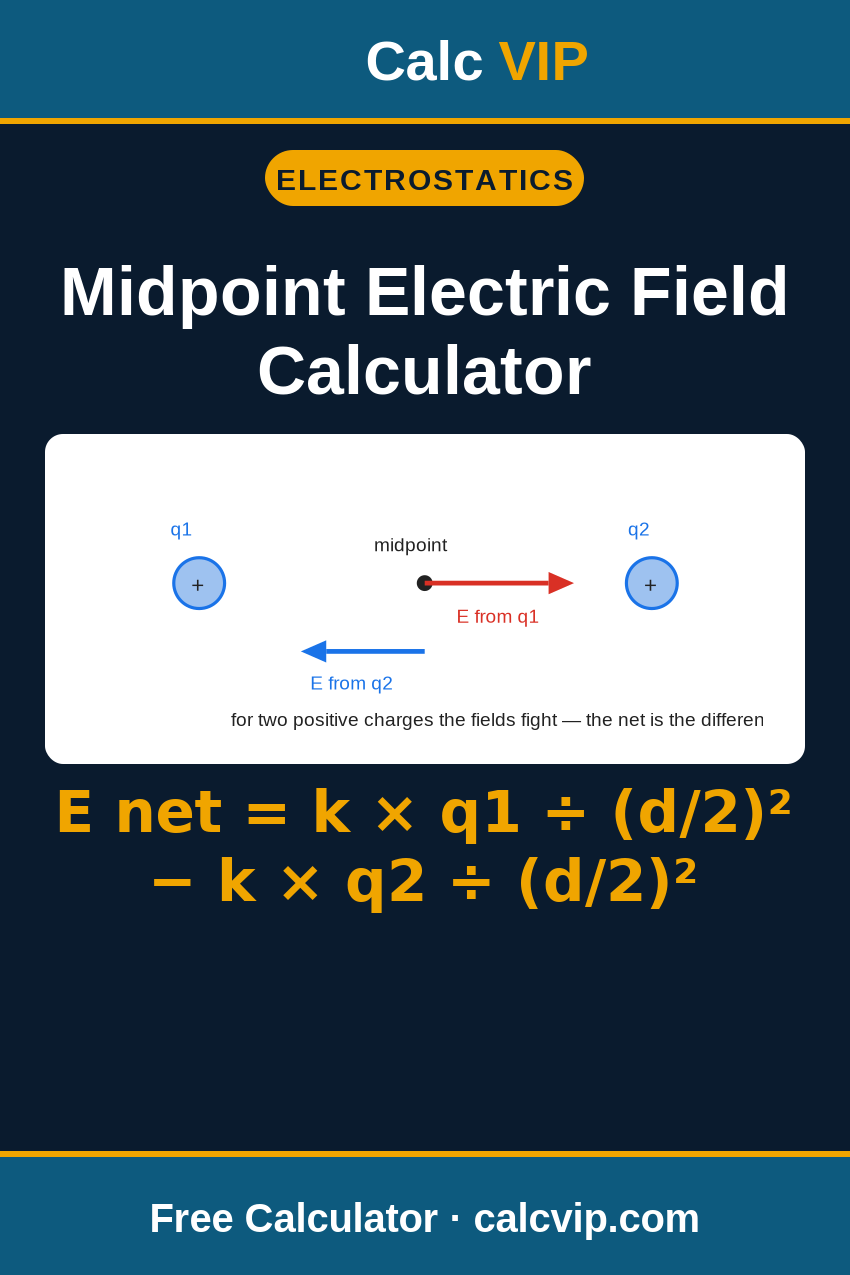
This calculator evaluates that contest for any pair of charges and any separation. It reports each field separately — so you can see the size of the fight — then the net field and its direction. Beyond homework, the midpoint field matters anywhere two charge centres face each other: between the plates of sensors, along the axis of molecular bonds, and at the neutral points engineers hunt for when they need a field-free pocket in a charged environment.
Formula
At the midpoint, each charge is d/2 away, so each field has magnitude k × q ÷ (d/2)². Taking right as positive:
Enet = k × q1 ÷ (d/2)² − k × q2 ÷ (d/2)² • E in newtons per coulomb (N/C), charges in coulombs (C), d in metres (m), k = 8.99 × 10⁹ N·m²/C²
The single-charge building block is E = k × q ÷ r², and it rearranges to q = E × r² ÷ k and r = √(k × q ÷ E) — the distance at which a charge's field fades to a chosen strength. The minus sign in the midpoint formula is not decoration: it encodes that a positive q2's field at the midpoint points left, against a positive q1's rightward field. Feed the charges in with their signs and the formula handles negative charges automatically, because a negative charge's field points towards it — the sign flips the arrow. Once E is known, the force on any charge placed at the midpoint is F = q × E, in the field's direction for a positive charge and against it for a negative one.
| Symbol | Meaning | Units |
|---|---|---|
| E | electric field strength at the midpoint | N/C (= V/m) |
| q1, q2 | the left and right charges (signs included) | coulombs (C) |
| d | full separation; each charge is d/2 from the midpoint | metres (m) |
| k | Coulomb constant, 8.99 × 10⁹ | N·m²/C² |
| F | force on a test charge at the midpoint, F = qE | newtons (N) |
Why the midpoint is special — and when it is not the interesting point
The midpoint is the one place where the geometry is perfectly fair: equal distances mean the inverse-square law cannot favour either charge, so the result is a pure referendum on q1 versus q2 and their signs. For like signs the net field is proportional to q1 − q2; for opposite signs it is proportional to q1 + q2 in size. Either way, doubling the separation quarters every field — the midpoint of charges 0.6 m apart feels fields four times weaker than the midpoint of the same charges 0.3 m apart, because each charge is twice as far away and 1/r² is unforgiving.
But the midpoint is not, in general, where the field vanishes. For unequal like charges the zero-field point slides towards the smaller charge, to the spot where the weaker charge's closeness compensates for its size. Take Example 1's pair — 4 µC and 1 µC, 0.6 m apart: the fields balance where 4/x² = 1/(0.6 − x)², which solves to x = 0.4 m from the big charge, and indeed both fields there are 224,750 N/C in opposite directions. For opposite-sign charges the balance point leaves the segment altogether and sits outside it, beyond the smaller charge. The midpoint is the clean special case; the sliding null point is the general truth it hints at.
There is a second quiet lesson at the midpoint: the field there is a vector sum, but each contribution was computed as if the other charge did not exist. Neither charge shields, dilutes or bends the other's field — in vacuum, fields pass through each other like ghosts, and the total is everywhere the simple sum. This superposition is an empirical fact about electromagnetism, not a logical necessity, and nearly all of classical field theory is built on it. The midpoint, where the sum is starkest — total cancellation or total cooperation — is where the principle is easiest to see and hardest to forget.
How to use
- Enter the left-hand charge as q1 and the right-hand charge as q2, in coulombs — scientific notation like 4e-6 works fine. Use a minus sign for a negative charge; left and right matter for the direction of the answer.
- Enter the full distance between the charges, in metres. The calculator halves it for you — do not halve it yourself.
- Click "Calculate" to see each field, the net field, and which way it points.
- Interpret the direction: a net field "toward q2" means a positive test charge at the midpoint would be pushed towards q2; a negative test charge would move the opposite way.
- Check limiting cases in your head: equal like charges must give zero; opposite signs must give a field pointing from the positive charge towards the negative one.
Worked examples
Example 1 — the bigger charge wins. q1 = 4 × 10⁻⁶ C and q2 = 1 × 10⁻⁶ C are 0.6 m apart, so the midpoint is 0.3 m from each.
Field from q1: 8.99 × 10⁹ × 4 × 10⁻⁶ ÷ 0.3² = 399,556 N/C pointing right (away from q1).
Field from q2: 8.99 × 10⁹ × 1 × 10⁻⁶ ÷ 0.3² = 99,889 N/C pointing left (away from q2).
Net field = 399,556 − 99,889 = 299,667 N/C (about 3.00 × 10⁵ N/C), pointing toward q2 — the bigger charge wins.
Example 2 — perfect cancellation. q1 = q2 = 2 × 10⁻⁶ C, d = 0.4 m. Each field at the midpoint (0.2 m away) is 8.99 × 10⁹ × 2 × 10⁻⁶ ÷ 0.2² = 449,500 N/C — enormous — yet they point in opposite directions, so the net field is exactly 0. A test charge placed precisely there feels no force at all, suspended between two giants.
Example 3 — opposite signs conspire. q1 = +3 × 10⁻⁶ C, q2 = −3 × 10⁻⁶ C, d = 0.5 m. At the midpoint, q1's field (8.99 × 10⁹ × 3 × 10⁻⁶ ÷ 0.25² = 431,520 N/C) points right, away from the positive charge; q2's field also points right, towards the negative charge that attracts field lines in. Net = 431,520 + 431,520 = 863,040 N/C toward q2 — an electric dipole's centre is a place of maximum cooperation.
Example 4 — unequal and opposite. q1 = +5 × 10⁻⁶ C, q2 = −1 × 10⁻⁶ C, d = 1.0 m (midpoint 0.5 m from each). q1 contributes 8.99 × 10⁹ × 5 × 10⁻⁶ ÷ 0.5² = 179,800 N/C rightwards; the negative q2 pulls the field towards itself, adding 8.99 × 10⁹ × 1 × 10⁻⁶ ÷ 0.5² = 35,960 N/C in the same direction. Net = 215,760 N/C toward q2.
Example 5 — both negative. q1 = −2 × 10⁻⁶ C, q2 = −6 × 10⁻⁶ C, d = 0.8 m. Fields point towards negative charges: q1's contribution at the midpoint is 112,375 N/C pointing left (towards q1), q2's is 337,125 N/C pointing right (towards q2). Net = 337,125 − 112,375 = 224,750 N/C toward q2 — the larger-magnitude charge attracts the field's allegiance just as a larger positive charge repels it.
Example 6 — from field to force. What would a charge feel at Example 1's midpoint, where E = 299,667 N/C? A 1 µC test charge feels F = qE = 10⁻⁶ × 299,667 = 0.30 N toward q2 — the weight of a small apple, from a speck of charge. An electron there feels 1.602 × 10⁻¹⁹ × 299,667 = 4.80 × 10⁻¹⁴ N toward q1 (opposite the field, because its charge is negative) — tiny, yet enough to accelerate it at 5 × 10¹⁶ m/s².
Midpoint fields in real life
Dipole antennas and molecules. A dipole's centre field — Example 3's doubling — is the starting point for understanding how antennas radiate and how polar molecules like water grab passing ions; the strong, directed field between opposite charges is what makes water such an aggressive solvent.
Field-free pockets. Engineers designing sensitive electrometers and electron optics hunt for null points where stray fields cancel; the sliding-zero mathematics of this page is how they place shielding charges to manufacture calm in a charged machine.
Mass spectrometry and ion optics. Ion beams are steered by fields between charged elements; at symmetry planes the fields of paired electrodes cancel or add by design, exactly as q1 and q2 do here, letting designers focus beams with no net sideways kick.
Lightning safety. Between a charged cloud base (one sign) and induced ground charge (the other), the air's field is a giant version of the dipole pattern; knowing where fields add tells you where breakdown — lightning — is most likely to start.
Electrostatic sensors. Capacitive touch and proximity sensors detect how a finger's charge perturbs the balanced field between electrodes; a touch is, electrically, a third charge arriving to spoil a midpoint cancellation.
Teaching laboratories. The midpoint is the first place students verify superposition quantitatively: measure the field contributions one charge at a time, then together, and watch arithmetic defeat intuition — the fields really do just add.
The dipole: why the opposite-sign midpoint matters most
A positive–negative pair is an electric dipole, the most common charge arrangement in nature — every polar molecule is one. Along the dipole's axis the midpoint field is 2 × k × q ÷ (d/2)², and far away the pair's field fades as 1/r³, faster than a single charge's, because from a distance the two nearly cancel. That near-cancellation with a strong local field is the dipole's signature: powerful at close range (dissolving, bonding, orienting neighbours), discreet at long range. The midpoint calculation is the doorway into that whole subject, and Example 3's 863,040 N/C is what the centre of a strong molecular-scale dipole "feels" like, scaled up to microcoulombs.
Dipoles also respond to fields as well as making them. Place a dipole in a uniform external field and the two ends are pulled opposite ways — no net force, but a torque that twists the dipole into line with the field. That twisting is how water molecules orient in the field of a passing ion, how liquid crystals turn in a display pixel, and how the midpoint field you calculate here becomes a handle by which the world manipulates molecules.
Quick reference: field of a single 1 µC charge
| Distance r | Field E = kq/r² |
|---|---|
| 0.1 m | 899,000 N/C |
| 0.2 m | 224,750 N/C |
| 0.3 m | 99,889 N/C |
| 0.5 m | 35,960 N/C |
| 1 m | 8,990 N/C |
To build any midpoint answer from this table, look up each charge's field at distance d/2 (scaling by the charge in µC), then add or subtract according to the signs. Compare with the potential table on the Electric Potential page: the field dies as 1/r² while the potential fades as 1/r, which is why distant charges still show up in voltmeters long after their force is negligible.
Common mistakes
- Using the full distance d in each field. Each charge is only d/2 from the midpoint. Forgetting to halve inflates the distance and shrinks each field by a factor of four.
- Adding the fields as plain numbers for like charges. Two positive charges produce opposing fields at the midpoint; the net is the difference. Blind addition turns Example 2's exact zero into a phantom 899,000 N/C.
- Assuming the midpoint is always the zero point. Only equal like charges cancel there. Unequal charges shift the null point towards the smaller charge, as the 0.4 m example shows.
- Getting the field direction of a negative charge wrong. Field points towards a negative charge, away from a positive one. At the midpoint this flips whether contributions add or subtract.
- Reporting the net field's direction as the force direction for any charge. F = qE follows E only for positive test charges. An electron at the midpoint accelerates against the field.
FAQ
FAQ
When is the midpoint field exactly zero?
When the two charges are equal in size and sign (q1 = q2). Their fields at the centre are equal and opposite, so they cancel completely.
Why do the fields subtract for two positive charges?
A field points away from a positive charge. At the midpoint, q1's field points right and q2's field points left — opposite directions, so they partly cancel. For opposite-sign charges the two fields point the same way at the midpoint and add up.
Does the midpoint field depend on a test charge?
No. The field is a property of the two charges and the point in space. A test charge placed there would feel a force F = qE, but E itself does not depend on it.
What if the two charges are equal and opposite?
That is a dipole: both fields at the midpoint point from the positive to the negative charge and add. Two 3 µC charges 0.5 m apart give 863,040 N/C — Example 3 works it in full.
How does the midpoint field change if the separation doubles?
Each charge is twice as far from the midpoint, and the field falls as 1/r², so the net field drops to a quarter — whatever the signs. Example 1's pair at 1.2 m would give about 74,917 N/C.
Where exactly is the zero-field point for unequal positive charges?
Between them, closer to the smaller charge, where q1/x² = q2/(d−x)². For 4 µC and 1 µC at 0.6 m it sits 0.4 m from the 4 µC charge — the smaller charge must be twice as close to compete.
Is there a zero-field point for opposite-sign charges?
Yes, but not between them — on the line outside the pair, beyond the smaller-magnitude charge, where the nearer small charge's field can match the farther big one's. Between opposite charges the fields always cooperate, never cancel.
What are the units N/C and V/m — are they the same?
Yes, identical. A field of 299,667 N/C is also 299,667 V/m: the potential drops by that many volts per metre travelled along the field. The two names emphasise force-per-charge and slope-of-potential respectively.
Does the midpoint field depend on the medium?
In a material, yes: fields are reduced roughly by the dielectric constant εr, because the medium polarises against them. This calculator assumes vacuum or air, where the correction is negligible.
Why is the field at the exact centre of two equal positive charges zero, but the potential is not?
Fields are arrows that cancel head-on; potentials are numbers that add. At that centre V = 2 × kq/(d/2) — large and positive — while E = 0. Height and slope are different things.