 Calc
Potential Difference Calculator – V = Ed in a Uniform Field & Work qV
 Created by Thomas Becker · Physics Writer · Electricity & Magnetism · Last updated: November 2026
Use this free Potential Difference Calculator for a uniform electric field — the kind between two charged parallel plates. Enter the field strength and the distance moved along it to get the voltage, then optionally add a charge to find the work done moving it. Charges can be typed in scientific notation — for example 1e-6 means one microcoulomb.
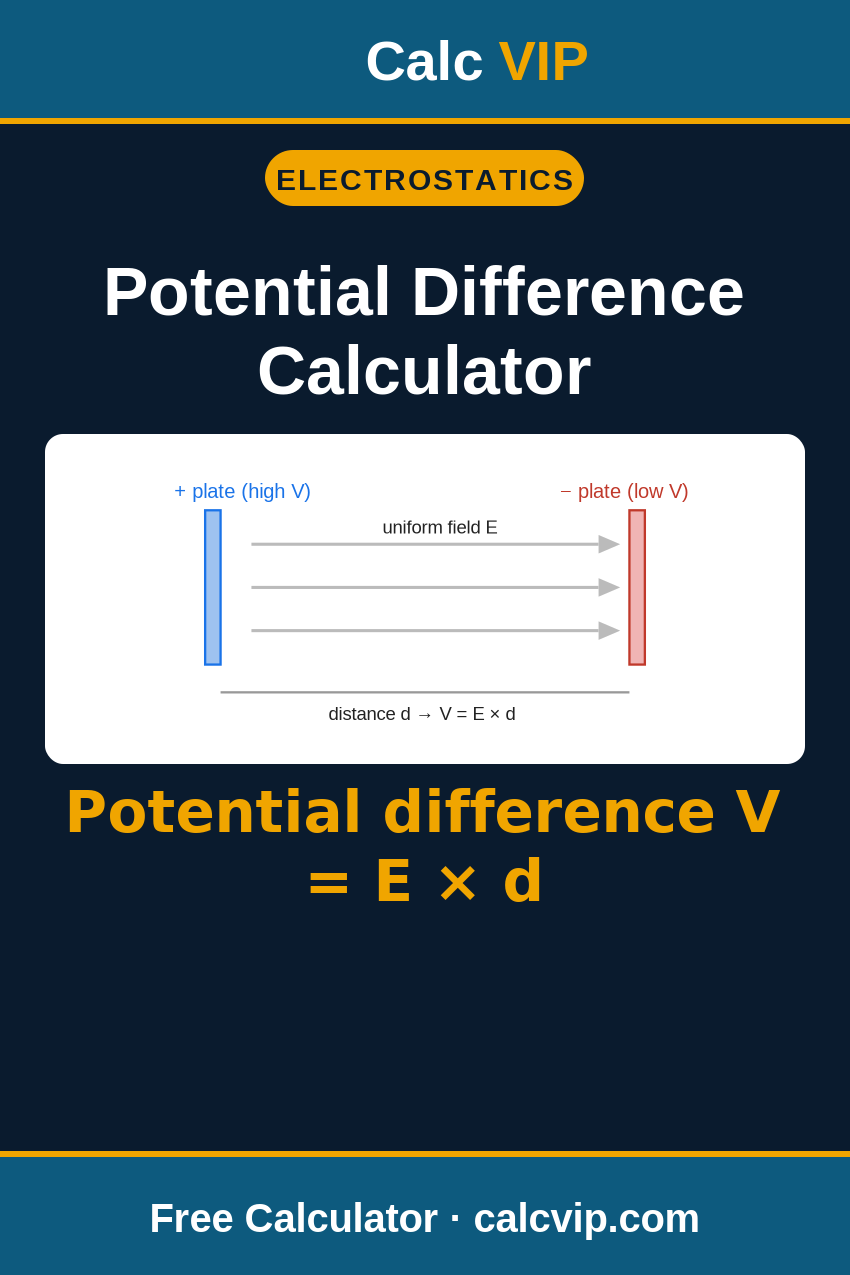
Between two charged plates, electricity becomes arithmetic at its simplest. The field there is uniform — the same strength and direction everywhere in the gap — so the potential changes at a perfectly steady rate as you cross it, and the voltage between two points is just the field times the distance: V = E × d. No inverse squares, no angles, no approximations. It is the one place in electrostatics where the landscape is a uniform ramp instead of hills and wells, and it is why the field's units can be written two ways: newtons per coulomb for the push on a charge, or volts per metre for the slope of the ramp — the same number wearing two name tags.
The formula is the bridge between the field picture and the circuit picture. Field people live in N/C; circuit people live in volts; V = Ed is the customs post where the two currencies exchange. A battery's 12 V spread across a millimetre of insulation is a field of 12,000 V/m; a thunderstorm's field of 100,000 V/m sustained over a kilometre of air is a potential difference of a hundred million volts. Every insulation rating, spark gap and capacitor specification is negotiated in this exchange, usually without anyone noticing the formula at work.
The optional second half of the calculator prices the journey of an actual charge: W = qV. The field pays out (or charges) q joules per volt crossed, so a charge's energy change is its size times the voltage — the same bookkeeping as the Electron-Volt page, where a charge of exactly e turns volts into electron-volts one-for-one. Between them, V = Ed and W = qV answer the two questions uniform fields ever ask: how much voltage does this gap hold, and what does it cost to cross it?
Formula
Potential difference V = E × d • V in volts (V), E in newtons per coulomb (N/C = V/m), d in metres (m) — uniform field only
Work done moving a charge: W = q × V • W in joules (J), q in coulombs (C)
The first formula rearranges to E = V ÷ d — the field a known voltage creates across a known gap, the single most-used computation in insulation design — and to d = V ÷ E, the spacing a voltage and a field limit jointly demand. The second rearranges to q = W ÷ V. Signs deserve care: moving along the field direction (from + plate towards − plate) is moving downhill, so the potential drops by Ed and a positive charge loses qEd of potential energy; moving against the field, you pay qEd in. This calculator reports magnitudes and lets the geometry speak. For a non-uniform field the product becomes a sum along the path — V is the accumulated E·(step) — and near a point charge that sum evaluates to kQ/r instead; the uniform formula is the constant-E special case of the general rule.
| Symbol | Meaning | Units |
|---|---|---|
| V | potential difference between two points | volts (V) |
| E | uniform field strength | N/C, equivalently V/m |
| d | distance moved along the field direction | metres (m) |
| W | work done moving charge q through V | joules (J) |
| q | the charge moved (optional input) | coulombs (C) |
Equipotentials: the free direction
A uniform field's landscape is a ramp, and like any ramp it has contour lines: planes perpendicular to the field, each at a single potential. Sliding along such a plane — sideways to the field — changes nothing: no voltage crossed, no work done, W = 0 however far you slide. Only the component of a journey along the field costs or pays. This is why the plates themselves, each an equipotential sheet of metal, can be any shape in plan view without changing V = Ed, and why a bird perched on one high-voltage wire is safe: both its feet stand on the same equipotential, so the potential difference across its body is zero and no current is invited through it.
The ramp picture also explains field direction conventions once and for all. Fields point downhill — from high V to low V — because positive charges roll downhill. The negative plate of a capacitor is not "negative" in potential because of its charge sign alone; it is the low end of the ramp the field descends. When textbooks write E = −dV/dx, the minus sign is exactly this: the field is the negative slope of the potential, the steepness of the descent. Between plates the slope is constant, the ramp is straight, and V = Ed is the rise-over-run of the simplest landscape in physics.
It is worth seeing how the uniform field gets its uniformity. Between two large plates carrying opposite surface densities ±σ, each plate alone would produce a field of σ/(2ε0) on both sides — the Charge Density page's distance-free sheet field. Between the plates the two contributions point the same way and add to σ/ε0; outside the plates they cancel to zero. The ramp exists because two non-fading fields cooperate in the gap and annihilate outside it — and its steepness E = σ/ε0 is fixed by the plates' charge density, which is why a capacitor's voltage for a given charge is V = σd/ε0, the seed of the whole capacitance formula.
How to use
- Enter the uniform field strength E in N/C (equivalently V/m). Between large parallel plates this is the field everywhere in the gap, away from the edges.
- Enter the distance moved along the field direction, in metres — the separation of your two points measured parallel to the field lines, not along any slant.
- Optionally enter a charge q — the calculator then also finds the work W = qV needed to move it through that voltage.
- Click "Calculate" for the potential difference in volts, and the work in joules if you supplied a charge.
- Check plausibility against breakdown: fields in air above ~3 × 10⁶ N/C cannot persist — they discharge as sparks — so a result implying a larger E in air describes a spark, not a steady state.
Worked examples
Example 1 — the reference gap. Between two plates the field is 500 N/C. Two points 0.04 m apart along the field have:
V = E × d = 500 × 0.04 = 20 V between them.
Moving a charge of 1 × 10⁻⁶ C through those 20 V takes work W = qV = 1 × 10⁻⁶ × 20 = 2 × 10⁻⁵ J.
Example 2 — a laboratory field. A stronger uniform field of 3,000 N/C across a 0.1 m apparatus: V = 3,000 × 0.1 = 300 V. This is the scale of electrostatics demonstrations — a few kilovolts per metre over bench distances gives hundreds of volts, which is why such rigs bite like mains electricity: they are, locally, mains electricity.
Example 3 — the thunderstorm's ramp. In a thundercloud the field can reach roughly 1 × 10⁵ N/C over a vertical extent of about 1,000 m. Multiplied out: V = 10⁵ × 1,000 = 1 × 10⁸ V — a hundred million volts between cloud and ground, an estimate (real fields vary with height) that lands squarely in the range lightning researchers quote. V = Ed is how such staggering numbers are built from merely large ones.
Example 4 — a proton crossing Example 1's gap. Move a proton (q = 1.602 × 10⁻¹⁹ C) through the 20 V of Example 1: W = 1.602 × 10⁻¹⁹ × 20 = 3.204 × 10⁻¹⁸ J — exactly 20 eV, as the Electron-Volt page promises. Cross it the other way, against the field, and the same amount must be paid in instead of collected.
Example 5 — the 9 V battery as a field. Run the formula backwards: a 9 V battery across plates 0.003 m apart implies E = V/d = 3,000 N/C. Check with the calculator's forward direction: E = 3,000 N/C, d = 0.003 m → V = 9 V. Mundane voltages across millimetre gaps are kilovolt-per-metre fields — the ramp is steeper than intuition suggests.
Example 6 — the sideways free ride. In Example 1's field, carry the 1 µC charge 0.04 m along the field (V crossed: 20 V, work 2 × 10⁻⁵ J), then slide it 0.03 m sideways, parallel to the plates. The sideways leg crosses no potential difference — it runs along an equipotential — so it costs 0 J, and the total work stays 2 × 10⁻⁵ J. Journeys are billed only for their along-field component.
Potential difference in real life
Insulation and clearance design. Engineers ask E = V/d backwards daily: given a voltage and air's breakdown field (~3 × 10⁶ V/m), the minimum safe gap is d = V/E — the reason high-voltage hardware is spacious and its terminals rounded and far apart.
Spark plugs. A plug's ~1 mm gap must spark reliably: at 20,000 V the field is 2 × 10⁷ V/m in the fuel mixture's conditions — comfortably past breakdown, by design, tens of thousands of times a minute.
CRT and oscilloscope deflection. Electron beams are steered by plate pairs whose V = Ed fields bend the beam proportionally to the applied voltage; the trace on the screen is this formula drawn in light.
The fair-weather field. On a fine day the atmosphere itself is a uniform-ish field of about 100 N/C pointing down — across a 1.7 m person, a nominal 170 V. You feel nothing because your conducting body is one equipotential: the field bends around you rather than through you, a live demonstration of Example 6.
Photocopier drums. A charged drum holds hundreds of volts across micrometres of photoconductor — fields of 10⁷ V/m that switch off where light falls, the V = Ed landscape becoming a printed page.
High-voltage DC transmission. At ±800 kV, every metre of air and insulator is budgeted by E = V/d; the formula decides tower dimensions, insulator string lengths and the clearances that keep a gigawatt from taking a shortcut.
When the field is not uniform: from product to sum
V = Ed is the constant-slope case of a general rule: the potential difference along any path is the sum of E × (small step) over all the steps, counting only the field's component along each step. Where E varies — near a point charge, around a sphere — the sum becomes an integral, and evaluating it for a point charge's 1/r² field gives exactly kQ/r, the Electric Potential page's formula. The two pages are the same law at two levels of honesty: this one for the flat ramp between plates, that one for the curved hillside around a point. Recognising which landscape you are in is the whole skill; the arithmetic afterwards is a multiplication or a sum.
There is comfort in how the two formulas shake hands at the boundary. Very close to a large charged plate, its field is nearly the uniform σ/ε0 and the potential falls almost linearly — V ≈ Ed works locally, over distances small compared with the plate. Zoom out and the same plate's field begins its 1/r² decline and the kQ/r landscape takes over. Nature does not switch laws; approximations hand over to each other, and knowing the handover distance is most of applied electrostatics.
Quick reference: fields and gaps
| Situation | Numbers |
|---|---|
| Fair-weather atmosphere | E ≈ 100 N/C; ~170 V across a person's height |
| 9 V battery, 3 mm plates | E = 3,000 N/C |
| CRT deflection plates | 10,000 V over 0.05 m → E = 200,000 N/C |
| Air breakdown | E ≈ 3 × 10⁶ N/C → 3,000 V across 1 mm |
| Thundercloud | ~10⁵ N/C over ~1,000 m → ~10⁸ V |
The breakdown row is the one to memorise: roughly 3 kV per millimetre of air. It sizes spark gaps, explains why static from a doorknob (a few kV) jumps a millimetre or two, and sets the scale for every clearance in electrical engineering.
Common mistakes
- Using V = Ed near a point charge. The field there falls as 1/r², so no single E × d is right. Use V = kQ/r for point charges; V = Ed is plates-only.
- Measuring d along a slant. Only the separation parallel to the field counts. Two points offset both along and across the field have a potential difference set by the along-field component alone.
- Getting the sign backwards. Moving with the field is downhill: potential decreases. A positive charge moved that way loses potential energy (the field does the work); moved against the field, you do the work.
- Thinking sideways motion is billed. Movement along an equipotential — parallel to the plates — costs no work at all, however long the slide (Example 6).
- Confusing N/C with V. E is per-metre steepness; V is the total drop over your d. A huge field over a tiny gap can be a tiny voltage, and a feeble field over a kilometre can be a lethal one.
FAQ
FAQ
Why does V = Ed only work for a uniform field?
The formula assumes E stays the same over the whole distance, as it does between large parallel plates. Near a point charge the field weakens with distance, and you must use V = kQ/r instead.
Which point is at the higher potential?
The one nearer the positive plate. The field points from high potential to low potential, so moving along the field direction means moving to lower V.
Is moving a charge sideways in the field free of work?
Yes — moving at right angles to the field crosses no potential difference (all points on such a path share the same V), so W = 0 for that part of the journey.
Why are N/C and V/m the same unit?
Because V = Ed rearranged is E = V/d — volts per metre. And a volt is a joule per coulomb while a newton is a joule per metre, so V/m and N/C are algebraically identical: two names for one quantity, one from the energy view, one from the force view.
How do I find the field between capacitor plates from the voltage?
Divide: E = V/d. A 12 V battery across a 1 mm gap makes 12,000 V/m; the Plate Capacitor page's devices all live by this division.
Does V = Ed work for a charged sphere?
Not directly — the sphere's field weakens with distance from its surface, so it is not uniform. Outside the sphere use V = kQ/R at the surface and kQ/r beyond it; between close parallel plates, V = Ed is the right tool.
What potential difference does an electron need to reach a given energy?
Numerically equal to the energy in eV: 20 eV needs 20 V. That identity is why the Electron-Volt calculator and this one are companions — W = qV with q = e collapses the conversion.
Can a potential difference exist with no field?
Between two points at different potentials, no — a difference implies a slope somewhere between them. But a region can be field-free at a high uniform potential, like the inside of a charged hollow sphere: high V, zero E, and zero potential difference between any two interior points.
Why does the calculator take |d| — can distance be negative?
Distances are magnitudes; direction is handled by interpretation (downhill versus uphill). If you need signed answers, attach the sign yourself: ΔV = −Ed when moving with the field, +Ed against it.
How large can E get between plates in practice?
Until the gap material breaks down: ~3 × 10⁶ V/m in air, ~10⁷–10⁸ V/m in good solid dielectrics. Vacuum gaps in accelerators are pushed near 10⁷ V/m, at the edge of field emission — the frontier is set by this formula's E = V/d.