 Calc
Gravity at Altitude Calculator – How g Changes with Height
 Created by Priya Sharma · Physics Editor · Energy & Gravity · Last updated: November 2026
Use this free Gravity at Altitude Calculator to find how weak gravity becomes as you climb above a planet, g = GM/(R + h)². Pick a planet, enter your height, and compare with the surface value.
Gravity does not switch off at the edge of the atmosphere, or anywhere else — it fades, smoothly and predictably, following Newton's inverse-square law. The acceleration we call g at a planet's surface, GM/R², becomes GM/(R + h)² at height h, because what matters is never the height above the ground but the distance from the planet's centre. Every metre of altitude is added to a radius of thousands of kilometres, which is why the fading is so gentle near the ground and so dramatic only once your altitude becomes comparable to the planet itself.
The numbers overturn the most stubborn misconception in popular science. At the Space Station's altitude, g is still 8.69 m/s² — 88.5% of its surface strength. Astronauts float not because gravity has left them, but because they and their station are falling together, endlessly, around the Earth: free fall and weightlessness are the same experience viewed from inside. If gravity truly vanished at 400 km, the station would fly off in a straight line and the Moon, far deeper into supposedly empty space, would have departed long ago. This calculator lets you watch g decline for yourself, planet by planet and kilometre by kilometre.
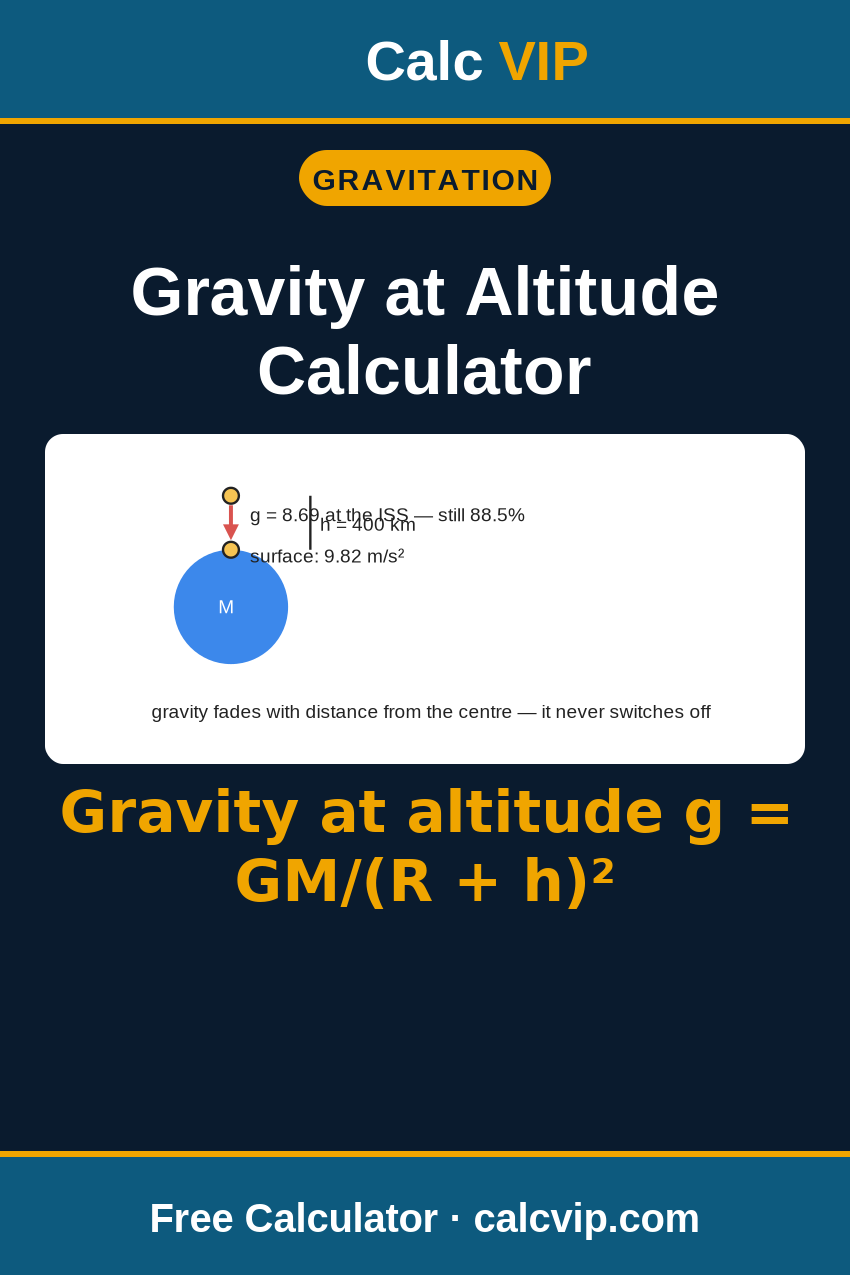
Because the distance is squared, the decline has a memorable rhythm: climb one full radius — 6,371 km for Earth — and g falls to a quarter; climb to where your centre distance has doubled again and it quarters once more. This page evaluates g at any altitude above Earth, the Moon, Mars or Jupiter, or around a custom body, and reports the surface value and the percentage remaining alongside, so the inverse-square fade is never just an abstraction.
Formula
Gravity at altitude g = GM/(R + h)², with G = 6.674 × 10⁻¹¹ N·m²/kg². At the surface (h = 0) it reduces to the familiar g = GM/R². The ratio form is the fastest way to think: g(h)/g(0) = (R/(R + h))² — the percentage remaining depends only on how the altitude compares with the radius. Because the distance is squared, gravity follows an inverse-square law: double your distance from the centre and g drops to one quarter; triple it and g drops to one ninth. Rearranged, the formula also solves for the altitude at which gravity reaches a chosen value: h = √(GM/g) − R.
| Symbol | Meaning | Units |
|---|---|---|
| g | gravitational field strength / acceleration due to gravity | m/s² (equivalently N/kg) |
| G | universal gravitational constant, 6.674 × 10⁻¹¹ | N·m²/kg² |
| M | mass of the planet | kilograms (kg) |
| R | radius of the planet | metres (m) in the formula; km in the tool |
| h | altitude above the surface | km in the tool |
Why astronauts float in 88.5% gravity
If the Space Station's gravity is nearly nine-tenths of what you feel reading this, why does everything aboard drift? Because weight is not gravity itself — it is the resistance to gravity. Standing on the ground, the floor pushes up against you, and that push is what your body senses as weight. In orbit, the station, the crew and the floating wrench beside them are all accelerating toward Earth at the same 8.69 m/s², with nothing pushing back. No push, no weight — even though gravity is doing some of its strongest work, bending the station's straight-line motion into a permanent circle.
Einstein elevated this observation into the equivalence principle: a freely falling laboratory is indistinguishable from one floating in deep space, and a rocket accelerating at 9.82 m/s² is indistinguishable from standing on Earth. Orbit is simply free fall that never lands, because the sideways speed — 7,672 m/s at the station's height — keeps carrying the faller past the planet's edge. The formula on this page gives the strength of the fall; the floating is what the fall feels like from inside.
How to use
- Pick a planet preset (Earth, Moon, Mars or Jupiter) or choose Custom and type its mass and radius — scientific notation like 5.972e24 works for the mass.
- Enter the altitude above the surface in kilometres; use 0 to recover the surface value itself.
- Click "Calculate Gravity" to see g at that height, the surface value for comparison, and the percentage of surface gravity that remains.
- Experiment with the inverse-square rhythm: try h equal to the planet's radius and confirm g has fallen to exactly a quarter of the surface figure.
Worked examples
Example 1 — the Space Station. Earth at h = 400 km:
g = GM/(R + h)² = 6.674 × 10⁻¹¹ × 5.972 × 10²⁴ / (6.771 × 10⁶)² ≈ 8.69 m/s² — still 88.5% of the surface value 9.82 m/s². Astronauts float because they are in continuous free fall, not because gravity is absent.
Example 2 — one full radius up. Earth at h = 6,371 km, so the centre distance has doubled:
g = 9.82 / 2² = 2.45 m/s² — exactly a quarter, the inverse-square law in its purest form. A 70 kg person who weighs 687 N at the surface would weigh about 172 N there.
Example 3 — the summit of Everest. h = 8.849 km:
g ≈ 9.79 m/s², a mere 0.3% below the sea-level value. Climbers are not noticeably lighter at the top of the world — their struggle is oxygen, not gravity — and precision gravimeters, not bathroom scales, are needed to detect the difference.
Example 4 — standing on Mars. Mars preset, h = 0 (M = 6.417 × 10²³ kg, R = 3,389.5 km):
g ≈ 3.73 m/s², about 38% of Earth's. A 70 kg astronaut weighs 687 N at home but only about 261 N on Mars — light enough for the famous bounding gait, heavy enough to walk rather than float.
Example 5 — a lunar orbit. The Moon at h = 100 km (M = 7.348 × 10²² kg, R = 1,737.4 km):
g ≈ 1.45 m/s², down from the surface's 1.62 m/s². The Moon's small radius means altitude bites faster there: climb just one lunar radius and g is already down to 0.41 m/s².
Example 6 — up at geostationary height. Earth at h = 35,869 km:
g ≈ 0.223 m/s², just 2.3% of the surface value. Yet even this whisper of gravity is precisely what holds geostationary satellites in their circle — at that distance, 0.223 m/s² of inward pull is exactly the centripetal acceleration a 24-hour orbit requires.
Gravity at altitude in real life
Explaining weightlessness honestly. This page is the antidote to the "zero gravity in space" myth. Teachers use the ISS figure — 8.69 m/s² — to show that orbit is free fall, and that "microgravity" aboard the station refers to tiny residual accelerations, not the absence of Earth's pull.
Gravimetry and prospecting. Survey instruments measure g to one part in a billion from aircraft and satellites. The altitude correction from this formula must be removed from every reading before the tiny anomalies that betray ore bodies, aquifers and magma chambers can be seen — the fade with height is the background the whole science subtracts.
Satellite drag planning. At 400 km, gravity is strong but so, relatively, is the remaining atmosphere. Mission designers combine this page's g with drag models to predict how fast an orbit decays — the station needs periodic reboosts precisely because it flies low, where g and air are both still substantial.
High-altitude flight and jumps. At airliner cruising height (11 km) g is 9.79 m/s² — a 0.3% discount no passenger notices. Felix Baumgartner's 39 km jump began at g ≈ 9.70 m/s²; the physics of his fall was Earth's gravity at 99% strength plus almost no air.
Designing for other worlds. Landers and habitats are engineered against the destination's surface g from this same formula: Mars at 3.73 m/s² dictates spring rates, ladder designs and dust behaviour; the Moon's 1.62 m/s² dictated the Apollo astronauts' loping stride.
Why the Moon stays. At the Moon's distance, Earth's g has faded to about 0.0027 m/s² — three thousandths of a metre per second squared. It sounds like nothing, yet applied continuously it bends the Moon's path into its monthly orbit. Gravity's infinite reach, however diluted, is never zero.
Inside the planet: where the formula turns around
The equation g = GM/(R + h)² describes the world outside a planet. Descend into a mine or a borehole and a different rule takes over: the shell of rock above you cancels out (Newton's shell theorem), and only the mass beneath your feet counts. For a planet of uniform density, g would shrink in direct proportion to your depth's remaining radius — at Earth's centre it reaches zero, the one place gravity truly vanishes, pulled equally in every direction. Earth is not uniform — its core is far denser than its crust — so in reality g actually rises slightly through the mantle, peaking near 10.7 m/s² at the core boundary before plunging to zero at the centre. The altitude formula and the depth rule meet at the surface, each sovereign on its own side.
The half-percent that isn't altitude: latitude, spin and rock
Altitude is not the only editor of surface gravity. Because Earth spins, a person at the equator is flung gently outward, relieving gravity by about 0.034 m/s²; because the planet bulges, that same person stands 21 km farther from the centre than a person at the pole, weakening gravity further. Combined, sea-level g runs from about 9.780 m/s² at the equator to 9.832 m/s² at the poles — a spread of roughly half a percent, equivalent to climbing some 16 km of altitude without leaving the ground. A 70 kg traveller's scale reading changes by about 0.37 kg between Quito and the North Pole, an effect precision scales, Olympic weightlifting calibrations and gravimeter surveys all quietly account for. The calculator's single surface value (9.82 m/s²) is the global mean of this small map, which is the right anchor for the altitude formula: once you are kilometres up, the inverse-square fall-off dwarfs the latitude ripples below.
Those ripples are themselves a science. Instruments called gravimeters — sensitive to one part in a billion of g — map the tiny anomalies caused by ore bodies, salt domes, aquifers and magma chambers, turning surface-gravity surveys into X-rays of the shallow Earth. The same measurements from orbit (the GRACE satellites and their successors) weigh groundwater loss and ice-sheet melting by their gravitational fingerprints. All of it is bookkeeping on the quantity this page varies with altitude: g is never just a constant, it is a field — and this calculator traces its smoothest, largest-scale feature, the fall-off with height.
Quick reference: Earth's g by altitude
| Altitude | g | % of surface |
|---|---|---|
| 0 km (surface) | 9.82 m/s² | 100% |
| 100 km (Kármán line) | 9.52 m/s² | 96.9% |
| 400 km (ISS) | 8.69 m/s² | 88.5% |
| 1,000 km | 7.34 m/s² | 74.7% |
| 2,640 km (half-gravity height) | 4.91 m/s² | 50.0% |
| 6,371 km (one radius up) | 2.45 m/s² | 25.0% |
| 10,000 km | 1.49 m/s² | 15.1% |
| 35,869 km (GEO) | 0.223 m/s² | 2.3% |
Surface values for the other presets: Moon 1.62 m/s², Mars 3.73 m/s², Jupiter 25.92 m/s² — Jupiter's gravity at its cloud tops exceeds anything in human experience by a factor of 2.6, and its altitude fade is correspondingly slower in percentage terms because its radius is so large.
The surveyor's version: the free-air correction
Geophysicists use this page's derivative daily. Differentiating g = GM/r² gives a surface gradient of 2g/R ≈ 0.308 milligals per metre of elevation — the "free-air correction" applied to every land gravity survey before its readings can be compared: measure on a hill 100 m up and your g is about 31 milligals lower for altitude alone, before the hill's own rock adds its say (the Bouguer correction handles that). Oil, mineral and groundwater exploration all begin by stripping this predictable altitude effect away so the unpredictable geology underneath can speak. The same gradient, run in reverse, is how satellite altimetry missions convert between the orbit heights they measure and the surface gravity field they map.
Buying weightlessness by the second: drop towers and parabolic flights
Because free fall cancels gravity at any altitude, researchers rent weightlessness close to home. The Bremen drop tower, 146 m tall, offers about 4.7 seconds of microgravity per drop — 9.3 seconds in catapult mode — inside a capsule falling down its evacuated tube, at full surface gravity the whole time. Parabolic aircraft flights stretch the same trick to 20–30 seconds per arc. These facilities exist precisely because of the fact this page quantifies: altitude alone will never give you weightlessness on human scales — g at the ISS's height is still 88.5% — but falling, at any height, gives it perfectly.
Common mistakes
- Saying gravity is zero in orbit. At the Space Station it is 8.69 m/s². Weightlessness is free fall, not missing gravity — if g truly vanished, orbits would be impossible and the Moon would leave.
- Squaring the altitude instead of the centre distance. The denominator is (R + h)², not h² and not R² + h². At h = 400 km the difference between using 400 and 6,771 is the difference between nonsense and 8.69 m/s².
- Expecting a linear decline. g does not drop by a fixed amount per kilometre; it drops by a fixed factor per doubling of distance. The first 400 km costs 11.5%, the next doubling of distance costs 75%.
- Forgetting rotation and shape. This formula gives pure gravitational g for a spherical planet. Measured surface gravity also reflects Earth's spin (up to 0.3% less at the equator) and its equatorial bulge — small corrections that precision work must add.
- Applying the formula underground. Below the surface the shell theorem takes over and g follows the interior mass, not GM/r² with the full M. The formula's domain is h ≥ 0.
FAQ
At what height is gravity half as strong?
When (R + h) = R√2, i.e. h ≈ 0.41 × R — about 2,640 km above Earth.
Is gravity zero on the space station?
No — it is about 8.7 m/s² up there, nearly 90% of the surface value. Weightlessness comes from free fall, not from missing gravity.
Why does the formula use R + h?
Newton's law measures distance from the planet's centre, so the surface radius must be added to the altitude above the ground.
How high must I go to feel half my weight?
Weight follows g, so you need g halved: (R + h) = R√2, giving h ≈ 2,640 km above Earth — far above the Space Station. And even there you would only "feel" it if something held you up; in free fall you would feel nothing at any height.
Does g depend on the mass of the falling object?
No. g = GM/(R+h)² contains only the planet's mass and the geometry. A hammer and a feather accelerate identically in this field — as Apollo 15's famous lunar demonstration showed, in vacuum at least.
Why is Earth's surface g quoted as both 9.81 and 9.82?
It varies with latitude and local geology, from about 9.78 at the equator to 9.83 at the poles; 9.81 is the conventional standard value, while this calculator's spherical-Earth constants give 9.82. All three are "right" for their definitions.
At what altitude does gravity become truly negligible?
Never, strictly — the inverse-square law reaches zero only at infinity. Practically, at the Moon's distance Earth's pull is 0.0027 m/s², and beyond that the Sun's field takes over as the dominant influence on spacecraft.
Is g at the top of a skyscraper measurably less?
At 500 m the reduction is about 0.016% — roughly 0.0015 m/s². Precision gravimeters detect it easily (it is a routine correction in their readings); your bathroom scale, which cannot resolve one part in ten thousand, cannot.
Why does Jupiter's surface gravity (25.92) not dwarf Earth's more?
Jupiter has 318 times Earth's mass, which alone would multiply g by 318 — but its radius is 11 times larger, and the squared radius divides by 121. The net is 318/121 ≈ 2.6. Big planets dilute their own gravity with their size.
Can gravity at altitude be stronger than at the surface?
Not above a spherical planet — the formula falls monotonically. Locally, though, dense rock formations can make g at one surface point exceed the value at a nearby higher point; those anomalies are the signal gravimetry hunts for.