 Calc
Gravity Field Solver – Find a Planet's Mass from g and Radius
 Created by Priya Sharma · Physics Editor · Energy & Gravity · Last updated: November 2026
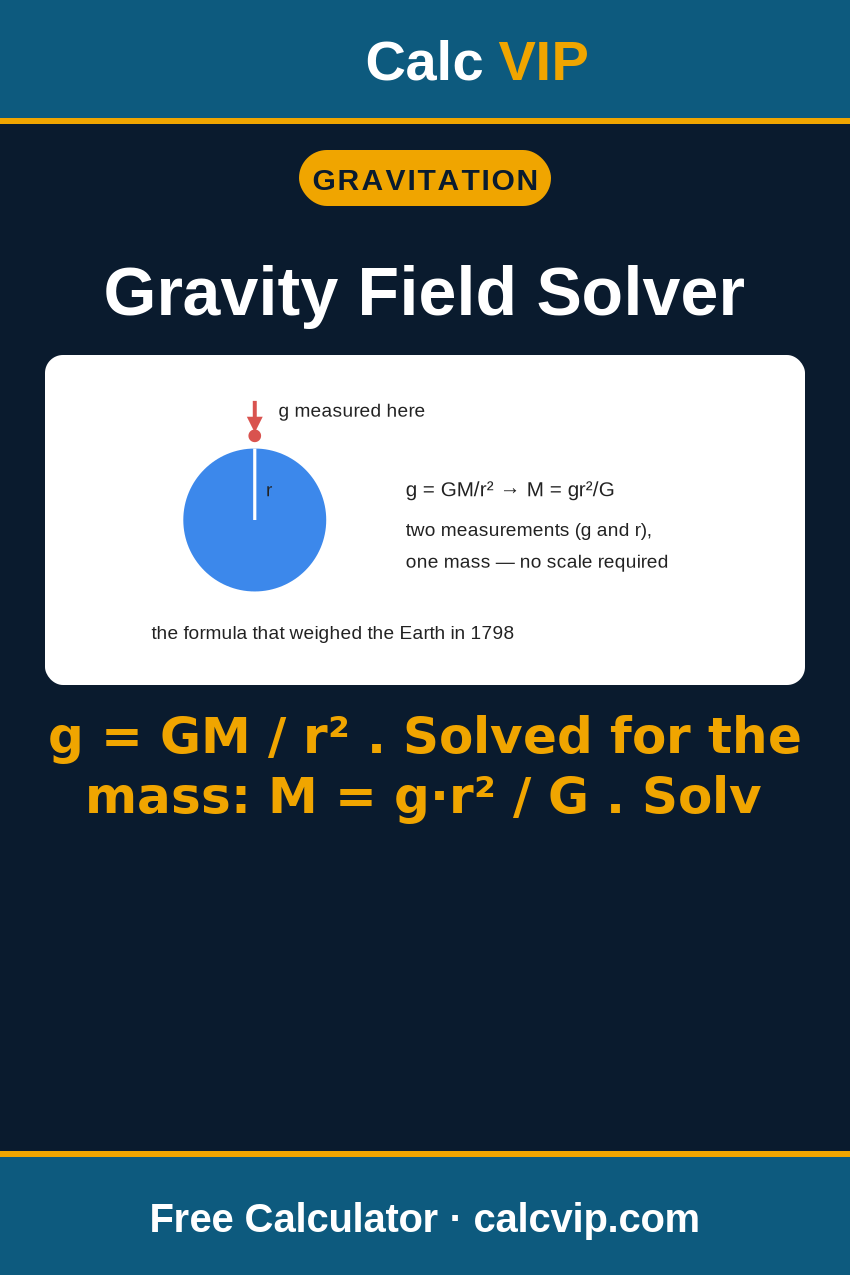
Use this free Gravity Field Solver to work a planet's mass out of its gravity. If you know the surface gravity g and the radius r, then M = gr²/G — this is how planets that have never been visited get "weighed".
Weigh a planet by standing on it. That is the quiet magic of this calculator: Newton's law of gravitation, g = GM/r², runs in both directions. Point it forward and it predicts how hard a world pulls on its surface; point it backward — enter the measured surface gravity and the radius — and it returns the world's mass, a number no scale could ever hold. This solver works the law in both directions, either computing a body's mass from its surface gravity and radius, or computing its surface gravity from a known mass and radius, with presets for Earth, the Moon, Mars and Jupiter and a custom mode for any world you can imagine.
The backward direction is how most of the solar system's masses were first found. Cavendish's 1798 tabletop experiment measured G itself — "weighing the Earth", as he put it — and from that moment, any world whose surface gravity and radius could be measured surrendered its mass to a two-line calculation. Drop experiments and pendulum timings gave g; eclipse shadows and parallax gave r; the multiplication gave M. Modern spacecraft refine the same arithmetic by tracking how their orbits bend, but the formula on this page remains the conceptual core: gravity at the surface is the planet's mass, divided by its radius squared, wearing a G.
Because g depends on M/r², worlds of wildly different size can share the same surface pull — a small dense world and a large fluffy one can feel identical underfoot — and that degeneracy is a feature: combining this page's mass with a radius measurement yields the mean density, M ÷ (4/3)πr³, the single most revealing number about a planet's interior. Rock, metal, ice and gas each occupy their own density band, so a mass from surface gravity plus a radius from a telescope amounts to an X-ray of a world nobody has ever touched.
Formula
Newton's law of gravitation evaluated at the surface: g = GM / r². Solved for the mass: M = g·r² / G. Solved for the radius (used in our other gravitation tools): r = √(GM/g). All three are the same law wearing different algebra, with G = 6.674 × 10⁻¹¹ N·m²/kg². A useful companion: the body's mean density follows from the mass, ρ = M / (4/3 π r³) = 3g / (4πGr) — surface gravity and radius alone determine it, no separate mass step needed.
| Symbol | Meaning | Units |
|---|---|---|
| g | surface gravity (field strength at r) | m/s² (or N/kg) |
| M | mass of the body | kilograms (kg) |
| r | radius of the body (distance from centre to surface) | metres (m) |
| G | universal gravitational constant, 6.674 × 10⁻¹¹ | N·m²/kg² |
| ρ | mean density, M ÷ (4/3 π r³) | kg/m³ |
Density: the free extra answer hidden in g and r
Run the numbers for Earth: g = 9.82 m/s² and r = 6,371 km give a mean density of about 5,514 kg/m³. But surface rocks run 2,700–3,300 kg/m³ — barely half. The discrepancy is a deduction about the unseen interior: somewhere below, material far denser than any surface rock must compensate, and seismology confirms it — an iron-nickel core at 10,000–13,000 kg/m³. The Moon tells the opposite story: its g and r give 3,335 kg/m³, essentially the density of its surface rocks throughout, meaning no large iron core — a clue that the Moon is made of Earth's lighter outer layers, exactly as the giant-impact origin story predicts. Two measurements anyone can make from outside, and the deep structure of worlds falls out. Exoplanet science runs on this: a transit gives r, a stellar wobble gives M, and the density sorts the planet into rocky, watery or gassy before any probe could dream of visiting.
The same relation polices the gas giants. Jupiter's mass from this solver is enormous — 318 Earths — yet its mean density is only 1,330 kg/m³, barely above water, because its radius grew even faster than its mass. Saturn goes further: 687 kg/m³, less dense than water. Surface gravity alone would never tell you this; g for Saturn is a mild 11.19 m/s². It is always the combination — mass from gravity, volume from radius — that reveals what a world is made of.
How to use
- Choose a mode: Find Mass (from surface gravity and radius) or Find Surface Gravity (from mass and radius).
- Pick a preset — Earth, Moon, Mars or Jupiter — to load its known values, or choose Custom and type your own.
- In Find Mass mode, enter g in m/s² and the radius in kilometres; in Find Gravity mode, enter the mass in kilograms (scientific notation such as 5.972e24 works) and the radius in kilometres.
- Click "Solve" and read the result: the mass in kg (with an Earth-masses comparison), or the gravity in m/s² (with an Earth-g comparison).
- Optional enrichment: divide the mass by 4/3 π r³ to get the mean density and classify the world's interior.
Worked examples
Example 1 — the Moon's mass from its surface gravity. Mode: Find Mass. g = 1.62 m/s², radius = 1,737.4 km:
M = g r² / G = 1.62 × (1.7374 × 10⁶)² / 6.674 × 10⁻¹¹ ≈ 7.33 × 10²² kg — against the accepted 7.35 × 10²² kg. Two surface measurements recover the mass of the Moon to within the rounding of the inputs.
Example 2 — Earth weighs itself. g = 9.82 m/s², r = 6,371 km:
M = 9.82 × (6.371 × 10⁶)² / G ≈ 5.972 × 10²⁴ kg — the accepted mass of the Earth, from a dropped ball's acceleration and a radius known since Eratosthenes.
Example 3 — Mars. g = 3.73 m/s², r = 3,389.5 km:
M ≈ 6.42 × 10²³ kg, matching the accepted 6.417 × 10²³ kg. Mars is about a tenth of Earth's mass — which is why its surface gravity, helped by its smaller radius, still reaches a comparatively healthy 38% of ours.
Example 4 — forward mode: Jupiter's gravity. Mode: Find Surface Gravity. M = 1.898 × 10²⁷ kg, r = 69,911 km:
g = GM/r² ≈ 25.92 m/s² ≈ 2.64 g. Three hundred eighteen Earth masses of pull, diluted by an eleven-Earth radius squared — the forward calculation shows exactly where the famous 2.64 comes from.
Example 5 — Europa, an ocean moon. g = 1.315 m/s², r = 1,560.8 km:
M ≈ 4.80 × 10²² kg, the accepted mass of Europa. Its implied mean density (≈ 3,010 kg/m³) says rock plus a substantial water-ice shell — the calculation behind the famous subsurface ocean.
Example 6 — a hypothetical exoplanet. A transit-and-wobble survey reports a planet with surface gravity 12.5 m/s² and radius 8,000 km:
M = 12.5 × (8 × 10⁶)² / G ≈ 1.20 × 10²⁵ kg ≈ 2.01 Earth masses, and its density (≈ 5,590 kg/m³) is unmistakably rocky — a super-Earth of Earth-like composition, classified from two numbers.
Gravity solving in real life
Weighing asteroids before visiting them. A spacecraft's radio signal bends measurably as it orbits a small body; the bending yields GM, and with the radius from cameras, this page's relation gives the mass and density — how OSIRIS-REx knew Bennu's rubble-pile nature (density ≈ 1,190 kg/m³) before touching it.
Exoplanet triage. Thousands of known exoplanets have a radius (from transits) and a mass (from wobbles). Their densities — computed exactly as in the density section above — sort them into rocky worlds, water worlds and mini-Neptunes, deciding which deserve precious telescope time.
Planetary defence. An asteroid's deflection requirement scales with its mass. When a new potentially hazardous object is found, its size comes from telescopes, but its mass — and therefore the push needed — comes from density estimates rooted in this formula's family.
Designing landers. A lander's legs, parachutes and terminal descent are built around the destination's g — computed in forward mode from the mass and radius long before arrival, and confirmed by tracking during approach.
Verifying G itself. The formula's weak point is G, known to only about five significant figures — the worst-measured fundamental constant. Modern torsion-balance and atom-interferometry experiments are, in effect, running this solver backward on laboratory masses to pin G down.
Moon and Mars resource planning. Regolith handling, drilling torque and habitat engineering all scale with local g; mission planners use forward-mode values for worlds (like Ceres, g = 0.28 m/s²) where no astronaut has yet stood to measure directly.
Where the simple formula bends: rotation and shape
The solver assumes a spherical, non-rotating body, and real planets politely disagree. Rotation subtracts a centrifugal term that peaks at the equator: Earth's spin relieves equatorial gravity by about 0.034 m/s², roughly a third of a percent. The resulting bulge adds a second effect — the equator is 21 km farther from the centre, weakening gravity there again — so a scale reads measurably less in Quito than in Helsinki (about 9.78 versus 9.83 m/s²) even before local geology speaks. Fast rotators exaggerate everything: Jupiter's 10-hour spin and huge bulge make its effective polar gravity substantially stronger than its equatorial value. Precision work therefore quotes a planet's GM (known superbly from spacecraft tracking) and a reference radius, and treats "surface gravity" as a small map rather than a single number. For the estimates this page is built for, the spherical answer is the right backbone — just know which decimal place the planet's spin starts to edit.
Chaining the solvers: from g and r to escape velocity
A mass from this solver unlocks the rest of this site's gravitation toolkit, because escape velocity can be written purely in surface terms: v = √(2gR). Try it on Europa — g = 1.315 m/s², R = 1,560.8 km — and out comes √(2 × 1.315 × 1.5608 × 10⁶) ≈ 2,026 m/s, Europa's accepted escape velocity, obtained without ever using its mass. Titan, Saturn's great moon: g = 1.352 m/s², R = 2,574.7 km gives ≈ 2,639 m/s — and comparing that with Titan's frigid molecular speeds explains its thick nitrogen atmosphere, the only substantial one any moon possesses. The chain runs the other way too: a measured escape velocity plus a radius returns g, and hence the mass. Surface gravity is the hub quantity of small-world physics, and this solver is where it is minted.
Push the forward mode to its limit and you meet the extremes of matter. A neutron star of 1.4 solar masses squeezed into a 10 km radius has surface gravity g = GM/R² ≈ 1.9 × 10¹² m/s² — about two hundred billion Earth gravities, where a dropped object would reach relativistic speeds within metres and the escape velocity exceeds half the speed of light. The same two-line formula spans the fall of an apple and the crushing surface of a dead star; only the inputs change. That universality — one law, every scale — is precisely what Newton claimed for it in 1687.
Quick reference: masses recovered from g and r
| Body | g (m/s²) | Radius (km) | Mass from solver | Mean density |
|---|---|---|---|---|
| Earth | 9.82 | 6,371 | 5.972 × 10²⁴ kg | 5,514 kg/m³ |
| Moon | 1.62 | 1,737.4 | 7.33 × 10²² kg | 3,335 kg/m³ |
| Mars | 3.73 | 3,389.5 | 6.42 × 10²³ kg | 3,940 kg/m³ |
| Jupiter | 25.92 | 69,911 | 1.898 × 10²⁷ kg | 1,330 kg/m³ |
| Europa | 1.315 | 1,560.8 | 4.80 × 10²² kg | 3,010 kg/m³ |
| Ganymede | 1.428 | 2,631.2 | 1.48 × 10²³ kg | 1,940 kg/m³ |
Every mass in the fourth column comes from just the two columns before it — and the density column, Earth's iron heart and Europa's ocean included, follows for free.
A scaling law worth keeping: same density, gentler growth
One elegant consequence hides in the two formulas. For a family of worlds with the same density, radius grows as M1/3, so surface gravity grows only as M1/3 too — double the mass at fixed density and g rises by just 26%. An Earth-composition planet of two Earth masses would have R ≈ 1.26 REarth and g ≈ 12.37 m/s², not the 19.6 m/s² of naive doubling. This is why the rocky exoplanets several times Earth's mass are not the crushing environments intuition suggests: size dilutes mass, and this solver's two equations are the whole argument.
Common mistakes
- Entering the diameter instead of the radius. Because r is squared, this single slip quadruples the mass. Check presets: Earth's radius is 6,371 km; 12,742 km is its diameter and will return a planet of four Earth masses.
- Forgetting the km → m conversion. The formula's G is in SI units, so r must be in metres. The tool converts for you; hand calculations that skip the conversion are wrong by 10⁶ after squaring — the loudest error in gravitation homework.
- Expecting g to scale with mass alone. Doubling a planet's mass while doubling its radius halves its surface gravity (M/r²). Comparisons between worlds are meaningless until both numbers are in hand.
- Treating the equatorial and polar values as one. Rotation and bulge make real surface gravity a range, not a point — up to ~0.5% on Earth and far more on Jupiter. Quote the spherical value as the mean and note the spread.
- Assuming a measured density names the composition uniquely. Density constrains but does not determine the interior: different mixtures of rock, metal and ice can average to the same number. It rules out whole families of interiors rather than certifying one.
FAQ
How is surface gravity measured for a distant planet?
From the wobble it causes in its moons' or spacecraft's orbits, and from how it bends their paths during flybys — the same physics, run through Kepler's laws.
Why do I need the radius as well as g?
Gravity at the surface mixes two effects: more mass pulls harder, but a bigger radius puts you further from the centre. Knowing both separates them and pins down M.
Can this find the mass at some height above the surface?
Yes — use the g measured at that height and set r to the full distance from the centre (radius + altitude).
How was G itself measured?
Henry Cavendish's 1797–98 torsion balance measured the twist caused by lead spheres attracting each other — a force of roughly 10⁻⁷ newtons — the weight of about ten micrograms of matter — and extracted G. Every mass in this page's tables descends from that tabletop measurement, refined by modern versions of the same experiment.
Can this find the mass of a star?
Not from surface gravity alone — a star's "surface" (photosphere) gravity is measurable spectroscopically, but its radius is the hard part. In practice stars are weighed by orbits (see our Binary Star Calculator), and this solver's method is reserved for planets, moons and asteroids with solid surfaces.
Why does the tool ask for radius in km but mass in kg?
Because that is how the data naturally arrives: radii are measured telescopically in kilometres, masses quoted in kilograms. The tool handles the conversions; the mixed inputs simply spare you two error-prone steps.
What surface gravity would a pure-iron Earth have?
Compressing Earth's radius at iron's density is not self-consistent, but the density shortcut shows the lever: at fixed radius, g scales with mean density — an all-iron Earth (ρ ≈ 7,900 kg/m³) at the same size would pull about 14 m/s². Composition reaches the surface through exactly this relation.
How do spacecraft measure a planet's mass better than this?
They track an orbiter's period and orbit radius and apply Kepler's law to get GM to many decimal places — then divide by G. Ironically, GM is known far better than M itself, because G remains the least precise constant in the chain.
Does the atmosphere's mass count?
It is included in M — Earth's air adds about 5 × 10¹⁸ kg, a millionth of the total. For gas giants the "surface" itself is a convention (the 1-bar level), which is why their radii, and hence densities, carry a definitional footnote.
Could two planets have identical g but different masses?
Yes — any pair with the same M/r² ratio. A planet with 4× Earth's mass and 2× its radius has exactly Earth gravity. Surface gravity is a ratio wearing a single number's clothes, which is precisely why this solver needs both inputs.