 Calc
Impulse Calculator – J = F × t & Momentum Change
 Created by James Carter · Physics Writer · Forces & Motion · Last updated: November 2026
Use this free Impulse Calculator to find the impulse delivered when a force acts for a short time — like a bat hitting a ball. Enter the force and the contact time, and the calculator gives you the impulse in newton-seconds (N·s).
Most forces in sport and in accidents do not push steadily — they strike. A bat meets a ball for a few thousandths of a second, a fist lands, a car meets a barrier. In these violent instants the force is enormous but brief, and neither the force nor the time alone tells the story. What matters is the two multiplied together: the impulse. Impulse is the measure of how much a force, acting for a time, changes the motion of whatever it hits.
The reason impulse deserves its own name is a theorem: the impulse delivered to an object equals the change in its momentum, J = Δp. Momentum (p = mv) is the quantity of motion an object carries; impulse is how that quantity gets changed. Every throw, kick, catch and crash in the world is an impulse transaction — momentum handed over during a contact time, at a rate set by the force. If you know any two of force, time and momentum change, the third is yours.
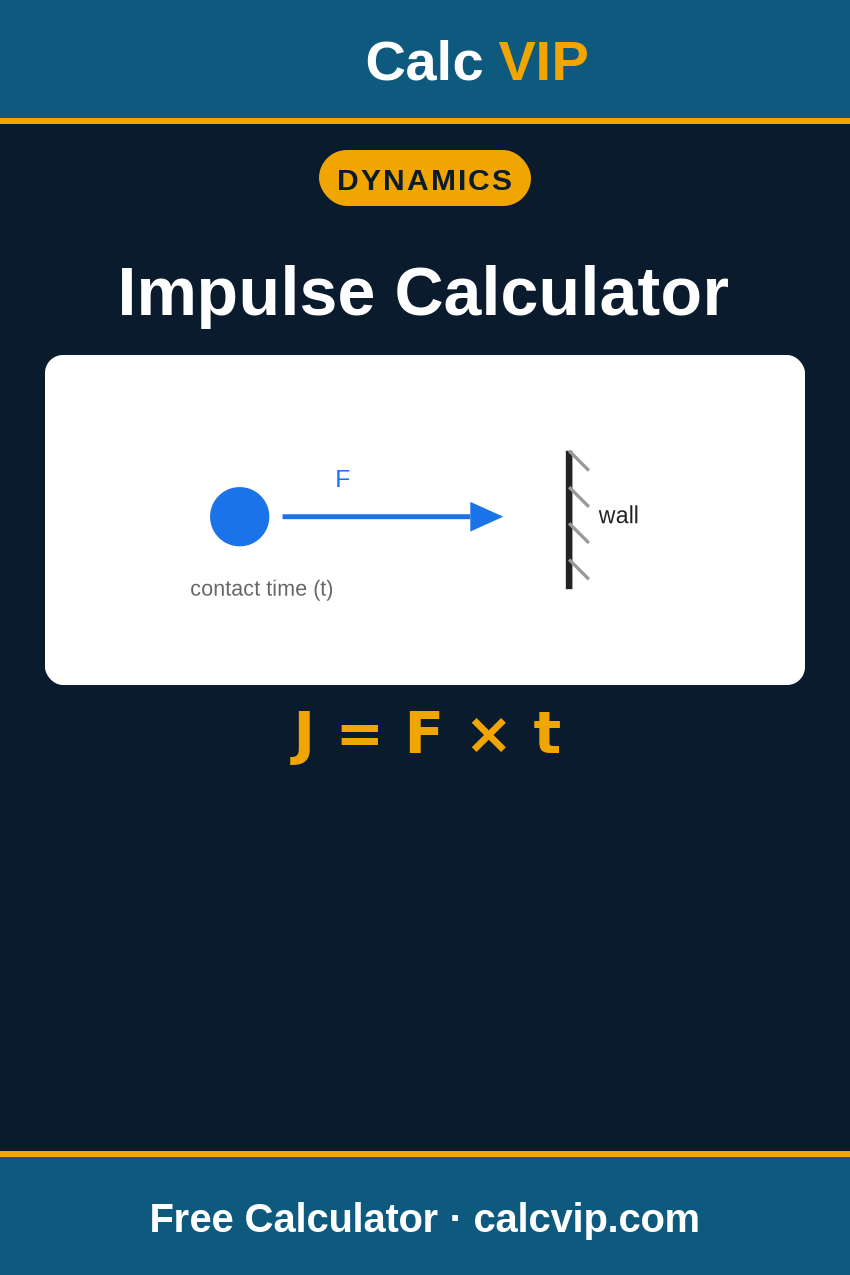
This dual nature makes impulse the key to two opposite arts. To launch something fast — a ball, a rocket, a sprinter from the blocks — you want the biggest impulse possible: a large force sustained for as long as contact allows. To stop something safely — a falling climber, a crashing car, a fragile egg — you want the same momentum change spread over the longest possible time, so the force at any instant stays survivable. One formula, two philosophies, and both are on this page.
Formula
Impulse = Force × Time → J = F × t
Impulse equals the change in momentum of the object (J = Δp). A bigger force, or the same force acting for longer, produces a bigger change in momentum. Written in its full form, the impulse–momentum theorem says J = F × t = m × v − m × u, where u is the starting velocity and v the final one. It rearranges naturally: the average force behind a known impulse is F = J ÷ t — an impulse of 60 N·s delivered in 0.4 s means an average force of 60 ÷ 0.4 = 150 N — and the velocity change of a known mass is Δv = J ÷ m.
Watch the units: newton-seconds and kilogram-metres per second are the same thing in disguise (a newton is a kg·m/s², so N·s = kg·m/s), which is exactly why impulse and momentum change can be set equal. When your calculation mixes them, the units are telling you the physics is right.
| Symbol | Meaning | Units |
|---|---|---|
| J | impulse | N·s (= kg·m/s) |
| F | force (average, if it varies) | newtons (N) |
| t | contact time | seconds (s) |
| Δp | change in momentum, equal to J | kg·m/s |
| m | mass | kilograms (kg) |
| Δv | change in velocity, Δv = J ÷ m | m/s |
Same impulse, very different force
Here is the insight that saves lives. A momentum change of 60 kg·m/s can be delivered as 150 N for 0.4 s, as 60 N for a full second, or as a brutal 600 N spike lasting 0.1 s — the impulse, and the final motion, are identical in all three, but the forces differ tenfold. Draw force against time and each version is a rectangle with the same area: tall and narrow, or low and wide. Impulse is that area. Safety engineering is the art of flattening the rectangle — stretching the time so the peak force falls — without changing the area, because the area is fixed by the momentum that must be removed.
How to use
- Enter the force in newtons (N).
- Enter the time the force acts, in seconds (s) — for hits and collisions this is often a fraction of a second.
- Click "Calculate Impulse" to see the result in newton-seconds.
- If a contact time is given in milliseconds, divide by 1000 first: 10 ms = 0.01 s.
Worked examples
Example 1 — a steady push. A force of 150 N acts for 0.4 s. Impulse = 150 × 0.4 = 60 N·s — so the object's momentum changes by 60 kg·m/s.
Example 2 — a football kick. A ball of mass 0.45 kg is kicked from rest to 20 m/s. The momentum change is Δp = 0.45 × 20 = 9 kg·m/s, so the boot must deliver an impulse of 9 N·s. If the boot stays in contact for about 0.01 s, the average force is 9 ÷ 0.01 = 900 N — roughly the weight of a 90 kg person, delivered in a hundredth of a second. Short contacts demand huge forces; that is the trade at the heart of every strike.
Example 3 — why the airbag wins. A driver of mass 70 kg travelling at 15 m/s must lose Δp = 70 × 15 = 1050 kg·m/s in a crash. Stopped by a hard dashboard in 0.1 s, the average force is 1050 ÷ 0.1 = 10,500 N. Stopped by an airbag and crumple zone over 0.5 s, it is 1050 ÷ 0.5 = 2100 N — the same impulse, one-fifth of the force, and the difference between injury and survival.
Example 5 — the boxer's punch, averaged. A punch lands with an average force of 1000 N over a contact of 0.01 s. J = 1000 × 0.01 = 10 N·s. Delivered to a 0.45 kg football, that impulse would change its velocity by 10 ÷ 0.45 ≈ 22.2 m/s — a respectable shot, produced by a force that lasted one hundredth of a second.
Example 6 — braking a car, impulse first. A 1000 kg car travelling at 20 m/s must shed Δp = 1000 × 20 = 20,000 N·s of impulse to stop. Spread over a calm 4-second stop, the brakes average 20,000 ÷ 4 = 5000 N. The impulse is non-negotiable; only its scheduling is — the entire philosophy of braking in one line.
Impulse in real life
Sport: follow-through and soft hands. Coaches preach follow-through because keeping the bat, racket or boot in contact longer stretches t, and a longer t at the same force means more impulse and a faster ball. Fielders do the reverse, letting their hands ride backwards with a catch: the ball's momentum change is fixed, so a longer stopping time means a gentler force — and no sting, no dropped catch.
Bungee jumping and climbing ropes. A falling climber's momentum must be removed by the rope. A stretchy dynamic rope extends the stopping time to a second or more, keeping the peak force within what bodies and anchors can bear; a steel cable would remove the same momentum in a blink, with forces that injure. The whole technology is impulse management.
Packaging. Foam around a phone does not change the momentum the phone must lose when dropped — it lengthens the stopping time, cutting the peak force below the screen's breaking point. Egg-drop competitions at school are, formally, impulse-spreading contests.
Example 4 — catching an egg without breaking it. An egg of mass 0.05 kg arrives at 10 m/s, carrying momentum 0.05 × 10 = 0.5 kg·m/s that your hands must remove. Grab it stiffly in 0.02 s and the force averages 0.5 ÷ 0.02 = 25 N — the shell fails. Cushion the catch over 0.25 s and the force drops to 0.5 ÷ 0.25 = 2 N, and breakfast survives. Same impulse, kinder force.
Helmets: foam as a time machine. A cycle helmet's foam crushes over a few extra milliseconds when the head strikes the ground. The head's momentum change is fixed by the fall; the foam's gift is purely time, and since F = J ÷ t, those milliseconds cut the peak force on the skull severalfold. A helmet is an impulse-scheduling device worn on the head.
Landing mats and bent knees. Gymnasts land on mats, and parachutists roll, for the same reason: both extend the stopping time of a body arriving with momentum. A stiff-legged landing from a metre's drop stops the body in perhaps 0.02 s; a deep, rolling landing stretches it towards half a second — a twenty-five-fold cut in average force for the identical impulse.
Impulse from a graph, and bouncing
Real impact forces are not constant — they rise and fall in a spike. For a varying force, impulse is the area under the force–time graph, and the "average force" this calculator uses is the height of the equivalent flat-topped rectangle. One more subtlety: direction counts. A ball that hits a wall at 5 m/s and bounces back at 5 m/s has not changed its speed at all, yet its momentum has flipped sign, so Δp = mv − m(−v) = 2mv — the wall delivered twice the impulse needed merely to stop the ball. Bouncing is the most expensive thing a collision can do, which is why a ball dropped on concrete jumps back so eagerly and why catching drills teach you to kill the bounce.
Impulse in rockets
Rocket engineers live by impulse: an engine's total impulse is its thrust multiplied by its burn time, and that total decides how much the rocket's momentum — and therefore its velocity — can change. A modest thrust sustained for minutes can out-perform a violent thrust that lasts seconds, which is why ion engines, producing a whisper of force for months on end, eventually push deep-space probes to remarkable speeds. Small force, enormous time, serious impulse.
Impulse in collisions between objects. When two objects collide, each delivers an impulse to the other \u2014 and by Newton's third law those two impulses are equal in size and opposite in direction, so the total momentum of the pair comes through the collision unchanged. What one object loses, the other gains, exactly. This is why momentum conservation and impulse are really a single idea seen from two sides, and why physicists reach for impulse whenever the forces in a collision are too brief and violent to measure directly.
Average force, peak force, and the triangle between them
Real forces are not the tidy constants of Example 1; they rise, crest and fall. For a typical impact the force–time graph is roughly a triangle, and the impulse — the area under it — is J = ½ × peak force × contact time. A bat–ball contact peaking at 1200 N for 0.01 s therefore delivers J = ½ × 1200 × 0.01 = 6 N·s, not the 12 N·s a careless peak-times-time multiplication would claim. When a problem or a datasheet quotes a single force for an impact, ask which one it is: the average (impulse ÷ time) is the honest currency of this page, and peaks commonly run at twice the average.
Instruments respect the distinction. Crash-test dummies and smart balls record the whole force–time curve, because injury and performance live in its shape: two impacts with the same impulse can have utterly different peaks, and it is the peak that breaks bones and bats. Impulse tells you how much momentum moved; the curve tells you how roughly it was handled on the way.
Quick reference: impulses at human scale
Notice how the table's impulses cluster: a kick, a punch and an egg catch all live between 0.5 and 10 N·s, while stopping a car demands thousands. The force column is absent on purpose — it cannot be filled in until each impulse is given its time, which is the whole lesson of this page.
| Event | Impulse |
|---|---|
| catching an egg (Ex. 4) | 0.5 N·s |
| football kick (Ex. 2) | 9 N·s |
| boxer's punch (Ex. 5) | 10 N·s |
| driver stopped in a crash (Ex. 3) | 1050 N·s |
| car braking from 20 m/s (Ex. 6) | 20,000 N·s |
The thirty milliseconds that decide a crash
A car crash, timed honestly, is over in about a tenth of a second — and the entire safety industry is an argument about how to spend it. The impulse is fixed the moment the speeds are set: Example 3's driver must shed 1050 N·s regardless of the car he bought. What the car chooses is the shape of those milliseconds — whether the force arrives as a single spike against a dashboard or as a long, managed push through belt, bag and crumpling steel.
Modern structures choreograph the pulse deliberately: soft initial contact, a plateau while the crumple zones fold, a gentle tail as the last momentum drains. Engineers plot the force–time curve the way cardiologists plot a heartbeat, and for the same reason — the area under it is fixed, so survival depends on the shape. Impulse is the diagnosis; time is the treatment.
Common mistakes
- Leaving contact times in milliseconds. Bat–ball contact of 10 ms is 0.01 s. Using 10 in the formula inflates the impulse a thousandfold.
- Calling impulse a force. Impulse is force × time, measured in N·s. A huge force for a tiny time and a small force for a long time can deliver identical impulses.
- Forgetting direction in bounces. If the object rebounds, its velocity changes sign, and the momentum change is larger than the incoming momentum — up to double for a perfect bounce.
- Assuming the force is the peak force. F × t with a single F uses the average force over the contact. Real impacts spike higher in the middle; designs must allow for the peak.
- Multiplying the peak force by the time. If 1200 N is the peak of a triangular impact lasting 0.01 s, the impulse is ½ × 1200 × 0.01 = 6 N·s, not 12. F × t wants the average force; using the peak doubles the answer.
FAQ
How is impulse different from momentum?
Momentum (p = mv) is what a moving object "has"; impulse is what a force "delivers" over time, and it equals the change in momentum: J = Δp.
Why do airbags and crumple zones save lives?
They increase the stopping time. For the same change in momentum, a longer time means a smaller force — and it is the force that injures people.
What are the units of impulse?
Impulse is measured in newton-seconds (N·s), which is exactly the same as kg·m/s, the unit of momentum.
Why does follow-through help in sport?
It lengthens the contact time between bat, racket or foot and the ball. More time at a similar force means more impulse, a bigger momentum change, and a faster departing ball.
Can impulse be negative?
Yes. If the force acts opposite to the chosen positive direction — braking, or a force slowing an object down — the impulse and the momentum change are negative. The sign records direction, not size.
How do I find the impulse if the force keeps changing?
Use the area under the force–time graph, or equivalently the average force multiplied by the total time. Both give the same impulse and the same momentum change.
Does a longer contact time always reduce the force?
For a fixed momentum change, yes — F = J ÷ t, so doubling the time halves the average force. That is the entire principle behind padding, crumple zones, bent knees on landing and soft hands in catching.
How much impulse does gravity deliver during a fall?
Gravity is a force like any other, so falling is impulse accumulating: a 2 kg object falling for 1 second receives J = mg × t = 2 × 9.81 × 1 = 19.62 N·s, which is exactly its momentum on arrival (2 × 9.81 = 19.62 kg·m/s). The impulse–momentum theorem and the fall formulas agree, as they must.
Why do cricketers and baseball players "give" with a catch?
Drawing the hands backwards extends the contact time while the ball's momentum falls to zero. Same impulse, longer time, smaller force — and the ball is less likely to bounce out, because a gentler force is also a more controllable one.
Can an impulse be delivered without touching?
Yes — any force delivers impulse while it acts, contact or not. Gravity during a fall, a magnet pulling a nail, a rocket's exhaust pushing from a distance of hot gas: each is F × t quietly rewriting a momentum, no handshake required.