 Calc
Electric Potential Energy Calculator – U = kq1q2/r in Joules & eV
 Created by Rachel Novak · Senior Editor · All Topics · Last updated: November 2026
Use this free Electric Potential Energy Calculator to find the potential energy stored between two point charges. The answer is given in joules and in electron-volts (eV). Charges are tiny, so you can type them in scientific notation — for example 1e-6 means one microcoulomb (0.000001 C).
Potential energy is the memory of work. When you push two repelling charges towards each other, the effort does not vanish — it is stored in the arrangement itself, in the electric field stretched between them, ready to be paid back the moment you let go. U = kq1q2/r is the bookkeeping of that storage for the simplest possible system: two point charges, a distance r apart, with nothing else in the universe. It is one of the foundational formulas of physics, because the same 1/r energy governs electrons bound in atoms, protons fused in stars and ions locked in crystals.
The formula's sign carries its meaning. Charges of the same sign give positive U: the system is like a compressed spring, loaded with energy you supplied, and it will spend that energy flying apart if released. Opposite signs give negative U: the pair is bound, sitting in an energy well, and you must pay energy in to separate them. Zero is set at infinite separation — the natural reference, where the charges no longer know about each other. Every value of U is therefore a comparison: how much better or worse off the pair is here than it would be infinitely far apart.
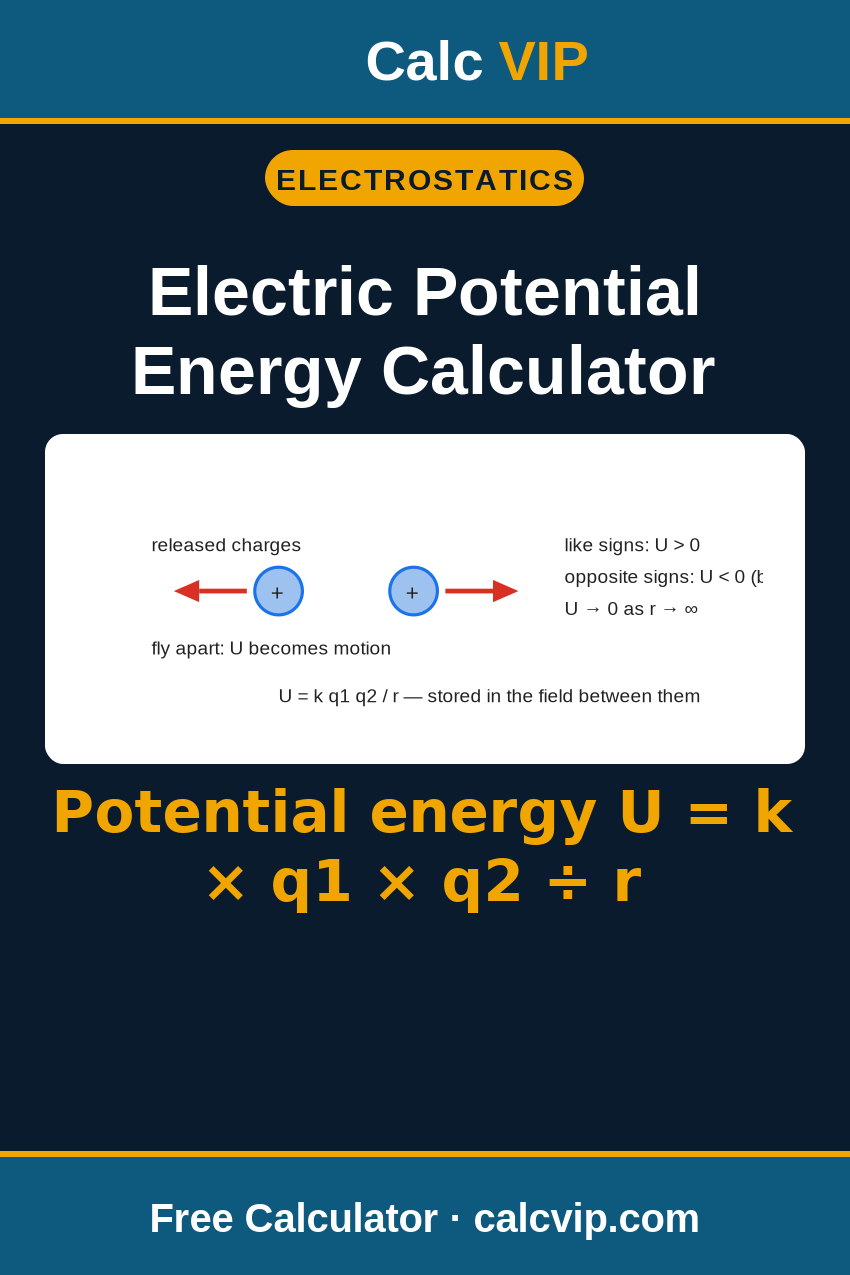
Notice what is absent from the formula: any mention of path, speed or history. The stored energy depends only on the two charges and their separation right now — carry them together by any route, fast or slow, and the same energy is banked. This path-independence is what makes potential energy such a powerful tool: whole problems that would be nightmares of changing forces collapse into a single subtraction, U(final) − U(initial). This calculator evaluates the stored energy for any pair of charges, in joules for the everyday world and in electron-volts for the atomic one.
Formula
Potential energy U = k × q1 × q2 ÷ r • U in joules (J), charges in coulombs (C), r in metres (m), k = 8.99 × 10⁹ N·m²/C²
The formula rearranges to r = k × q1 × q2 ÷ U (the separation at which a pair holds a chosen energy) and to q2 = U × r ÷ (k × q1). To convert joules to electron-volts, divide by 1.602 × 10⁻¹⁹ — the calculator does both units for you. U connects to the rest of electrostatics through two bridges: the force is its rate of change with distance, F = kq1q2/r² (one extra power of r, because force is energy's slope), and the potential at q2's location due to q1 is V = kq1/r, so that U = q2 × V — the energy is the second charge multiplied by the landscape the first one built. For systems of three or more charges, U is the sum over every pair, each pair counted once.
| Symbol | Meaning | Units |
|---|---|---|
| U | electric potential energy of the pair | joules (J), or eV |
| q1, q2 | the two charges (signs included) | coulombs (C) |
| r | distance between the charges' centres | metres (m) |
| k | Coulomb constant, 8.99 × 10⁹ | N·m²/C² |
| eV | electron-volt, 1 eV = 1.602 × 10⁻¹⁹ J | energy |
Where the energy actually lives
It is tempting to say the energy "belongs" to the charges, but physicists locate it in the electric field itself — in the space between and around them. Assemble the pair and the field pattern changes everywhere; the energy density stored in a field is ½ε0E², and if you add that up over all of space for two charges, out pops exactly kq1q2/r. This is not a philosophical garnish: it explains how energy can be transferred across empty space (the field carries it, at light speed) and why the energy changes smoothly as charges move rather than jumping. The charges are the authors of the field; the field is the bank account.
The well picture for opposite signs deserves a second look, because it runs the atomic world. An electron near a proton sits at U = −27.2 eV (at the Bohr radius): the pair is 27.2 eV better off together than apart. Yet the hydrogen atom's total energy is only −13.6 eV, because the electron's motion contributes +13.6 eV of kinetic energy — a universal half-and-half split for 1/r wells called the virial theorem. Binding energies quoted for atoms, molecules and nuclei are all, at heart, this calculator's U with the appropriate charges and distances, plus the kinetic energy the motion demands.
There is a useful analogy that keeps the signs straight: gravity. Two masses always attract, so their gravitational potential energy is always negative in the same convention — lifting a mass raises U towards zero, and letting it fall spends it. Electric U adds one twist gravity lacks: the sign choice. Like charges behave like a "repulsive gravity" whose energy is positive and falls to zero as they escape each other; opposite charges behave like ordinary gravity, bound in a well. If you ever forget which sign means bound, ask the gravitational question — would I have to do work to separate them? If yes, U is negative and the system is bound.
How to use
- Enter the first charge q1 in coulombs — scientific notation like 1e-6 works fine, with a minus sign for a negative charge.
- Enter the second charge q2 the same way. The product q1 × q2 carries the sign of the answer, so do not drop the minus signs.
- Enter the distance between the centres of the charges, in metres.
- Click "Calculate" to get U in joules and in electron-volts, with a note on whether the pair repels (stored energy) or attracts (bound).
- To find the energy change of a move, run the calculator at the starting and finishing distances and subtract: ΔU = U(final) − U(initial).
Worked examples
Example 1 — the reference pair. Two charges, q1 = 1 × 10⁻⁶ C and q2 = 2 × 10⁻⁶ C, are 0.25 m apart.
U = 8.99 × 10⁹ × (1 × 10⁻⁶ × 2 × 10⁻⁶) ÷ 0.25 = 0.01798 ÷ 0.25 = 0.0719 J.
In electron-volts: 0.0719 ÷ 1.602 × 10⁻¹⁹ = 4.489 × 10¹⁷ eV. The energy is positive because the charges have the same sign — you must push them together against their repulsion. Note how absurd the eV figure is for a macroscopic pair: the electron-volt is a unit built for single electrons, and this example shows why joules rule the bench-top world.
Example 2 — flip one sign. Keep q1 = 1 × 10⁻⁶ C and r = 0.25 m, but make q2 = −2 × 10⁻⁶ C: U = −0.0719 J. Same size, opposite meaning — the pair now releases 0.0719 J if allowed to fall together from infinity, and separating them back to infinity would cost exactly that much work.
Example 3 — inside the hydrogen atom. An electron and a proton (q = ±1.602 × 10⁻¹⁹ C) separated by the Bohr radius 5.29 × 10⁻¹¹ m: U = 8.99 × 10⁹ × (−1.602 × 10⁻¹⁹ × 1.602 × 10⁻¹⁹) ÷ 5.29 × 10⁻¹¹ = −4.36 × 10⁻¹⁸ J = −27.2 eV. This single number anchors atomic physics: it is the depth of the well the electron lives in, twice the atom's famous 13.6 eV ionisation energy.
Example 4 — the nuclear barrier. Two protons at a femtometre (10⁻¹⁵ m), the scale of a nucleus: U = 8.99 × 10⁹ × (1.602 × 10⁻¹⁹)² ÷ 10⁻¹⁵ = 2.31 × 10⁻¹³ J = 1.44 MeV. That 1.44 MeV hill is the Coulomb barrier fusion must overcome — in the Sun, quantum tunnelling and sheer temperature do the job; in a hydrogen bomb, a fission trigger does it.
Example 5 — close quarters. Two 1 µC charges at 1 cm: U = 8.99 × 10⁹ × 10⁻¹² ÷ 0.01 = 0.899 J. At 1 mm it is 8.99 J — the energy of a dropped brick, stored in the field between two specks of charge. The 1/r law makes close approaches expensive very quickly.
Example 6 — energy released in a move. Charges of +3 × 10⁻⁶ C and −3 × 10⁻⁶ C start 0.5 m apart (U = −0.162 J) and are pulled by their attraction to 0.1 m (U = −0.809 J). The change is ΔU = −0.809 − (−0.162) = −0.647 J: the field pays out 0.647 J, which becomes kinetic energy if the charges move freely, or heat and light if they collide and stop.
Potential energy in real life
Atoms and chemistry. Every chemical bond is a rearrangement of charge pairs whose U changes; the energy released by burning fuel is the difference between the potential energies of the starting and ending charge arrangements, paid out as the charges settle into deeper wells.
Ion traps and mass spectrometers. Trapped ions are held in engineered potential wells a few eV deep, and their U = qV energies decide how cold they must be not to escape — the basis of atomic clocks accurate to a second in the age of the universe.
Capacitor storage. Charging a capacitor is pair-by-pair work against repulsion on one plate and attraction to the other; the stored ½CV² is this formula summed over astronomical numbers of charges.
Lightning and sparks. A spark discharges the potential energy stored between separated charges in cloud and ground. The crackle you hear is U converting to heat, light and sound in microseconds.
Crystal binding. Table salt holds together because Na⁺ and Cl⁻ ions sit in a lattice whose pairwise U sum (the Madelung sum) is deeply negative — dissolving salt means paying that energy back, which is why the process cools the water slightly.
Particle accelerators. Beam physicists quote energies in eV because each particle's energy is literally q times the potential it fell through — the potential energy of this page, spent on motion.
Assembling a crowd: U is a sum over pairs
Real systems have more than two charges, and the rule is beautifully simple: the total U is the sum of kqaqb/rab over every pair, counted once. Three charges make three pairs; four make six; a crystal makes billions, yet the bookkeeping never changes in kind. This pair-sum is how the binding energy of salt is computed, how the energy of a charged water droplet is found, and how the stability of nuclei is estimated (every proton pair in a nucleus contributes a positive term fighting the strong force's negative one). This calculator handles one pair; systems are built by running it pair by pair and adding — tedious for a crowd, but never conceptually harder than Example 1.
A three-charge sketch shows the flavour. Add a third charge q3 = 2 × 10⁻⁶ C placed 0.5 m from the q1 of Example 1 and far from q2, and the new pair alone contributes k × 1 × 10⁻⁶ × 2 × 10⁻⁶ ÷ 0.5 = 0.0360 J on top of the original 0.0719 J — the system's energy is the running total of such pair terms, each oblivious to the others. Physicists call this superposition, and it is the reason electrostatics, for all its fearsome reputation, is ultimately an adding-up subject.
Why the 1/r energy and the 1/r² force are the same law
Force is energy's slope: F = −dU/dr. Differentiate kq1q2/r and out comes kq1q2/r², Coulomb's law, with the minus sign encoding that the force points downhill in energy. This is why the two formulas can never disagree, and why energy methods are often easier: forces change direction and magnitude at every step of a journey, but energy only cares about the endpoints. When a problem asks "how fast will it be going when it gets there?", energy bookkeeping with this page's U almost always beats chasing the force along the path.
Quick reference: U for two 1 µC charges
| Distance r | U = kq1q2/r |
|---|---|
| 0.01 m | 0.899 J |
| 0.1 m | 0.0899 J |
| 0.25 m | 0.0360 J |
| 0.5 m | 0.0180 J |
| 1 m | 0.00899 J |
Both charges negative gives the same table (the product is still positive); one negative charge flips every entry's sign. And if either charge doubles, every entry doubles — U is proportional to each charge separately. Read the table from the other direction and it becomes a design tool: choose the energy you need stored, pick your charges, and the table tells you the separation that banks exactly that amount.
Common mistakes
- Using r² in the denominator. That is the force law. Energy falls as 1/r: halving the distance doubles U, it does not quadruple it.
- Dropping a charge's sign. The sign of U is the physics: positive means stored/repelling, negative means bound/attracting. Entering both charges as positive erases the difference.
- Treating U as belonging to one charge. U belongs to the pair and their arrangement. Move either charge, or change either value, and the same single U changes.
- Confusing U with V. Potential V (volts) is per unit charge and belongs to a point; U (joules) is the energy of an actual charge there: U = qV. The eV conversion in this calculator applies to U, not V.
- Forgetting the reference point. U = 0 at infinite separation by convention. Only changes in U are absolute; a "negative energy" simply means bound relative to far-apart.
FAQ
FAQ
What does a negative potential energy mean?
It means the charges attract each other (opposite signs). You would have to do work to pull them apart — the pair is "bound", like an electron in an atom.
Why is U zero when the charges are far apart?
By agreement, U = 0 at infinite separation. Every value of U is measured against that starting point, so bringing charges together from far away either stores energy (like signs) or releases it (opposite signs).
How is this different from the Coulomb force?
The force (F = kq1q2/r²) tells you the push or pull right now; the potential energy (U = kq1q2/r) tells you how much work was stored in bringing the charges to that distance.
How do I find the energy change when charges move?
Calculate U at the start and finish distances and subtract: ΔU = U(final) − U(initial). A negative ΔU means the field released energy (it becomes kinetic energy); positive means you had to supply it.
What is the potential energy of three charges?
The sum over the three pairs: U = k(q1q2/r12 + q1q3/r13 + q2q3/r23). Run this calculator three times and add, keeping the signs.
Why is the hydrogen atom's energy −13.6 eV if U is −27.2 eV?
Because the electron is moving. Its kinetic energy is +13.6 eV — exactly half the depth of the potential well, a general rule (the virial theorem) for orbits in a 1/r field. Total = U + KE = −13.6 eV.
Can potential energy be stored in a single charge?
No — U is a property of an arrangement. A lone charge in empty space has no pair, no r, and no stored energy of this kind. (Its own field energy is a deeper topic that needs relativity-era care.)
How much energy is 1 eV in everyday terms?
1 eV = 1.602 × 10⁻¹⁹ J — about the energy of a single visible-light photon's worth divided by two or three. A joule, by contrast, is roughly 6 × 10¹⁸ eV: macroscopic energies are astronomical in eV, as Example 1 shows.
Does U depend on how the charges were brought together?
No. Fast, slow, straight or spiral — the stored energy depends only on the final charges and separation. That path-independence is what makes energy methods so powerful.
What happens to U when the charges are released?
It converts. Like-sign charges fly apart and U becomes kinetic energy; opposite-sign charges fall together and the lost (more negative) U becomes kinetic energy too — energy is conserved in both directions.