 Calc
Gravity from a Pendulum Calculator – Measure g = 4π²L/T²
 Created by James Carter · Physics Writer · Forces & Motion · Last updated: November 2026
Use this free Gravity from a Pendulum Calculator to measure the acceleration due to gravity the classic way. Time the swings of a pendulum, enter its length and period, and the calculator works out g from your measurements — plus the percentage error against the accepted value 9.81 m/s².
A pendulum is the cheapest precision instrument in physics. A piece of string, a dense bob and a stopwatch are enough to measure the acceleration of gravity — the same g that bends projectiles, sets escape velocities and holds the Moon in orbit — to within a percent or two, on a kitchen table. The trick is that a pendulum's period depends on only two things: its length and g. Measure both of the easy quantities (length with a ruler, period with a clock) and the hard one falls out of the algebra. This calculator performs that inversion and grades your result against the accepted 9.81 m/s².
The method has a noble history. In 1672 the astronomer Jean Richer carried a pendulum clock from Paris to Cayenne and found it losing time — the first hard evidence that g varies over the Earth's surface, and therefore that the Earth bulges at the equator. Huygens built the first pendulum clock on the same physics; Foucault's great pendulum demonstrated the Earth's rotation; and generations of surveyors mapped the planet's interior with pendulum gravimeters before spring and atom-interferometer instruments took over. When you time a swinging string in a school laboratory, you are repeating one of the founding experiments of geophysics with the original equipment.
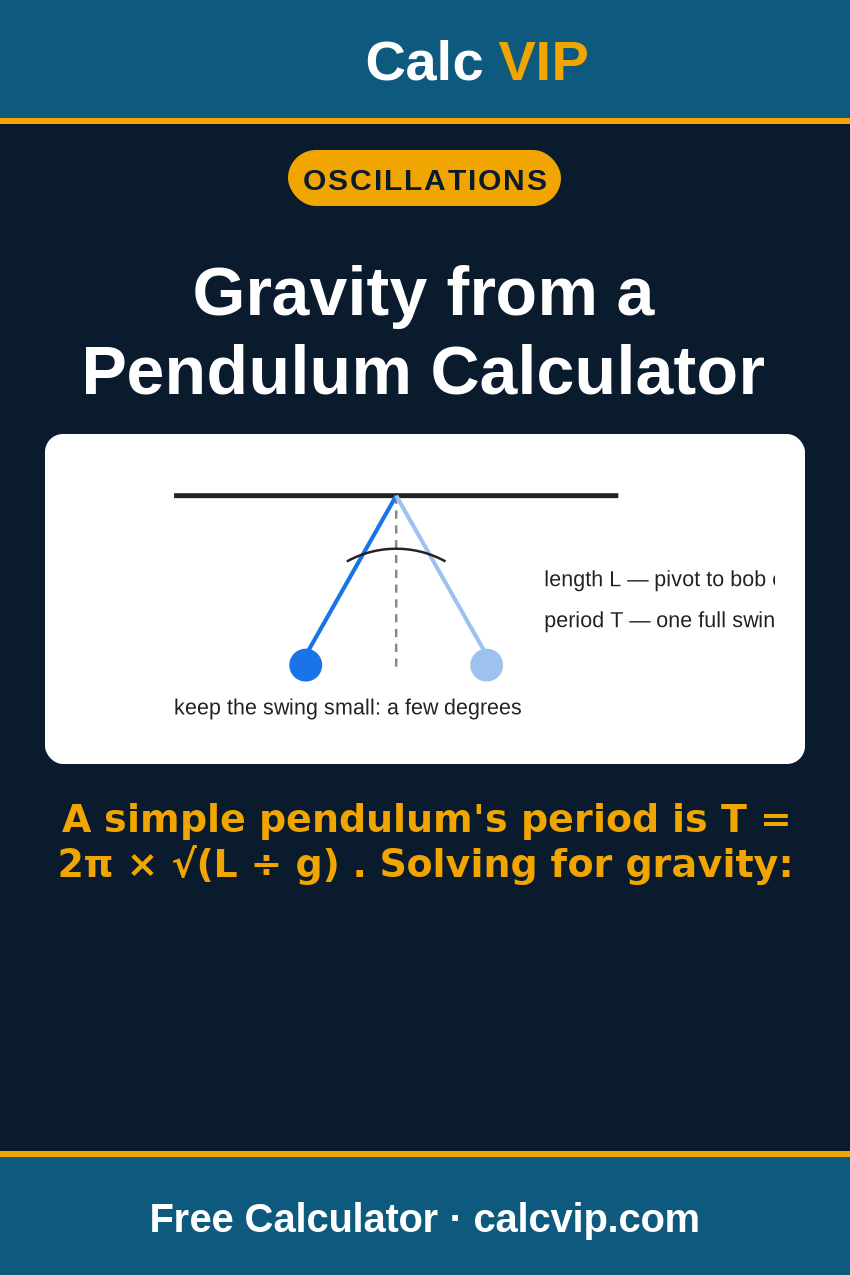
The catch — there is always a catch — is the small print of the formula: the period law is exact only for small swings, a point-like bob and a massless string. Real experiments honour those conditions approximately: swing the bob through a few degrees, not a wide arc; measure the length to the bob's centre, not its top; and time twenty swings instead of one, so human reaction time is divided by twenty. The examples below show what each of those disciplines buys you, in hard numbers.
Formula
A simple pendulum's period is T = 2π × √(L ÷ g). Solving for gravity:
g = 4π²L ÷ T² • g in m/s², L in metres, T in seconds
Two features of this formula run the whole experiment. First, the period does not contain the bob's mass or (for small angles) the swing's size — which is why a cheap string and any heavy lump measure the same g as a laboratory instrument. Second, T enters squared: a 1 percent error in the period becomes a 2 percent error in g, while a 1 percent error in length stays 1 percent. Timing is therefore where experiments live or die, and the professional habit — time N complete swings and divide — exists precisely to shrink that squared term's error. This calculator takes a single length and period, returns g, and reports the percentage error against 9.81 m/s².
| Symbol | Meaning | Units |
|---|---|---|
| L | pendulum length, pivot to centre of bob | m |
| T | period — time for one complete back-and-forth swing | s |
| g | acceleration due to gravity | m/s² |
| 4π² | the constant ≈ 39.478 | — |
Why the period ignores mass and (almost) amplitude
Double the bob's mass and two things double together: the gravitational pull trying to restore it, and the inertia resisting being restored. The two effects cancel exactly, so the period is mass-blind — Galileo's insight, and the reason pendulums measure gravity rather than weight. Amplitude is subtler. The restoring force is proportional to sin θ, and only for small θ is sin θ ≈ θ, which is the approximation the clean formula hides. The true period lengthens as the swing widens: by about 0.2 percent at 10°, about 1.8 percent at 30°, and over 7 percent at 60°. Since g is computed from T², a careless 30° swing quietly inflates the period enough to drag a g measurement down by roughly 3.5 percent — the single most common reason school experiments "discover" g = 9.4.
The same physics, run in reverse, built the first accurate clocks. A pendulum whose period is exactly 2 seconds (one second each way) at g = 9.81 needs L = g × T² ÷ 4π² = 9.81 × 4 ÷ 39.478 ≈ 0.994 m — the famous "seconds pendulum", within a centimetre of a metre, which is no coincidence: the metre itself was nearly defined by this length in revolutionary France. Every grandfather clock in the world is a gravity meter that happens to tell the time, and it will run measurably slow if carried up a mountain or towards the equator — Richer's 1672 discovery, still ticking in hallways.
How to use
- Measure the length from the pivot point to the centre of the bob, in metres — string length plus the bob's radius.
- Start the pendulum swinging through a small angle (under about 10°) and time 20 complete swings; divide the total by 20 to get T.
- Enter L and T and click "Calculate g".
- Read your measured g and its percentage error against 9.81 m/s². Under 2 percent is good school work; under 0.5 percent is excellent.
- If the error is large, suspect the timing first (it is squared), then the length measurement, then the swing amplitude — in that order.
Worked examples
Example 1 — a typical school result. L = 1.00 m, T = 2.05 s.
g = 4π² × 1.00 ÷ 2.05² = 39.478 ÷ 4.2025 = 9.39 m/s², an error of 4.24% below the accepted value. A period just 0.04 s too long — one hesitant stopwatch press in twenty swings, or a swing let out too wide — costs exactly this much. This is the commonest result in the world's classrooms, and now you know its biography.
Example 2 — a careful half-metre pendulum. L = 0.50 m, T = 1.42 s.
g = 39.478 × 0.50 ÷ 1.42² = 19.739 ÷ 2.0164 = 9.79 m/s² — an error of only 0.21%. Shorter pendulums swing faster and are harder to time per swing, but they fit on a desk and reward careful counting.
Example 3 — a two-metre pendulum. L = 2.00 m, T = 2.84 s.
g = 39.478 × 2.00 ÷ 2.84² = 78.957 ÷ 8.0656 = 9.79 m/s², error 0.21% again. The long pendulum's stately swing is the easiest of all to time — which is why demonstration halls and clock towers use them.
Example 4 — timing twenty swings. A 0.75 m pendulum is timed over 20 swings: total 34.7 s, so T = 34.7 ÷ 20 = 1.735 s.
g = 39.478 × 0.75 ÷ 1.735² = 29.609 ÷ 3.010 = 9.84 m/s², error 0.27%. Had the same reaction-time slip (~0.1 s) struck a single-swing timing, it would have poisoned T by 6 percent and g by 12; divided across twenty swings, it shrinks to almost nothing.
Example 5 — the same pendulum on the Moon. L = 1.00 m, and the measured period stretches to T = 4.93 s.
g = 39.478 ÷ 4.93² = 39.478 ÷ 24.30 = 1.62 m/s² — the lunar value, recovered from nothing but a string and a clock. A pendulum is a portable planet-weigher: carry it anywhere, and its period reports the local gravity. (This calculator's error percentage still grades against Earth's 9.81 — ignore the grade, keep the g.)
Example 6 — the squared-error trap, in numbers. For L = 1.00 m the true period is 2.006 s. Time it as 2.00 s and you compute g = 9.87 m/s² (0.61% high); time it as 2.02 s and g falls to 9.68 m/s² (1.37% low); at 1.98 s, g jumps to 10.07 m/s² (2.65% high). Two hundredths of a second — a blink — swings the answer by percent. No other school experiment punishes haste so precisely, or rewards patience so directly.
Measuring gravity in real life
Geophysics and prospecting. For a century, pendulum gravimeters mapped g's tiny variations — thousandths of a percent — to find oil domes, ore bodies and underground voids, because denser rock pulls measurably harder. Modern instruments differ; the principle is Richer's.
Clocks. Every pendulum clock is regulated by adjusting L until T is exact — clockmakers "rate" a clock by turning the bob's nut, lengthening or shortening the pendulum by fractions of a millimetre. A clock that gains time has, physically, a too-short pendulum or a too-strong local g.
Seismology's ancestors. Horizontal pendulums — the same physics tipped sideways — were the first instruments sensitive enough to record distant earthquakes, turning the period formula into a listening device for the planet's interior.
Teaching laboratories. This remains the canonical first precision experiment in physics courses worldwide, because it teaches the three real skills of measurement: define the quantity (length to the bob's centre), beat down the dominant error (time many swings), and distrust the approximation (keep the angle small).
Planetary science. A pendulum is among the simplest instruments that could report an alien gravity: proposals for cheap lander packages have repeatedly included one, because a period measurement needs no calibration against Earth standards — the formula carries its own.
Metrology history. The seconds pendulum nearly defined the metre, and pendulum surveys fixed the Earth's figure (oblate, bulging at the equator) decades before satellites confirmed it. Few experiments have weighed so much with so little.
Gravity is not 9.81 everywhere — and pendulums proved it
The "accepted value" this calculator grades against is a convention, not a constant of nature. Measured g runs from about 9.780 m/s² at the equator to 9.832 m/s² at the poles — a 0.5 percent range caused by the Earth's rotation (which flings equatorial observers slightly outward) and its equatorial bulge (which puts them farther from the centre). Altitude shaves off about 0.03 percent per kilometre; the Moon's gravity adds a daily wobble of a few parts in ten million (the solid-Earth tide). A pendulum clock carried from pole to equator loses roughly two and a half minutes a day — Richer's original observation (his clock, Paris to Cayenne, lost about 2½ minutes daily), scaled up. So a careful student in Quito or Singapore who measures 9.78 has not made an error; she has made a discovery. The percentage "error" on this page measures distance from the textbook's round number, and at the extremes of the Earth the textbook itself is the thing that is off.
Timing tricks the professionals use
Three refinements separate a 5 percent result from a 0.2 percent one, and none of them costs money. First, time at the centre, not at the extremes: the bob moves fastest as it crosses the bottom, so a given reaction-time error corresponds to the smallest timing error there — press as the bob crosses a marker at the centre of the swing (a "fiducial point"), never at the turning points where it dithers. Second, count long: twenty swings is the school minimum; fifty is better, and the error falls in proportion. Third, and most powerful, measure several lengths and plot T² against L: the points fall on a straight line whose slope is 4π² ÷ g = 4.024 s²/m for g = 9.81, and random timing errors average out along the line instead of concentrating in a single measurement. The graph also exposes a mis-measured length instantly, as a point off the line — a diagnostic no single measurement can offer. These are the habits that let nineteenth-century surveyors, armed with brass bobs and pocket chronometers, map gravity well enough to deduce the Earth's shape. They remain, two centuries on, the difference between an experiment that roughly works and one that genuinely measures.
Quick reference: periods of familiar pendulums (Earth, g = 9.81)
| Length L | Period T = 2π√(L/g) | Where you meet it |
|---|---|---|
| 0.25 m | 1.00 s | desk metronome territory |
| 0.50 m | 1.42 s | school bench pendulum |
| 0.994 m | 2.00 s | the seconds pendulum — grandfather clocks |
| 1.00 m | 2.01 s | the classic laboratory metre |
| 2.00 m | 2.84 s | demonstration-hall pendulum |
| 67 m | 16.4 s | Foucault's Panthéon pendulum, Paris |
Check any row against the calculator: enter L and the tabulated T and g returns 9.81 (to rounding) — the table and the tool are the same formula read in opposite directions.
Common mistakes
- Measuring to the top of the bob. L runs to the bob's centre of mass. Forgetting the bob's radius shortens L by centimetres and drags g down by twice that percentage.
- Timing a single swing. Human reaction time (~0.1–0.2 s) lands entirely on one period and is then squared. Time 20 swings and divide — the error divides by 20 while the value survives intact.
- Swinging too wide. Beyond ~10° the small-angle approximation leaks: at 30° the period runs ~1.8% long and g comes out ~3.5% low. A wide, dramatic swing is a worse measurement, not a better show.
- Counting the release as "one". The classic off-by-one: start the watch as you release and count the first return as 1, and you have timed N−1 swings while dividing by N. Count "zero" at release.
- Letting the pendulum swing in an ellipse. A carelessly launched bob traces an oval, whose period differs and whose plane precesses. Launch straight, in one plane, with no sideways push — and relaunch if it wobbles into an ellipse.
FAQ
Why time many swings instead of one?
Your reaction time when starting and stopping a stopwatch is roughly 0.1–0.2 s. Spread over 20 swings that error shrinks to about 0.01 s per period, which is why the multi-swing method gives a much better g.
Does the mass of the bob change the period?
No. The period depends only on length and g (for small swing angles). A heavier bob does not swing faster — it just keeps swinging longer against air resistance.
Why keep the swing angle small?
The formula T = 2π√(L/g) is exact only for small angles. Below about 10° the error is under 0.2%; at 30° the true period is already about 1.7% longer, which would make your g come out too small.
Why doesn't the bob's mass appear in the formula?
Because gravity's pull and the bob's inertia both scale with mass and cancel exactly. A brass bob and a wooden bob of the same size, on the same string, keep the same time — which is why the experiment measures g itself, not the bob.
How accurate can a string-and-stopwatch measurement be?
With the length measured to a millimetre, 20+ swings timed, and a small amplitude, 0.2–0.5 percent is realistic — matching Examples 2–4. That is better than many dedicated school instruments, from apparatus costing almost nothing.
What length gives a period of exactly one second?
L = g × T² ÷ 4π² = 9.81 × 1 ÷ 39.478 ≈ 0.248 m — about 24.8 cm. A one-second pendulum is a desk ornament; the two-second "seconds pendulum" (0.994 m) is the clockmaker's standard.
Would this work on a space station?
No — in free fall there is no effective gravity to restore the pendulum, so it would not swing at all; the bob would simply drift or circle if pushed. The experiment needs a genuine gravitational field (or steady acceleration, which Einstein's equivalence principle says is locally the same thing).
Why does my result always come out slightly low?
Usually a conspiracy of the three classic errors, all pushing the same way: length measured short (to the bob's top), period measured long (wide swing, slow stopwatch stops), or both. Check them in that order — the direction of the bias is diagnostic.
Who first measured g this way?
Galileo established the period law around 1600 (the cathedral-lamp story is likely legend, the result is not); Huygens turned it into the pendulum clock in 1656; and Richer's 1672 Cayenne expedition first showed g varying across the Earth — the measurement that revealed our planet's true shape.
Does air resistance spoil the period?
Barely. Drag mainly shrinks the amplitude over time rather than shifting the period, which is one more reason to start with a modest swing and time the early swings. A dense bob (lead, brass) makes drag negligible for school purposes.