 Calc
Pendulum Calculator – Period & Frequency of a Simple Pendulum
 Created by James Carter · Physics Writer · Forces & Motion · Last updated: November 2026
Use this free Pendulum Calculator to find the period and frequency of a simple pendulum from T = 2π√(L/g). Just enter the string length — the bob's mass does not matter.
Of all the instruments in physics, the pendulum is the one that taught us time. A mass on a string, swinging under gravity, divides duration into equal beats with a reliability that depends on almost nothing — not the bob's mass, not (for small swings) the width of the swing, only the length of the string and the strength of gravity. T = 2π√(L/g) is the whole theory in one line, and this calculator evaluates it: give it a length, and it returns the period and the frequency of the swing.
Pause on that list of things that do not matter. Galileo, timing a swinging lamp in Pisa cathedral against his own pulse (so the story goes), noticed the swings took the same time whether they were wide or narrow, and whether the lamp was heavy or light. Mass cancels out of the physics for the same reason it cancels for falling objects: gravity pulls harder on a heavier bob, but the heavier bob is proportionally harder to accelerate, and the two effects divide away. What remains is geometry and gravity — L and g — which is why a pendulum is simultaneously a clock and a gravimeter: fix the length and its beat reports the local strength of gravity itself.
The square root shapes the pendulum's character. Because T grows only as √L, quadrupling the length merely doubles the period — a clockmaker wanting a stately 2-second beat needs a full metre of pendulum, and a 10 m demonstration pendulum in a museum lobby swings with a majestic 6.3-second period, not the 20 seconds a linear law would suggest. Square roots compress: lengths from a centimetre to a hundred metres produce periods spanning only a factor of a hundred. The formula is short; its consequences fill three centuries of horology and one of physics' most famous public demonstrations.
Formula
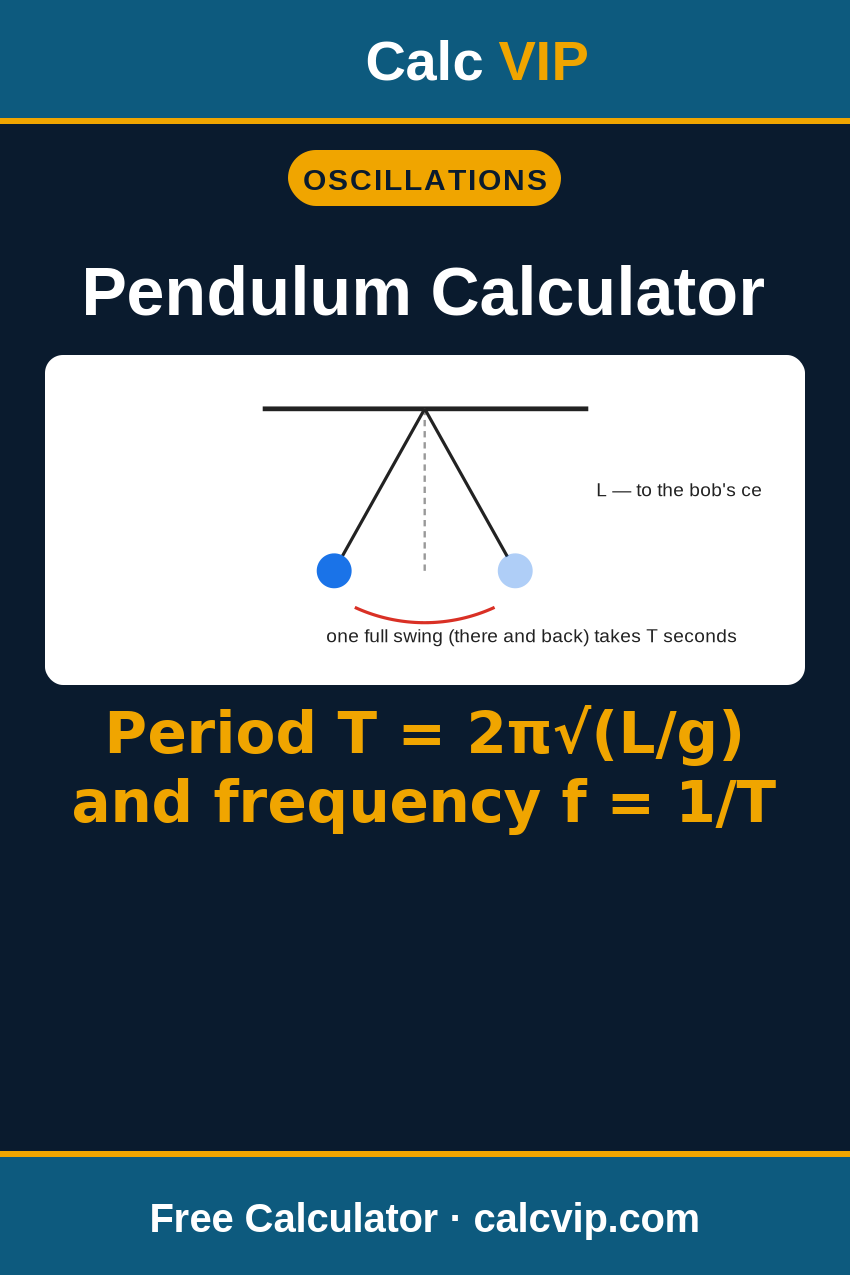
Period T = 2π√(L/g) and frequency f = 1/T — valid for small swing angles (up to about 15°). Note there is no mass in the formula: a heavy bob and a light bob swing at the same rate.
The formula rearranges into the two questions clockmakers actually ask: L = g × (T ÷ 2π)² — the length required for a target period (this is how the 0.994 m seconds pendulum is found), and g = 4π²L ÷ T² — gravity measured from a timed pendulum, the classic school-laboratory determination of g and, historically, a serious geophysical instrument. Frequency is always f = 1 ÷ T. Units discipline is simple but absolute: L in metres, g in m/s² (Earth 9.81, Moon 1.62, Mars 3.71), and the answer arrives in seconds and hertz. The small-angle condition — swings up to about 15° — is the one caveat, and the depth section below prices exactly how much it matters.
| Symbol | Meaning | Units |
|---|---|---|
| T | period — time for one complete swing, there and back | seconds (s) |
| f | frequency — complete swings per second, f = 1/T | hertz (Hz) |
| L | length from pivot to the bob's centre of mass | metres (m) |
| g | gravitational field strength | m/s² |
Why the period is what it is: the restoring pull
Displace the bob and gravity splits into two components: one along the string, cancelled by the string's tension, and one tangent to the arc, pulling the bob back towards the bottom. That tangential component is the restoring force, and for small angles it is beautifully behaved — proportional to the displacement, the signature of simple harmonic motion. Proportional restoring force always produces a period independent of amplitude, with the constant of proportionality setting the tempo. Here the "springiness" per unit mass is g/L: a short string gives gravity a steep arc to work on (strong restoring, quick beat), a long string a shallow one (weak restoring, slow beat). The 2π is the universal toll exacted by circular functions — the same 2π that appears in every oscillation from a mass on a spring to an LC circuit.
The mass-independence deserves one more look, because it is the equivalence principle in miniature. The restoring force is gravity, proportional to m; the inertia resisting it is also m. Their ratio — the acceleration — contains no m at all, which is why a lead bob and a cork bob of the same length keep identical time, and why astronauts' pendulums would behave like everyone's (if only orbit provided the gravity to run them). Einstein built general relativity on the suspicion that this cancellation is not a coincidence. The humble pendulum formula is one of the places that suspicion can be watched working.
How to use
- Enter the string length L in metres, measured from the pivot to the centre of the bob — not to its top edge.
- Leave g at 9.81 for Earth, or change it for the Moon (1.62) or Mars (3.71) to hear how the same clock would tick there.
- Click "Calculate Period" to get the period T in seconds and the frequency f in hertz.
- To design for a target period instead, use L = g × (T/2π)² — for a 2-second beat on Earth, 0.994 m.
Worked examples
Example 1 — the one-metre pendulum. A pendulum with a 1 m string on Earth (g = 9.81 m/s²):
T = 2π√(1 / 9.81) = 2.01 s
Frequency f = 1 / 2.01 ≈ 0.50 Hz — it completes about half a full swing every second.
Example 2 — a short, quick pendulum. A 0.25 m string on Earth:
T = 2π√(0.25 ÷ 9.81) = 2π × 0.1597 ≈ 1.00 s, so f ≈ 1.00 Hz. A quarter-metre pendulum beats almost exactly seconds — a coincidence of g's value that makes it a lovely classroom demonstration: halve the seconds pendulum's length and you do not halve its period, you divide it by √2... here landing, neatly, on 1.00 s because 0.25 m is a quarter of 0.994 m and √4 = 2.
Example 3 — the same pendulum on the Moon. Take Example 1's 1 m string to the Moon, g = 1.62 m/s²:
T = 2π√(1 ÷ 1.62) = 2π × 0.7856 ≈ 4.94 s. Lunar gravity is about a sixth of Earth's, and the period stretches by √6 ≈ 2.46 — clocks on the Moon would tick with a dreamlike slowness, and a grandfather clock shipped there would lose nearly three hours in every two. (On Mars, g = 3.71: T = 2π√(1 ÷ 3.71) ≈ 3.26 s.)
Example 4 — designing for a one-second period. What length beats exactly T = 1 s on Earth?
L = g × (T ÷ 2π)² = 9.81 × (1 ÷ 6.2832)² = 9.81 × 0.02533 ≈ 0.248 m — matching Example 2's quarter-metre result from the other direction. The two formulas are one fact read forwards and backwards.
Example 5 — the seconds pendulum, derived. For the clockmaker's T = 2 s:
L = 9.81 × (2 ÷ 2π)² = 9.81 × (0.3183)² = 9.81 × 0.10132 ≈ 0.994 m. This is the length quoted in the original FAQ — now you can see it is not a measured curiosity but a computed consequence of g. Because g varies slightly over the Earth's surface, so does the true seconds-pendulum length, by a few millimetres between equator and pole: clocks once served as gravity surveys.
Example 6 — Foucault's giant. The Panthéon pendulum of 1851 hung L = 67 m of wire:
T = 2π√(67 ÷ 9.81) = 2π × 2.6137 ≈ 16.42 s per complete swing — slow enough to watch the bob think. Museum pendulums still use such lengths: the period is stately, the swing plane's slow rotation (Earth turning beneath it) is the exhibit, and the formula predicts both.
The pendulum in real life
Three centuries of clocks. From Huygens' first pendulum clock in 1656 to the 1930s, the pendulum was time itself: it improved accuracy a hundredfold overnight (from quarter-hours to seconds per day) and enabled the longitude solution, modern astronomy and the railway timetable. Every one of those clocks is this formula with a 0.994 m heart.
Measuring g and mapping the Earth. Time a pendulum carefully and g = 4π²L/T² turns it into a gravimeter. Portable pendulum surveys mapped variations in g across the globe — revealing the Earth's equatorial bulge (g is smaller at the equator, where you are further from the centre) and, later, underground density contrasts used in prospecting.
Seismology's ancestor. A very long pendulum barely responds to rapid shaking of its support but registers slow tilts and distant tremors; the first seismometers were, in essence, pendulums with the bob made enormous and the string replaced by a near-frictionless mount. The formula's √L slowness is the feature: it filters the world down to earthquakes.
Metronomes and music. The mechanical metronome is an inverted pendulum whose sliding weight adjusts the effective length — the musician literally dials L to set T. Its tick is the pendulum formula keeping an orchestra honest.
Playground physics. A swing is a pendulum with a child as the bob: its period depends on the chain length to the child's centre of mass, which is why tall swings feel stately and short ones frantic — and why pumping works by effectively changing L at the right moments, a parametric trick the simple formula only hints at.
Demolition and cranes. A wrecking ball on a 10 m chain has T = 2π√(10 ÷ 9.81) ≈ 6.34 s; crane operators time their slewing to the load's pendulum period, because a load is a pendulum whether you invited it or not, and fighting its period ends in swinging chaos.
Large swings: where the simple formula bends
The formula T = 2π√(L/g) is exact only in the limit of infinitesimal swings. The true period, from the exact theory, is longer by a factor that depends on the swing amplitude θ (in radians): approximately 1 + θ²/16 + 11θ⁴/3072. At a gentle 10° (0.175 rad) the correction is 0.19% — a clock swinging so would lose about 2.7 minutes a day if uncorrected... at 5°, a more typical clock amplitude, the factor is 1.00048, about 41 seconds a day, which is why fine regulators keep their swings small and why Huygens experimented with curved "cheeks" to force the bob onto a cycloid path, the curve for which the period is exactly amplitude-independent. At 60° the simple formula underestimates the period by about 7% — fine for a playground estimate, unacceptable for a clock. Know your amplitude, know your error.
The physical pendulum: real objects swing too
A swinging bat, door or leg is not a point mass on a string, and its period uses the generalisation T = 2π√(I ÷ (m × g × d)), with I the moment of inertia about the pivot and d the pivot-to-centre-of-mass distance. The simple pendulum is buried inside it: a point bob has I = mL² and d = L, giving 2π√(mL²/(mgL)) = 2π√(L/g). The general form introduces a haunting concept — every physical pendulum has a "centre of oscillation", the length of the equivalent simple pendulum — and a practical one: reversible pendulums with two knife-edges, adjusted until both give the same period, measured g to parts-per-million accuracy in the great 19th-century surveys. The Kater pendulum in a museum case is this section, built in brass.
Quick reference: period by length (Earth)
| Length L | Period T | Frequency |
|---|---|---|
| 0.10 m | 0.63 s | 1.58 Hz |
| 0.25 m | 1.00 s | 1.00 Hz |
| 0.50 m | 1.42 s | 0.70 Hz |
| 1.00 m | 2.01 s | 0.50 Hz |
| 2.00 m | 2.84 s | 0.35 Hz |
| 10.0 m | 6.34 s | 0.16 Hz |
Notice the gentle arithmetic of the square root running down the table: a hundredfold increase in length (0.1 m to 10 m) buys only a tenfold increase in period.
Common mistakes
- Measuring L to the top of the bob. The length runs from the pivot to the bob's centre of mass. A 5 cm bob on a "1 m" string measured to its top edge really swings as a 1.025 m pendulum — a 1.2% period error, large in any careful g measurement.
- Timing one swing instead of twenty. Human reaction time (~0.2 s) swamps a single 2 s period at the 10% level. Time 20 complete swings and divide: the same reaction error is diluted twenty-fold, to 0.5%. Every school lab's first instruction exists because of this arithmetic.
- Counting the period as a half-swing. T is there and back. Timing from one extreme to the other measures T/2 — and a g computed from it comes out four times too big (the error squares). Count returns to the same extreme, or better, passages through the centre in the same direction.
- Swinging wide and trusting the simple formula. At 60° amplitude the true period is about 7% longer than 2π√(L/g). For timing experiments keep the release angle under about 10°, where the correction is under 0.2%.
- Using g = 10 and expecting precision. g = 10 m/s² is a fine estimate (it shifts T by about 1%), but it is not 9.81. In a g-measurement experiment, using the approximation inside the analysis of your own measurement is circular — measure with the real formula, compare with 9.81 at the end.
FAQ
Does a heavier bob swing faster?
No. The period depends only on the length and on gravity. Doubling the bob's mass changes nothing (for small swings).
How long is a "seconds pendulum"?
A pendulum with a period of exactly 2 seconds needs a length of about 0.994 m on Earth — nearly 1 metre. Such pendulums were used in old clock designs.
Why does the swing angle matter?
The simple formula assumes small angles. For large swings the true period is slightly longer than 2π√(L/g).
What is a seconds pendulum used for?
A pendulum with a period of exactly 2 seconds — one second for each swing across — ticks time in whole seconds, which made it the heart of precision clocks from 1656 until the 1930s. Its length on Earth is 0.994 m, close enough to a metre that the metre was very nearly defined by it during the French Revolution's standardisation debates; the seconds pendulum lost to the Earth-quadrant definition by a whisker.
Does the starting angle change the period?
Only slightly, and only at large angles. The simple formula assumes swings of a few degrees. The exact period grows by a factor of about (1 + θ²/16) for amplitude θ in radians: at 10° the correction is 0.2%, at 30° about 1.7%, at 60° about 6.9%. Clock pendulums swing through a few degrees precisely so the simple law rules them.
Would a pendulum work on the space station?
No — and the reason is profound. A pendulum needs gravity to provide the restoring pull towards the vertical. In free fall aboard the station, effective gravity is zero, so T = 2π√(L/g) explodes to infinity: a displaced bob simply stays where it is put, or drifts in a straight line. Pendulum clocks are gravity instruments as much as time instruments.
What is Foucault's pendulum?
A very long, heavy pendulum — Foucault's 1851 original hung 67 m from the dome of the Panthéon in Paris — left to swing for hours. Its swing plane stays fixed in space while the Earth rotates beneath it, so the plane appears to rotate (about 11° per hour in Paris), knocking over markers arranged around it. It was the first direct, tabletop-scale proof that the Earth turns. Its period, from Example 6's formula, is about 16.4 s.
How accurate were pendulum clocks?
Astonishingly. A well-made regulator clock in a temperature-controlled vault kept time to about a second a week; the Shortt clock of 1921, the peak of the technology, was good to roughly a second a year — so good that it detected tiny variations in Earth's own rotation. Quartz and atomic clocks then surpassed in a decade what pendulums had refined over three centuries.
Why does a pendulum eventually stop, and how do clocks prevent it?
Air resistance and pivot friction steal a little energy from every swing, so the amplitude decays. Clocks replace exactly that much energy with a tiny push each cycle from the escapement — timed, in a beautiful feedback loop, by the pendulum itself. The push is small enough not to disturb the period, which depends on length and gravity, not amplitude (at small angles).
What is a physical pendulum?
Any rigid body swinging about a fixed pivot that is not its centre of mass — a bat, a swinging door, your leg. Its period is T = 2π√(I/(mgd)), where I is the moment of inertia about the pivot and d the distance from pivot to centre of mass. A simple pendulum is the special case where all the mass sits in the bob: I = mL² and d = L collapse the formula back to 2π√(L/g).