 Calc
Pair Production Calculator – Threshold Photon Energy 2mc²
 Created by Yuki Tanaka · Physics Editor · Modern Physics · Last updated: November 2026
Use this free Pair Production Calculator to find the minimum (threshold) energy a photon needs to create a particle–antiparticle pair. A photon can turn into matter — but only if it carries at least twice the rest energy of the particle it creates.
Pair production is annihilation read backwards — the moment light turns into matter. A gamma-ray photon disappears, and in its place stand two brand-new particles: a particle and its antiparticle, most famously an electron and a positron. Nothing about it is metaphorical. The photon's energy is quite literally spent purchasing rest mass, at the universe's fixed exchange rate of E = mc² per particle, and the pair then carries off whatever change remains as kinetic energy. It was first seen in 1932–33, when Carl Anderson's cloud-chamber photographs showed photons in cosmic rays materialising into electron–positron pairs — the discovery that confirmed antimatter was real and not a theorist's decoration.
The threshold is the heart of the matter, and it is unforgiving. Because two particles must be paid for, the photon must bring at least 2mc²: 1.022 MeV for an electron pair, 211.32 MeV for muons, 1,876.56 MeV for protons. Below the threshold the process does not merely become inefficient — it is forbidden, exactly as a shopper one cent short cannot buy the goods. Above it, the surplus becomes motion. That sharp energy gate explains a remarkable amount of the high-energy world: why gamma rays above 1.022 MeV are absorbed differently in shielding, why the universe is opaque to its most energetic photons, and why particle physicists must build ever-larger machines to mint ever-heavier particles.
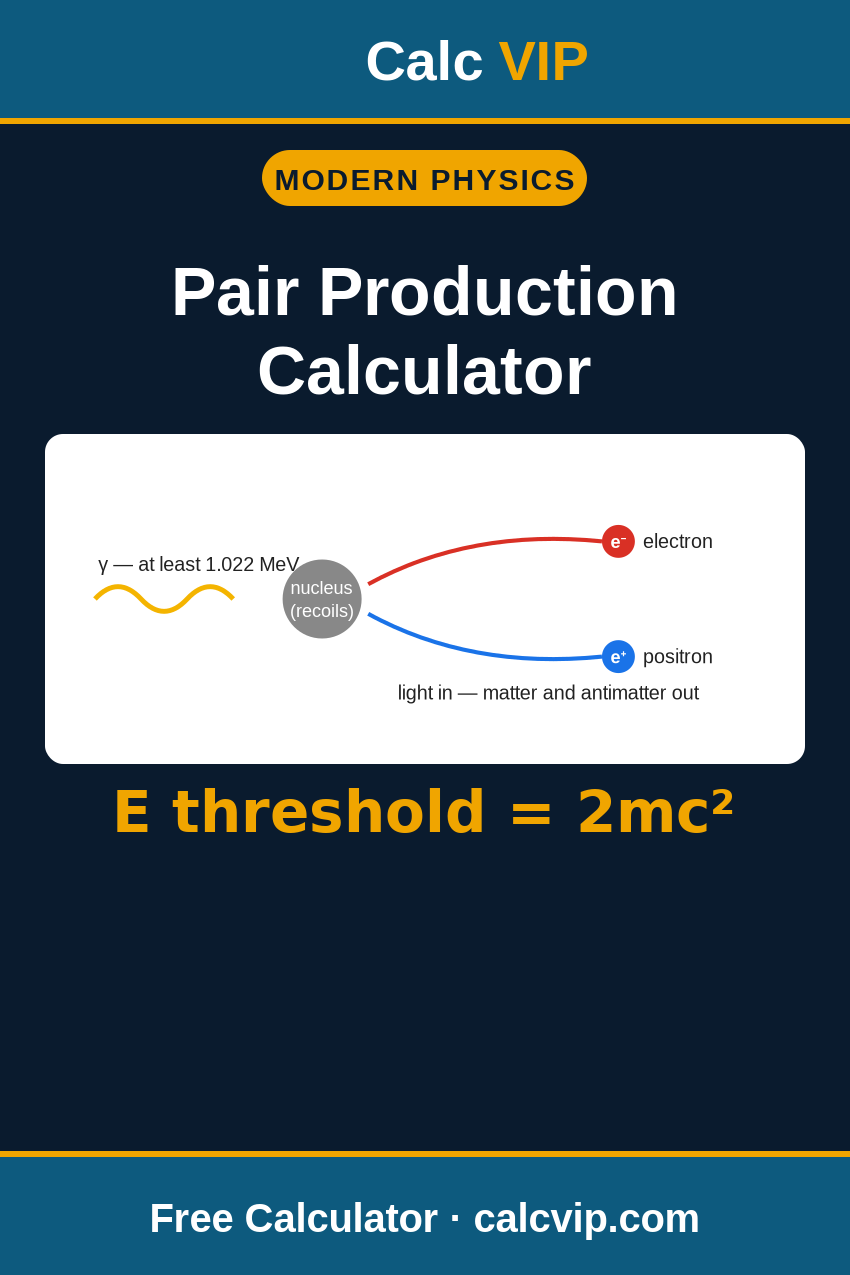
There is one more condition, easy to miss and impossible to waive: the photon cannot do it alone in empty space. A nucleus (or, more rarely, an electron) must be standing nearby to absorb recoil momentum, as the FAQ below explains. Pair production is therefore an interaction between light and matter, not a decay of light itself — it happens in the electric field of a nucleus, its rate grows with the square of the nuclear charge, and it is the dominant way sufficiently energetic photons are stopped by dense materials like lead. This calculator gives you the gate price for any pair: choose the particles, and it returns the minimum photon energy, the longest wavelength that can pay it, and the minimum frequency.
Formula
Ethreshold = 2mc² • longest usable wavelength λmax = hc / (2mc²) • minimum frequency fmin = 2mc² / h • surplus above threshold becomes kinetic energy: KEpair = Ephoton − 2mc²
The logic is a budget. The photon's energy E = hf = hc/λ must cover the rest energy of both new particles, 2mc², before a single joule is available for motion — hence the threshold, and hence λmax: any wavelength longer than hc/(2mc²) belongs to a photon too poor to pay. The rearrangements cover the working questions: given a photon, the heaviest pair it can create has m = E/(2c²); given a target particle, the accelerator or source must reach f = 2mc²/h. Work in MeV for the masses (electron 0.511, muon 105.66, proton 938.28) and the thresholds fall out by doubling; convert to joules with 1 MeV = 1.602 × 10⁻¹³ J only when SI is demanded. For a custom entry this calculator converts your mass in u at 931.5 MeV per u, then doubles — the same two steps, in the same order, every time.
| Symbol | Meaning | Units |
|---|---|---|
| m | rest mass of ONE particle of the pair to be created | kg, u, or MeV/c² |
| Ethreshold | minimum photon energy, = 2mc² | MeV or J |
| λmax | longest photon wavelength that can still create the pair | m (pm here) |
| fmin | minimum photon frequency, = 2mc²/h | Hz |
| Z | atomic number of the nearby nucleus — rate grows ~ Z² | — |
Why a bystander nucleus is non-negotiable
Try to balance the books for a lone photon converting in a vacuum and the accounts refuse to close. The photon carries momentum E/c. The new pair, in the frame where their total momentum is zero, needs total energy of at least 2mc² — but the photon in that same frame has its energy reduced by exactly the motion that gave it momentum, and the two requirements can never be met simultaneously. Energy and momentum conservation, applied together, forbid the process outright. The escape is a third party: a nucleus standing in the photon's path absorbs a small recoil momentum, its large mass letting it take momentum while stealing almost no energy (its recoil kinetic energy, p²/2M, is tiny because M is huge). The photon converts in the nucleus's intense electric field, the nucleus shudders almost imperceptibly, and both conservation laws balance to the last decimal.
That bystander requirement shapes everything practical about pair production. The rate scales roughly with the square of the nuclear charge Z, because the field doing the work belongs to the nucleus: lead (Z = 82) is ferociously better at converting gamma rays than aluminium (Z = 13), which is why high-energy photon shielding is a heavy-element game. Occasionally the bystander is an atomic electron instead — "triplet production", since the struck electron is ejected alongside the created pair. Because the light electron takes a real share of energy, that variant's threshold rises to 4mc² = 2.044 MeV for an electron pair. The calculator gives the nuclear-field threshold, the standard and dominant case; keep the triplet figure in mind when precision matters at low energies.
How to use
- Choose the pair you want to create — electron–positron, muon–antimuon or proton–antiproton — or pick "Custom mass".
- For a preset, the box shows one particle's rest energy in MeV. For a custom entry, type the particle's mass in atomic mass units (u); it is converted at 931.5 MeV per u.
- Click "Calculate Threshold Energy" to get the minimum photon energy in MeV and joules, the maximum wavelength that can do the job, and the minimum frequency.
- Compare your photon source against the answer: a source is capable only if its photons reach the threshold energy — equivalently, only if their wavelength is at or below the λmax shown. Cobalt-60 gamma rays (1.17 and 1.33 MeV) just clear the electron-pair gate; almost nothing else in a teaching laboratory does.
Worked examples
Example 1 — creating an electron–positron pair. Creating an electron–positron pair:
Threshold energy = 2 × 0.511 = 1.022 MeV (= 1.637 × 10⁻¹³ J)
Maximum wavelength = hc / E = 1.214 pm
Minimum frequency = 2.471 × 10²⁰ Hz
So only a hard gamma ray can create the pair — ordinary X-rays and visible light are far too weak. Note the wavelength is exactly half the 2.428 pm of a single 0.511 MeV photon: the photon must be twice as energetic, so its wavelength halves.
Example 2 — a muon pair. Muons are electrons' heavy siblings at 105.66 MeV each:
Threshold = 2 × 105.66 = 211.32 MeV (= 3.385 × 10⁻¹¹ J)
λmax = 0.005872 pm (5.872 fm)
fmin = 5.109 × 10²² Hz.
No radioactive source reaches this; muon pairs from light are an accelerator phenomenon, produced when high-energy electron beams radiate photons inside targets.
Example 3 — a proton–antiproton pair. The heaviest preset pair:
Threshold = 2 × 938.28 = 1,876.56 MeV (1.877 GeV, = 3.006 × 10⁻¹⁰ J)
λmax = 0.000661 pm (0.661 fm) — a wavelength smaller than the proton itself
fmin = 4.537 × 10²³ Hz.
When Fermilab's Tevatron collided protons and antiprotons, it first had to manufacture the antiprotons — and this threshold, paid in collision energy rather than by a single photon, was the entry fee.
Example 4 — a tau pair, entered as a custom mass. The tau lepton masses 1,776.9 MeV, which as a custom entry is 1,776.9 ÷ 931.5 = 1.90757 u:
Threshold = 2 × 1,776.9 = 3,553.8 MeV (3.554 GeV)
λmax = 0.000349 pm (0.349 fm), fmin = 8.592 × 10²³ Hz.
Electron–positron colliders such as Belle II run just above this threshold precisely so their collision energy condenses into tau pairs — the custom-mass route through this calculator is the same planning arithmetic those laboratories do.
Example 5 — spending the surplus: a 10 MeV photon. A 10 MeV gamma ray converts near a lead nucleus. The mass purchase is fixed at 1.022 MeV, leaving
KE = 10 − 1.022 = 8.978 MeV of kinetic energy,
shared between electron and positron — on average 4.489 MeV each if split evenly, though any individual event divides it unevenly, one partner often sprinting away with most of the surplus while the other barely clears the threshold. The nucleus's recoil takes momentum but, being heavy, a negligible slice of energy.
Example 6 — the pion pair. Charged pions (139.57 MeV each) set the scale for the strong interaction's lightest currency:
Threshold = 2 × 139.57 = 279.14 MeV (= 4.472 × 10⁻¹¹ J)
λmax = 0.004445 pm (4.445 fm), fmin = 6.749 × 10²² Hz.
Photons in the few-hundred-MeV range striking nuclei in cosmic-ray air showers pay this price constantly, seeding the particle cascades that rain down through the atmosphere to detectors at the surface.
Pair production in real life
Gamma-ray shielding. Above 1.022 MeV, pair production switches on as an absorption mechanism and grows with energy and Z² until it dominates photon attenuation in heavy materials. Shielding designers around reactors, radiotherapy bunkers and space hardware read this threshold as a cliff edge in their attenuation tables — below it, Compton scattering rules; far above it, lead eats photons by turning them into matter.
Gamma-ray astronomy's ceiling. The universe itself applies this calculator. Very-high-energy photons from distant blazars collide with background light photons en route and pair-produce into e⁻e⁺, so the cosmos grows opaque above certain energies — astronomers call it the gamma-ray horizon, and it limits how far the Fermi and Cherenkov telescopes can see at the highest energies.
Pair telescopes. The Fermi Large Area Telescope detects gamma rays by pair production: photons convert in tungsten foils, and silicon trackers follow the electron and positron to reconstruct the photon's direction and energy. The threshold sets the instrument's low-energy floor; its entire architecture is this page's formula built from metal and silicon.
Particle accelerators. Every new particle ever minted at a collider was pair-produced in the broad sense — collision energy converted into a particle–antiparticle pair at exactly the 2mc² gate (plus the practical premium of doing it efficiently). The Higgs boson programme began from the fact that 125 GeV of collision energy could pay for pairs of particles far heavier than anything in ordinary matter.
Electromagnetic showers. A high-energy electron in matter radiates a photon (bremsstrahlung); the photon pair-produces; the pair radiates again. This self-multiplying cascade — the engine inside particle detectors' calorimeters and cosmic-ray air showers alike — alternates between the two processes, and pair production's threshold is one of its two governing numbers.
Medical and industrial beams. Radiotherapy linacs above 10 MV produce beams energetic enough that pair production contributes measurably in tissue and shielding, and the photoneutron and activation bookkeeping around such machines starts from knowing precisely which photon energies can convert, and where.
The three ways a photon dies in matter
Pair production is one of three competing fates for a photon crossing matter, and which one wins is a contest of energy and atomic number. At low energies the photoelectric effect dominates — the photon is swallowed whole by an atom, ejecting an electron; it rules below a few hundred keV in most materials. Through the middle range, Compton scattering takes over: the photon bounces off an electron, surrendering part of its energy, and this is the main interaction for the ~1 MeV gamma rays of nuclear medicine in tissue. Only above the 1.022 MeV gate does pair production enter, its share growing steadily with energy until, for photons of tens of MeV in lead, it is essentially the only game. In low-Z materials like water and tissue the crossover comes later — pair production does not dominate there until tens of MeV — which is why the same gamma source demands different shielding logic in a hospital and in a reactor hall. Every attenuation curve in radiological physics is these three processes, plus this page's threshold, drawn as a map.
Quick reference: pair-production thresholds
| Pair | Threshold energy | λmax | fmin |
|---|---|---|---|
| electron – positron | 1.022 MeV | 1.214 pm | 2.471 × 10²⁰ Hz |
| muon – antimuon | 211.32 MeV | 5.872 fm | 5.109 × 10²² Hz |
| pion – antipion | 279.14 MeV | 4.445 fm | 6.749 × 10²² Hz |
| proton – antiproton | 1,876.56 MeV | 0.661 fm | 4.537 × 10²³ Hz |
| tau – antitau | 3,553.8 MeV | 0.349 fm | 8.592 × 10²³ Hz |
Notice the wavelengths: beyond the electron row, every λmax is measured in femtometres — nuclear dimensions. Creating heavy matter from light demands photons whose wavelength is the size of the particles themselves, one more way of seeing why heavy-pair production belongs to accelerators and cosmic rays, not to anything on a bench.
Common mistakes
- Using mc² instead of 2mc². The photon must pay for two particles. A 0.6 MeV photon exceeds the electron's rest energy yet cannot pair-produce; the gate is 1.022 MeV. This is the same factor-of-two trap as in annihilation, viewed from the other side.
- Expecting pair production in empty space. Without a nucleus (or electron) to take the recoil, the process is forbidden no matter how energetic the photon. Textbooks that draw it happening in a vacuum are silently assuming the bystander.
- Reading λmax backwards. Longer wavelength means lower energy. The pair is created by photons at or below λmax — shorter, harder photons. Reversing this inverts every shielding conclusion.
- Assuming the surplus splits evenly. Above threshold, the kinetic energy divides between the partners continuously and usually unevenly; 4.489 MeV each for a 10 MeV photon is the average, not a rule. Detectors that assume an even split mismeasure events.
- Forgetting the triplet threshold differs. When the recoil partner is an atomic electron rather than a nucleus, the threshold is 4mc² (2.044 MeV for electron pairs), because the light electron carries away real energy. Quoting 1.022 MeV for that channel understates the gate by a factor of two.
FAQ
Why can't pair production happen in empty space?
A lone photon turning into a pair in a vacuum cannot conserve energy and momentum at the same time. A nearby nucleus takes up the small recoil, which makes the process possible.
What happens to a photon with more than the threshold energy?
The extra energy becomes kinetic energy shared between the electron and the positron (and a tiny recoil of the nucleus).
Where does pair production matter?
It is the main way high-energy gamma rays are absorbed in matter, it limits gamma-ray telescopes, and particle–antiparticle pairs are produced routinely in particle accelerators.
Is the created matter permanent?
Rarely for long. The positron typically annihilates with an electron within a nanosecond or so in matter, returning the 1.022 MeV as two photons — pair production and annihilation chasing each other in a loop. Muons decay in 2.2 microseconds; antiprotons annihilate on the first nucleus they meet. Only the electron of the pair routinely survives.
Why does the rate grow with Z²?
The conversion happens in the nucleus's electric field, whose strength scales with its charge Z — and the probability scales with the field's intensity, hence roughly Z². Lead (Z = 82) converts photons about forty times more readily per atom than aluminium (Z = 13) on this factor alone.
Can visible light or X-rays pair-produce?
No. The most energetic X-rays from a 150 kV tube reach 0.15 MeV — nearly seven times short of the 1.022 MeV gate. Pair production is exclusively a gamma-ray phenomenon, which is why it never appears in radiography physics.
What did Anderson actually see in 1932?
In a cloud chamber in a magnetic field, cosmic-ray photons entering a lead plate emerged as pairs of oppositely curving tracks — an electron and a particle with the electron's mass but opposite charge: the positron, antimatter's first confirmed sighting, found through exactly this process.
Does pair production happen in the Sun?
In the Sun's core, photons are thermal — tens of keV at most — far below threshold, so no. But in gamma-ray bursts, pulsar magnetospheres and the early universe, temperatures and photon energies run so high that pair production is rampant; for the first fractions of a second after the Big Bang, the universe was substantially a photon–pair equilibrium soup.
How is pair production different from the photoelectric effect?
In the photoelectric effect the photon's energy frees an existing electron — no new mass is created, and there is no antimatter. In pair production the photon's energy becomes two new particles. One rearranges matter; the other manufactures it.
Why do detectors put heavy material in front of gamma-ray telescopes?
Because conversion is the detection. A space telescope cannot focus gamma rays with lenses, so it converts them: tungsten plates pair-produce the photons, trackers follow the e⁻ and e⁺, and the original photon's direction and energy are reconstructed from its children — the Fermi telescope's entire design.