 Calc
Moseley's Law Calculator – Kα X-Ray Frequency & Energy
 Created by Yuki Tanaka · Physics Editor · Modern Physics · Last updated: November 2026
Use this free Moseley's Law Calculator to predict the frequency, wavelength and energy of the Kα X-ray line of any element. Moseley discovered that the square root of the frequency grows in a straight line with the atomic number Z — the discovery that put the periodic table in the right order.
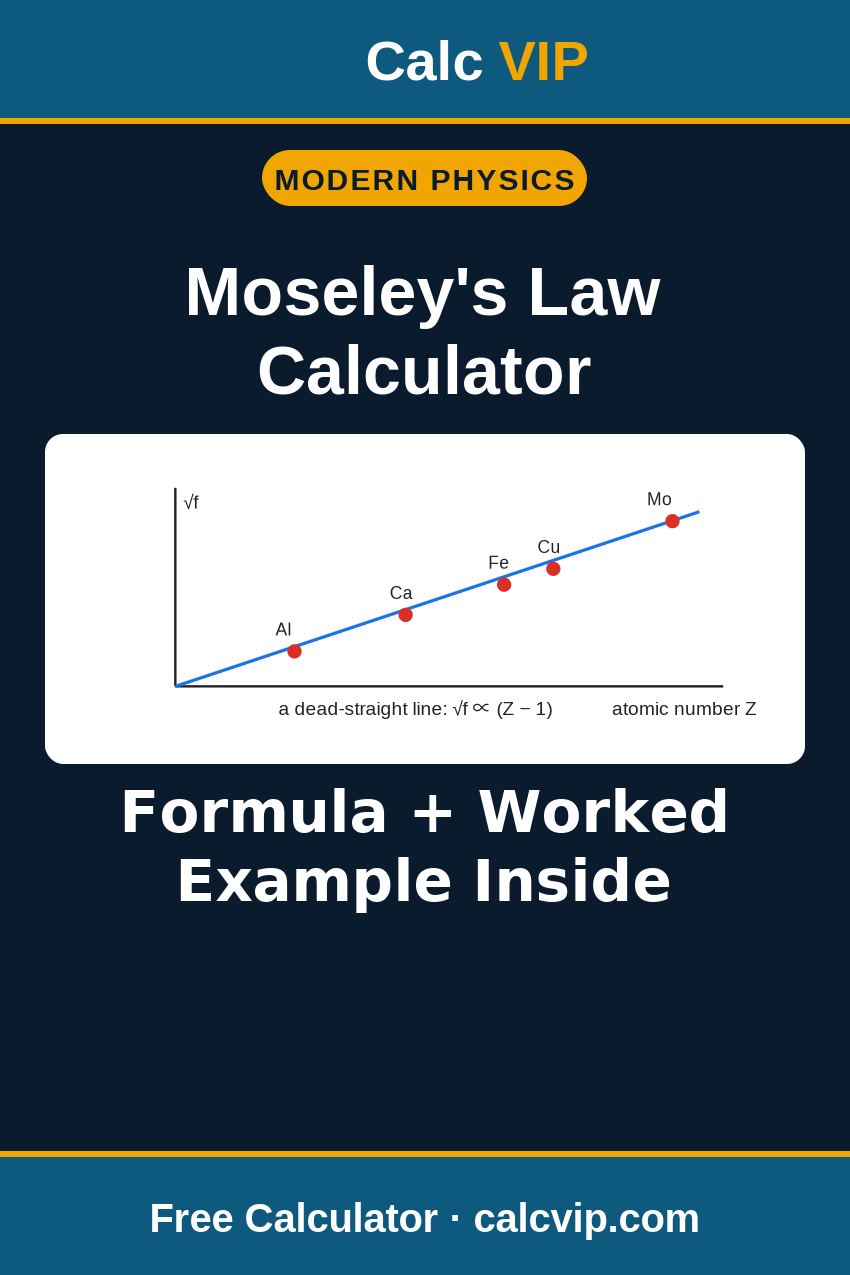
Every element, when its innermost electron shell is disturbed, answers with an X-ray whose energy is as unique as a fingerprint — and Moseley's law is the rule that predicts the fingerprint from a single integer. Knock an electron out of the K shell (the innermost shell, n = 1), and an electron from the L shell (n = 2) drops down to fill the vacancy, emitting the difference as the Kα photon. Because inner shells are screened from the chemical chaos of the outer atom, the Kα energy depends on essentially one thing: how many protons sit in the nucleus. Henry Moseley, working in 1913–14 with apparatus he built himself, found the pattern — √f proportional to (Z − 1) — and in doing so discovered what atomic number physically is.
The law's consequences were immediate and dramatic. The periodic table of the day was ordered by atomic mass, which put cobalt before nickel and tellurium before iodine against their chemistry's protests. Moseley's X-ray frequencies marched in perfect step with charge, not mass: cobalt is 27, nickel 28, and the table's anomalies evaporated. Gaps in his sequence at Z = 43, 61, 72 and 75 were not errors but predictions — elements not yet found, each later discovered (technetium, promethium, hafnium, rhenium), hafnium turning up in Copenhagen in 1923 exactly where Moseley's law said a missing element should hide, inside zirconium ores that chemists had mis-filed for decades.
Today the law earns its keep as an identification engine. X-ray fluorescence instruments — from bench analysers to handheld guns used on scrap yards and archaeological digs, to the PIXL instrument on NASA's Perseverance rover — read Kα energies and report elements, inverting this calculator's arithmetic millions of times a day. This page runs it forwards: give it an atomic number and it returns the Kα frequency, wavelength and photon energy, accurate to a fraction of a percent for the light and middle elements, and honestly approximate (for reasons explained below) at the heavy end of the table.
Formula
f ≈ 2.47 × 10¹⁵ × (Z − 1)² Hz • then λ = c / f and E = hf • equivalently E ≈ 10.2 × (Z − 1)² eV
The formula is the Bohr model wearing an X-ray coat. A hydrogen-like transition from n = 2 to n = 1 releases a fraction (1 − 1/4) = 3/4 of the ground-state binding energy 13.6 × (effective Z)² eV, and the frequency form is the same statement with the Rydberg constant: f = (3/4) × R∞c × (Z − 1)², where (3/4) × 1.097 × 10⁷ × 3 × 10⁸ = 2.47 × 10¹⁵ Hz. The "(Z − 1)" is the physics of screening: the one electron remaining in the K shell blots out roughly one proton's worth of charge, so the falling electron responds to Z − 1. The energy shortcut E ≈ 10.2(Z − 1)² eV (since 13.6 × 3/4 = 10.2) is the fastest mental version — for copper, 10.2 × 28² = 7,997 eV ≈ 8.0 keV, matching the full calculation below. Rearranged, the law also runs backwards, as every XRF instrument runs it: measure E, and Z = 1 + √(E/10.2 eV) names the element.
| Symbol | Meaning | Units |
|---|---|---|
| Z | atomic number — the count of protons in the nucleus | whole number ≥ 2 |
| Z − 1 | effective charge after screening by the remaining K electron | — |
| f, λ, E | Kα frequency, wavelength and photon energy | Hz, m (pm here), keV |
| Kα | the X-ray line from an L-shell (n = 2) electron filling a K-shell (n = 1) vacancy | — |
| R∞ | Rydberg constant, 1.097 × 10⁷ /m — the law's hidden constant | per metre |
Screening: why the atom hides one proton
The (Z − 1) deserves a closer look, because it is the difference between a law and a coincidence. When a K electron is ejected — by an electron beam, an X-ray photon or a radioactive process — the K shell is left with one electron in it. The L electron that will fall sits outside that survivor, and from out there the survivor's negative charge cancels one proton's positive charge almost exactly: the falling electron is attracted not by the bare nucleus but by a nucleus wearing a one-electron veil. Hence the effective charge Z − 1, and hence the square: transition energies in hydrogen-like systems scale with the square of the charge the electron feels. Moseley's genius was to see the straight line in √f against Z and read the offset of exactly one as physics, not error.
Deeper shells are veiled more thickly. For L-series lines (transitions down to n = 2), the screening constant is about 7.4 rather than 1, because two full shells of electrons now stand between the falling electron and the nucleus: fLα ≈ (5/36) × R∞c × (Z − 7.4)². The pattern generalises into a whole spectroscopy of inner shells, each with its own Moseley line, and modern precision work replaces the tidy integers with computed screening for every shell and subshell. But the Kα version on this page remains the workhorse: the strongest line, the least screened, and the one whose simple formula — one constant, one subtraction, one square — still lands within a percent or two of experiment across half the periodic table.
How to use
- Select an element — iron, copper or molybdenum — or choose "Custom atomic number Z" and type any whole atomic number of 2 or more.
- Click "Calculate Kα Line".
- Read the Kα frequency in Hz, the wavelength in pm (and nm), and the photon energy in keV.
- To identify an unknown line instead, run the law backwards by hand: Z = 1 + √(E ÷ 10.2 eV). A measured line at 6.4 keV gives Z = 1 + √(6400 ÷ 10.2) ≈ 1 + 25 = 26 — iron. That inversion is precisely what XRF software does.
Worked examples
Example 1 — copper, Z = 29. For copper, Z = 29:
f = 2.47 × 10¹⁵ × (29 − 1)² = 2.47 × 10¹⁵ × 784 = 1.936 × 10¹⁸ Hz
λ = c / f = 154.92 pm (0.155 nm)
E = hf = 8.009 keV
The measured copper Kα line is 8.04 keV — Moseley's simple formula is accurate to better than half a percent. Copper's line is the calibration standard of X-ray crystallography for exactly this reason: strong, sharp and precisely known.
Example 2 — iron, Z = 26. The element Moseley's generation cared most about:
f = 2.47 × 10¹⁵ × 25² = 2.47 × 10¹⁵ × 625 = 1.544 × 10¹⁸ Hz
λ = 194.33 pm, E = 6.385 keV (measured: 6.40 keV).
Iron's Kα is astronomy's favourite line: hot gas in galaxy clusters and around black holes glows at 6.4–6.7 keV, and telescopes read accretion physics from its shape — all indexed by this one calculation.
Example 3 — molybdenum, Z = 42. The other great laboratory source:
f = 2.47 × 10¹⁵ × 41² = 2.47 × 10¹⁵ × 1,681 = 4.152 × 10¹⁸ Hz
λ = 72.25 pm, E = 17.173 keV (measured: about 17.4–17.5 keV, within roughly 2%).
Molybdenum's shorter wavelength suits it to small-molecule crystallography and mammography targets, where its K lines land in a diagnostically sweet band.
Example 4 — aluminium, Z = 13. Down at the light end:
f = 2.47 × 10¹⁵ × 12² = 2.47 × 10¹⁵ × 144 = 3.557 × 10¹⁷ Hz
λ = 843.5 pm (0.843 nm), E = 1.471 keV (measured: 1.487 keV).
Such soft X-rays are absorbed by air and by the sample itself within millimetres, which is why light-element XRF needs vacuum chambers or helium paths — the law predicts the line, and the line's softness dictates the instrument.
Example 5 — calcium, Z = 20. The element of bone and limestone:
f = 2.47 × 10¹⁵ × 19² = 2.47 × 10¹⁵ × 361 = 8.917 × 10¹⁷ Hz
λ = 336.4 pm, E = 3.688 keV (measured: 3.691 keV — agreement to 0.1%).
Handheld XRF units read this line to assay cement, soils and fertiliser; the near-perfection of the prediction at Z = 20 is typical of the law's home territory.
Example 6 — tungsten, Z = 74: where the simple law drifts. Push to the heavy end:
f = 2.47 × 10¹⁵ × 73² = 2.47 × 10¹⁵ × 5,329 = 1.316 × 10¹⁹ Hz
λ = 22.79 pm, E = 54.44 keV — but the measured tungsten Kα is 59.3 keV, about 8% higher.
The drift is itself instructive: at Z = 74 the K electron moves at a substantial fraction of light speed, relativistic mass increase deepens its binding beyond the Bohr formula's account, and screening is no longer a clean one unit. Moseley's law remains the right first estimate — but heavy-element precision belongs to relativistic calculations, and honest use of this calculator says so.
Moseley's law in real life
X-ray fluorescence analysis. An XRF gun excites a sample, reads the Kα (and L) lines, and inverts the law to name and quantify elements in seconds: scrap-metal sorting, RoHS compliance screening for lead and cadmium, mining grade control, and soil testing all run on Moseley's arithmetic.
X-ray crystallography. Diffraction needs a single, known wavelength. Copper (154.92 pm) and molybdenum (72.25 pm) anodes are the standard sources precisely because their Kα lines — predicted on this page — are intense, sharp and matched to typical crystal spacings.
Planetary exploration. The PIXL instrument on Perseverance and the APXS instruments before it fire X-rays at Martian rocks and read the fluorescent lines to map chemistry grain by grain. Moseley's law is operating on another planet, identifying elements in rocks no human has touched.
Art and archaeology. Conservators aim XRF at paintings, coins and manuscripts: the Kα lines of lead white, mercury vermilion or gold leaf reveal pigments, forgeries and hidden layers without taking a single sample. The fingerprint logic is exactly Moseley's — each element announces its Z.
X-ray astronomy. The iron line near 6.4 keV (Example 2) is the most studied feature in the X-ray sky, emitted by gas orbiting black holes and suffusing galaxy clusters. Its identity is never in doubt because Moseley's law pins iron's line to one energy across the entire universe.
Tube design. Anode materials for X-ray tubes are chosen by their K lines and the voltage needed to excite them: tungsten for general radiography, molybdenum and rhodium for mammography's soft band. The design conversation starts from the (Z − 1)² scaling this calculator embodies.
The straight line that rebuilt the periodic table
Moseley's method deserves a moment of awe for its economy. With a crystal spectrometer and photographic plates, in a matter of months across 1913–14, he measured the K lines of elements from calcium to zinc and the L lines of the heavy elements, and plotted √f against the element's position in the table. The points fell on a straight line — but only if the elements were numbered by nuclear charge, with cobalt and nickel swapped from their mass order and three gaps left open. In one plot, atomic number stopped being a mere counting index and became a physical quantity: the number of protons, the thing X-ray frequencies actually measure. The modern periodic table — ordered by Z, its anomalies resolved, its missing members predicted with addresses — is that plot's legacy. Moseley was killed at Gallipoli in August 1915, aged 27, in a loss so keenly felt by science that Britain changed its policy on sending scientists to the front. Physicists of the stature of Rutherford called his work among the most important of the age; the law on this page is why.
Quick reference: Kα lines of common elements
| Element | Z | Frequency | λ | E (Moseley) |
|---|---|---|---|---|
| aluminium | 13 | 3.557 × 10¹⁷ Hz | 843.5 pm | 1.471 keV |
| calcium | 20 | 8.917 × 10¹⁷ Hz | 336.4 pm | 3.688 keV |
| iron | 26 | 1.544 × 10¹⁸ Hz | 194.33 pm | 6.385 keV |
| copper | 29 | 1.936 × 10¹⁸ Hz | 154.92 pm | 8.009 keV |
| molybdenum | 42 | 4.152 × 10¹⁸ Hz | 72.25 pm | 17.173 keV |
| silver | 47 | 5.227 × 10¹⁸ Hz | 57.40 pm | 21.617 keV |
| tin | 50 | 5.930 × 10¹⁸ Hz | 50.59 pm | 24.529 keV |
Keep the scaling in your bones: energy grows with (Z − 1)², so doubling Z roughly quadruples the line energy, and the whole table from aluminium's soft 1.5 keV to tin's hard 24.5 keV is one square law unspooling. Any unidentified line in a spectrum is an unknown Z waiting for this arithmetic.
Common mistakes
- Squaring Z instead of (Z − 1). For copper that is 29² = 841 against the correct 28² = 784 — a 7% error in frequency and energy, far larger than the law's own inaccuracy. The subtraction is small, physical and non-optional.
- Confusing Kα with Kβ. Kβ comes from n = 3 falling to n = 1, so it is always the higher-energy, weaker line (copper Kβ ≈ 8.9 keV against Kα's 8.04). Reporting the wrong line misidentifies elements in XRF work.
- Applying the Kα formula to L lines. L-series transitions end at n = 2 and are screened by about 7.4 charges, not 1: the formula is a different one. Gold's famous Lα line (9.7 keV) cannot be obtained from this page's equation — by design.
- Demanding exactness at high Z. The simple law drifts as relativity bites — tungsten is off by ~8% (Example 6). Treat heavy-element outputs as first estimates and consult tabulated line energies for precision work above Z ≈ 50.
- Forgetting the vacancy must be made first. No Kα photon appears until a K electron is removed, which needs an incoming electron, photon or particle with at least the K-edge energy (for copper, 8.98 keV). A 5 kV tube cannot make copper Kα at any current — excitation has a threshold just as emission has a law.
FAQ
Why (Z − 1) and not Z?
After one K electron is knocked out, one K electron remains. It shields (screens) about one unit of the nuclear charge, so the falling L electron "feels" an effective charge of roughly Z − 1.
Why was Moseley's law so important?
In 1913–14 Henry Moseley showed that X-ray frequencies order the elements by atomic number, not atomic mass. This fixed the places of cobalt and nickel, and predicted missing elements such as hafnium and rhenium.
What are Kα lines used for today?
They are fingerprints of the elements: X-ray fluorescence (XRF) analysers identify materials by their Kα energies, and copper and molybdenum Kα sources are standard in X-ray crystallography.
What is the Kβ line?
The companion line from an n = 3 (M shell) electron filling the K vacancy. It carries more energy than Kα — the fall is longer — but occurs less often, so it is the weaker peak beside Kα in every spectrum. Copper's Kβ sits at about 8.9 keV, and filters in crystallography exist largely to strip it away and leave pure Kα.
How did Moseley measure these frequencies?
With a crystal spectrometer of his own construction: X-rays reflected from a crystal at measured angles (Bragg diffraction) gave wavelengths, and the elements were mounted on a little trolley he could slide through his vacuum chamber to measure them in sequence. Photographic plates recorded the lines. The apparatus was simple; the insight was not.
Why does the law slowly fail for heavy elements?
Two neglected effects grow with Z: the K electron's speed approaches a good fraction of c, so relativistic corrections deepen its binding; and screening stops being a tidy one unit as the other electrons' own structure matters. Example 6's tungsten discrepancy (54.4 predicted, 59.3 measured) is the size of the combined effect at Z = 74.
Can Moseley's law identify elements in a mixture?
Yes — that is XRF in one sentence. Each element contributes its own Kα (and L) lines at the law's energies, so a spectrum of an alloy, soil or pigment reads like a bar code of its composition. Overlapping lines and absorption effects complicate the quantification, but identification starts here.
What is the screening constant for L lines?
About 7.4, replacing the 1 in (Z − 1): the L shell sits outside the filled K shell and part of the L shell itself, so far more charge is veiled. The same √f straight line appears, with a different slope and offset — Moseley found both, and the two together pinned down the electron-shell structure of atoms.
Did Moseley win a Nobel Prize?
No — he was killed at Gallipoli in 1915, at 27, before the prize could recognise work that senior physicists already ranked with the era's best. His death moved Britain to stop deploying trained scientists as infantry. The law, the reordered table and the predicted elements are his memorial.
Why don't chemical bonds change the Kα energy?
Chemistry rearranges the outer electrons; the K and L shells sit deep inside, screened from all of it, feeling essentially only the nucleus and each other. That is why XRF identifies elements regardless of their compounds — iron's line is 6.4 keV in metal, rust and haemoglobin alike (tiny chemical shifts exist at precision levels, but they are parts per ten thousand).