 Calc
Mass–Energy Calculator – E = mc² Rest Energy & Mass Equivalent
 Created by Yuki Tanaka · Physics Editor · Modern Physics · Last updated: November 2026
Use this free Mass–Energy Calculator to convert between mass and energy with Einstein's famous equation E = mc². Find the rest energy locked inside any mass, or the mass equivalent of any amount of energy.
E = mc² is the most famous equation ever written, and this calculator is all of it: multiply a mass by the speed of light squared and you get the energy that mass is, even sitting perfectly still. The shock of the equation is the size of c² — 9 × 10¹⁶ in SI units — which acts as an exchange rate of grotesque generosity. One gram of anything, fully converted, yields 9 × 10¹³ joules: roughly the energy of a 21-kiloton explosion, or the electricity a large city uses in hours. Mass, Einstein showed, is not a separate substance from energy; it is energy in its most concentrated form, and this tool performs the conversion both ways.
The reverse direction is just as strange and just as true. Every amount of energy has a mass equivalent, m = E/c²: a charged battery is (immeasurably) heavier than a flat one, a hot cup of tea outweighs the same tea cold, and the sunlight streaming through a window carries mass equivalence as it goes. The effects are undetectably small in daily life only because c² is so large — dividing ordinary energies by 9 × 10¹⁶ leaves almost nothing. But in particle physics the conversion is routine bookkeeping, and in nuclear physics it is the whole story: the energy released by fission, fusion and radioactive decay is precisely the mass that goes missing, multiplied by c².
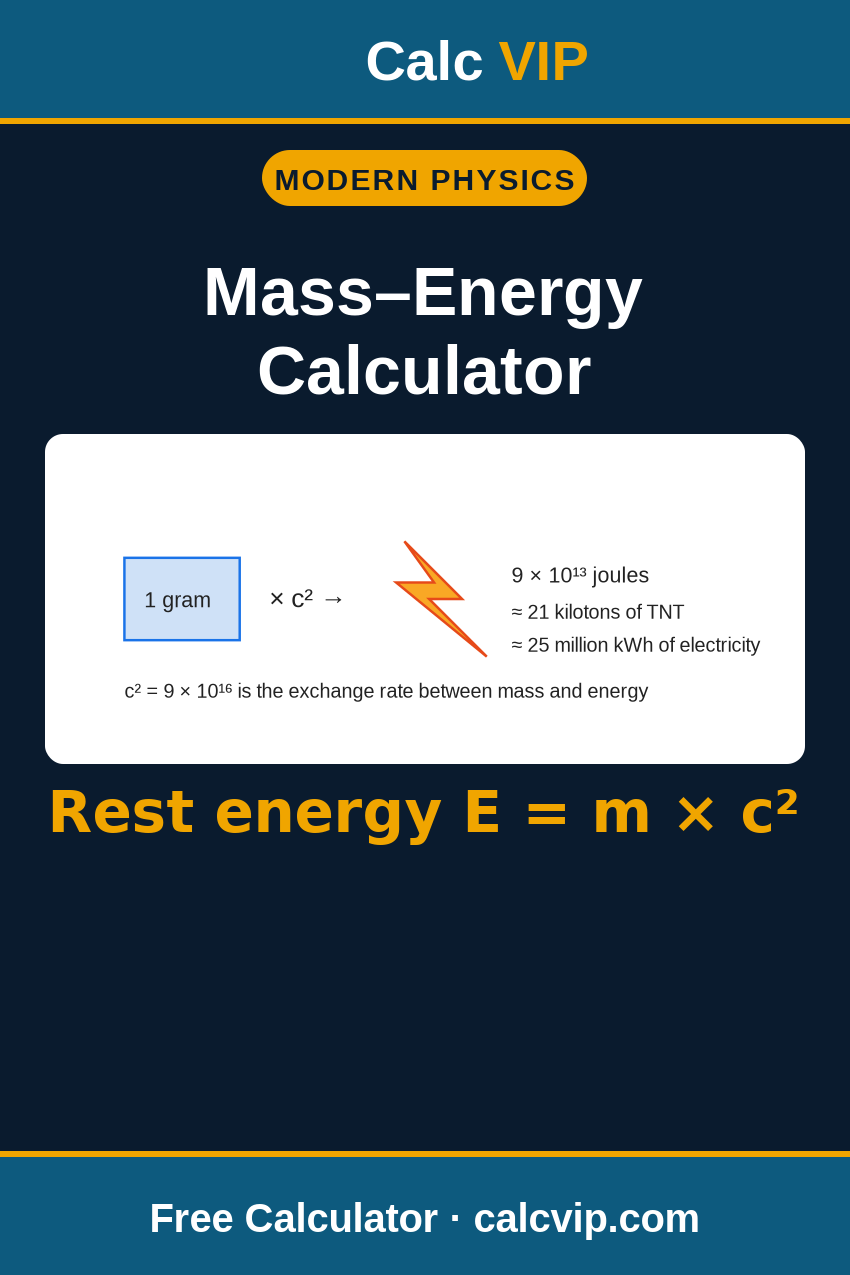
Handle the equation's fame with one care: it describes the energy of mass at rest — rest energy. It does not say any lump of matter can simply be turned into energy on demand; conversion happens only through specific processes (annihilation converts all of it; nuclear reactions convert a fraction of a percent). What E = mc² guarantees is the accounting: whenever energy appears, mass somewhere has decreased by E/c², and whenever mass vanishes, energy E = mc² has gone somewhere. The calculator keeps those books in either direction, in joules, kilowatt-hours and electron-volts.
Formula
Rest energy E = m × c² • Mass equivalent m = E ÷ c² • c = 3 × 10⁸ m/s, so c² = 9 × 10¹⁶ m²/s²
With m in kilograms the energy arrives in joules. Two conversions make the results graspable: divide joules by 3.6 × 10⁶ for kilowatt-hours, and divide by 1.602 × 10⁻¹⁹ for electron-volts (or by 1.602 × 10⁻¹³ for MeV, the particle physicist's working unit). The equation's companions matter as much: a moving object's total energy is E = γmc² (the relativistic-energy calculator handles that), and for a particle with momentum the full relation is E² = (pc)² + (mc²)², which reduces to this page's formula when p = 0. Keep one discipline throughout: mass in kilograms, never grams — a gram entered as "1" inflates the energy a thousandfold.
| Symbol | Meaning | Units |
|---|---|---|
| E | rest energy contained in the mass | J (also kWh, eV, MeV) |
| m | mass | kg |
| c | speed of light, 3 × 10⁸ | m/s |
| c² | the conversion factor, 9 × 10¹⁶ | m²/s² |
| γ | Lorentz factor, for moving objects (E = γmc²) | dimensionless |
Why c²? The exchange rate explained
Nothing in the formula is arbitrary. In relativity, energy and momentum form a single object, and c is the universe's conversion constant between space and time units; c² is then forced as the conversion between mass and energy units. A homelier way to feel it: kinetic energy grows with v², and c is the largest speed there is, so mc² is like the "kinetic energy scale" of mass itself at the ultimate speed — the deepest energy a mass can represent. Einstein arrived at it in 1905 by asking a deceptively small question: if a body emits light of energy E, does it lose mass? The answer, m = E/c², was yes — and with it, the two conservation laws of physics (mass and energy) merged into one.
The merger has a measurable consequence chemists had missed for a century: reactions change mass. Burn a kilogram of petrol and the exhaust gases, once cooled, weigh less than the fuel and oxygen did — by about 5 × 10⁻¹⁰ kg, since 4.4 × 10⁷ J ÷ 9 × 10¹⁶ ≈ 4.9 × 10⁻¹⁰ kg. No balance can detect it, but the mass is genuinely gone, carried off as heat and light. Nuclear reactions simply make the same effect a million times larger per atom — large enough to weigh, to bill for, and to power cities with.
How to use
- Choose the direction: "Energy from mass (E = mc²)" or "Mass from energy (m = E/c²)".
- Enter the mass in kilograms (1 gram is 0.001) or the energy in joules — scientific notation such as 9e13 is accepted.
- Click "Calculate" to see the result in joules, kilowatt-hours and MeV, or the mass in kilograms and grams.
- For scale, compare with the reference points in this page: 1 g ↔ 9 × 10¹³ J. If your answer for a gram-scale mass is nowhere near 1014 J, a grams/kilograms slip is the likely cause.
Worked examples
Example 1 — one gram. m = 0.001 kg:
E = 0.001 × 9 × 1016 = 9 × 10¹³ J = 5.618 × 1026 MeV = 2.5 × 10⁷ kWh. Run in reverse, the same 9 × 10¹³ J corresponds to 0.001 kg — the calculator's two directions are the same fact read either way. A gram of paper, a gram of uranium, a gram of anything: identical rest energy, because the equation asks only how much mass, never what kind.
Example 2 — one kilogram. E = 1 × 9 × 1016 = 9 × 10¹⁶ J = 2.5 × 10¹⁰ kWh — about 25 billion units of electricity, comparable to a large power station's output for years — or 21.5 megatons of TNT. This is the energy scale that makes antimatter (the only perfect converter) so coveted in fiction and so impractical in fact.
Example 3 — the electron's rest energy. m = 9.11 × 10⁻³¹ kg: E = 9.11 × 10−31 × 9 × 1016 = 8.199 × 10⁻¹⁴ J = 0.512 MeV. This number is a celebrity: when an electron meets a positron and both annihilate, each of the two gamma photons produced carries exactly this energy — the 0.511–0.512 MeV signature that PET scanners are built to detect.
Example 4 — the Sun's weight loss. The Sun radiates 3.87 × 1026 J every second (taking its mass conversion rate as 4.3 × 10⁹ kg/s: E = 4.3 × 109 × 9 × 1016 = 3.87 × 1026 W). That is over four million tonnes of mass converted to light and heat every second — and the Sun is so massive (2 × 1030 kg) that it can keep this up for billions of years while barely noticing.
Example 5 — the mass of a year's light. A 100 W bulb burning for a year emits E = 100 × 3.156 × 107 = 3.156 × 10⁹ J of light and heat. Its mass equivalent: m = 3.156 × 10⁹ ÷ 9 × 1016 = 3.51 × 10⁻⁸ kg = 35 micrograms. A year of lamplight "weighs" less than a grain of sand — the reverse conversion is real but ruthlessly small.
Example 6 — the mass that powered an explosion. The Hiroshima bomb released about 15 kilotons of TNT energy: 15 × 4.184 × 1012 = 6.28 × 10¹³ J. The mass converted: m = 6.28 × 10¹³ ÷ 9 × 1016 = 7 × 10⁻⁴ kg ≈ 0.7 grams — less than a paperclip's worth of the uranium's mass became the energy that destroyed a city; the rest became radioactive debris and lighter nuclei, whose masses sum to 0.7 g less than the original.
Mass–energy in real life
The Sun and every star. Fusion converts about 0.7% of the hydrogen's mass into energy: four protons (plus electrons) become a helium nucleus that is lighter by that fraction, and the difference shines. E = mc² is the starlight equation, running in every sun in the sky.
Nuclear power. A fission reactor splits uranium nuclei into fragments whose total mass is about 0.1% less; that missing mass, times c², is the heat that boils the water. One kilogram of uranium-235 yields roughly 8 × 10¹³ J — about three million times the same mass of coal.
PET medical scanners. A tracer emits positrons; each positron annihilates with an electron, converting 2 × 0.512 MeV of mass into two gamma photons flying apart in opposite directions. The scanner times those photons to locate the annihilation — mass–energy equivalence doing diagnostic medicine.
Particle accelerators. Colliders run the equation backwards: kinetic energy is converted into brand-new mass. The Higgs boson was created by pouring beam energy into a point until 125 GeV/c² of new mass condensed out of it — E = mc² as a manufacturing process.
Your body's warmth. The chemical reactions of metabolism release energy, so you are — by roughly 10−10 kg per day's food energy of 8.37 × 10⁶ J — lighter after radiating a day's heat than the food and oxygen you took in would suggest. Undetectable, but the books balance.
Cosmic rays and antimatter. When high-energy cosmic rays strike the atmosphere, their energy materialises as particle–antiparticle pairs — mass from pure energy, observed daily. Nature performs both directions of this calculator constantly at high energies.
Quick reference: rest energies
| Mass | Rest energy | Familiar comparison |
|---|---|---|
| electron | 0.512 MeV | the PET-scan photon |
| proton | 939.9 MeV | ≈ 1 GeV, the accelerator unit |
| 1 atomic mass unit | ≈ 933 MeV | nuclear binding bookkeeping |
| 1 gram | 9 × 10¹³ J | ≈ 21 kt TNT · 2.5 × 10⁷ kWh |
| 1 kilogram | 9 × 10¹⁶ J | ≈ 21.5 Mt TNT |
| a 70 kg person | 6.3 × 10¹⁸ J | ≈ 1.5 gigatons TNT equivalent |
The last row startles everyone: the rest energy of a human body equals a large thermonuclear arsenal's yield. It is not accessible energy — no process converts bulk matter wholesale — but as a statement about what mass is, nothing makes the point faster.
What E = mc² does not say
Three clarifications protect against the commonest misreadings. First, the equation is not about speed: it holds for a mass sitting still, and motion adds the γ factor handled by the relativistic-energy calculator. Second, it is not a recipe: it states an equivalence, not a method — converting mass to energy needs a physical process, and chemistry converts so little (~10−9) that for centuries mass seemed perfectly conserved. Third, mass is not "frozen energy" in a metaphorical sense but in the bookkeeping sense: in every reaction ever measured, total energy (counting mc² for every mass) is conserved exactly, and any energy released is matched by mass lost, to the precision of the finest instruments. The equation is less a slogan than an accounting identity for the universe.
Chemistry obeys the same law, at unmeasurable scale. Burning a kilogram of petrol releases about 4.6 × 10⁷ J, so the exhaust gases and ash weigh less than the fuel and oxygen did — by E ÷ c² = 5.1 × 10⁻¹⁰ kg, half a microgram spread over tonnes of exhaust. No scale will ever catch it, which is why Lavoisier's "mass is conserved" survived as chemistry's founding approximation: it is wrong in principle and right to one part in ten billion in practice. Nuclear reactions sit in the sweet spot where the mass change is a fraction of a percent — large enough to weigh, large enough to power cities and weapons, and the entire reason E = mc² is famous as a nuclear formula rather than a universal footnote to every campfire.
Antimatter sets the energy-density record. One gram of antimatter annihilating with one gram of ordinary matter converts the full 2 grams: E = 0.002 × 9 × 1016 = 1.8 × 10¹⁴ J, about 43 kilotons of TNT — from two grams. Nothing else comes close, which is why antimatter haunts both propulsion studies and fiction. The catch is bookkeeping: every antimatter particle must first be manufactured in collisions that cost far more energy than the annihilation returns, and storing even nanograms defies current technology. E = mc² promises the energy; it says nothing about the engineering, and the engineering is merciless.
Common mistakes
- Entering grams as kilograms. E = mc² in SI units wants kilograms. One gram is 0.001 kg; entering 1 for a gram overstates the energy a thousand times.
- Forgetting the square. c² is 9 × 10¹⁶, not 3 × 10⁸. Using plain c undervalues every result by a factor of three hundred million.
- Believing all that energy is obtainable. Rest energy is the total content, not the accessible yield. Fission liberates ~0.1%, fusion ~0.7%, chemistry ~10−9 — only annihilation reaches 100%.
- Thinking mass is destroyed and energy created from nothing. Neither is created or destroyed; one is converted into the other with c² as the rate. The total, counted properly, never changes.
- Applying E = mc² to a photon. Photons have zero rest mass; their energy is E = hf (equivalently E = pc). Feeding a photon into this calculator is a category error — use the photon-energy calculator instead.
FAQ
Does E = mc² mean any object can turn into pure energy?
Only in processes that convert mass completely, like matter–antimatter annihilation. In nuclear reactions only a small fraction of the mass becomes energy — but even that fraction powers the Sun and nuclear plants.
Why is the energy so large?
Because it is multiplied by c² — the speed of light squared, 9 × 10¹⁶. That giant factor is why a gram of anything holds city-scale energy.
What is the mass equivalent of sunlight?
Energy has mass equivalence too: 9 × 10¹³ J of energy "weighs" 0.001 kg. The Sun loses about 4 million tonnes of mass every second by shining.
Does a hot object really weigh more than a cold one?
Yes, by E/c². Heating a litre of water from 20 °C to 100 °C adds 3.35 × 10⁵ J, hence 3.7 × 10⁻¹² kg — real, and about a million times below the sensitivity of the best balances, which is why nobody notices.
Where does the mass go in a nuclear reaction?
It leaves as the kinetic energy of the products and as photons. Weigh the products of fission precisely and they are lighter than the original nucleus by exactly the released energy divided by c² — measured routinely in mass spectrometers.
Why can't we power homes with antimatter?
Annihilation is the perfect converter, but antimatter must first be manufactured — at an energy cost far exceeding what annihilation returns — and stored without touching matter. Nature provides no mineable supply; the physics is flawless and the economics impossible.
Is mass really energy, or just convertible into it?
Modern physics treats them as the same ledger: a system's mass is its rest energy divided by c². A box containing hot gas has more mass than the same box cold; a compressed spring outweighs a relaxed one. "Convertible" undersells it — they are two names for one quantity.
What did Einstein actually publish in 1905?
A three-page paper asking whether a body's inertia depends on its energy content, concluding that mass lost as radiation is m = E/c². The compact E = mc² form came slightly later; the idea — mass and energy are one — was complete in that short paper.
How much mass does the Earth lose to sunlight's warmth?
Energy radiated away carries mass with it, but Earth also gains mass-equivalent from absorbed sunlight; the planet is in near balance. The Sun itself is the big loser: about 4.3 × 10⁹ kg every second, gone as light.
Does E = mc² apply to binding energy in atoms and molecules?
Yes — a helium nucleus weighs less than its two protons and two neutrons separately by the binding energy ÷ c² (about 0.7%), and even a water molecule is lighter than its atoms by its chemical binding ÷ c², an effect a billion times smaller but identical in kind.