 Calc
Radiation Calculator – Stefan–Boltzmann Power P = εσAT⁴ (Gross & Net)
 Created by Anna Kowalski · Physics Editor · Heat & Atoms · Last updated: November 2026
Use this free Radiation Calculator to find the power radiated by a hot surface with the Stefan–Boltzmann law, P = εσAT⁴. Enter the emissivity, surface area and absolute temperature — and optionally switch to net radiation against cooler surroundings.
Everything radiates. You are radiating as you read this — several hundred watts of infrared, streaming silently off your skin. So is the chair, the wall, the ice in a freezer. Thermal radiation is the third way heat moves, after conduction and convection, and the only one that needs no medium at all: it is light, mostly invisible infrared light, emitted by every object whose temperature is above absolute zero. The Stefan–Boltzmann law prices that glow with startling simplicity — the power is proportional to the surface area, to the emissivity ε that grades the surface's enthusiasm, and to the fourth power of the absolute temperature. That T⁴ is the most dramatic exponent in everyday physics: double the temperature and the radiation does not double, it multiplies sixteenfold.
The law's two faces are both on this page. The gross power P = εσAT⁴ is what a body emits, full stop — a figure that depends only on the body itself. The net power, P = εσA(T⁴ − Ts⁴), is what it actually loses once the surroundings' own radiation, streaming back in, is subtracted. Stand in a warm room and your gross radiation is some 800 W, yet you are not freezing in seconds: the room radiates nearly as much back, and only the modest difference — around a hundred watts — is your true radiative loss. Every thermal camera, every spacecraft radiator, every calculation of how fast a planet cools is this subtraction performed carefully.
Two of the law's characters deserve respect before you calculate. Emissivity ε runs from near 0 for polished metal — a mirror is a miserly radiator — to 0.9 and above for skin, paint, wood and most dull surfaces, with the perfect black body at exactly 1 as the reference standard. And the temperature is absolute: T⁴ amplifies unit errors mercilessly, so a Celsius value slipped into the formula does not bend the answer, it destroys it. Give the calculator kelvin, an honest ε and the area, and it returns the invisible river of energy that every warm thing pours into the universe.
Formula
Stefan–Boltzmann law P = εσAT⁴ — where ε is the emissivity (1 for a perfect black body), σ = 5.67 × 10⁻⁸ W/m²·K⁴ is the Stefan–Boltzmann constant, A is the surface area (m²) and T is the absolute temperature (K). Against surroundings at Ts, the net power is P = εσA(T⁴ − Ts⁴).
The law rearranges to find the temperature a known radiator must be running at — the trick behind every non-contact thermometer: T = (P/(εσA))1/4, the fourth root of the power per unit emissivity and area. Infrared thermometers and thermal cameras are this rearrangement in a plastic case: they measure P, assume an ε (0.95 is the usual default), and report the T that satisfies the equation — which is why they misread shiny metal, whose true ε is far below the assumed value. Note also what the net formula whispers: only differences of fourth powers matter, so two bodies at the same temperature exchange radiation furiously and net exactly nothing. Radiation never stops; it merely balances.
| Symbol | Meaning | Units |
|---|---|---|
| P | radiated power (gross, or net in the second formula) | W |
| ε | emissivity of the surface, 0 to 1 | — |
| σ | Stefan–Boltzmann constant, 5.67 × 10⁻⁸ | W/m²·K⁴ |
| A | surface area doing the radiating | m² |
| T | absolute temperature of the body | K |
| Ts | absolute temperature of the surroundings | K |
Why the fourth power? Two multiplications hiding in one
The T⁴ looks like a conjuring trick, but it is two honest effects multiplied. First, every part of the spectrum brightens as temperature rises: a hotter body's vibrations drive its charges harder, so at any given wavelength it emits more. Second, the spectrum itself shifts: the peak emission slides to shorter wavelengths (Wien's law, the subject of the depth section below), recruiting whole new, more energetic bands of the spectrum into service. Total power is roughly "brightness per band × number of bands in play", and since both factors grow with T, their product grows as T⁴. Stefan found the law experimentally in 1879; Boltzmann derived it five years later from thermodynamics alone.
The cast list matters too. What a body emits, it emits in all directions from its surface, and — by a companion result of Kirchhoff's — a surface's emissivity at any wavelength equals its absorptivity there. Good absorbers are good emitters; a black surface both drinks in sunlight and radiates its own heat away efficiently, while a polished mirror does little of either. This is why the ε in the formula is a surface property and not a bulk one: a coat of paint, a layer of oxide, a film of frost — each rewrites the surface's contract with the radiation field, while the material underneath keeps its own counsel. It is also why "colour" misleads: colour describes behaviour in visible light only, and in the infrared, where room-temperature business is done, almost all paints — white included — are effectively black, with ε around 0.9.
Finally, the law is why the universe's energy traffic is dominated by its hottest members. A star at twice the Sun's surface temperature radiates sixteen times more per square metre; a furnace at 1,000 K out-radiates a room-temperature wall (per square metre) by a factor of (1000/300)⁴ ≈ 123. Cooling anything hot is therefore mostly a radiation problem, and heating anything cold is mostly a battle against its own T⁴ enthusiasm to give the energy back.
How to use
- Choose total or net radiation from the drop-down.
- Enter the emissivity: polished metal ≈ 0.05, most non-metals and skin ≈ 0.9–0.97, ideal black body = 1.
- Enter the surface area in square metres and the temperature in kelvin (add 273.15 to °C).
- For net mode, also enter the surroundings temperature. Click "Calculate Radiated Power".
- Read a negative net result as a gain: the surroundings are hotter, and radiation is heating the body, not cooling it.
Worked examples
Example 1 — the reference black body. A black body (ε = 1) of area 1 m² at T = 400 K.
P = 1 × 5.67 × 10⁻⁸ × 1 × 400⁴ = 1,451.52 W
Against surroundings at 300 K, the net loss is 5.67 × 10⁻⁸ × (400⁴ − 300⁴) = 992.25 W.
Example 2 — you, radiating. Skin has ε ≈ 0.97 and area about 1.7 m²; take skin temperature as 306 K (33 °C).
Gross: P = 0.97 × 5.67 × 10⁻⁸ × 1.7 × 306⁴ ≈ 820 W. In a room at 293 K the net loss is 0.97 × 5.67 × 10⁻⁸ × 1.7 × (306⁴ − 293⁴) ≈ 131 W — roughly your resting metabolic rate: in balance, food replaces what you pour into the room as light.
Example 3 — the Sun's surface and total output. At T = 5,800 K, each square metre of the Sun (ε ≈ 1) radiates σT⁴ = 5.67 × 10⁻⁸ × 5800⁴ ≈ 6.42 × 10⁷ W — 64 million watts. Multiplied by the Sun's whole surface, 4πR² ≈ 6.09 × 10¹⁸ m², the total is ≈ 3.9 × 10²⁶ W, the luminosity that warms every planet and drives every thermal camera pointed skyward.
Example 4 — a heater element. An electric fire's element runs at 900 K with emissivity 0.85 and radiating area 0.05 m².
P = 0.85 × 5.67 × 10⁻⁸ × 0.05 × 900⁴ ≈ 1,581 W — the familiar glow of a one-and-a-half-kilowatt fire, delivered entirely as radiation before any air is warmed. The element glows dull red because at 900 K the spectrum's peak is still infrared, but its short-wavelength tail has crept into visible red.
Example 5 — the sixteenfold law, checked. A black surface of 1 m² at 300 K radiates σ × 300⁴ = 459.27 W. Heat it to 600 K — double the absolute temperature — and it radiates σ × 600⁴ = 7,348.32 W, which is 459.27 × 16 exactly. No other everyday quantity punishes or rewards temperature changes so steeply; it is why furnaces are opened cautiously and why a "slightly hotter" star is a vastly brighter one.
Example 6 — the Earth's effective glow. Averaged over its surface, Earth radiates to space like a black body at about 255 K.
P per m² = 5.67 × 10⁻⁸ × 255⁴ ≈ 240 W — matching the roughly 240 W/m² of sunlight the planet absorbs (the 1,361 W/m² arriving at the top of the atmosphere, averaged over the whole sphere and discounted by reflection). In balance the books agree; add greenhouse gases and the surface must warm until escaping radiation balances again — the entire climate problem in one line of arithmetic.
Radiation in real life
Thermal cameras and fever scanners. A thermal camera is an array of tiny radiation meters running the rearranged formula: measure P, divide by εσA, take the fourth root, paint the temperature as a colour. Human skin at 306 K peaks near 9.5 µm — deep in the band these cameras are built to see — which is why people glow in thermal images while a polished kettle, radiating feebly at the same temperature, nearly vanishes.
The vacuum flask. A thermos attacks all three heat transfers at once, but its signature move is radiative: the glass walls are silvered, dropping ε towards 0.05 and throttling radiation twenty-fold, exactly as the second diagram shows. Soup stays hot for hours in a bottle whose walls are, radiatively speaking, mirrors refusing to participate.
Frost on a clear night. Under a clear sky, a car roof radiates up to an effective sky temperature far below freezing — outer space is the coldest of cold reservoirs — while cloudy skies radiate back down and spoil the effect. So frost forms on exposed surfaces on still, clear nights even when the air itself stays above 0 °C: the roof's net radiation went negative-side-down faster than the air could resupply it.
Spacecraft radiators. In orbit there is no air to convect and nothing to conduct to — a spacecraft can shed heat only by radiating it, εσAT⁴ at a time. The International Space Station's great white panels are pure Stefan–Boltzmann engineering: sized so that at their working temperature, with their coating's emissivity, they radiate exactly the station's waste heat to the 3 K sky.
Light-bulb filaments. An incandescent filament at about 2,700 K radiates σT⁴ ≈ 3.0 × 10⁶ W/m² — three megawatts per square metre from a surface the size of a fingernail clipping. Only a few percent of that falls in the visible band, which is why the bulbs were always better heaters than lamps, and why LEDs, which make light without the T⁴ bonfire, replaced them.
White roofs and desert building. In hot climates the radiation ledger runs backwards — the enemy is incoming sunlight. Light-coloured, high-albedo roofs reflect the Sun's visible flood, while their (still high) infrared emissivity lets them radiate their own heat to the sky. Reflect the short waves, emit the long ones — Kirchhoff's equality applied by wavelength is the whole design.
Wien's law: the colour of heat
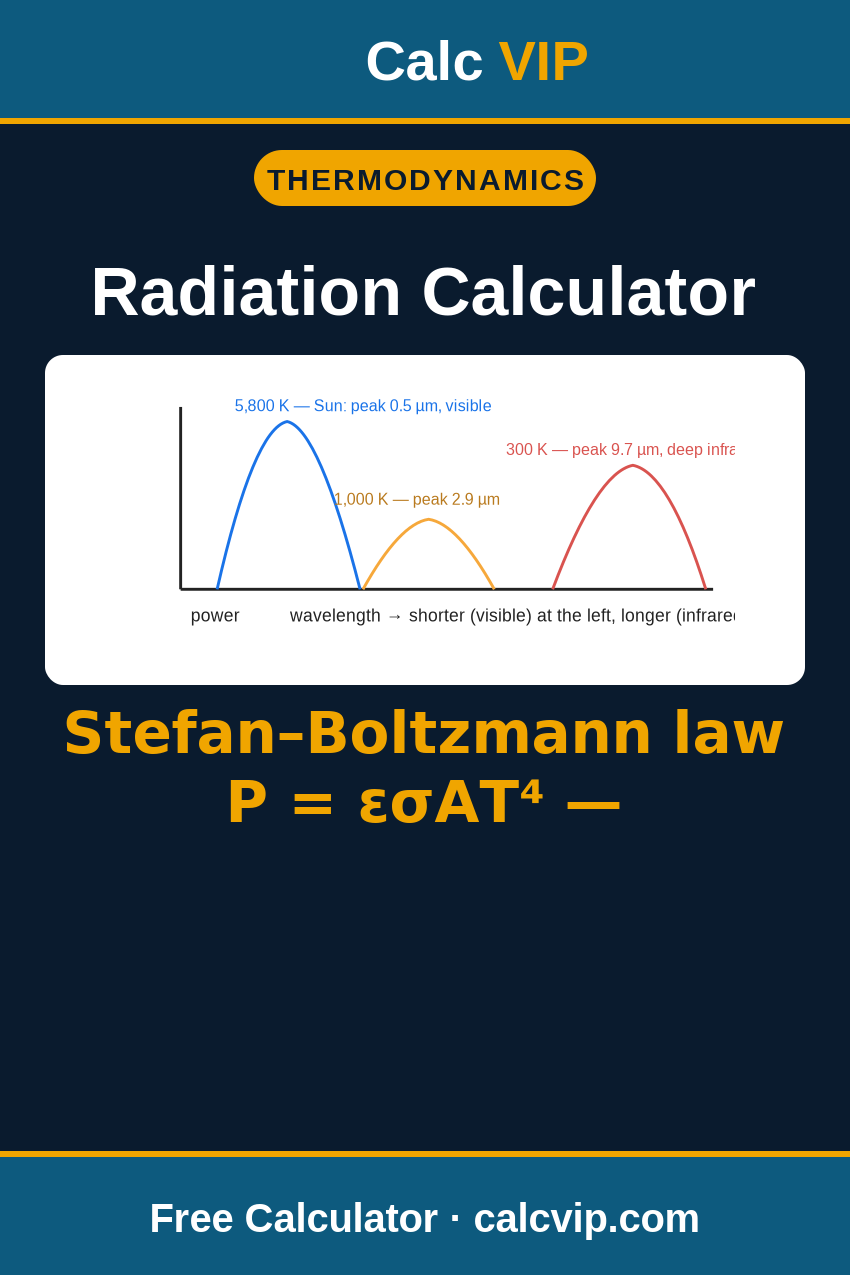
The Stefan–Boltzmann law totals the whole spectrum; Wien's displacement law locates its peak: λmax = 2.898 × 10⁻³ ÷ T, with λ in metres. The three curves of the first diagram are this law drawn. At 300 K the peak sits at 9.7 µm — far infrared, which is why warm things are invisible to the eye but obvious to a thermal camera. At 1,000 K it has slid to 2.9 µm, still infrared, though the spectrum's edge now glows dull red. At the Sun's 5,800 K the peak is 0.5 µm — green visible light — and it is no accident that eyes evolved to be most sensitive almost exactly there: we see best in the light our star emits most. Astronomers run Wien's law backwards on every star they meet, reading temperature off colour — blue-white for the hottest, orange and red for the cool — and blacksmiths have done the same by eye for three thousand years.
Quick reference: black-body power per square metre
| Temperature | P/A = σT⁴ (ε = 1) | Object |
|---|---|---|
| 100 K | 5.67 W/m² | a cold night on the Moon |
| 200 K | 90.72 W/m² | dry ice is warmer than this |
| 300 K | 459.27 W/m² | a room-temperature wall |
| 400 K | 1,451.52 W/m² | a hot oven's inner wall |
| 500 K | 3,543.75 W/m² | a kiln shelf, a pizza stone |
| 1,000 K | 56,700 W/m² | glowing furnace steel |
Keep the 300 K row in mind as the baseline of ordinary life: every square metre of every room-temperature surface is quietly broadcasting about 459 W of infrared. The world is not dark and still; it is roaring with light we cannot see.
Common mistakes
- Using Celsius in a fourth power. The deadliest slip available on this page. A body at 127 °C is at 400 K and radiates 1,451.52 W/m²; feed "127" into T⁴ and you get 14.75 W/m² — wrong by a factor of about a hundred. Kelvin is not a preference here; the law is built on absolute temperature.
- Reporting gross radiation as heat loss. A body in a warm room emits hundreds of watts and absorbs nearly as much back. Quoting the gross figure as "heat loss" overstates the cooling wildly — use the net formula whenever surroundings are anywhere near the body's temperature, which is most of the time.
- Trusting a shiny surface's thermometer reading. Infrared thermometers assume an emissivity (usually 0.95). Point one at polished metal (true ε ≈ 0.05) and it reads the faint radiation as a low temperature — the metal may be scalding while the display shrugs. Put a patch of tape on the surface and measure that instead.
- Believing colour sets emissivity. Visible colour and infrared emissivity are different properties. White paint radiates infrared almost as well as black paint (ε ≈ 0.9 for both) — it reflects sunlight better, which is a separate, visible-band effect. Judge a surface's ε by its finish — shiny versus dull — not its colour.
- Forgetting the area, or feeding it in cm². The formula wants square metres. A 100 cm² plate is 0.01 m²; entering "100" inflates the power ten-thousandfold. And a large lukewarm object can out-radiate a small hot one — area and T⁴ trade against each other, so neither may be guessed.
FAQ
Why does the power depend on T to the fourth power?
Radiation grows extremely fast with temperature: doubling the absolute temperature multiplies the radiated power by 2⁴ = 16. This is why a red-hot object glows so much more brightly than a warm one, and why the Sun's 5800 K surface radiates about 64 million watts per square metre.
What is emissivity?
A number between 0 and 1 describing how well a surface radiates compared with a perfect black body. Shiny polished surfaces radiate poorly (low ε); dull, dark surfaces radiate well (ε close to 1).
Can net radiation be negative?
Yes — if the surroundings are hotter than the body (Ts > T), the body gains more radiation than it emits, so the net power is negative: it is being heated by radiation.
Do cold objects radiate too?
Yes — everything above absolute zero does, including ice, which radiates infrared exactly like anything else at its temperature (at 273 K, a black surface emits σ × 273⁴ ≈ 315 W/m²). Cold objects radiate less and absorb more than they emit in a warm room, so their net flow is inward — but the emission never switches off.
What is a black body, if nothing is perfectly black?
An idealisation: a surface that absorbs every wavelength falling on it (so ε = 1 and it also emits the maximum possible at its temperature). The best laboratory versions are cavities with a tiny hole — radiation entering the hole bounces until absorbed, and the hole itself glows with a nearly perfect black-body spectrum. Soot, at ε ≈ 0.95, is the everyday approximation.
Why does a thermal camera see people but not a polished kettle?
Both sit near 300–370 K, but skin's ε ≈ 0.97 makes it a near-perfect emitter in the camera's band, while the kettle's polished metal has ε ≈ 0.05 and emits twenty times less — most of what the camera detects from the kettle is reflected room radiation instead. Emissivity, not temperature, writes most of a thermal image's contrast.
Does thermal radiation need air or any medium?
No — it is electromagnetic radiation, like light and radio, and crosses vacuum perfectly. That is how sunlight reaches Earth across 150 million kilometres of nothing, and it is why radiation is the only cooling method available to a spacecraft.
How does the greenhouse effect fit this formula?
Greenhouse gases are wavelength-selective: transparent to the Sun's incoming short-wave peak, absorbent in the infrared band where Earth radiates. They behave like a surface with low ε for outgoing radiation only, so the planet must warm until the radiation that does escape balances the sunlight absorbed — Example 6's ledger, with the atmosphere editing one column of it.
Why are house radiators often painted white if black radiates best?
Because in the infrared, white paint is already nearly black: its ε is around 0.9, like almost all paints, so the colour costs almost nothing in output. (Most of a "radiator's" heat actually leaves by convection anyway — the name is a historical misnomer.) A truly polished chrome radiator, by contrast, does emit noticeably less.
Who were Stefan and Boltzmann?
Josef Stefan, a Slovenian-Austrian physicist, inferred the T⁴ law from experimental data in 1879 — and used it to make the first good estimate of the Sun's surface temperature. His student Ludwig Boltzmann derived the law theoretically in 1884 from thermodynamics and Maxwell's electromagnetism. The constant σ was later shown to be built from fundamental constants of nature — Boltzmann's own k, Planck's h and the speed of light.