Calc
Phase Change Energy Calculator – Ice Below 0 °C to Steam, Step by Step
 Created by Anna Kowalski · Physics Editor · Heat & Atoms · Last updated: November 2026
Use this free Phase Change Energy Calculator to find the total heat needed to turn cold ice into steam. Enter the mass and the starting temperature of the ice — the tool works through all five heating steps and shows the energy for each one.
Turning ice into steam sounds like one job and is actually four. Warm the ice to its melting point; melt it; warm the water to boiling; boil it away. Each stage drinks heat at its own rate, and the stages are wildly unequal: the final one — boiling — swallows about three-quarters of the entire energy budget, a fact that surprises everyone the first time and explains everything from kettle times to the violence of steam burns. This calculator walks the whole journey step by step, so you can see not just the total but where the heat actually goes.
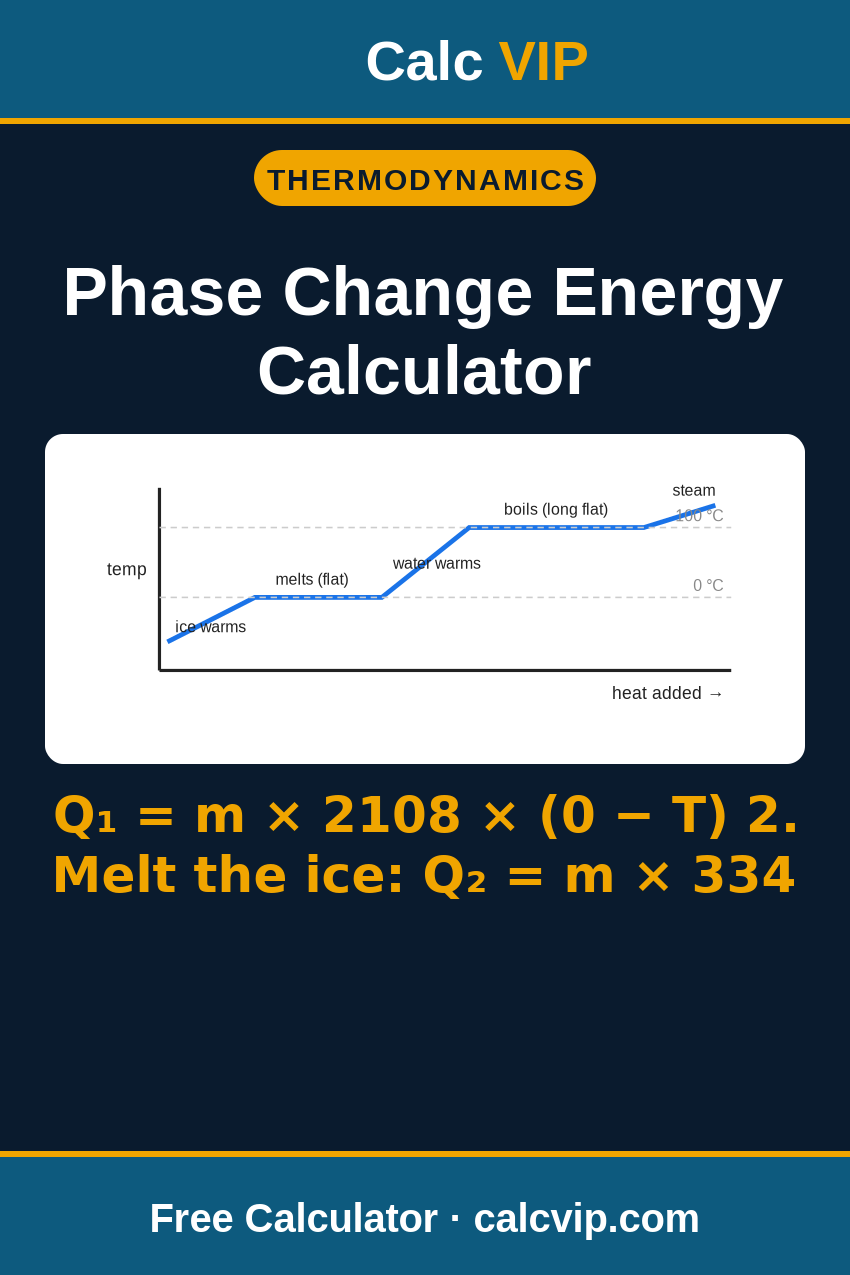
Two kinds of heat alternate along the journey. Sensible heat raises temperature: it is governed by specific heat capacity, Q = mcΔT, and it shows on a thermometer. Latent heat changes phase at constant temperature: it is governed by the latent heats of fusion and vaporisation, Q = mL, and a thermometer watching it sees nothing at all — the temperature pins itself to 0 °C or 100 °C while enormous energy pours silently into rearranging molecules. The heating curve's flat plateaus are latent heat's signature, and their lengths on the graph are drawn by the latent heats' sizes.
Water is an extreme case among common substances, which is why it anchors this calculator and most textbooks. Its specific heat is unusually high, its latent heat of vaporisation (2.26 × 10⁶ J/kg) is enormous — among the largest of any everyday liquid — and its latent heat of fusion is hefty too. Those three numbers shape weather (hurricanes run on latent heat released by condensing vapour), climate moderation by oceans, and the whole technology of steam power. The constants used here — c(ice) = 2108, c(water) = 4186 J/(kg·K), Lf = 3.34 × 10⁵, Lv = 2.26 × 10⁶ J/kg — are water's standard school values.
Formula
The journey from ice at T °C (below zero) to steam at 100 °C has five steps:
1. Warm the ice to 0 °C: Q₁ = m × 2108 × (0 − T)
2. Melt the ice: Q₂ = m × 334,000
3. Warm the water to 100 °C: Q₃ = m × 4186 × 100
4. Boil the water: Q₄ = m × 2,260,000
5. Total: Q = Q₁ + Q₂ + Q₃ + Q₄
using c(ice) = 2108 J/(kg·K), latent heat of fusion Lf = 3.34 × 10⁵ J/kg, c(water) = 4186 J/(kg·K) and latent heat of vaporisation Lv = 2.26 × 10⁶ J/kg. (Step 5 is just the sum — the steam is taken at 100 °C.)
Behind the recipe stand the two master equations of calorimetry: Q = mcΔT whenever temperature changes (steps 1 and 3) and Q = mL whenever phase changes at fixed temperature (steps 2 and 4). Every heating or cooling problem — for any substance, over any range — is assembled from those two bricks: a mcΔT for each stretch within one phase, an mL for each boundary crossed. Run the journey backwards (steam condensing to ice) and the same four quantities come back out as heat released, sign reversed: condensation and freezing give back exactly what boiling and melting borrowed.
| Symbol | Meaning | Value / units |
|---|---|---|
| m | mass of water/ice | kg |
| c(ice) | specific heat capacity of ice | 2108 J/(kg·K) |
| c(water) | specific heat capacity of liquid water | 4186 J/(kg·K) |
| Lf | latent heat of fusion (melting/freezing) | 3.34 × 10⁵ J/kg |
| Lv | latent heat of vaporisation (boiling/condensing) | 2.26 × 10⁶ J/kg |
| Q | heat energy for a step, or the total | J (also shown in kJ and MJ) |
Where the heat goes: bonds, not speed
Temperature measures the average kinetic energy of molecules — their jiggling speed. During the warming steps, incoming heat buys speed, and the thermometer climbs. During a phase change it buys something else entirely: separation. In ice, every molecule is locked into a hydrogen-bonded lattice; melting pays the energy to loosen that lattice until molecules can slide past one another, while their average speed — the temperature — stays exactly where it was. Boiling pays a far larger bill: it must tear molecules completely free of one another against all their attractions and push back the atmosphere to make room for the gas, which is why vaporisation costs nearly seven times fusion, per kilogram.
This division explains the heating curve's shape at a glance. The slopes are the sensible stretches, steep where c is small (ice warms about twice as fast per joule as water, because its c is about half), and the plateaus are the latent stretches, their lengths proportional to the L values. The boiling plateau dwarfs the melting one for the same reason steam burns dwarf hot-water scalds: there is simply far more stored energy per kilogram in the liquid-to-gas unbinding than in the solid-to-liquid loosening.
How to use
- Enter the mass of ice in kilograms.
- Enter its starting temperature in °C — it must be 0 °C or colder, since the sample starts as ice.
- Click "Calculate Total Heat" to see the energy of every step and the grand total in J, kJ and MJ.
- For a partial journey (say, ice to cold water only), add just the steps your journey includes — the step-by-step breakdown is designed to be raided, not merely read.
Worked examples
Example 1 — the full journey. How much heat turns 0.5 kg of ice at −10 °C into steam at 100 °C?
Step 1 — warm ice: 0.5 × 2108 × 10 = 10,540 J
Step 2 — melt: 0.5 × 334,000 = 167,000 J
Step 3 — warm water: 0.5 × 4186 × 100 = 209,300 J
Step 4 — boil: 0.5 × 2,260,000 = 1,130,000 J
Total = 10,540 + 167,000 + 209,300 + 1,130,000 = 1,516,840 J ≈ 1.52 MJ.
Notice that boiling alone takes almost 75% of all the energy.
Example 2 — starting at the melting point. 1 kg of ice already at 0 °C skips step 1 entirely:
Melt 334,000 + warm 418,600 + boil 2,260,000 = 3,012,600 J ≈ 3.01 MJ. Per kilogram, the full ice-to-steam journey costs almost exactly 3 MJ — a figure worth memorising.
Example 3 — a small, colder sample. 0.2 kg of ice at −20 °C:
Step 1: 0.2 × 2108 × 20 = 8,432 J · Step 2: 0.2 × 334,000 = 66,800 J · Step 3: 0.2 × 4186 × 100 = 83,720 J · Step 4: 0.2 × 2,260,000 = 452,000 J → Total = 610,952 J ≈ 0.61 MJ.
Example 4 — the freezer's block. 2 kg of ice at −5 °C:
Step 1: 2 × 2108 × 5 = 21,080 J · Step 2: 668,000 J · Step 3: 837,200 J · Step 4: 4,520,000 J → Total = 6,046,280 J ≈ 6.05 MJ. Doubling Example 1's mass roughly quadruples nothing — every step scales linearly with m, as each formula promises.
Example 5 — how long the kettle takes to boil dry. A 2,000 W kettle holding 0.5 kg of water already at 100 °C needs only step 4: 1,130,000 J.
Time = 1,130,000 / 2,000 = 565 s ≈ 9.4 minutes of boiling to empty it — which is why kettles have automatic cut-offs, and why "boiling off" is the slow step in every kitchen and power station alike.
Example 6 — melting versus warming, head to head. Melting 1 kg of ice costs 334,000 J. Warming 1 kg of water by 1 K costs 4,186 J.
334,000 / 4,186 ≈ 79.8 — so melting a kilogram of ice absorbs as much heat as warming the resulting water by about 80 K. That is the whole secret of the ice pack, the igloo and the ice-cooled drink, in one ratio.
Pressure adds a coda the staircase hides. Squeeze ice and its melting point falls — by about 0.0074 K per atmosphere — because liquid water is denser than ice, and pressure favours the denser phase. Under a wire loaded with weights, ice melts at the contact line, the water flows around, and refreezes above: regelation, the effect that lets a wire pass through a block of ice leaving it whole. The same physics sets the pressure-melting at glacier beds, where ice at the melting point, pressed by kilometres of its own weight, lubricates the glacier's slide — phase-change energetics again, with the plateau shifted slightly by pressure.
Phase-change energy in real life
Steam burns and steam heating. When steam condenses on skin it surrenders its 2.26 × 10⁶ J/kg latent heat first, then the hot water cools further — a double injury that boiling water alone cannot match. The same generosity makes steam an industrial heating champion: each kilogram condensed in a radiator delivers its latent heat exactly where it lands.
Ice storage air-conditioning. Some buildings freeze water overnight on cheap electricity and melt it through the hot day for cooling — banking cold in the latent heat of fusion. Example 6's ratio is the business case: a tank of ice stores as much cooling as a far larger tank of chilled water.
Hurricanes and thunderstorms. Evaporating ocean water charges the air with latent heat; condensing it aloft releases that heat and powers the storm's engine — the boiling plateau, run in reverse, at planetary scale.
Sweating and survival. Evaporating 1 kg of sweat carries away about 2.26 MJ of body heat (slightly more at skin temperature) — the reason sweating works, and the reason humid days, where evaporation stalls, are dangerous.
Power-station steam cycles. A boiler's job is mostly step 4: the latent heat loaded into steam at the boiler is unloaded at the condenser after the turbines have taken their cut. The efficiency of the whole cycle is negotiated around the sizes of these steps.
Frost protection in orchards. Growers spray water on blossoms before a frost: as the water freezes it releases its latent heat of fusion, holding the blossom at 0 °C through the cold night — the melting step run backwards as a heating system.
The journey in reverse: heat you get back
Every step of this calculator is reversible, and the reverse journey is technology's favourite direction. Steam condensing in a heating system pays back the full 2.26 × 10⁶ J/kg it borrowed; water freezing in a heat pump's source or an orchard's spray returns 3.34 × 10⁵ J/kg. Phase-change materials (PCMs) built into wallboards and cold-chain shipping boxes exploit exactly this: they melt by day, absorbing heat at a pinned temperature, and freeze by night, returning it. The numbers are always the same four constants — the art is only in choosing a substance whose melting point sits where you need the temperature pinned.
Why water's constants are so large
Water's outsized c and L values trace back to hydrogen bonding. Each water molecule reaches out to its neighbours with attractions strong enough that warming, melting and especially vaporising must pay a heavy toll in broken bonds. Vaporisation must break essentially all of them at once — hence Lv near the top of the league table for common liquids (ethanol manages 0.85 × 10⁶ J/kg; liquid metals and water sit far higher). The consequences cascade through nature: oceans buffer the planet's temperature because evaporating and condensing water shuttles latent heat around the globe, coastal climates are mild, sweat cools efficiently, and steam became the industrial revolution's working fluid. One molecular quirk, four constants, half of thermal engineering.
Quick reference: the per-kilogram ladder (ice from −10 °C)
| Step | Energy per kg (J) | Share of total |
|---|---|---|
| 1. Warm ice −10 °C → 0 °C | 21,080 | 0.69% |
| 2. Melt at 0 °C | 334,000 | 11.01% |
| 3. Warm water 0 °C → 100 °C | 418,600 | 13.80% |
| 4. Boil at 100 °C | 2,260,000 | 74.50% |
| Total per kg | 3,033,680 | 100% |
Scale any row by your mass and you have the corresponding step of any problem this calculator solves — the table is the tool with m = 1 kg, printed for the wall.
Common mistakes
- Skipping a step. The classic error is jumping from "ice at −10 °C" straight to mcΔT with ΔT = 110, as if one formula spanned the journey. It does not: each phase boundary inserts its own mL payment, and the boundaries carry most of the energy.
- Using water's c for the ice step. Ice's specific heat (2108) is about half of water's (4186). Warming the ice with 4186 roughly doubles step 1 — small in the total, fatal in an exam that marks steps.
- Expecting the temperature to rise during melting. It cannot: until the last crystal melts, every joule goes into the phase change. A graph (or a result) showing warming during steps 2 or 4 signals a conceptual slip.
- Confusing Lf and Lv. They differ by a factor of about 6.8. Assigning the vaporisation value to melting inflates the total grotesquely; check which boundary you are crossing.
- Forgetting the reverse journey returns the heat. Condensation and freezing are not free: they release exactly the latent heats listed here. Problems about steam heating, frost protection or dew ask for the same numbers with the sign flipped.
FAQ
Why does the temperature stop rising during melting and boiling?
All the incoming energy goes into breaking the bonds between molecules instead of speeding them up. Temperature only measures molecular speed, so it stays fixed until the phase change is complete — those are the flat parts of the heating curve.
Why does vaporisation need so much more energy than melting?
Melting only loosens the solid's structure a little — the molecules stay close together. Boiling must separate the molecules completely against their attractions, which takes far more energy: Lv (2.26 × 10⁶ J/kg) is nearly 7 times Lf (3.34 × 10⁵ J/kg).
Why do steam burns hurt more than boiling-water burns?
When steam touches skin it condenses, dumping its huge latent heat (2.26 × 10⁶ J/kg) on top of the heat released as the hot water then cools. That extra latent heat is what makes steam burns so severe.
What if my ice starts exactly at 0 °C?
Then step 1 is zero and the journey has three payments: melt, warm, boil — 3,012,600 J per kilogram in total, as Example 2 shows. The calculator handles it automatically when you enter 0.
Does the pressure matter?
Yes, quietly. These constants assume atmospheric pressure, where water boils at 100 °C. On a mountain (lower pressure) boiling happens cooler and Lv is slightly larger; in a pressure cooker the reverse. For school and kitchen purposes the standard values are the right ones.
How much energy to freeze water back to ice?
Exactly what melting absorbed: freezing releases 3.34 × 10⁵ J/kg, and cooling the water to 0 °C first releases its sensible heat too. The full steam-to-ice journey returns the entire 3.03 MJ/kg — energy is conserved in both directions.
Why is ice's specific heat about half of water's?
In the solid lattice, molecules can only vibrate in place; many of the ways liquid water stores energy — rotations and bond flexing among neighbours — are frozen out. Fewer storage modes per kelvin means a smaller c.
Can I use this for substances other than water?
The method, yes — mcΔT steps plus mL boundaries — but the constants, no: each substance has its own c for each phase and its own latent heats. This calculator's numbers are water's alone.
What is sublimation, and what would it cost?
Sublimation skips the liquid: ice turns directly to vapour (as freezer-burn and freeze-drying exploit). Its latent heat is about 2.83 × 10⁶ J/kg — essentially the fusion and vaporisation costs paid together, since vaporisation at 0 °C costs a little more than at 100 °C.
Why does the boiling step dominate so completely?
Because it must defeat every intermolecular attraction and expand the liquid roughly 1,600-fold into gas against atmospheric pressure. Melting loosens a lattice; boiling demolishes it. The 74.5% share in the table is that difference, priced in joules.