 Calc
Magnetic Force on a Moving Charge Calculator – F = qvB sinθ
 Created by Thomas Becker · Physics Writer · Electricity & Magnetism · Last updated: November 2026
Use this free Magnetic Force on a Moving Charge Calculator to find the force on a charged particle moving through a magnetic field, using F = qvB sinθ. You can type values like 1.6e-19 in the charge box.
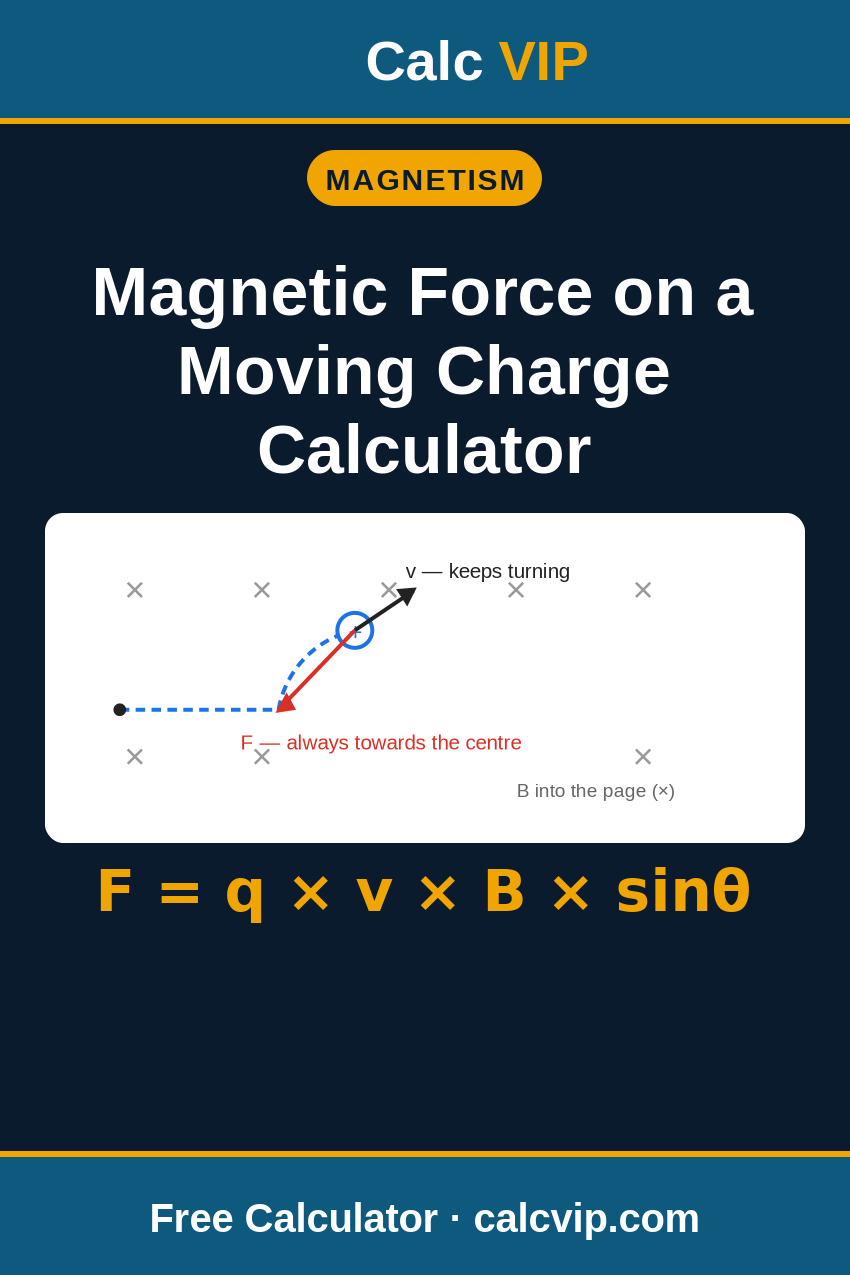
Of all the forces in physics, this is the one with the strangest manners. It refuses to act on a charge that is standing still, no matter how strong the field. It never pushes a moving charge forwards or backwards along its path. Instead it shoves the charge sideways — always at right angles to both the direction of travel and the magnetic field — and in doing so it can bend the particle's path into a perfect circle without ever changing its speed. Every electric motor, every particle accelerator and every aurora is this sideways shove at work.
The formula's shape tells the story. The force grows in direct proportion to the charge q, the speed v and the field B: double any of them and the force doubles. But the angle term, sinθ, is the gatekeeper. Only the part of the motion that crosses the field lines counts. A charge spearing straight along the field (θ = 0°) feels nothing at all, however fast it goes; a charge crossing the field square-on (θ = 90°) feels the full qvB. Between those extremes the force is qvB multiplied by the sine of the angle — at 30°, exactly half the maximum.
The numbers involved span an extraordinary range. A single proton in a laboratory field feels a force of around 10⁻¹³ newtons — absurdly small by everyday standards — yet because a proton's mass is smaller still, that force produces an acceleration of nearly 10¹⁴ m/s² and curls the particle into a circle a few centimetres across. Scale the same law up to the trillions of charges flowing in a wire and it becomes the force that turns motors; scale it out to space and it is the force that shepherds cosmic rays around the Earth and traps radiation in the Van Allen belts. This calculator works at the single-particle end of that story, where everything else in magnetism begins.
Formula
F = q × v × B × sinθ • F in newtons (N), q in coulombs (C), v in m/s, B in tesla (T), θ the angle between the velocity and the field.
The same equation rearranges to solve for any one quantity: B = F ÷ (q v sinθ) if you measured a force and want the field that caused it; v = F ÷ (q B sinθ) for the speed; and q = F ÷ (v B sinθ) for the charge. At θ = 90° the sine is 1 and the formula reaches its simplest form, F = qvB — the version used to define the tesla: a field of 1 T exerts 1 N on a charge of 1 C moving across it at 1 m/s. Because the force is always perpendicular to the velocity, it also supplies exactly the centripetal force for circular motion, qvB = mv²/r, giving the path radius r = mv ÷ (qB) — the bridge between this calculator and the cyclotron formula. This calculator uses the magnitude of the charge; the sign of q decides the direction of the force, not its size.
| Symbol | Meaning | Units |
|---|---|---|
| F | magnetic force on the charge | newtons (N) |
| q | charge of the particle (magnitude) | coulombs (C) |
| v | speed of the particle | m/s |
| B | magnetic field strength (flux density) | tesla (T) |
| θ | angle between v and B | degrees (°) |
A force that pushes sideways — and never does any work
Work is force multiplied by distance moved along the force. The magnetic force is always at right angles to the motion, so the distance moved along it is always zero, and the work done is always zero. A magnetic field cannot speed a particle up, slow it down, or change its kinetic energy by a single joule. It is a steering force, not an engine. When a particle in a magnetic field does gain energy — inside an accelerator, say — an electric field somewhere is doing the pushing; the magnets merely bend the path so the particle can be pushed again and again.
Steering has its own drama, though. Because the force forever points at right angles to the velocity, the velocity's direction rotates at a steady rate while its size stays fixed: the definition of uniform circular motion. Setting qvB equal to the centripetal requirement mv²/r gives r = mv/(qB). For the proton of Example 1 below, r = (1.673 × 10⁻²⁷ × 10⁶) ÷ (1.602 × 10⁻¹⁹ × 0.5) = 0.0209 m — a circle just 2.09 cm in radius. And the acceleration behind it, F/m = 8 × 10⁻¹⁴ ÷ 1.673 × 10⁻²⁷ ≈ 4.8 × 10¹³ m/s², is some five trillion times the acceleration of gravity, produced by a force too small to feel. Small forces are not weak forces when the thing they push is small enough.
How to use
- Enter the charge of the particle in coulombs, using its magnitude — for a proton or electron that is 1.6e-19 (scientific notation like 1.6e-19 is accepted; for an alpha particle use 3.2e-19).
- Enter the particle's speed in metres per second (1e6 style entries work here too).
- Enter the magnetic field strength in tesla. Watch prefixes: the Earth's field is about 0.00005 T, a strong lab magnet about 1 T.
- Enter the angle θ between the velocity and the field in degrees — 90 if the particle crosses the field square-on, 0 if it travels along it.
- Click "Calculate" to get the force in newtons, with the sine of your angle shown. Remember the result is a magnitude: use the left-hand rule to get its direction, and reverse it for negative charges.
Worked examples
Example 1 — a proton crossing a field. A proton with charge 1.6 × 10⁻¹⁹ C moves at 1 × 10⁶ m/s at right angles through a field of 0.5 T (θ = 90°, sinθ = 1).
F = qvB sinθ = 1.6 × 10⁻¹⁹ × 1 × 10⁶ × 0.5 × 1 = 8 × 10⁻¹⁴ N.
The force is tiny, but so is a proton's mass — it is enough to bend the proton's path into a circle.
Example 2 — an electron in a weak field. An electron (q = 1.6 × 10⁻¹⁹ C) travelling at 2 × 10⁶ m/s crosses a field of 0.1 T at 90°.
F = 1.6 × 10⁻¹⁹ × 2 × 10⁶ × 0.1 = 3.2 × 10⁻¹⁴ N — smaller than Example 1 despite the higher speed, because the field is five times weaker. The force on an electron also points opposite to the direction the same formula gives a positive charge.
Example 3 — an alpha particle. An alpha particle carries twice the charge, q = 3.2 × 10⁻¹⁹ C. At 5 × 10⁵ m/s in a 0.8 T field at 90°:
F = 3.2 × 10⁻¹⁹ × 5 × 10⁵ × 0.8 = 1.28 × 10⁻¹³ N. Double charge and a strong field outweigh the slower speed.
Example 4 — an angled crossing. A proton at 4 × 10⁶ m/s enters a 0.25 T field at θ = 30°, so sinθ = 0.5.
F = 1.6 × 10⁻¹⁹ × 4 × 10⁶ × 0.25 × 0.5 = 8 × 10⁻¹⁴ N — exactly the force of Example 1. Four times the speed at half the sine and half the field lands on the same answer, and the proton spirals rather than circling, because the part of its velocity along the field sails on untouched.
Example 5 — a doubly charged ion in a strong magnet. An ion with q = 3.2 × 10⁻¹⁹ C moving at only 1 × 10⁵ m/s crosses a 2 T superconducting magnet at 90°.
F = 3.2 × 10⁻¹⁹ × 1 × 10⁵ × 2 = 6.4 × 10⁻¹⁴ N. Slow particles can still be gripped hard if the field is strong enough — the working principle of magnetic plasma confinement.
Example 6 — a cosmic-ray proton in the Earth's field. A proton arriving from space at 3 × 10⁷ m/s (a tenth of light speed) meets the Earth's field of about 5 × 10⁻⁵ T.
F = 1.6 × 10⁻¹⁹ × 3 × 10⁷ × 5 × 10⁻⁵ = 2.4 × 10⁻¹⁶ N. Feeble per second, but applied relentlessly over thousands of kilometres it is enough to deflect the particle, funnel it towards the poles, or trap it in orbit around the Earth.
Magnetic force on charges in real life
Mass spectrometers. Ions are fired through a known field and bend by an amount set by r = mv/(qB): heavier or slower ions swing wide, lighter ones curl tight. Measuring where each lands weighs molecules to a fraction of an atomic mass unit — the technique behind drug testing, forensics and carbon dating checks.
The aurora. Charged particles from the solar wind reach the Earth and spiral along its field lines, corkscrewing down towards the poles where the lines converge. Their sideways force is what guides them there; the glow itself comes when they strike air molecules high in the atmosphere.
Old television tubes and electron microscopes. In a cathode-ray tube, coils steer an electron beam across the screen. An electron at 10⁷ m/s in a modest 0.001 T steering field feels F = 1.6 × 10⁻¹⁹ × 10⁷ × 0.001 = 1.6 × 10⁻¹⁵ N — yet with an electron's tiny mass that is plenty to paint a picture line by line.
Tokamaks and plasma bottles. The plasma inside a fusion reactor is far too hot for any material wall, so it is held by fields alone: the charged particles are forced to spiral around field lines and never touch the sides. Example 5's strong-field grip, scaled up, is the bottle.
Hall-effect sensors. Run a current through a thin strip in a magnetic field and this force pushes the moving charges to one edge, producing a small sideways voltage. Your phone's compass, car wheel-speed sensors and clamp meters all read fields this way.
The Van Allen belts. The Earth's field traps protons and electrons in two doughnut-shaped belts thousands of kilometres up, where they bounce and spiral for years — a natural demonstration of Example 6, and a radiation hazard satellite designers must route around or shield against.
Circles, helices and the pitch of the spiral
What path does the force actually carve? Split the velocity into two parts: the part across the field, v⊥, and the part along it, v∥. The along-field part feels no force and simply continues. The across-field part is bent into a circle. Added together, circle plus steady drift equals a helix — a corkscrew wrapped around a field line. Take a proton moving at 10⁶ m/s at an angle such that v⊥ = 8 × 10⁵ m/s and v∥ = 6 × 10⁵ m/s in a 0.5 T field. The circular part has radius r = mv⊥/(qB) = (1.673 × 10⁻²⁷ × 8 × 10⁵) ÷ (1.602 × 10⁻¹⁹ × 0.5) = 0.0167 m ≈ 1.67 cm, and one turn takes T = 2πm/(qB) = 1.31 × 10⁻⁷ s (131 nanoseconds). In that time the drift carries it v∥ × T = 6 × 10⁵ × 1.31 × 10⁻⁷ = 0.0787 m along the line — a pitch of about 7.9 cm per turn. This is precisely the motion of auroral particles and of plasma in a tokamak: tight little circles, strung along the field like beads on a wire.
Quick reference: force on a proton at 10⁶ m/s, θ = 90°
| Field B | Force F = qvB | Familiar source |
|---|---|---|
| 0.00005 T (50 µT) | 8 × 10⁻¹⁸ N | Earth's magnetic field |
| 0.1 T | 1.6 × 10⁻¹⁴ N | strong fridge magnet, near the surface |
| 0.5 T | 8 × 10⁻¹⁴ N | laboratory electromagnet |
| 1 T | 1.6 × 10⁻¹³ N | research magnet |
| 2 T | 3.2 × 10⁻¹³ N | superconducting / MRI-class magnet |
Read the table as a scaling law: at fixed speed and angle the force is simply proportional to B, and the same proportionality holds for q and for v. Any new case is one multiplication away from a row you already know.
Common mistakes
- Measuring θ from the wrong line. θ is the angle between the velocity and the field itself — not between the velocity and the perpendicular to the field. Using the complement swaps sine for cosine and can turn a maximum into a zero.
- Dropping the sinθ. Writing F = qvB for an angled crossing overstates the force; at 30° the true force is only half of qvB. The full formula costs nothing to use.
- Expecting the particle to speed up. A magnetic force can never change a particle's speed or kinetic energy, only its direction. If a problem asks for the new speed after crossing a field, the answer is the old speed.
- Entering the charge "in electrons". The box wants coulombs. A charge described as "3 electrons' worth" must first be multiplied by 1.6 × 10⁻¹⁹ — entering 3 gives an answer wrong by nineteen orders of magnitude.
- Mixing up tesla and microtesla. The Earth's field is 50 µT = 0.00005 T, not 50 T. A factor of a million hides in that prefix, and it is the commonest cause of absurd answers on this page.
FAQ
Which way does the force point?
The force is always at right angles to both the velocity and the field. Use Fleming's left-hand rule (or the right-hand rule): for a positive charge moving right with the field going into the page, the force points up the page, as in the diagram. A negative charge feels the force in the opposite direction.
Why is there no force when θ = 0°?
Because sin 0° = 0. A charge moving exactly along the field lines is not deflected at all — only the part of the motion across the field produces a force.
Does the magnetic force speed the particle up?
No. The force is always perpendicular to the velocity, so it changes the direction of motion but never the speed or the kinetic energy. That is why charges spiral or circle in magnetic fields instead of accelerating in a straight line.
What if the charge is negative, like an electron?
The size of the force is unchanged — the formula uses the magnitude of q — but its direction reverses. An electron curves the opposite way to a proton in the same field, which is why this calculator asks only for the magnitude and leaves direction to the hand rules.
What is the force on a charge that is not moving?
Zero, exactly. v = 0 makes F = 0 whatever the field. A magnetic field on its own cannot stir a stationary charge into motion; that takes an electric field (or a changing magnetic field, which creates one).
How big is one tesla?
Large, by everyday standards. The Earth's field is about 50 µT (0.00005 T), a fridge magnet manages a few millitesla at its surface, a scrapyard electromagnet reaches about 1 T, and hospital MRI scanners work at 1.5–3 T. The 0.5 T of Example 1 is a serious laboratory field.
Why does the particle travel in a circle instead of being pushed in a straight line?
Because the force turns with the particle. Each instant, the force points perpendicular to the current velocity; as the velocity rotates, so does the force, always aiming at the same centre point. A constant-magnitude force that forever points at one centre is exactly what circular motion requires.
What happens at θ = 45°?
sin 45° ≈ 0.707, so the force is about 71% of the square-on maximum, and the path is a helix: the across-field part circles while the along-field part drifts, as in the third diagram.
Can a magnetic field ever change a particle's energy?
Not directly — the force does no work. But a changing magnetic field generates an electric field (Faraday's law), and that electric field can do work. Accelerators exploit the division of labour: electric fields feed in energy, magnetic fields steer.
How is this related to the force on a current-carrying wire?
A current is simply a crowd of moving charges. Add up qvB over every charge drifting in a length L of wire and the sum tidies into F = BIL sinθ — the subject of the companion calculator. The wire formula is this formula, counted in bulk.