 Calc
Magnetic Moment Calculator – μ = NIA & Torque on a Current Loop
 Created by Thomas Becker · Physics Writer · Electricity & Magnetism · Last updated: November 2026
Use this free Magnetic Moment Calculator to find the magnetic moment of a current loop or coil, μ = N × I × A, and the torque the loop experiences in a magnetic field, τ = μ × B × sin θ — the principle behind every electric motor.
Every current loop is a magnet. Run current around a circle of wire and the loop acquires a north and a south face, attracts and repels other magnets, and twists in an external field exactly as a compass needle does. The single number that captures how strong a magnet the loop is — how hard it will twist, how much energy it stores in a given orientation — is its magnetic moment, μ = NIA: the current, multiplied by the area it encloses, multiplied by the number of turns. This calculator finds μ from the coil's construction and then works out the torque the coil feels in a field of strength B at any angle θ.
Magnetic moment is one of physics' great unifying quantities because it does not care what makes the magnet. A 200-turn laboratory coil, a fridge magnet, the Earth itself (μ ≈ 7.94 × 10²² A·m²) and a single electron (whose spin moment is one Bohr magneton, 9.274 × 10⁻²⁴ A·m²) are all described by the same symbol and obey the same two laws: a torque τ = μB sin θ that tries to align them with the field, and a potential energy U = −μB cos θ that is lowest when they succeed. The forty-six orders of magnitude between the electron and the Earth change nothing about the mathematics — only the size of the numbers.
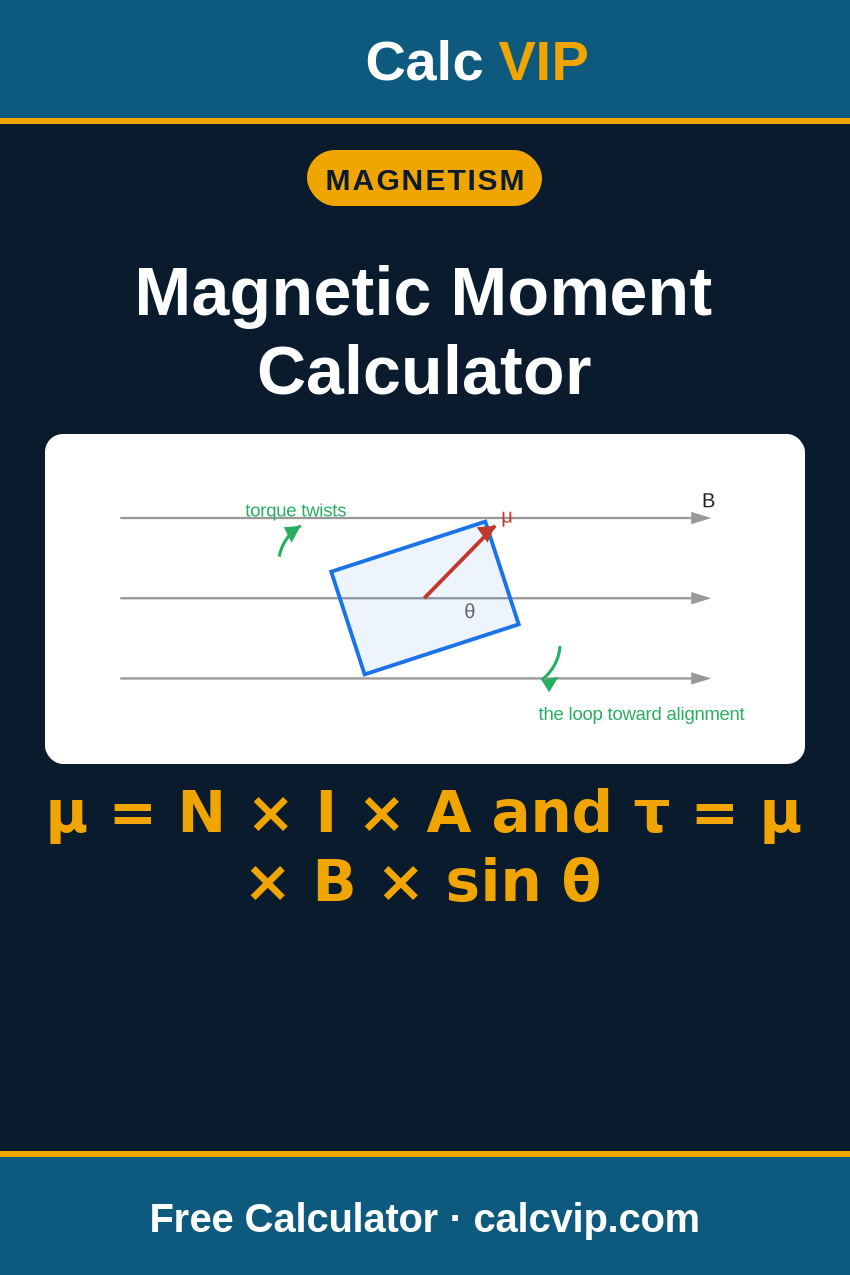
The direction of μ matters as much as its size. By the right-hand rule, curl the fingers of your right hand in the direction the current flows and your thumb points along μ, out of the loop's north face. Torque exists because the field pushes the loop's sides in opposite directions; it vanishes when μ points along the field (θ = 0°, the stable resting place) and is greatest when μ is perpendicular to it (θ = 90°). Every electric motor ever built is a machine for exploiting that one fact repeatedly, flipping the current at just the right moments so the torque never gets the chance to settle.
Formula
μ = N × I × A and τ = μ × B × sin θ • μ in ampere-square-metres (A·m²), τ in newton-metres (N·m). The magnetic moment points along the loop's normal (right-hand rule: curl your fingers with the current, your thumb gives μ). The torque tries to rotate the loop until μ lines up with B.
Substituting the first formula into the second gives the full design equation, τ = N × I × A × B × sin θ, which is the working formula of motor engineering: every factor is a lever a designer can pull. The companion energy formula, U = −μ × B × cos θ, completes the picture — torque is greatest exactly where the energy is falling fastest, at θ = 90°, and zero at the energy minimum (θ = 0°) and maximum (θ = 180°). For a circular loop the area is A = π r²; for a rectangular coil, A = length × width. If you know μ and want the torque's ceiling, it is simply τmax = μB, reached at θ = 90°.
| Symbol | Meaning | Units |
|---|---|---|
| μ | magnetic moment of the loop or coil | A·m² |
| N | number of turns | — (a count) |
| I | current in the coil | amps (A) |
| A | area enclosed by one turn | m² |
| B | magnetic field strength | tesla (T) |
| θ | angle between μ (the loop's normal) and B | degrees (°) |
| τ | torque twisting the loop toward alignment | N·m |
Where the torque comes from: two forces and a lever arm
The torque formula looks like bookkeeping until you take a rectangular loop apart. Sit the loop in a field with its normal at angle θ. The two sides of the loop that run parallel to its axis of rotation carry current in opposite directions, so the field pushes one side up and the other down — a couple, two equal opposite forces separated by the loop's width. Each force is B × I × (side length), and with N turns it is multiplied N times. Multiply the couple by its lever arm and simplify, and out falls τ = NIAB sin θ: the magnetic moment was hiding inside the mechanics all along. The other two sides of the loop contribute nothing — the forces on them pull along the axis, stretching the loop but not turning it.
This picture explains the sin θ without any memorising. When the loop's face is edge-on to the field (normal perpendicular, θ = 90°), the pushed sides are fully exposed and the lever arm is the whole width — maximum torque. As the loop rotates toward alignment the effective lever arm shrinks as sin θ, reaching zero at θ = 0°, where the forces on the two sides point along the same line and merely tug the loop apart. It also explains the motor designer's obsession: torque scales with the loop's area because area is simultaneously the current's enclosure and the couple's lever arm.
How to use
- Enter the coil's turns, current and the area enclosed by each turn, in square metres (for a circular loop, A = π × r²; for a rectangle, length × width).
- Add the field strength in tesla and the angle between the loop's normal (the line perpendicular to its face) and the field, in degrees.
- Click "Calculate" to get the magnetic moment and the turning torque at that angle.
- Compare the torque with the figure also shown for θ = 90° — that is the most the same coil in the same field can ever produce, and the number motor designers work from.
Worked examples
Example 1 — a laboratory coil. A coil of N = 200 turns, each of area A = 0.01 m², carries I = 0.5 A in a field of B = 0.3 T, with its normal at θ = 60° to the field.
μ = NIA = 200 × 0.5 × 0.01 = 1 A·m².
τ = μB sin θ = 1 × 0.3 × sin 60° = 0.3 × 0.866 = 0.2598 N·m.
In a motor, a commutator flips the current every half-turn so this torque keeps pushing the coil around instead of letting it settle facing the field.
Example 2 — a single loop of wire. One turn of radius 5 cm encloses A = π × 0.05² = 7.854 × 10⁻³ m². At I = 3 A its moment is μ = 1 × 3 × 7.854 × 10⁻³ = 0.02356 A·m², and in a 0.1 T field its greatest possible torque is μB = 2.356 × 10⁻³ N·m — a whisper of a twist, which is why practical devices always multiply turns.
Example 3 — a galvanometer coil. A sensitive meter movement uses N = 100 turns of area 2 cm² (2 × 10⁻⁴ m²) carrying just 1 mA: μ = 100 × 0.001 × 2 × 10⁻⁴ = 2 × 10⁻⁵ A·m². In its permanent magnet's 0.2 T field the maximum torque is 4 × 10⁻⁶ N·m — tiny, yet enough to swing a featherweight needle against a hairspring, which is the whole art of analogue meter design.
Example 4 — a motor rotor. A rotor winding with N = 500, I = 2 A and A = 0.005 m² has μ = 500 × 2 × 0.005 = 5 A·m². In a 0.8 T field the torque peaks at μB = 4 N·m at θ = 90°, and is still 2 N·m at θ = 30°. Real motors arrange many such coils at staggered angles so that as one coil's sin θ fades, another's is peaking.
Example 5 — the Earth's field on a bench coil. Take the Example 1 coil (μ = 1 A·m²) out of its 0.3 T magnet and leave it in the Earth's field of about 50 µT. The greatest torque the planet can exert on it is μB = 1 × 50 × 10⁻⁶ = 5 × 10⁻⁵ N·m — some six thousand times weaker than in Example 1, yet this is exactly the torque that swings a compass needle, because the needle is free to turn and almost frictionless.
Example 6 — designing for a target moment. A torque motor needs μ = 10 A·m² from a supply limited to I = 0.2 A with room for N = 1,000 turns. The area must be A = μ ÷ (N × I) = 10 ÷ (1,000 × 0.2) = 0.05 m² — a coil about 25 cm × 20 cm. The formula rearranged is a shopping list: moment is bought with turns, current or area, in any combination whose product suffices.
Magnetic moment in real life
Every electric motor. From a phone's vibration buzzer to a ship's propulsion pod, motors are coils whose μ is kept near 90° to the field by commutators or electronics, harvesting τ = μB sin θ continuously. The rating plate's torque figure is this formula, industrialised.
Analogue meters. In a moving-coil galvanometer the coil's magnetic torque fights a spring; the needle settles where μB sin θ equals the spring's restoring torque, turning a current measurement into an angle you can read off a scale.
Compass needles and magnetometers. A compass needle is a permanent μ aligning with the Earth's field under a torque of at most μB — with B only ~50 µT, the needle must be light and its pivot nearly frictionless, exactly as Example 5's small number suggests.
Magnetic stirrers and couplings. The spinning bar in a chemistry lab's stirrer plate is a permanent magnet whose moment locks onto a rotating field beneath the bench, dragging it around through glass with no shaft or seal.
Satellite attitude control. Magnetorquer rods on satellites are coils with moments of tens to hundreds of A·m². Their torque against the Earth's field — μB of order 10⁻³ N·m — slowly but surely reorients the spacecraft without spending any propellant.
Atoms and MRI. Each proton in your body carries a moment of 1.411 × 10⁻²⁶ A·m². An MRI scanner's field aligns a slight excess of them, and the whole imaging method is bookkeeping on ~10²³ such moments at once — μ = NIA's atomic echo.
From torque to motor: the commutator's trick
Left alone, a coil in a field rotates to θ = 0° and stops — the torque that moved it dies at alignment. The motor's entire ingenuity is a refusal to accept this. A split-ring commutator reverses the current every half revolution, which reverses μ, which moves the stable point to wherever the coil is not: the coil is perpetually falling toward an alignment that keeps teleporting to the other side. Brushless motors do the same job with sensors and transistors instead of sliding contacts. Either way, the average torque over a revolution is a healthy fraction of μB, and the design variables remain exactly the four in τ = NIAB sin θ — which is why a motor's power scales so stubbornly with its physical size: A is in the formula, and area is bought with iron and copper.
Quick reference: how torque depends on angle
| θ | sin θ | Torque τ (× μB) | Situation |
|---|---|---|---|
| 0° | 0 | 0 | aligned — stable rest |
| 30° | 0.500 | 0.500 μB | half the maximum |
| 45° | 0.707 | 0.707 μB | — |
| 60° | 0.866 | 0.866 μB | Example 1's angle |
| 90° | 1 | μB | maximum — loop face parallel to B |
| 180° | 0 | 0 | anti-aligned — unstable |
The table hides a useful symmetry: the torque at θ and at 180° − θ are equal, but their characters differ — past 90° the coil is being pulled toward the anti-aligned position's far side, which is precisely the behaviour the commutator exploits.
Common mistakes
- Measuring θ from the loop's face instead of its normal. The formula's θ is between μ (the normal) and B. If your angle is from the face, the torque uses cos of that angle instead — the two conventions differ by 90° and swapping them turns a maximum into a zero.
- Entering the area in cm². A must be in m²: 100 cm² is 0.01 m². Forgetting the conversion inflates μ and the torque ten-thousandfold.
- Using the diameter where the area needs the radius. For a circular loop A = π r² = π d²/4. Squaring the diameter without the quarter overstates the area four times over.
- Expecting torque at alignment. At θ = 0° the torque is exactly zero however strong the field — that is why a plain coil cannot start a motor from every position, and why real motors use several coils at angles to each other.
- Thinking a bigger field always means a proportionally bigger motor torque. τ = μB sin θ is linear in B only until the motor's iron saturates; beyond about 1.5–2 T in the iron, extra field stops arriving and the torque curve flattens.
FAQ
When is the torque zero, and when is it maximum?
The torque is maximum at θ = 90° (loop's face parallel to the field, sin θ = 1) and zero at θ = 0° or 180°, where the moment is aligned (or anti-aligned) with the field — the aligned position is the stable resting point.
Does the loop's shape matter?
No — only the enclosed area counts. A circular loop, a square loop and an irregular loop with the same area, turns and current all have the same magnetic moment μ = NIA.
Is magnetic moment the same for atoms?
Yes — electrons orbiting and spinning give atoms their own tiny magnetic moments, measured in Bohr magnetons (9.274 × 10⁻²⁴ A·m²). How these atomic moments align is what makes materials magnetic.
How many Bohr magnetons make a bench coil's moment?
The Example 1 coil's 1 A·m² equals about 1.08 × 10²³ Bohr magnetons — a mole-scale number, which is no coincidence: a coil's moment is the organised sum of enormous numbers of atomic ones, plus the conduction current's own contribution.
Can a permanent magnet be described the same way?
Yes. A bar magnet has a fixed μ (a small fridge magnet, roughly 0.1–1 A·m²), feels the same τ = μB sin θ, and stores the same U = −μB cos θ. Only its μ is built in rather than dialled by a current.
Why do motors use many turns of thin wire instead of few turns of thick wire?
μ = NIA rewards turns and current equally, but a supply delivers limited current more cheaply than limited voltage. Many thin turns reach the same NIA at low current — at the price of resistance, which is the design trade-off in every winding.
What is the torque on a coil carrying current parallel to the field everywhere?
If the loop's normal is along the field (θ = 0°), zero — the forces on opposite sides cancel as a turning effect. Tilt it even slightly and a restoring torque appears, which is the principle of the compass and the galvanometer alike.
Does the torque depend on the loop's orientation axis or pivot position?
The torque about the loop's centre is τ = μB sin θ regardless of where the loop sits in a uniform field. In a non-uniform field there is also a net force pulling the loop toward stronger field — the effect that traps magnetic beads and stirs ferrofluids.
How is magnetic moment measured for an unknown magnet?
Hang it in a known field and measure either the maximum torque (τmax = μB) or the period of its torsional oscillation, which depends on μB and its moment of inertia. Both are standard laboratory determinations, and both are this calculator run backwards.
Why is the unit A·m² and not something more magnetic-sounding?
Because μ is defined by the current loop: amps of current around square metres of area. The same unit emerges from the torque law — a moment of 1 A·m² in a 1 T field feels a maximum torque of exactly 1 N·m, so A·m² is also J/T in disguise.