 Calc
Magnetic Levitation Calculator – Current for BIL to Balance Weight
 Created by Thomas Becker · Physics Writer · Electricity & Magnetism · Last updated: November 2026
Use this free Magnetic Levitation Calculator to find the current a wire in a magnetic field needs so that the force BIL exactly balances a load's weight — or, in reverse, the force a given current produces. This is the physics behind maglev demonstrations and magnetic balances.
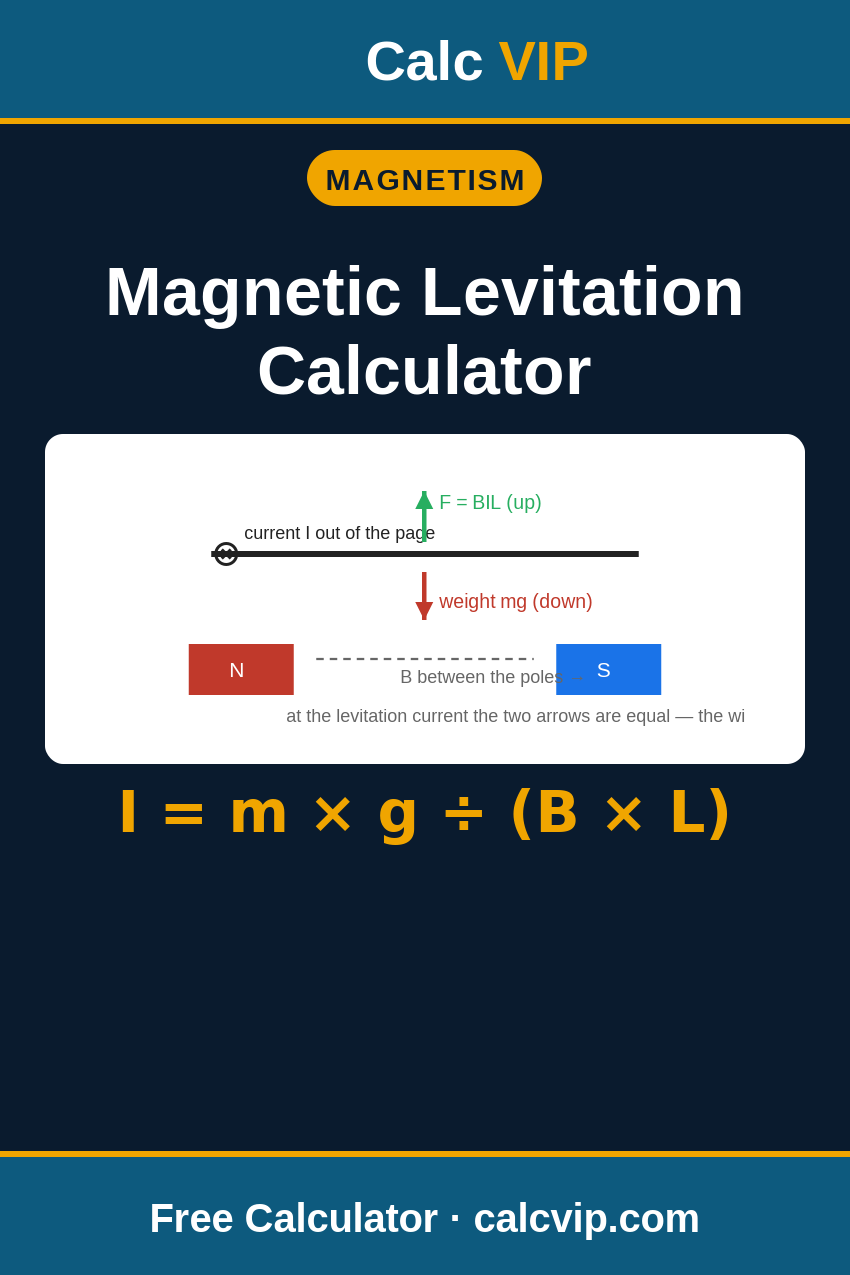
A current-carrying wire in a magnetic field feels a force. Arrange the geometry kindly — wire horizontal, field horizontal and perpendicular to it — and that force points straight up, opposing gravity. Feed the wire enough current and the upward force exactly balances the weight: the wire floats, held up by nothing visible. This calculator performs that balance, solving I = mg/(BL) for the levitation current of a wire of given mass, field and length.
It is the simplest honest model of magnetic levitation, and it is worth being precise about what it is and is not. It is a true force balance — the same equation, with better geometry, sizes the lift magnets of maglev trains and the bearings of flywheels. It is not a complete levitation scheme, because a bare balance like this is unstable: nudge the wire and nothing restores it, a consequence of Earnshaw's theorem that the final sections explore. Real systems add sensors and feedback, adjusting the current hundreds of times a second. But every one of them starts from this page's arithmetic: how much force, from how much current, in how much field.
The numbers have a pleasing concreteness. The fields are tenths of a tesla — strong permanent magnets or a modest electromagnet. The currents are single-digit amps. The masses are grams to hundreds of grams. That is why this is a beloved classroom demonstration: a metre of wire, a pair of magnets and a bench power supply are enough to watch the Lorentz force hold something up against gravity, visibly, in defiance of every intuition about what needs a hook.
Formula
I = m × g ÷ (B × L) • I in amps (A), m in kg, g = 9.81 m/s², B in tesla (T), L in metres. It comes from balancing the magnetic force on a straight wire, F = B × I × L, against the wire's weight, F = m × g. It assumes the wire is perpendicular to the field — the full force law is F = BIL sin θ.
The same balance rearranges for every design question. The force available at a given current: F = B × I × L. The mass a setup can float: m = B × I × L ÷ g. The field a given current needs: B = m × g ÷ (I × L). And with an angle, the current becomes I = m × g ÷ (B × L × sin θ) — as θ shrinks toward parallel, the required current grows without limit, reaching infinity at θ = 0 where no current can levitate the wire at all. If the "wire" is one side of a coil of N turns in the field, L is effectively N times the side's length, which is how real actuators multiply their force.
| Symbol | Meaning | Units |
|---|---|---|
| I | current needed to levitate | amps (A) |
| m | mass of the wire (or load) | kilograms (kg) |
| g | gravitational field strength, 9.81 | m/s² |
| B | magnetic field strength | tesla (T) |
| L | length of wire in the field | metres (m) |
| θ | angle between wire and field (90° assumed) | degrees (°) |
The force balance — and the stability it lacks
Setting BIL = mg gives the current at which the wire neither rises nor falls. But a balance point is not the same as a resting place. If the wire drifts slightly upward in this simple geometry, the field it sits in is unchanged (the model assumes a uniform field), so the force is unchanged and nothing pushes it back; if the current is a hair too large it accelerates away, a hair too small and it sinks. Worse, in any real magnet arrangement the field weakens with height, which sounds stabilising for a permanent-magnet lifter but comes paired with sideways instabilities — the content of Earnshaw's theorem (1842), which proves no arrangement of static fields and fixed magnets or currents can hold an object stably in all directions at once.
Every working levitation system is therefore a way of cheating Earnshaw honestly. Feedback is the commonest: a sensor watches the gap, a controller trims the current, and the balance point is re-found hundreds of times per second — the wire (or train, or rotor) never rests, it is perpetually caught. Diamagnetic materials cheat differently, being repelled by fields in a way that does find a stable minimum; superconductors cheat best of all, pinning flux so the levitation is stable with no power at all. The force arithmetic never changes — mg must still equal the magnetic force — only the stability is engineered on top of it.
How to use
- Enter the mass of the wire (or of the load it carries) in kilograms — 50 g is 0.05 kg.
- Enter the field strength in tesla and the length of wire actually inside the field, in metres — only the part between the magnet's poles counts.
- Click "Calculate" to get the levitation current in amps.
- Plan the supply generously: the wire must carry this current continuously, and its resistance will heat it — check the wire's rating, and remember the balance is unstable without feedback or guides.
Worked examples
Example 1 — floating a light wire. A wire of mass m = 0.05 kg (50 g) lies in a field of B = 0.4 T, with L = 0.25 m of its length in the field.
I = m g ÷ (B L) = (0.05 × 9.81) ÷ (0.4 × 0.25) = 0.4905 ÷ 0.1 = 4.905 A.
Check the balance: F = B I L = 0.4 × 4.905 × 0.25 = 0.4905 N, exactly the weight (0.05 × 9.81). Below this current the wire rests on its supports; above it, the wire lifts. Real demonstrations need a little extra to overcome the supports and any stiffness in the leads.
Example 2 — a heavier rig. A demonstration bar of m = 0.1 kg in B = 0.5 T with L = 0.2 m in the field: I = (0.1 × 9.81) ÷ (0.5 × 0.2) = 0.981 ÷ 0.1 = 9.81 A. The round number is a coincidence of the chosen values (mg and BL both 0.981 and 0.1), but it underlines the scaling: double the mass at fixed geometry and you double the current.
Example 3 — how much can 10 A lift? With I = 10 A, B = 0.8 T and L = 0.15 m: F = BIL = 0.8 × 10 × 0.15 = 1.2 N, which floats m = F ÷ g = 1.2 ÷ 9.81 = 0.122 kg — about the mass of a small apple, held up by a field and a car battery's worth of current.
Example 4 — a weak field demands current. A wire of m = 0.02 kg with L = 0.5 m in the field but only B = 0.1 T available: I = (0.02 × 9.81) ÷ (0.1 × 0.5) = 0.1962 ÷ 0.05 = 3.924 A. A long wire in a weak field can beat a short wire in a strong one — L and B are interchangeable in the product, a useful freedom when magnets are expensive and wire is cheap.
Example 5 — the cost of a tilt. Example 1's rig, but the wire sits at θ = 30° to the field instead of square: I = mg ÷ (BL sin 30°) = 0.4905 ÷ (0.1 × 0.5) = 9.81 A — exactly double, because sin 30° = 0.5 halves the force per amp. Alignment is not a nicety in levitation rigs; it is half the force budget.
Example 6 — sensitivity: grams per amp. A rig with B = 0.3 T and L = 0.1 m at I = 2 A produces F = 0.3 × 2 × 0.1 = 0.06 N, floating 0.06 ÷ 9.81 = 6.12 g. Since F ∝ I, each amp here is worth 3.06 g of lift — the "gain" a feedback controller works with, and the reason levitation current supplies are specified by their fine control, not just their maximum.
Magnetic levitation in real life
Maglev trains. The Transrapid and Linimo systems float entire trains on this force balance, scaled up: electromagnets under the vehicle pull up toward a rail (attractive levitation) with the gap held at about 10 mm by fast feedback — Earnshaw cheated by electronics, at 400 km/h.
Magnetic bearings. Turbines, flywheels and vacuum pumps spin on active magnetic bearings: coils whose currents are trimmed continuously to centre the shaft. The force law is BIL's close family; the product is a bearing with no contact, no lubricant and no wear.
The classroom demonstration. Example 1 is a standard school experiment — a wire between magnet poles on a balance, its "weight" vanishing as the current rises. It remains the most direct way to see the motor effect, because the force becomes visible as a missing weight.
Levitating globes and displays. Desk toys float a globe or product above a base using a permanent magnet plus an electromagnet trimmed by a Hall sensor — the feedback architecture in miniature, holding the balance point this calculator computes.
Superconducting levitation. A superconductor over a magnet array levitates stably with no power and no feedback, its trapped flux pinning it in place — the demo where a puck floats, locked, even tilted or upside down. The force still balances mg; the stability comes free from flux pinning.
Diamagnetic levitation. Strong fields (10–16 T) can float even living things — the famous levitated frog — because water is diamagnetic and is repelled from strong-field regions into a stable pocket. The forces are feeble per gram, which is why it needs a laboratory magnet the size of a room.
Earnshaw's theorem: why floating is the easy part
Samuel Earnshaw proved in 1842 that no stationary arrangement of charges, magnets and fixed currents can hold an object in stable equilibrium — any equilibrium is a saddle: stable in one direction, unstable in another. The wire of this page is the theorem in miniature: vertically it can balance, but sideways the field's shape either ignores it or expels it, and rotationally it is free to twist until the force geometry collapses. The theorem's loopholes are now a catalogue of technologies: feedback (fields that change in time, exempting the "static" assumption), diamagnetism (materials Earnshaw did not consider, repelled by fields), superconductors (whose pinned flux is not a fixed current), and spinning (the Levitron top, stable by gyroscopic precession). Whenever you see something levitating quietly, one of those four loopholes is at work — the force balance on this page is necessary, but it is never the whole story.
The heat bill for floating
Levitation by current is never free, and the bill is paid in heat. While the wire floats, the supply delivers no mechanical work — the wire is not moving — yet it delivers I²R of electrical power continuously, all of it warming the wire. Example 1's rig, if its in-field wire and leads total 0.5 Ω, dissipates 4.905² × 0.5 ≈ 12 W for as long as it floats: the power of a small soldering iron, spent on standing still. This is why the quick-reference table's trade matters so much — doubling B halves I and quarters the heating — and why practical magnetic bearings and maglev vehicles fight for every tesla and every turn: the force balance decides whether floating is possible, but the I²R bill decides whether it is practical for more than a demonstration's few minutes.
Quick reference: levitation current for a 50 g load with L = 0.25 m
| Field B | Current I = mg/(BL) | Magnet that gives it |
|---|---|---|
| 0.1 T | 19.62 A | large ferrite pair, wide gap |
| 0.2 T | 9.81 A | strong ferrite or small electromagnet |
| 0.4 T | 4.905 A | neodymium pair (Example 1) |
| 0.6 T | 3.27 A | close-gap neodymium |
| 0.8 T | 2.45 A | serious electromagnet |
| 1.0 T | 1.96 A | laboratory magnet territory |
The trade is exact: I ∝ 1/B. Every doubling of field halves the current — and with it the resistive heating (which falls fourfold, since heating goes as I²R). Strong magnets are bought with money; weak ones are paid for in heat.
Common mistakes
- Counting wire that is not in the field. Only the length between the poles feels the force. A metre of wire with 25 cm between the magnets is an L of 0.25 m — the leads contribute nothing but resistance.
- Forgetting the angle. The formula assumes the wire is perpendicular to B. At 30° the force halves (Example 5); parallel to the field it vanishes entirely, and no current will lift the wire.
- Expecting the balance to be stable. BIL = mg is an equilibrium, not a trap. Without feedback, guides or a loophole from Earnshaw's list, the wire drifts off the balance point — plan the stabilisation, not just the current.
- Ignoring heating at the levitation current. The current flows continuously, and thin wire at 5–10 A gets hot, its resistance rises, and insulation suffers. Size the wire for the current, not just the geometry.
- Getting the force direction wrong. Reverse either the current or the field and the force points down, pressing the wire onto its supports with mg + BIL. Fleming's left-hand rule, applied once, carefully, prevents a demonstration that pins instead of floats.
FAQ
Is this how maglev trains work?
Trains use the same force law but with electromagnets acting on a guideway rather than a single wire, plus fast feedback control — a bare magnet arrangement is naturally unstable (Earnshaw's theorem), so the current must be adjusted many times per second to hold the gap steady.
Why does only the length inside the field count?
The force F = BIL acts only where current and field overlap. Wire outside the magnet's gap feels no force, so L is the length within the field region, not the whole wire.
What if the wire is not perpendicular to the field?
The force becomes F = BIL sin θ, where θ is the angle between wire and field. At θ = 0° (wire parallel to the field) the force vanishes entirely — direction matters as much as size.
Why does the wire need the current to keep flowing?
The magnetic force exists only while charge moves. Switch off and F falls to zero instantly, leaving gravity in sole charge — unlike a permanent-magnet lifter, the current-driven wire has no residual hold.
Would a stronger magnet always help?
Yes for the current budget — I falls as 1/B — but the field in the gap is what matters, and very strong magnets bring their own problems: they attract the rig's steel parts, pinch fingers, and saturate any iron in the setup.
Can this scale to levitating a person?
The arithmetic scales fine (a 70 kg person needs BIL = 687 N — say 0.5 T × 20 A × 69 m of conductor, which is why real systems use coils of many turns). The engineering — stability, heating, safety — is what grows teeth, and is why passenger levitation uses feedback-controlled attraction systems instead.
Why is the balance unstable — can't the wire just sit there?
That is Earnshaw's theorem: static fields alone cannot make a stable trap in all directions. The wire can balance vertically yet be free to slide sideways or twist. Real levitators add feedback, diamagnetism, superconductors or spin.
Would the same current levitate the wire on the Moon?
Less current would do: g there is 1.62 m/s², so I falls to about a sixth — 0.81 A for Example 1's rig. The formula's g is doing exactly the job it should.
Why do demonstrations use a balance instead of free floating?
Because the balance measures the force while constraining the instability: the wire rests on the pan, the magnetic force unloads it, and the scale reads the difference. It is the honest instrument version of levitation — the same physics, with the sideways freedom removed.
Can a coil lift more than a straight wire?
Yes — force adds per turn in the field. A coil side of N turns behaves like N wires: F = N × BIL. Motors, relays and maglev bogies all exploit this, trading wire (and resistance) for force at fixed current.