 Calc
Manometer Calculator – Pressure Difference ΔP = ρgh
 Created by Elena Petrova · Physics Editor · Fluids & Rotation · Last updated: November 2026
Use this free Manometer Calculator to find a pressure difference from the height difference in a U-tube manometer. A denser column liquid means a shorter, easier-to-read column for the same pressure.
The manometer is the oldest pressure instrument in the world and still one of the most honest: a U-shaped tube, part-filled with liquid, with one side connected to the pressure you want to measure and the other to a reference. The higher pressure pushes the liquid down on its side and up on the other, and the difference in levels — a length you can measure with a school ruler — is the pressure, wearing no disguise. No calibration certificate, no battery, no drift: if you know the liquid's density and the local gravity, the height difference is the pressure difference, by definition of how fluids behave.
The physics is a single line: ΔP = ρgh. The pressure difference supports a column of liquid of height h against gravity, and the column pushes back with exactly ρgh. Every consequence flows from that line. Use a dense liquid and the column shrinks — mercury, 13.6 times denser than water, turns a whole atmosphere into a manageable 76 cm. Use a light liquid and the column stretches, magnifying small pressures into readable heights: a gentle 1.5 kPa of gas pressure, invisible on a mercury tube at barely a centimetre, stands 15 cm tall in water. Choosing the liquid is choosing the instrument's magnification.
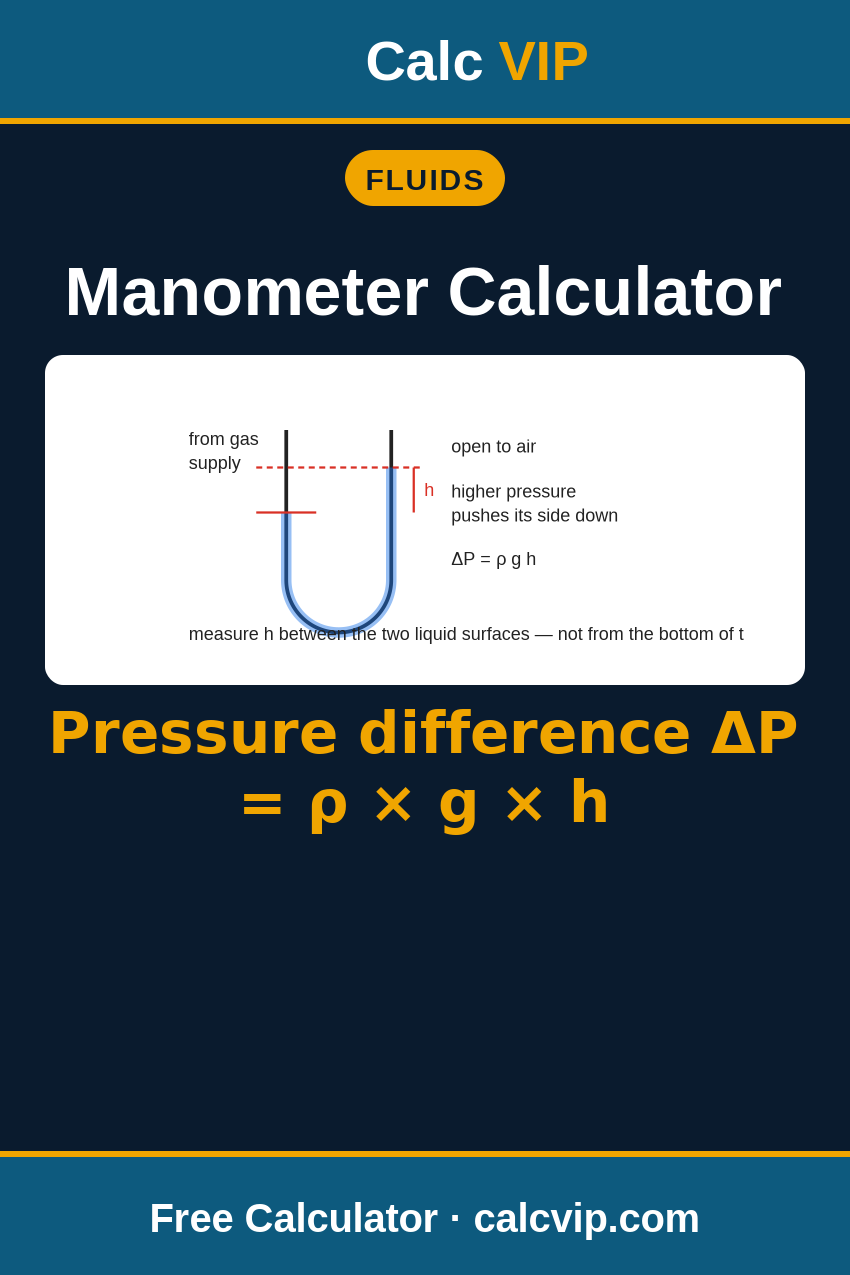
This calculator does the ρgh sum for the three classic column liquids — mercury, water and oil — or any density you type in, with the height in metres, centimetres or millimetres. It is the right tool for gas-supply pressures, ventilation and duct measurements, filter monitoring, laboratory work and the long tradition of checking one instrument against another — because when a modern electronic gauge is doubted, the court of appeal is still a tube of liquid and a ruler.
Formula
Pressure difference ΔP = ρ × g × h • ΔP in pascals (Pa), ρ in kilograms per cubic metre (kg/m³), g = 9.81 m/s², h in metres (m)
The formula rearranges to find the height a given pressure will produce: h = ΔP ÷ (ρg) — the design equation for choosing a manometer liquid. Read the physics off the symbols: ΔP grows in direct proportion to all three factors, so doubling the density or doubling the height doubles the pressure. Notice what is absent: the tube's diameter and shape appear nowhere. A wide tube and a narrow tube with the same liquid show the same h for the same ΔP — the first hint of the hydrostatic paradox explored below. This calculator evaluates ΔP for the standard liquids (mercury 13,600, water 1000, oil 850 kg/m³) or your own density, and reports pascals and kilopascals.
| Symbol | Meaning | Units |
|---|---|---|
| ΔP | pressure difference between the two sides | Pa (1000 Pa = 1 kPa) |
| ρ | density of the column liquid | kg/m³ |
| g | gravitational field strength | 9.81 m/s² |
| h | difference in height between the two liquid surfaces | m (enter cm or mm in the calculator) |
The hydrostatic paradox: only height matters
Fill three vessels of wildly different shapes — a narrow tube, a wide jar, a cone flaring upward — connect them at the base, and the liquid comes to rest at exactly the same level in all three. The pressure at the base of each is ρgh: it depends on the height of liquid above the point and nothing else — not on the total volume, not on the vessel's width, not on the weight of water in the system. This is the hydrostatic paradox, and the manometer is its most useful child. The U-tube does not care that one arm is fat and the other thin, or that the tube bends; the free surfaces settle where ρgh balances ΔP, and the vertical distance between them is the whole story. It is also why water finds its own level in connected tanks, why a builder's water level works around corners, and why the pressure at the foot of a skyscraper's standpipe is set by the building's height alone and not by the size of the tank on its roof.
Practical manometry adds three honest complications. First, capillarity: in narrow tubes the liquid surface climbs or sags at the wall, so precision tubes are made wide enough (a centimetre or more) for the effect to shrink below the reading error — and you read the bottom of the meniscus, consistently. Second, temperature: the liquid expands as it warms, its density falls, and the same pressure supports a slightly taller column; mercury barometers carry a temperature correction table for exactly this reason. Third, the gas in the connecting lines has weight too — negligible for liquids against gas pressures, but the reason precision gas manometry sometimes corrects for the columns of gas above the liquid. None of these overturn ΔP = ρgh; they are the difference between a school measurement and a standards laboratory.
How to use
- Choose the column liquid — mercury, water or oil — or type any liquid density in kg/m³ into the density field.
- Enter the height difference between the two liquid surfaces (the vertical distance between the two levels, not the depth of either one).
- Choose the height unit: metres, centimetres (pre-selected) or millimetres.
- Click "Calculate Pressure Difference" to see ΔP in pascals and kilopascals.
- To design in the other direction — "how tall a column will this pressure make?" — divide your pressure by (ρ × 9.81), or try heights in the calculator until ΔP matches.
Worked examples
Example 1 — mercury, 15 cm. A mercury manometer shows a height difference of 15 cm (0.15 m). ΔP = 13600 × 9.81 × 0.15 = 20,012 Pa ≈ 20.01 kPa. The same pressure with a water manometer would need a column about 2.04 m tall — which is why dense mercury is used.
Example 2 — a water manometer on a duct. A ventilation technician's water manometer shows 30 cm between levels. ΔP = 1000 × 9.81 × 0.30 = 2943 Pa ≈ 2.94 kPa — the pressure a fan is maintaining against the duct's resistance, read off a column a ruler can measure.
Example 3 — an oil manometer. With oil of density 850 kg/m³ and a difference of 25 cm: ΔP = 850 × 9.81 × 0.25 ≈ 2085 Pa ≈ 2.08 kPa. Oil's slightly lower density than water stretches the same pressure over a slightly taller column — and oil does not evaporate or corrode the tube, which is why it fills many workshop gauges.
Example 4 — the whole atmosphere. A mercury column of 76 cm: ΔP = 13600 × 9.81 × 0.76 ≈ 101,396 Pa ≈ 101.4 kPa — essentially one standard atmosphere (101.325 kPa). This is Torricelli's 1643 experiment, the first barometer: the atmosphere itself, weighed against a mercury column, and the reason pressure is still quoted in "millimetres of mercury".
Example 5 — a small gas pressure. A mercury manometer on a laboratory gas line shows just 2 cm of difference: ΔP = 13600 × 9.81 × 0.02 ≈ 2668 Pa ≈ 2.67 kPa. Switch that measurement to a water tube and the same pressure stands 27 cm tall — the magnification trick of Example 2's logic, and the standard way to make small pressures readable.
Example 6 — designing for a target pressure. A gas supply must be checked at 1.5 kPa above atmospheric. In water, h = 1500 ÷ (1000 × 9.81) ≈ 0.153 m — about 15.3 cm, comfortably readable on a bench U-tube. In mercury the same check would show 1500 ÷ (13600 × 9.81) ≈ 0.011 m — barely a centimetre, too small to read well. The liquid is chosen to fit the pressure, and this example is the choosing.
Manometers in real life
Gas safety checks. Gas fitters test new pipework with a water manometer (the "U-gauge") at pressures around 2–3 kPa: fill the tube, connect, and watch whether the level holds. A falling level over the standing time is a leak, announced by gravity with no electronics to fail.
Ventilation and cleanrooms. Hospital isolation rooms and laboratories are kept a few pascals above or below their corridors so air flows the safe way. Inclined water manometers — tilted to stretch the scale — monitor differences as small as 5–25 Pa, where a mercury column would not move a readable amount.
Filter and duct monitoring. A manometer across an air filter reads the pressure drop the filter causes; as the filter clogs, ΔP climbs. Building engineers log it the way you would watch a fuel gauge — when the column says the pressure drop has doubled, the filter is changed.
Weather and altitude heritage. Every mercury barometer is a manometer with one side evacuated, measuring the atmosphere against vacuum — the direct ancestor of the aneroid dial and the phone sensor, and still the reference instrument against which the others are calibrated.
Blood pressure. The traditional sphygmomanometer is a mercury manometer squeezed by a cuff — the unit mmHg survives in every clinic long after the mercury column itself was retired, and "120 over 80" is a pair of manometer readings wearing modern clothes.
Aircraft and wind tunnels. Pitot-static systems turn airspeed into a pressure difference, and multi-tube manometer banks once lined wind-tunnel walls, dozens of columns mapping the pressures over a model wing in a single glance — a bar chart drawn by physics itself.
The well-type manometer: reading one level instead of two
Reading a U-tube means measuring two moving levels and subtracting — fiddly when both are drifting. The well-type (reservoir) manometer removes the subtraction: one arm of the U is replaced by a wide reservoir, so nearly all the movement appears in the single narrow measuring tube. Push the pressure up and the tube level climbs by almost the full h while the reservoir surface barely sinks. "Almost" is the professional's caveat: the reservoir level does fall a little, by the tube's rise times the ratio of the tube's cross-section to the reservoir's. With a reservoir a hundred times wider than the tube, the error is 1% — small enough to print the scale slightly compressed and forget it, which is exactly what manufacturers do. The design dominates wall-mounted workshop and laboratory manometers for a practical reason: one scale, one meniscus, one reading. The physics remains the U-tube's — ΔP = ρgh between the reservoir surface and the tube surface — with geometry quietly absorbing the bookkeeping.
The inclined manometer: stretching the scale
Tilt a manometer tube and the same vertical rise h spreads along a longer length of tube: at an angle of 10° to the horizontal, the liquid travels about 5.8 times farther along the slope than it rises vertically (the factor is 1 ÷ sin 10° ≈ 5.76). Ventilation engineers exploit this ruthlessly — an inclined water or oil manometer resolves pressure differences of a few pascals, the breathing-scale pressures of cleanrooms and isolation wards, into millimetres of travel that eyes can read. The physics has not changed: ΔP still equals ρg times the vertical height. Only the ruler has been stretched. It is a fitting emblem for the whole instrument family — three centuries old, and still being refined by nothing more exotic than geometry.
Quick reference: what a column of liquid is worth
| Column | Pressure | Note |
|---|---|---|
| 1 mm mercury | ≈ 133 Pa | the mmHg / torr of medicine |
| 1 cm water | ≈ 98 Pa | ventilator pressures are quoted in these |
| 10 cm water | ≈ 981 Pa | a gentle duct pressure |
| 15 cm mercury | ≈ 20.01 kPa | Example 1 of this page |
| 76 cm mercury | ≈ 101.4 kPa | one standard atmosphere |
| 10.33 m water | ≈ 101.3 kPa | the water barometer nobody builds |
| 1 m oil (850 kg/m³) | ≈ 8.34 kPa | oil magnifies ~18% more than water |
Keep the first two rows in your pocket and most manometer work becomes mental arithmetic: a millimetre of mercury is about 133 pascals, a centimetre of water about 98 — call it 100 and you are within 2%.
Common mistakes
- Measuring one side's depth instead of the difference. h is the vertical distance between the two surfaces. Reading from the bottom of the U, or using one column's height alone, fabricates a pressure that was never there.
- Forgetting the unit of h. 15 entered as metres instead of centimetres inflates ΔP a hundredfold. The calculator's unit selector exists because this slip is so common.
- Using water's density for a dyed alcohol or oil tube. Workshop manometer fluids are often alcohol (about 790 kg/m³) or oil (850). Using 1000 overstates every reading by a fifth or more.
- Reading the top of the meniscus for water. Water climbs the glass at the edges; the level is read at the bottom of the curve, with the eye level with it. Mercury does the opposite — read the top of its dome.
- Ignoring temperature on precision work. A mercury column at 30 °C is about half a percent taller than at 0 °C for the same pressure. School work can ignore it; calibration work cannot.
FAQ
Why is mercury used in manometers?
Mercury is about 13.6 times denser than water, so even atmospheric pressure only supports a 76 cm column. A water barometer would have to be over 10 m tall.
What if the two levels are equal?
Then h = 0 and ΔP = 0 — the pressures on both sides are the same.
Can a manometer measure a vacuum?
Yes. Connect one side to the vacuum and leave the other open to the air; the column difference then shows how far below atmospheric pressure the vacuum is.
Does the width of the tube change the reading?
No. Pressure at a depth depends only on ρ, g and h, so a fat tube and a thin tube settle at the same levels. Width matters only practically: very narrow tubes suffer capillary effects that distort the surface, which is why precision manometers use tubes a centimetre or more across.
What is the difference between a manometer and a barometer?
A barometer is a manometer whose reference side is a sealed vacuum, so it reads absolute atmospheric pressure. A U-tube manometer with both sides connected reads the difference between two pressures; leave one side open to the air and it reads gauge pressure.
Why do gas fitters use water instead of mercury?
Because gas pressures are small — a domestic supply runs about 2 kPa above atmospheric, which is 20 cm of water but only 1.5 cm of mercury. Water magnifies the reading into something a ruler can judge, it is cheap and safe, and a leak test's slow fall is easy to watch. Mercury is also toxic and increasingly restricted.
How accurate can a liquid manometer be?
Remarkably accurate — a careful reading is good to a fraction of a millimetre of column, which for water is a few pascals. National standards laboratories still use precision manometers (with temperature and gravity corrections) as primary pressure standards against which electronic gauges are calibrated.
What does "inches of water" mean on a specification?
It is ΔP quoted as the height of a water column: 1 inch of water ≈ 249 Pa. HVAC and fan specifications use inches of water (or centimetres) because duct pressures are naturally a few columns tall. Convert with this calculator by entering the height and choosing water.
Can a manometer measure pressure in a liquid system?
Yes, provided the manometer fluid does not mix with the system liquid and is denser than it — mercury under water-based systems is the classic pairing. If the fluids mix, an air gap or a diaphragm separator is used, and the simple ρgh reading gets a correction for the interfaces.
Why does the column bounce or oscillate when I connect it?
The liquid column is a mass on a spring of compressed gas, and it rings like one when the pressure changes suddenly. Wait for it to settle, and if the source pressure pulsates (a compressor, an engine manifold), a small restrictor in the connecting line damps the swing so the mean level can be read.