Calc
Pitot Tube Calculator – Flow Speed from Dynamic Pressure
 Created by Elena Petrova · Physics Editor · Fluids & Rotation · Last updated: November 2026
Use this free Pitot Tube Calculator to find the speed of a flowing fluid from a pitot tube reading. Enter the difference between the stagnation pressure and the static pressure, plus the fluid density — the calculator converts that dynamic pressure into flow speed.
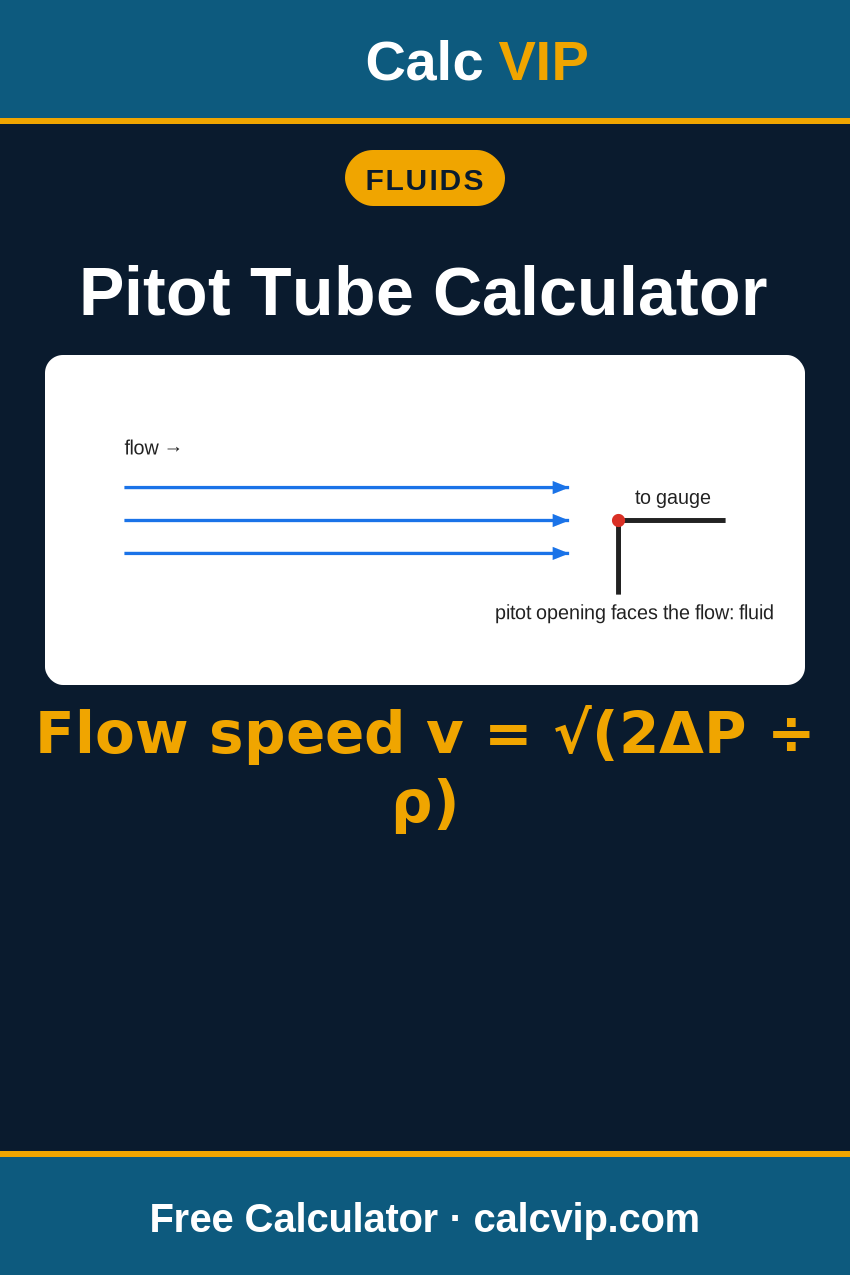
The pitot tube is a bent straw with a genius idea inside it: point a tube directly into a flow and the fluid that enters is brought to a halt against the trapped column inside. Halting it costs exactly its kinetic energy, which reappears as extra pressure — the stagnation pressure. Compare that with the static pressure of the undisturbed flow, and the difference, the dynamic pressure ½ρv², is a direct reading of the speed. Henri Pitot presented the device to the French Academy in 1732 to measure the Seine; today its descendants report the airspeed of every airliner aloft.
The formula could not be shorter: v = √(2ΔP/ρ). But the smallness of the numbers it deals in deserves attention. Air at a brisk 28.6 m/s — over 100 km/h — produces a dynamic pressure of just 500 Pa, half of one percent of atmospheric pressure. Airspeed measurement is therefore an exercise in measuring tiny pressure differences accurately, which is why aircraft carry heated, carefully shaped pitot-static probes and why a wasp nest in a pitot tube is a genuine emergency: the instrument's whole world is a few hundred pascals.
The same equation serves water as happily as air, with the density swapped: a ship's pitot log, a river gauger's probe and a ventilation engineer's duct traverse all read ΔP and report √(2ΔP/ρ). This calculator performs that conversion for any fluid, returning the speed in m/s and km/h. Everything else on the page is about the two pressures you subtract, the limits of the incompressible assumption, and the long list of machines that trust their speed to this one square root.
Formula
Flow speed v = √(2ΔP ÷ ρ), where ΔP = stagnation pressure − static pressure • v in m/s, ΔP in Pa, ρ in kg/m³
The formula is Bernoulli's equation solved for speed, and it rearranges into the dynamic pressure itself: ΔP = ½ρv² — worth memorising, because it tells you the pressure any speed will generate (and the force per unit area a flow can exert on a facing surface, the basis of wind-load calculations). Because ΔP grows with the square of speed, doubling speed quadruples the reading; because ρ sits inside the square root, the same ΔP in water (ρ = 1000) means a speed √816 ≈ 28.6 times slower than in air. The calculator reports m/s and km/h; multiply m/s by 1.944 for knots, the mariner's and aviator's unit.
| Symbol | Meaning | Units |
|---|---|---|
| v | flow speed | m/s (also km/h) |
| ΔP | dynamic pressure = stagnation − static | Pa |
| ρ | fluid density at the probe | kg/m³ |
| ½ρv² | kinetic energy per unit volume of the flow | Pa (= J/m³) |
Two pressures, one subtraction
Everything in pitot work is the honest measurement of the two pressures. The stagnation (or total) pressure is read by the forward-facing opening. The static pressure — the pressure of the flow minding its own business — must be sampled without disturbing it: through flush holes in a wall or duct, or through the ring of side holes on a combined pitot-static probe, placed where the flow has closed back around the stem. Subtract, and the difference is pure motion: ½ρv². A manometer makes the subtraction visible — connect the two ports across a U-tube and the column difference is ΔP, which is how Pitot himself read the Seine's speed in metres of water column.
The catch is that the formula prices the flow at the probe's tip only. Real flows have profiles: a duct's centreline runs about 20% faster than its average, a river's speed varies with depth, and the air a few centimetres from an aircraft's skin is not the free stream. Professional practice therefore traverses — sampling a grid of points and averaging — or applies a probe position factor. The calculator gives the speed at the point you probed; turning point speeds into a duct's flow rate is surveying, and it is where the craft of the instrument lives.
How to use
- Measure or look up the dynamic pressure ΔP in pascals — the stagnation (pitot) reading minus the static reading at the same point.
- Enter the fluid density ρ in kg/m³: air 1.225 at sea level (less at altitude or in heat), water 1000, sea water 1025.
- Click "Calculate" to see the flow speed in m/s and km/h.
- Benchmark: ΔP = 500 Pa in air must return about 28.6 m/s (103 km/h). If your answer looks like a car's speed on a motorway when you probed a breeze, the density or the pressure unit has slipped.
Worked examples
Example 1 — highway-speed air. ΔP = 500 Pa, air (ρ = 1.225):
v = √(2 × 500 ÷ 1.225) = √816.3 = 28.57 m/s = 102.9 km/h. Five hundred pascals — the pressure of a 5 cm water column — is all that separates still air from a motorway-speed flow.
Example 2 — a light aircraft on climb-out. ΔP = 2,000 Pa, air: v = √(4000 ÷ 1.225) = 57.14 m/s = 205.7 km/h. Quadrupling Example 1's ΔP only doubled the speed — the square root again, and the reason airspeed indicators need their most sensitive region at low speed, near the stall.
Example 3 — a river current. ΔP = 2,000 Pa, water (ρ = 1000): v = √(4000 ÷ 1000) = 2 m/s. The identical pressure difference that meant 57 m/s in air means a gentle 2 m/s in water — density inside the square root is destiny.
Example 4 — a cyclist's headwind. ΔP = 50 Pa, air: v = √(100 ÷ 1.225) = 9.04 m/s = 32.5 km/h. Fifty pascals is a whisper of pressure, yet it is the full dynamic signature of a strong riding pace — and the force that same ½ρv² exerts on the rider's chest is the drag she fights.
Example 5 — a ship's pitot log. ΔP = 12,500 Pa, sea water taken as ρ = 1000: v = √(25,000 ÷ 1000) = 5 m/s ≈ 9.7 knots. Water's density makes pitot pressures generous and easy to measure — thousands of pascals at walking-to-running speeds.
Example 6 — a ventilation duct. ΔP = 125 Pa, air: v = √(250 ÷ 1.225) = 14.29 m/s = 51.4 km/h. Duct traverses with readings like this, taken on a grid and averaged, are how building engineers verify that a ventilation system delivers its designed air changes.
Pitot tubes in real life
Aircraft airspeed. The pitot-static system is the primary speed reference on everything from a glider to an A380. Air data computers correct the raw √(2ΔP/ρ) for altitude density and compressibility and present indicated, calibrated and true airspeeds — three refinements of this one formula.
HVAC and cleanrooms. Ventilation engineers traverse ducts with pitot grids to balance systems, and cleanroom monitors watch tiny ΔP values to prove air moves in the right direction between rooms.
Ships' logs. A pitot (or electromagnetic) log reports speed through the water from the same dynamic pressure — distinguishing it from GPS speed over the ground is a daily navigational judgement.
Rivers and hydrology. Gauging a stream's discharge starts with point velocities from a pitot or propeller meter at standard depths, integrated across the channel — river science built on ½ρv².
Wind engineering. Wind-tunnel balances and building-wind studies calibrate tunnel speed with pitot rakes; the pressure a storm exerts on a facade is ½ρv² with the storm's v, which is why cladding is rated in pascals.
Industrial gas ducts. Flue-gas and process-air flows are monitored by averaging pitot arrays (Annubars), chosen because a plain tube survives heat, dust and corrosion that would destroy delicate meters.
When the simple formula bends: compressibility and altitude
Bernoulli's simple form treats the fluid as incompressible — its density the same at the probe as in the stream. For liquids that is essentially exact. For air it holds while the flow is slow compared with sound: below about Mach 0.3 (≈ 100 m/s at sea level) the error stays under ~2%. Faster, the air piles up and compresses at the stagnation point, the true ΔP exceeds ½ρv², and the simple formula overstates the speed; air data computers switch to the compressible (isentropic) relation. Altitude bends the formula the other way: ρ falls to about 0.4 kg/m³ at airliner cruise heights, so the same true speed makes a third of the sea-level ΔP. An airspeed indicator — a ΔP gauge with a speed dial — therefore under-reads at altitude unless corrected: "true airspeed" is this calculator run with the density at altitude, and the gap between indicated and true is a first lesson of flight training.
Quick reference: dynamic pressure of air at sea level
| Speed | km/h | ΔP = ½ρv² (Pa) |
|---|---|---|
| 10 m/s | 36 | 61 |
| 20 m/s | 72 | 245 |
| 30 m/s | 108 | 551 |
| 40 m/s | 144 | 980 |
| 50 m/s | 180 | 1,531 |
Read the table as a warning about sensitivity: the whole span from a breeze to a hurricane's onset lives between 60 and 1,500 Pa. Pitot work is precision low-pressure measurement, and every technique in the field — liquid manometers, capsule gauges, electronic differential sensors — exists to resolve those pascals honestly.
From one point to a flow rate: the traverse
A pitot tube reads the speed where its tip sits, and ducts are not uniform — so the professional measurement is a traverse: the probe is stepped across a grid of positions whose spacing follows a standard pattern (equal-area or log-Tchebycheff points), the speed at each point is computed from its ΔP with this calculator, and the speeds are averaged before multiplying by the duct's area. Two disciplines make it honest. First, average the speeds, not the pressures: because v ∝ √ΔP, averaging ΔP first overstates the flow whenever the profile is uneven. Second, respect the profile's shape: in a round duct with turbulent flow the centreline speed is typically about 1.2 times the mean, so a single centre reading multiplied by the area overstates the flow by roughly a fifth. A 0.5 m × 0.5 m duct whose traverse averages 8 m/s carries Q = 0.25 × 8 = 2 m³/s — a number no single proud centreline reading of 9.6 m/s should be allowed to inflate to 2.4. The pitot tube is a point instrument; the traverse is what turns points into truth.
For dirty or hot gas streams there is a hardened variant, the S-type (Stauscheibe) pitot: two larger facing tubes, back to back, that resist blockage and are calibrated against a standard probe. It trades a coefficient (typically ≈ 0.84, applied to the formula) for the ability to survive flue gas — a reminder that in pitot work, as everywhere in measurement, the instrument is chosen for the stream first and the equation second.
Pitot's rivals — and why the tube survives them
Three rivals contest the pitot tube's territory, and each wins somewhere. The hot-wire anemometer measures the cooling of a heated filament and resolves speeds and turbulence fluctuations far below and above the pitot's range — but it is fragile, costly and drifts with dirt, so it lives in laboratories. The ultrasonic meter times sound pulses up and down the stream and needs no insertion at all — the choice for custody transfer in big gas lines — but it prices like the instrument it is. The vane and cup anemometers of weather stations are rugged and self-powered but have inertia, bearings and a starting threshold. The pitot tube endures because it is the only one that is simultaneously cheap, calibration-stable for decades, indifferent to heat and dirt, and traceable to a primary quantity — pressure — with no electronics in the stream. Three centuries after the Seine, the bent tube's remaining enemies are not rival instruments but blocked holes and careless alignment, which is why the mistakes list below is short and worth obeying.
The tube's newest workplace makes the point about scale: a small drone cruising at 15 m/s asks its pitot probe to resolve ΔP = ½ × 1.225 × 15² ≈ 138 Pa, and its autopilot holds speed from that whisper against a 101,325 Pa atmosphere — a differential measurement of one part in a thousand, performed by a sensor smaller than a fingernail. Pitot's idea scales from the Seine to a quadcopter without changing a single symbol.
Common mistakes
- Feeding the gauge the absolute pressure instead of the difference. The formula wants stagnation minus static. Entering the stagnation pressure alone (≈ 101,000 Pa in air) returns an absurd 400+ m/s.
- Using sea-level density at altitude or in hot ducts. Speed scales with 1/√ρ. Air at 3,000 m is about 0.91 kg/m³; using 1.225 understates the true speed by roughly 14%.
- Misaligning the probe. A pitot tube yawed more than about 10–15° from the flow reads low, because the opening no longer halts the full stream. Alignment is the cheapest accuracy there is.
- Trusting the formula at high Mach. Above ~0.3 Mach, compressibility inflates ΔP and the incompressible formula overstates speed. Aircraft correct for it; hand calculations should at least flag it.
- Taking one centreline reading as the average. In a duct the centre runs roughly 20% fast. Flow rate needs a traverse average, not the proudest number in the profile.
FAQ
What is the difference between static and stagnation pressure?
Static pressure is the pressure of the undisturbed flow, measured through a hole in the side wall. Stagnation pressure is measured facing the flow, where the fluid is brought to rest — it is higher by the dynamic pressure ½ρv².
When does the pitot formula become inaccurate?
It assumes incompressible flow. For air it works well up to about 0.3 times the speed of sound (~100 m/s); faster aircraft apply a compressibility correction. It also reads low if the tube is not aligned with the flow.
Can a pitot tube measure water speed?
Yes — the same formula works for liquids with ρ = 1000 kg/m³. Pitot tubes are used on ships and in rivers and ducts, though the pressure differences are much larger than in air at the same speed.
Why do aircraft have heated pitot tubes?
Because the probe flies through cloud, where supercooled droplets freeze on contact. Ice blocking the opening destroys the reading — implicated in real accidents — so the tubes are electrically heated and checked before flight.
What is a pitot-static tube?
A combined probe: the pitot opening in the tip plus a ring of side holes a little way back that sample static pressure without facing the flow. One insertion gives both pressures, hence ΔP, hence speed — the standard aircraft and duct instrument.
How small a speed can a pitot tube measure?
In air, a 1 m/s breeze makes only 0.6 Pa — below most gauges. Liquid manometers and sensitive electronic sensors push the floor to about 2–3 m/s in air; below that, hot-wire and ultrasonic anemometers take over. In water the pressures are 816 times larger at the same speed, so the floor is far lower.
Does the tube's diameter matter?
Hardly at all to the reading — the stagnation pressure is a property of the flow, not the hole — but a larger tube disturbs small flows more and responds more slowly, while a tiny tube blocks more easily. Size is chosen for the duct and the dirt, not the physics.
Why does the airspeed indicator under-read at altitude?
It is a ΔP gauge calibrated with sea-level density. At altitude the same true speed produces less ΔP (thinner air), so the dial shows less. True airspeed is recovered by rerunning this calculation with the density at altitude.
Can a pitot tube measure flow rate in a pipe?
Indirectly: it measures the speed at its tip. Multiply by the pipe area only after establishing the profile factor — the ratio of average to centreline speed (about 0.82–0.85 for turbulent flow in smooth pipes). Traversing several points removes the guesswork.
Who invented the pitot tube?
Henri Pitot, a French engineer who described it in 1732 after using it to show that the Seine's surface current was faster than the deep current — overturning the assumption of the day. Henry Darcy refined the design in the 1850s into essentially the modern instrument.