 Calc
Pascal's Law Calculator – Hydraulic Force Multiplication
 Created by Elena Petrova · Physics Editor · Fluids & Rotation · Last updated: November 2026
Use this free Pascal's Law Calculator to find the output force of a hydraulic system. Enter the input force and the areas of the small and large pistons — the calculator shows the pressure in the fluid, the multiplied output force, and the mass it could lift.
Pascal's law is the principle that makes hydraulics feel like a magic trick with an honest explanation. Squeeze a confined liquid anywhere and the pressure you create appears everywhere in the liquid, undiminished, pushing on every surface it touches. Push gently on a small piston and that same pressure, acting on a much larger piston, delivers a force many times greater — enough for a person to lift a car with one hand on a jack handle, or for a fingertip's worth of pedal force to clamp brake discs hard enough to stop two tonnes of moving car. This calculator turns the trick into arithmetic: input force and two piston areas in, pressure and multiplied output force out.
Blaise Pascal stated the law in the 1650s, in the same decade he was bursting barrels with tall tubes of water to prove that fluid pressure depends on depth, not volume. The law's content is one sentence — pressure applied to a confined fluid is transmitted equally in all directions — but the engineering harvest from that sentence is enormous: jacks, lifts, presses, brakes, diggers, aircraft controls and the squeeze of a dentist's chair all run on it. Wherever you see smooth, silent, enormous force, there is usually a small piston, a large piston, and Pascal in between.
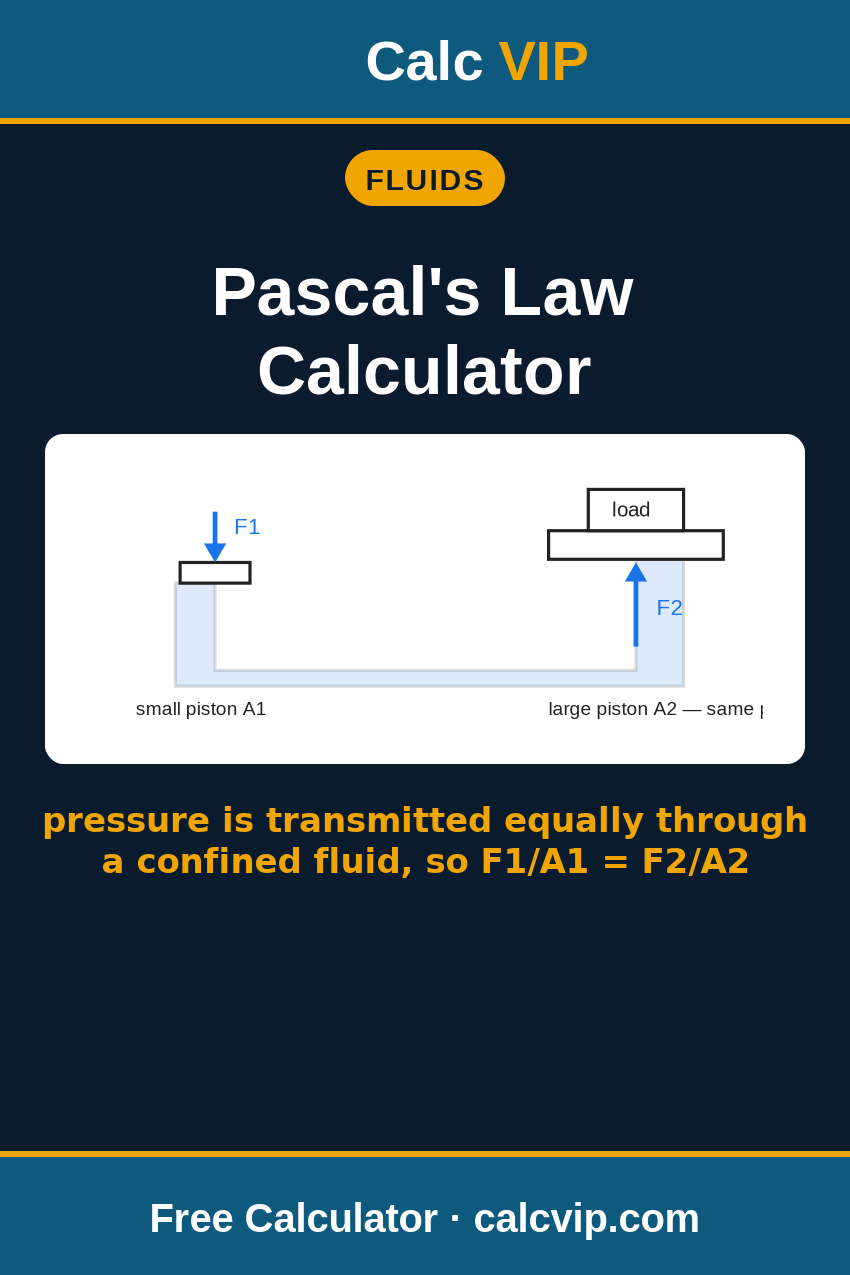
The exchange rate of the trick is the area ratio. Output force equals input force times A2/A1 — nothing else matters, not the fluid, not the shape of the vessel, not the distance between the pistons. This calculator also shows the shared pressure in the fluid and the mass the output force could lift, the two numbers that tell you whether a proposed jack, press or brake circuit is in the right universe before you build it. One honest warning, which the FAQ below expands: the force is multiplied, the energy is not — the small piston pays in distance what the large piston gains in force.
Formula
Pascal's law: pressure is transmitted equally through a confined fluid, so F1/A1 = F2/A2
Output force: F2 = F1 × (A2/A1)
The pressure everywhere in the fluid is the same: P = F1/A1. A large piston with 50 times the area produces 50 times the force — this is how hydraulic jacks lift cars and how car brakes multiply the force of your foot.
The law rearranges for design in both directions: the area a load piston needs is A2 = A1 × (F2/F1), and the input force a given system demands is F1 = F2 × (A1/A2). Because pistons are usually round, areas often arrive as diameters: A = π(D/2)², so the force ratio becomes the diameter ratio squared — F2 = F1 × (D2/D1)². A load piston three times wider than the pump piston gives nine times the force, a fact that surprises everyone who expects three.
| Symbol | Meaning | Units |
|---|---|---|
| F1 | input force on the small piston | newton (N) |
| F2 | output force from the large piston | N |
| A1, A2 | piston areas, small and large | m² |
| P | pressure in the fluid — the same everywhere | pascal (Pa) |
Why the fluid cannot keep a secret
A liquid is a crowd of molecules in constant negotiation. Push extra pressure into one corner of a confined liquid and the molecules there are squeezed slightly closer, pushing harder on their neighbours, who push harder on theirs — the news crosses the fluid at the speed of sound in that liquid (about 1,500 m/s in oil), and within a blink every wall, piston and valve in the system feels the identical new pressure. There is nowhere for the pressure to hide and no direction it prefers: that is the physical content of Pascal's law. It is also why the liquid matters: a gas would simply compress, absorbing the push like a spring and returning it late and unevenly, which is precisely the spongy failure you feel when air contaminates a brake line.
The second deep fact is the conservation law standing guard behind the trick. The output piston rises only as far as the displaced fluid allows: the volume the small piston sweeps out (A1 × its travel) must equal the volume gained under the large piston (A2 × its rise). Multiply force by distance on both sides and the two works are identical — F1 × d1 = F2 × d2 exactly when F2/F1 = A2/A1 = d1/d2. Hydraulics is a lever made of liquid: it trades travel for force at a rate set by geometry, and it never, ever pays out more energy than was put in. Every "miracle" lifting device on Earth obeys that ledger; Pascal's law is just its most elegant bookkeeping.
How to use
- Enter the force applied to the small piston in newtons.
- Enter the areas of the small and large pistons in square metres (100 cm² = 0.01 m²). If you know diameters instead, area = π × (D/2)².
- Click "Calculate Output Force" to see the fluid pressure, the output force and the mass it can lift.
- To find how far the load moves, use the volume rule: load rise = small-piston travel × (A1/A2).
Worked examples
Example 1 — the hydraulic jack. A mechanic pushes the small piston of a hydraulic jack with F1 = 100 N. The small piston has area A1 = 0.01 m² and the large piston A2 = 0.5 m². Pressure = 100 ÷ 0.01 = 10,000 Pa. Output force F2 = 100 × (0.5 ÷ 0.01) = 100 × 50 = 5,000 N — enough to lift a mass of 5,000 ÷ 9.81 ≈ 509.7 kg, like the corner of a car.
Example 2 — the garage car lift. A technician leans on a lift's pump piston with 200 N; A1 = 0.005 m², A2 = 0.4 m². Pressure = 200 ÷ 0.005 = 40,000 Pa; F2 = 200 × (0.4 ÷ 0.005) = 200 × 80 = 16,000 N, lifting up to 16,000 ÷ 9.81 ≈ 1,631 kg — a whole family car, raised by a force one person can apply with a foot.
Example 3 — hydraulic brakes. A driver's foot delivers 50 N to a master-cylinder piston of area 3 cm² (0.0003 m²), creating P = 50 ÷ 0.0003 ≈ 166,667 Pa in the brake fluid. At each wheel, caliper pistons totalling 24 cm² (0.0024 m²) convert that pressure back: F2 = 50 × (0.0024 ÷ 0.0003) = 400 N of clamping force per wheel — before the pedal lever and any servo assistance add their own multiplication on top.
Example 4 — the dentist's chair. A foot pump applies 60 N to a piston of 0.002 m²; the chair's lift piston is 0.06 m². F2 = 60 × (0.06 ÷ 0.002) = 60 × 30 = 1,800 N, enough to raise 1,800 ÷ 9.81 ≈ 183.5 kg — patient, chair and all — with the smooth, silent motion hydraulics is loved for. Barber chairs and hospital beds run the identical circuit.
Example 5 — the distance bill comes due. In Example 1's jack, suppose the small piston is pumped through a total travel of 0.5 m. Volume swept = 0.01 × 0.5 = 0.005 m³, so the large piston rises 0.005 ÷ 0.5 = 0.01 m — one centimetre. Work in: 100 N × 0.5 m = 50 J. Work out: 5,000 N × 0.01 m = 50 J. The books balance to the joule; that is why real jacks need many pump strokes to lift a car to working height.
Example 6 — a workshop press. A press pump delivers 500 N onto A1 = 0.002 m²; the ram has A2 = 0.1 m². Pressure = 500 ÷ 0.002 = 250,000 Pa (2.5 bar), and F2 = 500 × 50 = 25,000 N — two and a half tonnes of squeeze for pressing bearings, crimping fittings and bending brackets, from a handle one person pulls.
Pascal's law in real life
Vehicle brakes. Example 3 is the safety-critical version: one fluid circuit carries your foot's modest force to four wheels simultaneously, equally, and instantly — Pascal's "everywhere at once" is precisely what braking needs. Dual circuits and ABS modulate the pressure, but the multiplication is pure 1650s physics.
Jacks, lifts and presses. From the bottle jack in a car boot to the 100-tonne press in a forge, the recipe never changes: small piston, large piston, area ratio chosen to match the load. The handle's long lever usually adds a first stage of multiplication before the hydraulics even begin.
Earth-moving machinery. An excavator's arm is a set of hydraulic cylinders driven by an engine-powered pump; the pump's job is simply to maintain pressure (industrial systems run at hundreds of bar) while the cylinder areas turn that pressure into the forces that tear up ground. Force on demand, in any direction a hose can reach.
Aircraft controls. Airliner control surfaces are far too large for cables and muscle; hydraulic actuators at up to about 200 bar move them, with the same pressure-everywhere logic letting one pump farm power several surfaces at once. The flight deck's light control forces and the tail's enormous ones are related by piston areas.
Medical and dental equipment. Chairs, operating tables and patient lifts choose hydraulics for the quality of the motion — perfectly smooth, silent, and self-locking when the valve closes, because a confined liquid under load simply stays where it is put.
Hydraulic cranes and tail lifts. The delivery truck's tail lift and the crane's boom are Pascal with a diesel accent: an engine-driven pump holds pressure in reserve, and rams of carefully chosen area spend it as force exactly where the load hangs.
Pressure ratings: the number that sizes real systems
Working engineers rarely quote the forces first — they quote the pressure the system is built to hold, because seals, hoses and pumps are all rated in bar. Car brake circuits peak around 100 bar and more under hard braking; workshop jacks live in the low hundreds of bar; industrial hydraulics commonly run at 200–350 bar; and the waterjet cutters that slice steel run specialised intensifiers at several thousand bar. Raising the pressure rating is how designers shrink machinery: at fixed force, F = P × A means higher pressure buys the same force from a smaller, lighter piston. The calculator's pressure output is the figure to compare against the ratings of real components — if your design needs 2,000 bar from bicycle parts, Pascal approves and the hardware does not.
Quick reference: force multiplication by area ratio
| Area ratio A2/A1 | Force multiplier | Load travel per 10 cm of input | 100 N input lifts |
|---|---|---|---|
| 5 | × 5 | 2 cm | ≈ 51 kg |
| 10 | × 10 | 1 cm | ≈ 102 kg |
| 25 | × 25 | 4 mm | ≈ 255 kg |
| 50 | × 50 | 2 mm | ≈ 510 kg |
| 100 | × 100 | 1 mm | ≈ 1,019 kg |
The middle columns are the honest price list of hydraulic force: every factor of ten in force costs a factor of ten in travel. Jacks pay it gladly, stroke by patient stroke.
Pneumatics: Pascal's law with a spring in the circuit
Everything on this page has a compressed-air cousin, and the comparison is instructive. Pneumatic systems also transmit pressure through a confined fluid — Pascal's law holds for gases exactly as for liquids — so a factory air line at the usual 7 bar (700,000 Pa) acting on a cylinder piston of 0.01 m² delivers F = 700,000 × 0.01 = 7,000 N, quite respectable force. The difference is temperament: air compresses, so a pneumatic cylinder is springy, stores energy in its own working fluid, moves fast and cushions its end-stops, but cannot hold a load with the rock-steady indifference of a hydraulic ram, and wastes more energy as heat in the compression. Hence the division of labour across industry: pneumatics for fast, light, forgiving automation — grippers, clamps, packaging machines — and hydraulics wherever the forces are huge, the loads must not sag, or the motion must be millimetre-sure. Same law, two fluids, two personalities; the area ratio arithmetic on this page prices them both.
Common mistakes
- Feeding diameters into an area formula. The law wants areas. If you have diameters, square the ratio: F2 = F1 × (D2/D1)². A 3× wider piston gives 9× the force, not 3×.
- Botching cm² conversions. 1 m² = 10,000 cm². Entering "100" for a 100 cm² piston instead of 0.01 m² inflates the answer ten-thousandfold — the most destructive slip available on this page.
- Expecting free energy. Force multiplies; work does not. Any design that needs the load to move far and hard needs a pump delivering many strokes or continuous flow — check the travel column of the table before promising a lift height.
- Ignoring the pressure rating. Pascal's law will happily compute 5,000 bar for a toy system. Real seals and hoses fail first. Always read the calculator's pressure output against the hardware's rating.
- Assuming it works with air in the lines. Trapped air compresses, storing the input travel as spring instead of transmitting it as pressure. Spongy brakes and bouncy jacks are air contamination announcing itself — bleed the system.
FAQ
Does a hydraulic jack create energy from nothing?
No. The small piston must move a long distance to lift the load a short distance — force is multiplied, but the work (force × distance) stays the same, minus small friction losses.
Why is liquid used instead of air in hydraulics?
Liquids are almost incompressible, so pressure is transmitted instantly and fully. Air compresses like a spring, which would waste the input movement — that is why brakes fail if air gets into the brake lines.
How do I convert cm² to m²?
Divide by 10,000. For example, 100 cm² = 0.01 m² and 5,000 cm² = 0.5 m².
Does the shape of the container between the pistons matter?
No. Pressure depends only on the applied force and piston area, not on the vessel's shape or the path the fluid takes — which is why hydraulic lines can snake around an engine bay and still deliver full force at the wheels.
What fluid is actually used?
Usually a mineral hydraulic oil: nearly incompressible, lubricating for the pumps and seals, and formulated not to foam or corrode. Brake systems use a dedicated brake fluid with a high boiling point, since friction heat travels back into the calipers.
Can Pascal's law multiply force without limit?
In principle the ratio is unbounded; in practice pressure is the limit. Doubling force at fixed input area means doubling pressure, and seals, hoses and cylinder walls all have ratings. Real systems top out at a few hundred bar for good reason.
Why does the load stay up when I stop pumping?
A one-way valve traps the pressurised fluid under the load piston. The confined liquid cannot escape, so the pressure — and the force — simply persists. Lowering the load means opening a release valve and letting the fluid home in a controlled way.
How is this different from a lever?
Only in medium, not in logic. A lever trades force against distance around a pivot; hydraulics trades force against distance through a fluid. The fluid version wins where the two ends must be far apart, oddly angled, or multiplied to several outputs at once — brakes again.
Does gravity's hydrostatic pressure interfere?
Slightly: if the two pistons sit at very different heights, the fluid's own ρgh adds or subtracts a little pressure between them. In vehicle brakes and jacks the heights differ by centimetres and the effect is negligible beside the working pressures; in tall building systems it is designed for explicitly.
What is the connection to Pascal's barrel experiment?
The barrel showed the depth side of fluid pressure: a tall thin column generated bursting pressure from a jug of water. Pascal's law is the companion insight — pressure, however created, spreads through a confined fluid undiminished. Together they are the whole of hydrostatics' greatest hits.