Calc
Orifice Flow Calculator – Discharge Through an Orifice Plate
 Created by Elena Petrova · Physics Editor · Fluids & Rotation · Last updated: November 2026
Use this free Orifice Flow Calculator to find how much fluid passes through an orifice plate or a hole in a tank. Enter the hole diameter, the pressure difference across it and the fluid density — the calculator applies the discharge coefficient to give the real flow rate.
An orifice is the simplest flow meter ever made: a plate with a hole in it. Force fluid through the hole and it jets out at a speed set by the pressure difference; measure that difference and the flow is yours. The physics is Torricelli's 1643 insight — a jet's speed equals the speed of a body falling from the surface, v = √(2ΔP/ρ) — corrected by one honest fudge factor, the discharge coefficient Cd, which admits that the real jet is narrower and slower than the ideal one. This calculator carries both: it shows the ideal jet speed and then applies your Cd to give the real flow rate.
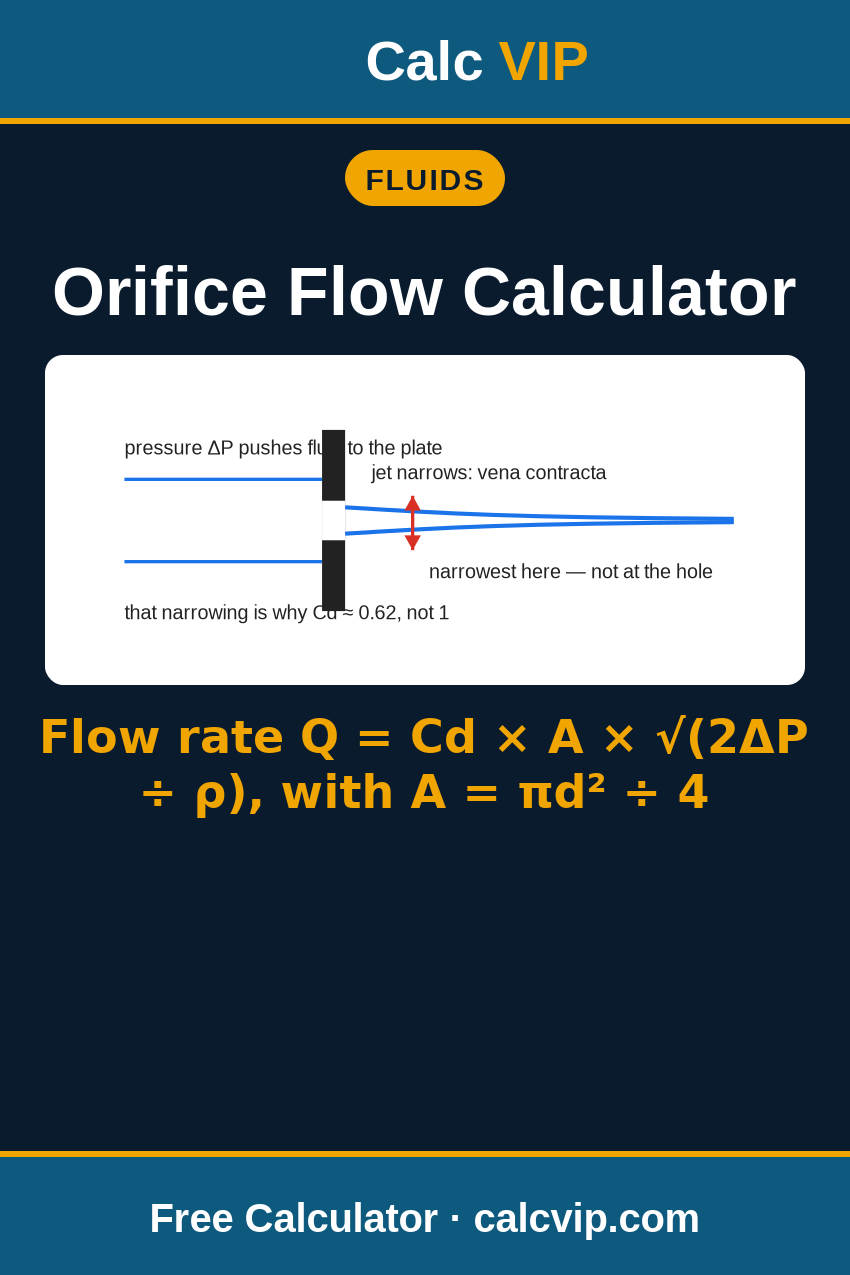
The fudge factor deserves respect rather than embarrassment. A sharp-edged hole makes the flow contract after the plate — the vena contracta — so the jet's working cross-section is only about 62% of the hole's area, and friction trims a little more. The result, Cd ≈ 0.62 for a sharp edge, is one of the most reproducible numbers in engineering: drill the same hole anywhere on Earth and the same 0.62 appears. Round the hole's entry and Cd climbs towards 0.95; the difference between the two numbers is the entire design space of nozzles, and the reason this calculator asks you for Cd instead of assuming it.
Orifices do double duty. As meters, they are cheap, rugged and standardised, at the price of wasting most of the pressure difference they create. As restrictions — a calibrated hole dropped into a line — they set flows, damp pulsations and limit surges in everything from gas hobs to hydraulic circuits. Both jobs are the same equation: Q = Cd × A × √(2ΔP/ρ), with the diameter entered here in millimetres because that is how holes are actually specified.
Formula
Flow rate Q = Cd × A × √(2ΔP ÷ ρ), with A = πd² ÷ 4 • Q in m³/s, d in metres inside the area, ΔP in Pa, ρ in kg/m³
The ideal jet speed √(2ΔP/ρ) rearranges into the pressure a jet needs: ΔP = ρv² ÷ 2 — the same dynamic-pressure form as the pitot tube, because a jet and a pitot reading are the same physics facing opposite ways. For a tank draining through a hole at depth h, ΔP = ρgh and the formula collapses to Torricelli: v = √(2gh), with the flow Q = Cd × A × √(2gh). The dependences to internalise: Q grows with the square of the diameter (through A), but only with the square root of the pressure — so doubling a hole quadruples the flow, while doubling the pressure adds only 41%.
| Symbol | Meaning | Units |
|---|---|---|
| Q | volume flow rate | m³/s (also L/s) |
| Cd | discharge coefficient (0.62 sharp-edged) | dimensionless |
| d, A | orifice diameter and area πd²/4 | mm (entered), m² |
| ΔP | pressure difference across the orifice | Pa |
| ρ | fluid density | kg/m³ |
The vena contracta: why the jet cheats the hole
Fluid approaching a sharp hole arrives from all directions, including sideways along the plate's face. It cannot turn the sharp corner instantly, so the jet keeps curving inward after it exits and reaches its narrowest — the vena contracta — about half a diameter downstream, at roughly 62% of the hole's area for a sharp edge. Only then does it straighten into a parallel jet at full speed. The discharge coefficient packages this contraction (the big effect) and friction (the small one) into a single multiplier, which is why Cd for a sharp-edged orifice in a large tank or pipe is so stable at 0.60–0.62 across sizes and fluids: the geometry of the turn, not the fluid, sets it.
Change the geometry and Cd reports the change faithfully. A rounded entry lets the flow follow the wall, the contraction nearly vanishes, and Cd rises to 0.95 or better — that is a nozzle. A short tube attached to the hole (about three diameters long) guides the jet back to the full area after its contraction, lifting Cd to about 0.82 while keeping the cheap drilled-plate construction. A ragged, burred or corroded edge does the opposite damage silently, which is why custody-transfer orifice plates are inspected and their edges measured like optics.
How to use
- Enter the orifice diameter d in millimetres.
- Enter the discharge coefficient Cd: 0.62 for a sharp-edged hole, about 0.82 for a short tube, 0.95+ for a rounded nozzle — or 1.0 to see the ideal upper limit.
- Enter the pressure difference ΔP across the orifice in pascals (for a tank, ΔP = ρgh with h the depth of liquid above the hole's centre).
- Enter the density ρ in kg/m³ and click "Calculate" for the hole area, the ideal jet speed and the real flow rate Q in m³/s and L/s.
Worked examples
Example 1 — the standard plate. d = 50 mm, Cd = 0.62, ΔP = 10,000 Pa, water (ρ = 1000).
A = π × 0.05² ÷ 4 = 0.001963 m²; ideal jet = √(2 × 10,000 ÷ 1000) = √20 = 4.47 m/s; Q = 0.62 × 0.001963 × 4.47 = 0.005444 m³/s = 5.44 L/s.
Example 2 — a tank draining (Torricelli). A hole of d = 20 mm sits 2 m below the surface of a water tank, so ΔP = ρgh = 1000 × 9.81 × 2 = 19,620 Pa. Jet = √(2 × 19,620 ÷ 1000) = 6.26 m/s — exactly √(2gh), as Torricelli promised. Q = 0.62 × 0.000314 × 6.26 = 0.00122 m³/s = 1.22 L/s.
Example 3 — air through a big opening. d = 100 mm, Cd = 0.62, ΔP = 500 Pa, air (ρ = 1.225): jet = √(1000 ÷ 1.225) = 28.57 m/s; Q = 0.62 × 0.007854 × 28.57 = 0.139 m³/s = 139 L/s. The same ΔP that barely stirs water drives a brisk air jet — density sits inside the square root, and air has almost none.
Example 4 — a small, hard-driven hole. d = 10 mm, Cd = 0.62, ΔP = 50,000 Pa, water: jet = √(100,000 ÷ 1000) = 10 m/s; Q = 0.62 × 0.0000785 × 10 = 0.000487 m³/s = 0.487 L/s. Small holes pass surprisingly little even at 5 bar-equivalent pressure — area, squared, rules.
Example 5 — oil under pressure. d = 25 mm, Cd = 0.62, ΔP = 200,000 Pa, oil (ρ = 900): jet = √(400,000 ÷ 900) = 21.08 m/s; Q = 0.62 × 0.000491 × 21.08 = 0.00642 m³/s = 6.42 L/s. Hydraulic restrictors are sized with exactly this arithmetic.
Example 6 — four times the pressure, twice the flow. Repeat Example 1 with ΔP = 40,000 Pa: jet = √80 = 8.94 m/s, Q = 0.01089 m³/s = 10.89 L/s — precisely double Example 1, because √4 = 2. To double an orifice's flow you must quadruple its pressure difference; to double it cheaply, enlarge the hole by 41% instead (√2 on the diameter, squared in the area). Push the same test to ΔP = 90,000 Pa — nine times Example 1 — and the flow exactly triples, to 16.33 L/s: the square root keeps its promises at every scale.
Orifice flow in real life
Flow metering. Orifice plates remain the world's commonest industrial flow meter — standardised (ISO 5167), cheap, and with no moving parts — accepting the permanent pressure loss as the price of simplicity. Gas pipelines bill millions through plates like Example 1's, scaled up.
Tank and dam outlets. Every "how fast will it empty?" question is Torricelli with a falling head: the jet slows as the level drops, and emptying-time calculations integrate this calculator's formula over the falling ΔP.
Gas appliances. The jet in a gas hob or boiler is a drilled orifice whose size, with the supply pressure, fixes the gas rate and hence the heat output. Swapping jets is how the same appliance is converted between gas types.
Hydraulic damping. Shock absorbers and hydraulic dampers force oil through small orifices; the ΔP the orifice generates against the piston is the damping force, tuned by hole size to a fraction of a millimetre.
Irrigation and sprinklers. A sprinkler nozzle is an orifice whose flow the farmer computes from line pressure; pressure-compensating emitters exist precisely because flow follows √ΔP and fields are not level.
Leak estimation. A hole in a pressurised water main or air line loses fluid at this formula's rate — the standard first estimate for how fast a leak of a given size is draining a system (and a reservoir's budget).
Draining a tank: the formula with a moving target
Example 2 hides a subtlety: as the tank empties, the depth h — and therefore ΔP and the jet — fall continuously, so the flow is never steady. The draining time for a tank of cross-section At emptying from depth h₁ to h₂ through an orifice of area A is t = [At ÷ (Cd × A × √2g)] × 2(√h₁ − √h₂). The square roots explain a familiar experience: a tank drains briskly at first, then spends a disproportionate time on its last few centimetres, because the flow fades with √h. It also explains why the last of the bathwater seems to take forever — the physics is literally decelerating under you.
Quick reference: Cd by edge geometry
| Geometry | Typical Cd | Why |
|---|---|---|
| sharp-edged hole in a thin plate | 0.60–0.62 | full vena contracta, no guidance |
| hole in a thick plate (short tube) | ≈ 0.82 | jet reattaches to the tube wall |
| rounded-entry nozzle | 0.95–0.99 | flow follows the curve, no contraction |
| conical diffuser exit | up to ≈ 1.0 | pressure recovery in the cone |
Two cautions ride with the table: Cd also drifts slightly with Reynolds number (very slow, viscous flows contract less), and for gas flow at large ΔP the density changes through the hole, so a compressibility factor joins the formula. For liquids and modest gas pressure drops, the table values are the working truth.
Orifice, venturi or nozzle? Choosing the hole
The three pressure-drop meters are one idea at three prices. The orifice plate costs least and wastes most: Cd ≈ 0.62, permanent loss typically 50–70% of its ΔP, but it is a disc of metal that fits between flanges and can be swapped in an hour. The flow nozzle — a rounded entry with no recovery cone — splits the difference (Cd ≈ 0.95, but still loses most of its ΔP downstream) and survives erosive steam that would chew a plate's sharp edge. The venturi costs most and wastes least (Cd ≈ 0.97, loss 10–20% of ΔP) because its diffuser recovers the pressure. The draining numbers from the earlier section show what "waste" means over time: the 2 m² tank emptying through a 20 mm hole from 2 m of head takes t = [At ÷ (Cd × A × √2g)] × 2√h₁ = [2 ÷ (0.62 × 0.000314 × 4.43)] × 2.83 ≈ 6,557 s — about 109 minutes — and every second of that flow paid the orifice's toll in turbulence. Choose the plate when the fluid is cheap and the run is short; choose the venturi when the pumping bill is forever.
At the small end: the fuel injector
Shrink the hole and raise the pressure and the same equation runs a fuel injector. Take one rounded injector hole of d = 1 mm (Cd ≈ 0.95) on a rail at ΔP = 300,000 Pa of petrol (ρ = 740): A = π × 0.001² ÷ 4 = 0.000000785 m²; the jet speed is √(2 × 300,000 ÷ 740) = 28.47 m/s; and Q = 0.95 × 0.000000785 × 28.47 ≈ 0.0000212 m³/s — about 21 mL/s. Real injectors split that duty among several smaller holes and fire it in millisecond pulses, but the budget is set here: hole area, rail pressure, one square root. It is Torricelli in a tailored suit, metering the fuel of the world's fleet a droplet budget at a time.
Common mistakes
- Using Cd = 1 for a sharp hole. That overstates the flow by over 60%. The ideal jet speed is real; the ideal flow is not — the jet is narrower than the hole.
- Entering the diameter in metres — or the radius as the diameter. The calculator expects millimetres and squares the diameter for the area: a radius-for-diameter slip cuts the computed flow to a quarter.
- Forgetting that tank ΔP changes as it drains. A single calculation gives the flow at one depth. Emptying times need the draining formula, not one snapshot multiplied by a guess.
- Expecting flow to double when pressure doubles. Q follows √ΔP: double pressure gives ×1.41, quadruple gives ×2. Budgets and pump upgrades fail on this square root every year.
- Ignoring the approach velocity in a pipe. This calculator's form assumes the fluid starts nearly at rest (a tank, or a hole small compared with its pipe). For a large orifice in a pipe, the venturi-style correction with the area ratio is the better tool.
FAQ
Why is the discharge coefficient less than 1?
The jet keeps narrowing for a short distance after the hole (the vena contracta), so its effective area is smaller than the hole, and friction removes a little more. A sharp-edged orifice has Cd ≈ 0.62.
How does this connect to Torricelli's law?
For a tank draining under gravity, ΔP = ρgh, so √(2ΔP/ρ) becomes √(2gh) — Torricelli's result that the jet speed depends only on the depth of liquid above the hole.
What happens if I double the pressure difference?
The flow grows with the square root of ΔP, so doubling the pressure raises the flow by √2 ≈ 1.41 times — not double. To double the flow you need four times the pressure difference.
What is the vena contracta?
The point, about half a diameter past the hole, where the jet is narrowest. Streamlines cannot turn the sharp edge instantly, so the jet overshoots inward; for a sharp-edged hole its area there is only about 62% of the hole's — the main ingredient of Cd.
How deep is the water if the jet lands a known distance away?
That is the classic projectile trick: time the jet's fall from the hole to the bench, measure its horizontal range, and the jet speed follows — then h = v²/(2g). It is how Torricelli's law is verified in school labs with nothing but a ruler.
Does the hole's position in the tank wall matter?
Only through the depth: ΔP = ρgh uses the depth of liquid above the hole's centre. A hole near the surface dribbles; the same hole at the bottom jets — which is why leaks low in a hull or tank are the urgent ones.
Can an orifice meter measure gas?
Yes — most industrial gas metering is orifice-based — but at large pressure drops the gas expands through the hole and an expansibility factor must multiply the formula. For ΔP small compared with the absolute pressure, the plain formula here is adequate.
Why use an orifice instead of a venturi?
Cost and convenience: a plate is cheap, fits between existing flanges and is easily swapped to change range. The price is energy — an orifice permanently loses half or more of its ΔP, where a venturi loses a tenth or two. High-flow, always-on lines justify the venturi; the rest of the world buys plates.
What if the orifice is submerged on the exit side?
Then ΔP is the difference between the two sides' pressures (for two tanks, ρg times the difference in levels). The formula is unchanged — it always was the difference that drives the jet.
How accurate is Cd = 0.62?
For a sharp-edged hole with turbulent approach flow it is reliable to a few percent, which is why standards still build metering on it. Precision work measures the actual plate, checks the edge sharpness, and applies the standard's Reynolds-number corrections.