 Calc
Mixture Density Calculator – Density of Two Mixed Liquids
 Created by Elena Petrova · Physics Editor · Fluids & Rotation · Last updated: November 2026
Use this free Mixture Density Calculator to find the density of a blend of two liquids. The density of a mixture is simply the total mass divided by the total volume — enter the mass and volume of each liquid and get the combined density.
Mix two liquids and the blend has a density of its own — never a mystery, always an accounting exercise. Density is mass per unit volume, so a mixture's density is fixed by two totals: everything that was poured in, weighed together, divided by the space the blend occupies. There is no interaction term, no chemistry in the arithmetic itself. That simplicity makes this one of the most useful calculations in any laboratory, kitchen, fuel depot or boatyard, because the density of a blend is measurable at a glance with a hydrometer and predictable in advance with this page — and where prediction and measurement disagree, the disagreement itself is information, as the contraction story below will show.
The trap this calculator exists to disarm is the seductive shortcut of averaging the two densities. Average them and you will sometimes be right — but only by accident, when the two volumes happen to be equal. In general the bigger pour drags the result towards its own density, in exact proportion to its volume. Two litres of oil and one litre of water do not meet halfway; the oil, holding two-thirds of the volume, claims two-thirds of the say. The correct method never changes: masses add, volumes add, then divide. Everything else on this page is commentary on those three operations.
Notice what the formula quietly assumes: that the volumes genuinely add. For most pairs — oil and water (which refuse to mix anyway), petrol and diesel, brine and fresh water — that is an excellent approximation. For one famous pair it is not: ethanol and water shrink on mixing, by up to about 3–4% near equal volumes, because the smaller water molecules nestle into gaps in the alcohol's structure. The calculator gives the ideal, additive answer; the depth section below shows how to read the real one. Knowing which assumption you are standing on is the difference between using a formula and understanding it.
Formula
Mixture density ρmix = (m₁ + m₂) / (V₁ + V₂) • masses in kilograms, volumes in litres here, density out in kg/m³ and kg/L
Each liquid's own density is ρ = m / V, so if you know densities and volumes instead of masses, recover each mass first with m = ρ × V and then apply the same totals rule. Written out in densities, the formula becomes ρmix = (ρ₁V₁ + ρ₂V₂) / (V₁ + V₂) — visibly a volume-weighted average of the two densities, which is the honest form of the "average" shortcut: each density is weighted by how much space its owner occupies. Two useful rearrangements follow. To hit a target blend density ρ* by mixing volumes of a light liquid ρ₁ and a heavy one ρ₂, the required volume ratio is V₂/V₁ = (ρ* − ρ₁)/(ρ₂ − ρ*) — the rule behind blending fuels and antifreeze to specification.
| Symbol | Meaning | Units |
|---|---|---|
| ρmix | density of the blend | kg/m³ (1 kg/L = 1,000 kg/m³) |
| m₁, m₂ | mass of each liquid poured in | kg |
| V₁, V₂ | volume of each liquid poured in | litres (1 L = 0.001 m³) |
| ρ₁, ρ₂ | each liquid's own density, m/V | kg/m³ |
Why the average lies: weighting by volume
Imagine the blend built litre by litre. Every litre of liquid 1 contributes ρ₁ kilograms to the total mass; every litre of liquid 2 contributes ρ₂. The blend's density is the average contribution per litre — and contributions are counted per litre, not per liquid. That is the whole story: the "average of the densities" treats the two liquids as equal partners regardless of how much of each arrived, while nature weights the partnership by volume. The error is not academic. Blend 9 litres of petrol (737 kg/m³) with 1 litre of a heavy additive at 1,200 kg/m³ and the naive average promises 968 kg/m³; the true blend is (9 × 737 + 1 × 1,200) / 10 = 783 kg/m³ — wrong by nearly 200 kg/m³, enough to misread a hydrometer check completely.
There is a mirror-image weighting worth knowing. If the recipe is given by mass — equal kilograms, say, as in many chemical formulations — then it is the volumes that must be recovered first (V = m/ρ) and the blend density becomes a mass-weighted harmonic mean: ρmix = (m₁ + m₂) / (m₁/ρ₁ + m₂/ρ₂). Example 3 below runs exactly that case. Recipes by volume weight the densities arithmetically; recipes by mass weight them harmonically; the totals rule — add masses, add volumes, divide — survives both, which is why this page asks for masses and volumes and nothing else.
How to use
- Enter the mass (kg) and volume (litres) of the first liquid. If you know only its density and volume, mass = density × volume (with volume in m³ for kg/m³, or litres for kg/L).
- Enter the mass and volume of the second liquid the same way.
- Click "Calculate Mixture Density" to see the blend density in kg/m³ and kg/L, the totals, and each liquid's own density for checking.
- Compare against a hydrometer reading if you have one: agreement confirms the blend; a reading a few percent higher suggests a contracting pair such as alcohol and water.
Worked examples
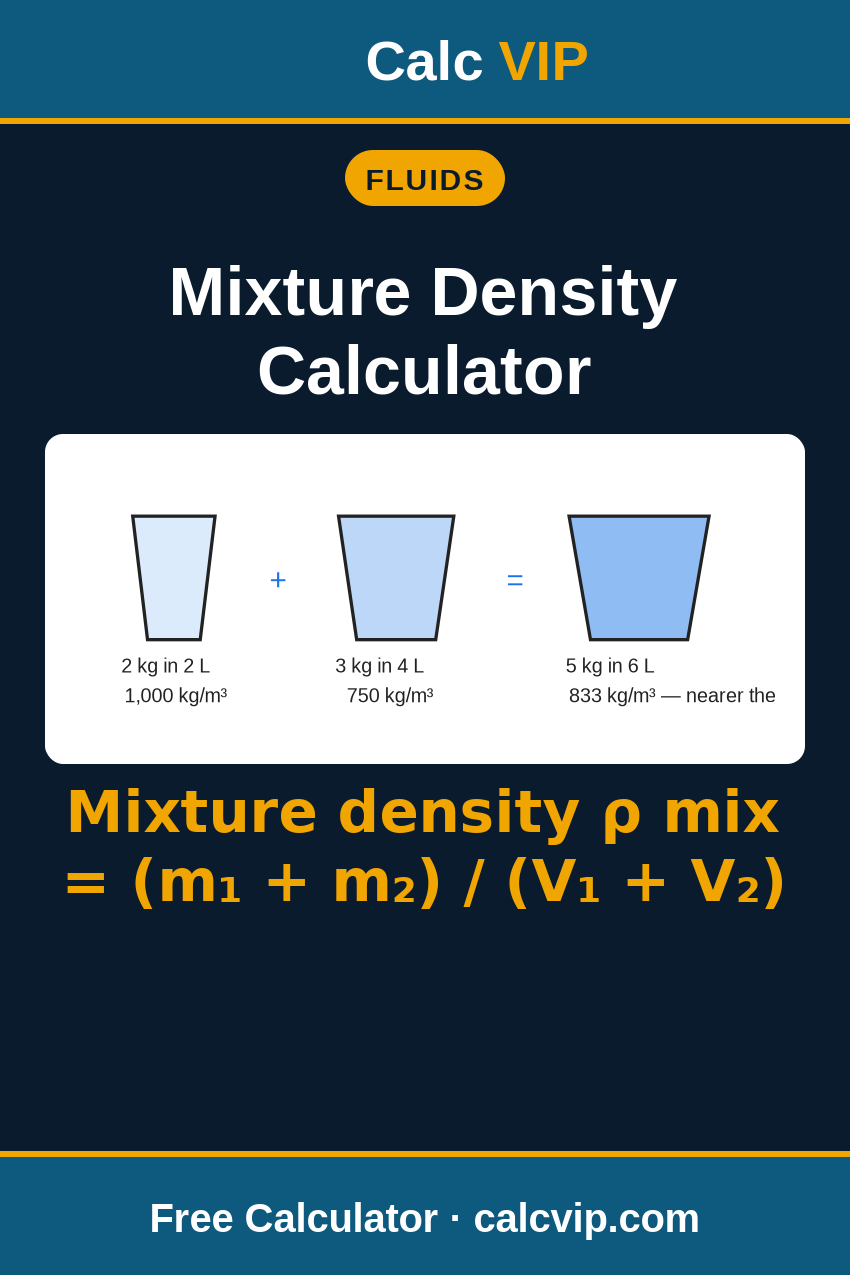
Example 1 — the reference blend. Mix 2 kg occupying 2 L (a water-like liquid, 1,000 kg/m³) with 3 kg occupying 4 L (an oil-like liquid, 750 kg/m³).
Totals: mass 5 kg, volume 6 L. ρmix = 5 ÷ 6 = 0.833 kg/L = 833.33 kg/m³. Note the position: 833 sits between 750 and 1,000 but closer to 750, because the oil holds 4 of the 6 litres.
Example 2 — equal volumes, where the shortcut works. One litre of water (1 kg) plus one litre of oil at 800 kg/m³ (0.8 kg): ρmix = 1.8 ÷ 2 = 0.9 kg/L = 900 kg/m³ — exactly the plain average of 1,000 and 800. Equal volumes are the one case where averaging densities is legitimate, and this is why the shortcut survives: it is right often enough in the kitchen to feel like a rule.
Example 3 — equal masses, where it does not. One kilogram of water (1 L) plus one kilogram of the same 800 kg/m³ oil (1.25 L): ρmix = 2 ÷ 2.25 = 0.889 kg/L = 888.89 kg/m³, not 900. The oil, taking more space per kilogram, dilutes the blend further than the naive average expects.
Example 4 — alcohol and water, honestly. 500 mL of ethanol (0.789 kg/L, so 0.3945 kg) plus 500 mL of water (0.5 kg) gives totals of 0.8945 kg in an ideal 1 L: 894.5 kg/m³. In reality the blend contracts by roughly 3.5%, occupying about 0.965 L, so a hydrometer reads nearer 0.8945 ÷ 0.965 ≈ 927 kg/m³. Distillers' tables exist precisely because this pair breaks the additive rule — the calculator's answer is the ideal baseline from which the real deviation is measured.
Example 5 — brackish estuary water. Three litres of river water (3 kg) meet one litre of sea water (1,025 kg/m³, so 1.025 kg): ρmix = 4.025 ÷ 4 = 1.00625 kg/L = 1,006.25 kg/m³. Estuary densities in exactly this range decide where sediment settles and where a freshwater lens floats on salt water underground.
Example 6 — blending fuel. Forty litres of petrol at 737 kg/m³ (29.48 kg) blended with ten litres of ethanol at 789 kg/m³ (7.89 kg): totals 37.37 kg in 50 L, so ρmix = 747.4 kg/m³. Fuel suppliers run this calculation continuously — density is a legal quality specification for petrol and diesel, checked at the pump depot with the same totals rule.
Mixture density in real life
Fuel blending and duty. Petrol, diesel and aviation fuel are taxed and certified by specification, density among them. Blending ethanol into petrol, or biodiesel into diesel, is steered by exactly this weighted average, verified by hydrometer at the depot.
Antifreeze and coolant. A 50/50 ethylene-glycol–water coolant's protection depends on the blend ratio; mechanics read it off a refractometer or hydrometer calibrated in density, and top up using the volume-weighting rule to restore the target.
Spirits and brewing. The alcohol content of a spirit is a density measurement in disguise: distillers and brewers track fermentation and proofing with hydrometers, converting density to alcohol percentage through tables that correct for the ethanol–water contraction.
Battery electrolyte. A lead-acid battery's state of charge is read from the density of its sulphuric acid — about 1,280 kg/m³ fully charged, falling towards 1,100 discharged. Topping up and mixing acid safely are mixture-density problems.
Concrete and slurries. The density of a pumped slurry or drilling mud — solids suspended in water — follows the same totals rule and decides pump loads, settling behaviour and whether a pipeline plugs.
Oceanography. Where river meets sea, the brackish mixture's density (Example 5) drives estuary circulation: lighter blend water slides over denser salt water, carrying nutrients and sediment in patterns that fisheries depend on.
The contraction exception: when volumes refuse to add
Ethanol and water are the famous case, but the underlying physics is general: when molecules of two liquids attract each other more strongly than they attract their own kind, the mixture packs tighter than either pure liquid and the volume shrinks; when they attract less, it can expand slightly. For ethanol–water the maximum contraction, near equal volumes, is roughly 3–4% — small, but larger than the precision of any hydrometer, and commercially significant when a distillery's tax bill depends on the volume of spirit it holds. The practical workflow respects both rules: predict with the additive formula, measure with the hydrometer, and treat a systematic few-percent gap as the signature of a non-ideal pair, consulting the official alcoholometric tables where money or law is involved. For the overwhelming majority of liquid pairs — oils, fuels, brines, coolants — the gap is under a fraction of a percent and the totals rule stands unchallenged.
Quick reference: densities of common liquids (kg/m³)
| Liquid | Density |
|---|---|
| petrol | ≈ 737 |
| ethanol | 789 |
| olive oil | ≈ 910 |
| fresh water | 1,000 |
| sea water | 1,025 |
| milk | ≈ 1,030 |
| glycerine | 1,260 |
| honey | ≈ 1,420 |
| mercury | 13,595 |
One guarantee the formula always keeps: the blend's density lies between the two ingredients' densities, weighted towards whichever occupies more volume. A calculated answer outside that interval is not a discovery — it is an arithmetic error announcing itself.
Temperature deserves a final word in the same spirit. Every density in the table is quoted near room temperature; warm a liquid and it expands, so its density falls — petrol by roughly 0.1% per degree Celsius, enough for a tanker load measured on a hot afternoon to "lose" hundreds of litres against its morning paperwork. Professional fuel accounting therefore corrects every volume and density to a reference temperature of 15 °C before the totals rule is applied.
Reading a recipe: by volume, by mass, or by fraction?
Blend instructions arrive in three dialects, and mistranslating between them is the commonest practical error after the naive average. A recipe "by volume" — 3 parts oil to 1 part vinegar — feeds this calculator directly once each part's density is known. A recipe "by mass" — 5% salt by weight, the standard in food science and chemistry — needs each mass converted to volume through V = m/ρ before the totals rule applies, or handled with the harmonic form given above. The third dialect, concentration, states how much of one ingredient sits in a unit of finished blend: grams per litre in a laboratory solution, or alcohol by volume (ABV) on a bottle. ABV is defined on the finished volume, which is exactly where the ethanol–water contraction bites: 500 mL of ethanol plus 500 mL of water yields about 965 mL of spirit, so the true ABV is 500/965 ≈ 51.8%, not the 50% the ingredient volumes suggest. Tax authorities, who levy duty on that number, maintain official tables for it.
The safe habit is to translate every recipe into the calculator's native language — a mass and a volume for each ingredient — before touching any numbers. Masses come from a scale or from density × volume; volumes from a jug or from mass ÷ density. Once both ingredients are expressed as (m, V) pairs, all three dialects collapse into the same two additions and one division, and the remaining disagreements with reality are the honest physical ones: contraction, temperature and incomplete mixing.
Common mistakes
- Averaging the densities directly. Correct only for equal volumes. With unequal pours the error grows with the imbalance — always add masses, add volumes, then divide.
- Mixing unit systems mid-problem. Masses in kg with volumes in litres give kg/L; multiply by 1,000 for kg/m³. Entering a volume in m³ where litres are expected shrinks the density a thousandfold.
- Forgetting that oil and water do not mix. The formula predicts a blend density, but immiscible liquids separate into layers, each keeping its own density — the "mixture" exists only while shaken.
- Trusting the additive answer for alcohol and water. Expect the real blend to read a few percent denser because of contraction (Example 4); use official tables for tax or legal work.
- Ignoring temperature. Densities are temperature-dependent — fuel expands noticeably on a hot day. Compare and blend at a stated temperature, conventionally 15 °C or 20 °C, or expect drift of a few tenths of a percent.
FAQ
Can I just average the two densities?
Only if the two volumes are equal. In general you must add the masses, add the volumes, then divide — a bigger volume of one liquid pulls the mixture density closer to its own.
What if I only know the densities and volumes?
Work out each mass first (mass = density × volume), then enter those masses with the volumes here.
Does this work for mixing a liquid with a gas or solid?
The formula works for any mixture whose volumes simply add together. It is approximate for liquids like alcohol and water, whose combined volume shrinks slightly on mixing.
Can a mixture be denser than both ingredients?
Only through contraction: if the blend occupies less volume than the sum of its parts, its density can exceed the volume-weighted prediction — ethanol and water manage exactly this, reading denser than the additive formula says, though still not denser than pure water in typical blends.
How do I blend to a target density?
Use the volume-ratio rule: V₂/V₁ = (ρ* − ρ₁)/(ρ₂ − ρ*), where ρ* is your target and ρ₂ the denser liquid. For a target of 850 from petrol (737) and a heavy stock (1,000): V₂/V₁ = (850−737)/(1,000−850) = 113/150 ≈ 0.75 — three parts heavy stock to four parts petrol, approximately, before fine-tuning by hydrometer.
What if I have three or more liquids?
The totals rule extends unchanged: add every mass, add every volume, divide once. This calculator handles two at a time — combine two, treat the blend as one liquid with its computed mass and volume, then combine with the third.
Why does my hydrometer disagree with the calculator?
Three usual causes: contraction (alcohol pairs), temperature (warm liquid reads light), or a recipe measured by mass being treated as one by volume. Check those before suspecting the arithmetic.
Does shaking or stirring change the density?
No — once fully mixed, density is a property of the blend, not of its history. Stirring matters only to make the mixture uniform so that a sample anywhere represents the whole.
How is mixture density used to test milk?
Watered milk is less dense than pure milk (≈1,030 kg/m³). A lactometer — a specialised hydrometer — exposes dilution by exactly this weighted-average physics, a fraud test older than the motor car.
What density is a 50/50 water–glycerine blend?
Equal volumes: (1,000 + 1,260)/2 = 1,130 kg/m³ by the totals rule (0.5 L of each: 0.5 kg + 0.63 kg = 1.13 kg in 1 L) — the equal-volume shortcut is legitimate here.