 Calc
Isolated Sphere Capacitance Calculator – C = 4πε0R with Charge and Energy
 Created by Rachel Novak · Senior Editor · All Topics · Last updated: November 2026
Use this free Isolated Sphere Capacitance Calculator to find the capacitance of a single conducting sphere on its own, C = 4πε0R. Even a lone conductor has capacitance — measured against infinity. Enter the radius, and optionally a voltage, to also see the charge the sphere holds and the energy it stores. Sphere capacitances are tiny, so answers are shown in picofarads too.
A capacitor is supposed to need two plates — yet a single isolated sphere has a perfectly definite capacitance, C = 4πε0R. The resolution of the paradox is that the second plate exists: it is the rest of the universe, at infinity. Capacitance measures how much charge an object holds per volt of its own potential, and a sphere's potential is V = kQ/R, set by its radius alone. This calculator finds C from R, and — if you supply a voltage — also the charge on the sphere and the energy stored in its field.
Prepare to be underwhelmed by the numbers, because that is the lesson. Capacitance grows only in direct proportion to radius, and the constant 4πε0 is tiny (1.11 × 10⁻¹⁰ F/m), so a 10 cm sphere manages 11.1 pF and even a metre sphere only 111 pF. To build a 1 µF capacitor as a lone sphere you would need a radius of about 9,000 km — larger than the Earth, whose own capacitance is a modest 709 µF. Practical capacitors cheat gloriously: two huge areas separated by a whisker of dielectric, a geometry the lonely sphere cannot imitate. Its capacitance is small for the same reason its field is honest: everything is spread to infinity.
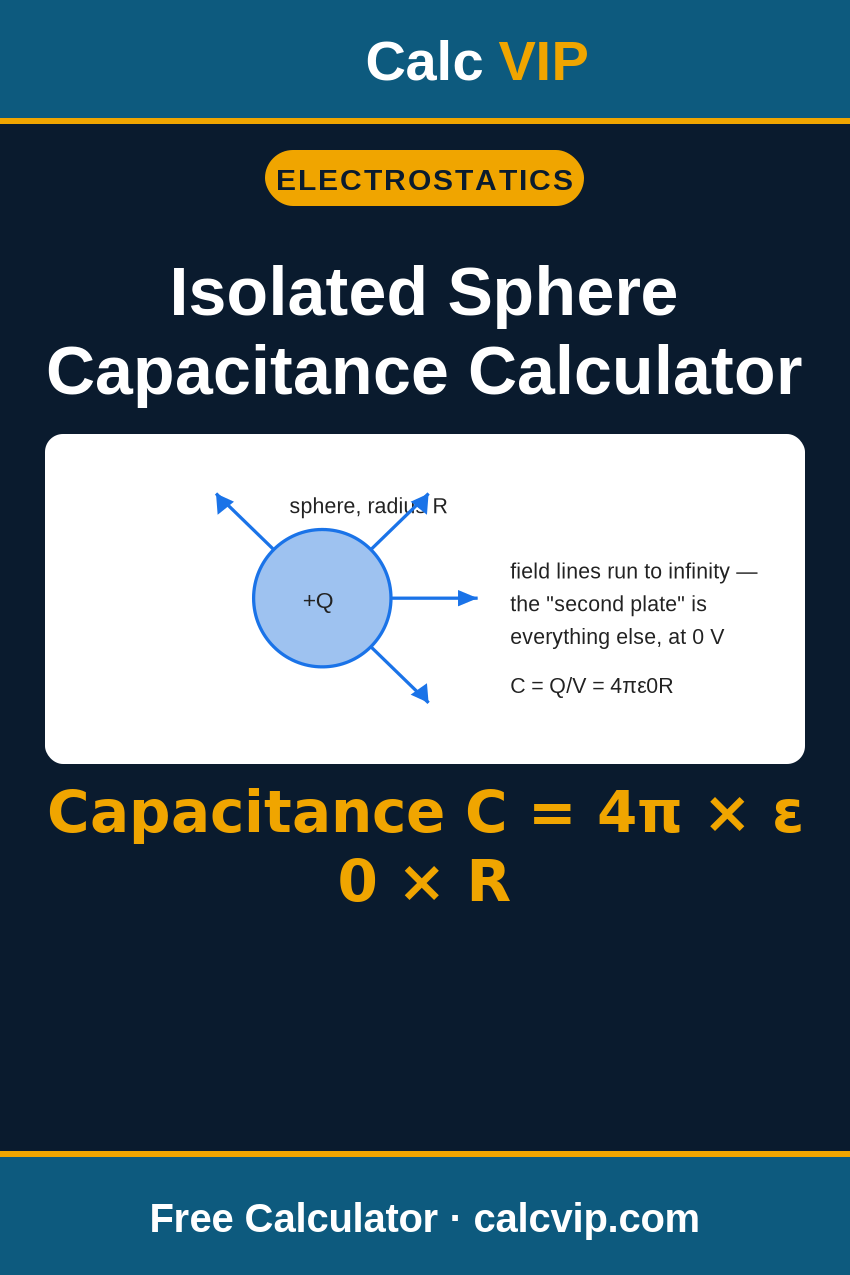
Small is not useless, though. The sphere is the one capacitance that can be computed exactly from first principles, which makes it the calibration object of electrostatics — and it is the working geometry of Van de Graaff terminals, high-voltage bushings, sphere gaps for measuring kilovolts, and the human body's capacitance in static-electricity standards. Enter a radius, optionally a voltage, and the calculator returns C in farads and picofarads, plus Q and U when V is given.
Formula
Capacitance C = 4π × ε0 × R • Charge Q = C × V • Energy U = ½ × C × V² • C in farads, R in metres, ε0 = 8.854 × 10⁻¹²
The derivation is two lines and worth owning. A sphere's surface potential is V = kQ/R with k = 1/(4πε0). Capacitance is Q/V, so C = Q ÷ (kQ/R) = R/k = 4πε0R — the charge cancels, leaving pure geometry. A rule of thumb falls out: 4πε0 = 1.113 × 10⁻¹⁰ F/m, so C in picofarads ≈ 111 × R in metres. A sphere's capacitance also caps its career: the surface field is E = V/R, so air breakdown (3 × 10⁶ V/m) limits the voltage to Vmax = 3 × 10⁶ × R — a ceiling the examples put to work.
| Symbol | Meaning | Units |
|---|---|---|
| C | capacitance of the isolated sphere | farads (F), usually pF |
| R | radius of the sphere | metres (m) |
| V | potential of the sphere relative to infinity | volts (V) |
| Q / U | charge held at V / energy stored in the field | coulombs / joules |
Where the energy lives: a sphere's field, integrated
The sphere makes an honest test-bed for the claim that energy lives in fields. Its field falls as kQ/r² from the surface outward, so the energy density u = ½ε0E² falls as 1/r⁴ — fiercely concentrated near the sphere, yet spread over all space. Integrating that density from R to infinity returns exactly U = Q²/(8πε0R) = ½CV²: every joule accounted for by empty space, none left in the metal. Half of it lies within a sphere of radius 2R — the energy hugs its source. This is why the "isolated" sphere is not really isolated from its surroundings: charge it, and you have rearranged the energy of the entire space around it, out to infinity.
The same geometry explains the sphere's role as the shape of high-voltage terminals. For a given potential, the surface field is E = V/R — bigger radius, gentler field. A Van de Graaff dome is a sphere (or near it) precisely because roundness is the cheapest way to buy voltage without corona: double the radius and you double both the capacitance and the breakdown voltage, a bargain no other shape offers so cleanly.
How to use
- Enter the sphere's radius R in metres — 10 cm is 0.1, a 25 cm dome is 0.25.
- Optionally enter a voltage V to see the charge and stored energy at that potential. Leave it blank if you only want C.
- Click "Calculate". The capacitance is reported in farads and picofarads — expect pF; farads would mean you have built a planet.
- Check the voltage against the corona ceiling: if V exceeds 3 × 10⁶ × R, a real sphere in air would leak charge by corona before reaching it.
- For two nearby spheres or a sphere near a wall, treat the answer as a starting estimate — neighbours raise the capacitance above the isolated value, which is the beginning of the sphere-gap story below.
Worked examples
Example 1 — the reference sphere. R = 0.1 m.
C = 4π × 8.854 × 10⁻¹² × 0.1 = 1.11 × 10⁻¹¹ F = 11.13 pF. At V = 1,000 V: Q = CV = 1.11 × 10⁻⁸ C and U = ½CV² = 5.56 × 10⁻⁶ J. A grapefruit-sized ball of metal, a thousand volts, five microjoules — electrostatics at its most honest.
Example 2 — a metre sphere at high voltage. R = 1 m, V = 10,000 V.
C = 1.11 × 10⁻¹⁰ F (111 pF); Q = 1.11 × 10⁻¹⁰ × 10⁴ = 1.11 × 10⁻⁶ C; U = ½ × 1.11 × 10⁻¹⁰ × 10⁸ = 5.56 × 10⁻³ J. Even a beach-ball terminal at 10 kV stores less energy than a falling snowflake's worth of warmth — high voltage, tiny capacitance, small joules.
Example 3 — the Earth itself. R = 6.371 × 10⁶ m.
C = 4πε0R = 7.09 × 10⁻⁴ F ≈ 709 µF. The entire planet is a sub-millifarad capacitor — yet at one volt it would hold 7.09 × 10⁻⁴ C, and the global atmospheric circuit, which keeps the ionosphere about 300 kV above the ground, works against this very capacitance.
Example 4 — a Van de Graaff dome at its ceiling. R = 0.25 m.
C = 2.78 × 10⁻¹¹ F (27.8 pF). Air breakdown caps its voltage at Vmax = 3 × 10⁶ × 0.25 = 750,000 V, where Q = CV = 2.78 × 10⁻¹¹ × 7.5 × 10⁵ = 2.09 × 10⁻⁵ C and U = ½CV² = 7.82 J — a respectable spark's worth, and the reason dome demonstrations crackle so impressively.
Example 5 — the human body as a sphere. Static-electricity standards model a person as about 100 pF. What sphere is that?
R = C ÷ 4πε0 = 100 × 10⁻¹² ÷ 1.113 × 10⁻¹⁰ = 0.90 m — an arm-span-sized sphere, a fair caricature of a standing adult. When you shuffle across a carpet to 10 kV, the discharge that bites the doorknob is this "sphere" emptying its ½CV² ≈ 5 mJ.
Example 6 — a millimetre sphere. R = 0.001 m at V = 100 V.
C = 1.11 × 10⁻¹³ F (0.111 pF); Q = 1.11 × 10⁻¹¹ C — which is 1.11 × 10⁻¹¹ ÷ 1.602 × 10⁻¹⁹ = 6.95 × 10⁷ electrons. Seventy million electrons sounds grand until you recall that a coulomb is 6 × 10¹⁸ of them: small spheres are charge misers.
Isolated spheres in real life
Van de Graaff terminals. Example 4 is the design brief: the dome's radius sets both its capacitance and its voltage ceiling, and the stored 7.8 J at full charge is the demonstration spark's entire budget. Bigger domes, higher voltages, longer sparks — radius is destiny.
Sphere gaps for voltage measurement. Two equal spheres at a set spacing spark at a voltage tabulated internationally — before precision dividers, this was the way to measure hundreds of kilovolts, exploiting the reproducibility of C and breakdown geometry together.
ESD standards and the human body. The 100 pF body model of Example 5 is written into the test standards for electronics handling: a charged person is a ~100 pF capacitor at kilovolts, and the discharge waveform into a device is computed from exactly this page's Q and U.
The global atmospheric circuit. Earth (709 µF) and the ionosphere form a spherical capacitor kept charged by thunderstorms worldwide; the fair-weather field of ~100 N/C is its slow leakage. The planet's weather runs, in part, on Example 3.
High-voltage bushings and terminals. Wherever a conductor must exit an earthed tank at high voltage, a rounded, sphere-like grading terminal spreads the field — the E = V/R rule applied to keep corona below threshold.
Kelvin's water-dropper and influence machines. Historic electrostatic generators charged isolated conductors whose capacitance is sphere-like; their voltages were read from the charge they could be made to hold, C = Q/V run backwards — the same measurement logic as the capacitance calculator's bench use.
Spheres in company: neighbours change the answer
The word "isolated" in this calculator's name is load-bearing. Bring a second conductor near — a wall, the Earth, another sphere — and the first sphere's capacitance rises, because the neighbour offers field lines a nearer home than infinity. Two spheres wired together share charge in proportion to their radii, as the FAQ describes, and each one's effective capacitance exceeds its lonely value. The effect is not a small correction in the real world: a Van de Graaff dome near its hall's walls and floor may carry tens of percent more capacitance than 4πε0R promises. A half-metre sphere makes a tidy reference point for the scale of things: alone in space it would have C = 55.6 pF and a corona ceiling of 3 × 10⁶ × 0.5 = 1.5 × 10⁶ V — a million and a half volts from a beach ball's bigger sibling, before the air around it gives up.
The ceiling: corona, and why spheres grow domes
An isolated sphere in air cannot be charged without limit, because its own surface field E = V/R rises with the voltage. At V = 3 × 10⁶ × R the surrounding air begins to break down — 300 kV for the 10 cm sphere of Example 1, where Qmax = CV = 3.34 × 10⁻⁶ C. Beyond the ceiling, charge leaks away as fast as it is supplied: the sphere becomes a corona source, hissing its surplus into the air. Every design response is in the formula — raise R (bigger, smoother domes), raise the breakdown field (pressurised or SF₆-filled enclosures), or accept the leak and use it, as corona-based ionisers do. The humble C = 4πε0R thus quietly governs the architecture of every high-voltage hall: those great polished mushrooms are this equation, inflated.
Quick reference: capacitance by radius
| Radius R | Capacitance C | Object of that size |
|---|---|---|
| 1 mm | 0.111 pF | a pinhead |
| 1 cm | 1.11 pF | a marble |
| 10 cm | 11.13 pF | a grapefruit |
| 25 cm | 27.8 pF | a Van de Graaff dome |
| 1 m | 111 pF | a beach-ball terminal |
| 6.371 × 10⁶ m | 709 µF | the Earth |
Strictly linear all the way from pinhead to planet: multiply the radius by ten, multiply the capacitance by ten. Sixteen orders of magnitude of radius buy only sixteen of capacitance — the slowest exchange rate in electrostatics. The Earth row deserves a pause: the largest conductor you will ever stand on is out-capacitied by a handful of the supercapacitors in a hybrid bus, which recalibrates any intuition that big must mean electrically capacious.
Common mistakes
- Using the diameter. The formula wants the radius. Feeding in the diameter doubles C — and halves the implied surface field, which can matter more than the capacitance error.
- Expecting microfarads from desktop objects. A sphere needs a 9 km radius for 1 µF. If your answer for a bench object comes out in µF, a unit has slipped — picofarads are the honest currency here.
- Forgetting that "isolated" is an assumption. Nearby walls, earth and other conductors all raise the capacitance above 4πε0R, sometimes severalfold. The formula is exact only for a sphere alone in space — a good estimate, not gospel, in a crowded room.
- Thinking C depends on the charge or voltage. C = 4πε0R is geometry only. Charge the sphere twice as much and V doubles in step; the ratio — the capacitance — never moves.
- Ignoring the corona ceiling. The calculator will happily report Q at a million volts for a 1 cm sphere, but air surrenders at V = 3 × 10⁶ × R = 30 kV for that sphere. Check the ceiling before believing the charge.
FAQ
How can one sphere be a capacitor — where is the second plate?
The "other plate" is infinity. Capacitance here means how much charge the sphere holds for each volt of its own potential, and a sphere's potential is V = kQ/R, which gives C = 4πε0R.
How big is the Earth's capacitance?
With R = 6.371 × 10⁶ m, C = 4πε0R ≈ 7.09 × 10⁻⁴ F — about 709 µF. That sounds large, but it is smaller than many electronic supercapacitors you can hold in your hand.
Why are isolated-sphere capacitances so small?
Capacitance grows only in direct proportion to radius. To reach even 1 µF with a lone sphere you would need a radius of about 9,000 km — bigger than the Earth. Practical capacitors instead use large areas and tiny gaps.
What is the capacitance of a sphere the size of a person?
About 100 pF, by the standards bodies' model — equivalent to a sphere of radius 0.90 m, as Example 5 shows. It is the number behind every "human body model" ESD test that electronics must survive.
Does the sphere have to be solid?
No. Charge lives on the outer surface of a conductor, so a hollow shell has exactly the same capacitance as a solid ball of the same radius. Van de Graaff domes are thin shells for this reason — the interior is free for machinery.
What if the sphere is buried in a dielectric?
Replace ε0 with ε0εr: C = 4πε0εrR. A sphere embedded in a material of εr = 4 has four times the vacuum capacitance — the surrounding medium does part of the field's work.
Why is the second plate "at infinity" rather than the Earth?
Formally, capacitance is defined against a zero of potential, and infinity is the natural zero for an isolated object. If the sphere is near the Earth or a wall, that conductor becomes an effective second plate and the capacitance rises — the isolated value is the floor, reached when everything else is far away.
How does a sphere's capacitance compare with a parallel-plate capacitor's?
The plate formula, C = ε0A/d, wins by geometry: area can be huge and d microscopic, while the sphere's "d" is effectively the distance to infinity. A 10 cm sphere (11 pF) is matched by plates of 0.01 m² separated by about 8 mm of air — and real capacitors then multiply that by foil area and thin dielectrics.
Can two spheres share charge predictably?
Yes — connect them with a wire and charge flows until their potentials equalise: Q₁/R₁ = Q₂/R₂, so the larger sphere takes the larger share, in proportion to radius. It is the cleanest demonstration that charge distributes by capacitance, and the historical route by which relative capacitances were first compared.
What limits the voltage on a small sphere in a vacuum?
Not the air — there is none — but field emission: at surface fields around 10⁷–10⁸ V/m the metal itself begins to spray electrons. Vacuum raises the ceiling roughly tenfold over air, which is why vacuum-insulated high-voltage gear can be more compact despite the sphere formula being unchanged.