 Calc
Prism Refractive Index Calculator – n from Prism Angle & Minimum Deviation
 Created by Rachel Novak · Senior Editor · All Topics · Last updated: November 2026
Use this free Prism Refractive Index Calculator to find the refractive index of a prism's material from the two angles measured in the classic spectrometer experiment: the prism angle A and the angle of minimum deviation δm. This is one of the most accurate everyday ways to measure n for glass.
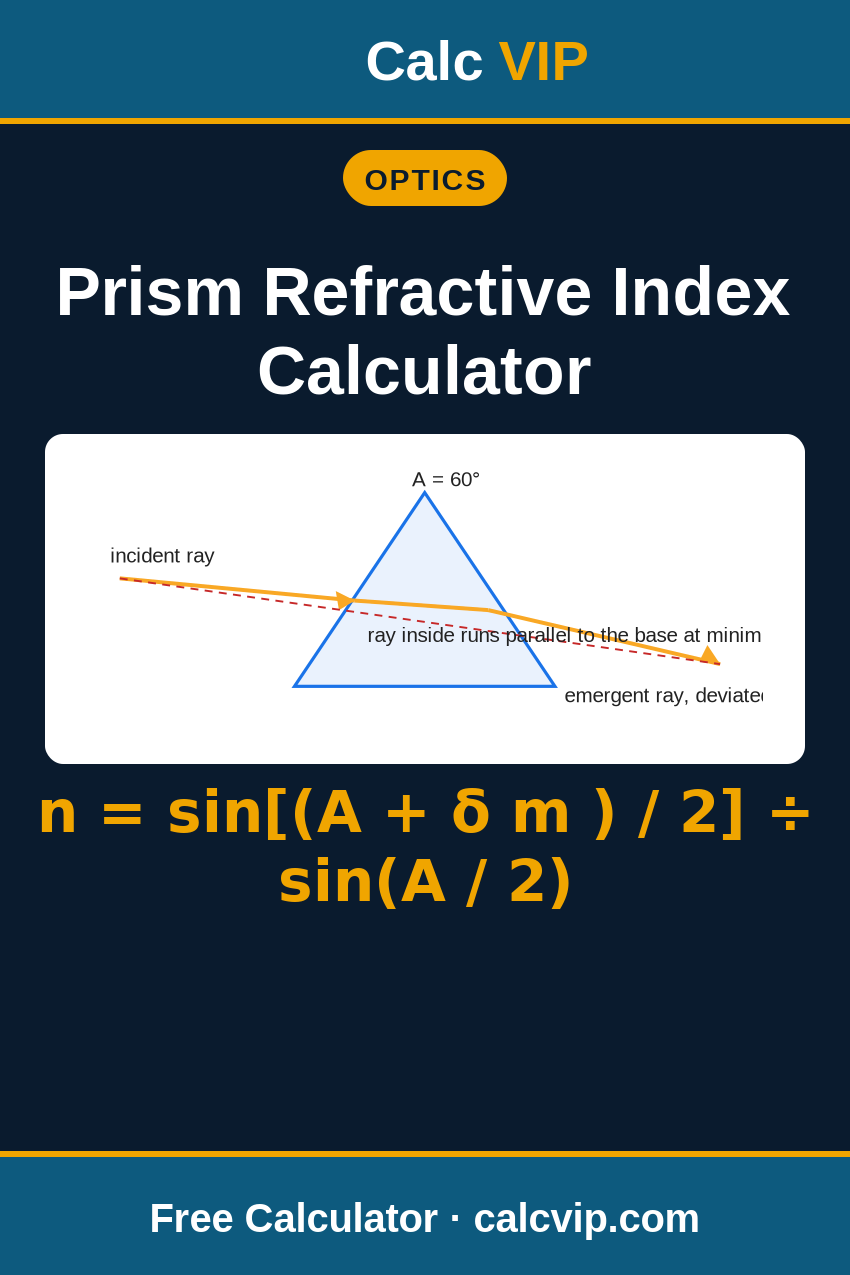
Hold a glass prism in a beam of light and the beam emerges bent — deviated — by an angle that depends on how the prism is turned. Rotate the prism slowly and the deviation shrinks, hesitates, and grows again: at one special orientation the bending is least, the angle of minimum deviation δm, and there the ray inside the prism is travelling exactly parallel to the base, entering and leaving symmetrically. That symmetry is a gift to measurement, because it collapses the two refractions into one clean formula connecting the deviation to the refractive index: n = sin[(A + δm)/2] ÷ sin(A/2). Two angle measurements — the prism's own angle A and the deviation at the turning point — identify the glass.
The experiment this calculator serves is one of the oldest precision measurements in optics, and it survives in every teaching laboratory for good reason: it is startlingly accurate. Angles on a spectrometer can be read to a minute of arc, and because the deviation is stationary at its minimum — barely changing as the prism turns near that point — the measurement is naturally armoured against the experimenter's small errors. Refractive indices to four significant figures come out of apparatus a nineteenth-century physicist would recognise, which is why glass catalogues still quote indices measured essentially this way.
There is also a spectrum hiding in the method. Run it with white light and there is no single δm: each colour deviates by its own amount, because n depends on wavelength. The prism formula therefore measures not just an index but a dispersion curve — n at red, n at yellow, n at blue — and the spread between them, quantified in the examples below, is the property that lens designers fight (as chromatic aberration) and spectroscope makers exploit (as resolution). One triangular piece of glass, two angles, and both numbers fall out.
Formula
n = sin[(A + δm) / 2] ÷ sin(A / 2) • rearranged: δm = 2 sin−1(n sin(A/2)) − A • thin-prism approximation: δ ≈ (n − 1) × A
At the minimum-deviation position the ray passes through the prism symmetrically — entering and leaving at equal angles — which makes the geometry collapse into this one clean formula. You find that position on a spectrometer by rotating the prism until the deviated image stops, turns around, and starts moving back; the deviation at the turning point is δm. The rearrangement predicts the deviation a known glass will produce (the design direction), and the thin-prism approximation — excellent for prism angles under about 10° — is the form ophthalmic optics uses for the weak prisms prescribed in spectacles, where deviation in "prism dioptres" is just 100 × tanδ.
| Symbol | Meaning | Units |
|---|---|---|
| A | refracting (apex) angle of the prism | degrees |
| δm | angle of minimum deviation | degrees |
| n | refractive index at the wavelength used | no units |
| δ | deviation at a general orientation | degrees; δ ≥ δm always |
Why a minimum exists at all
Turn a prism in a fixed beam and watch the deviation: steeply angled in one direction, the ray bends a lot; rotate towards symmetry and the bending relaxes; rotate past it and the bending grows again. The deviation curve has a floor, and the floor is at the symmetric passage. The intuition is that deviation is the sum of two bends, one at each face, and the total is least when the work is shared equally — the same reason a journey with a fixed total direction change is gentlest when split evenly. At symmetry the internal ray runs parallel to the base, each surface contributes δm/2 of bending, and Snell's law at a single surface, applied twice, assembles into the prism formula.
The minimum's flatness is its second gift. Because the deviation is stationary there — mathematically, its rate of change with prism angle is zero — a small mis-setting of the prism barely moves δ. Measurements cluster at turning points in physics for exactly this reason (the same trick times a pendulum at the bottom of its swing): nature provides a position where the quantity you want is insensitive to the quantity you cannot perfectly control. The formula is elegant; the minimum's stability is why the experiment built on it out-measured far more elaborate methods for two centuries.
How to use
- Enter the refracting angle of the prism A (60° for a standard equilateral prism).
- Enter the measured angle of minimum deviation δm for your light source — found on the spectrometer by rotating the prism until the image stops and turns back.
- Click "Calculate Refractive Index" to get n for that wavelength.
- For dispersion, repeat the measurement with different colours: each colour's own δm gives its own n, and the spread between red and blue values is the glass's dispersive character.
Worked examples
Example 1 — the standard measurement. A glass prism has angle A = 60°, and a spectrometer measures a minimum deviation of δm = 37.18°.
n = sin[(60 + 37.18) ÷ 2] ÷ sin(60 ÷ 2) = sin(48.59°) ÷ sin(30°) = 0.75 ÷ 0.50 = 1.50.
The prism is made of ordinary crown-type glass — and measuring δm separately for red and blue light would show n is slightly higher for blue, which is dispersion.
Example 2 — flint glass, run in reverse. A flint prism of A = 60° has n = 1.62. Predict its minimum deviation:
δm = 2 sin−1(1.62 × sin30°) − 60° = 2 sin−1(0.81) − 60° = 2 × 54.10° − 60° = 48.19°. Denser glass, dramatically larger deviation — and checking backwards, sin[(60 + 48.19)/2] ÷ sin30° = 1.62, as it must.
Example 3 — a smaller prism angle. A prism of A = 45° in the same crown glass as Example 1 (n = 1.50):
δm = 2 sin−1(1.50 × sin22.5°) − 45° = 2 sin−1(0.574) − 45° = 25.06°. Halving-ish the prism angle much more than halves the deviation — the relationship is sine-shaped, not proportional, which is why the thin-prism rule δ ≈ (n−1)A (giving 22.5° here) is only a small-angle friend.
Example 4 — dispersion measured. The Example 1 prism measured for two colours of its glass (nred = 1.51, nblue = 1.53):
δm,red = 2 sin−1(1.51 × 0.5) − 60° = 38.05°; δm,blue = 2 sin−1(1.53 × 0.5) − 60° = 39.81°. The spectrum fans out over 1.76° — small, but a spectrometer reads it easily, and that fan is the raw material of every prism spectroscope's resolving power.
Example 5 — a water prism. A hollow prism filled with water (n = 1.33), A = 60°:
δm = 2 sin−1(1.33 × 0.5) − 60° = 2 × 41.68° − 60° = 23.36°. Liquids are measured in hollow prisms exactly this way — fill, measure δm, and this calculator's formula returns the liquid's index, temperature permitting.
Example 6 — the thin prism of spectacles. A weak ophthalmic prism has A = 5° in glass of n = 1.50.
Exact: δm = 2 sin−1(1.50 × sin2.5°) − 5° = 2.50°. Approximation: δ ≈ (n − 1) × A = 0.5 × 5° = 2.50°. At small angles the two agree to two decimal places — which is why spectacle prisms can be prescribed with the simple rule and this calculator's full formula is reserved for the big glass triangles.
Prism measurements in real life
Glass manufacture and catalogues. Every optical glass in a catalogue carries an index measured to five decimal places, historically by minimum-deviation spectrometry on prisms cut from the melt. Lens designers trust those digits; the method of this page produced them.
Spectroscopy. A prism spectroscope is Example 4 with a telescope attached: the deviation fan sorts light by wavelength, and calibrating the instrument means running this formula for known spectral lines to map angle to colour.
Teaching laboratories. The spectrometer experiment remains the standard undergraduate measurement of n because it teaches three skills at once — vernier angle reading, the hunt for a stationary point, and error analysis — while delivering four-figure accuracy from brass-and-glass apparatus.
Liquid analysis. Hollow prisms turn the method on liquids: sugar solutions, oils and solvents are identified and concentration-checked by their indices, a tabletop cousin of the refractometer industry.
Ophthalmic prisms. Prisms prescribed for eye-alignment problems are thin prisms dosed by deviation — Example 6's approximation in clinical dress, with the "prism dioptre" (100 tanδ) as its unit.
Direct-vision spectroscopes. Cementing a crown prism to a flint prism apex-to-apex lets the two deviations oppose: sized correctly, the pair passes yellow light straight through while red and blue still fan out either side — a spectrum you can view looking directly at the source. The design arithmetic is this page's rearranged formula applied twice with opposite signs.
Testing diamond and gems. A diamond prism of A = 60° cannot even pass a symmetric ray — n sin(A/2) = 2.42 × 0.5 = 1.21 > 1, so the internal ray would strike the second face beyond its critical angle. Gem prisms use smaller angles: at A = 30°, δm = 2 sin−1(2.42 × sin15°) − 30° = 47.56°. The formula quietly dictates the shapes of the instruments themselves.
Quick reference: minimum deviation for A = 60° prisms
| Material | n | δm at A = 60° |
|---|---|---|
| water (hollow prism) | 1.33 | 23.36° |
| crown glass | 1.50 | 37.18° |
| crown glass (dense) | 1.52 | 38.93° |
| flint glass | 1.62 | 48.19° |
| diamond | 2.42 | no symmetric passage — see text |
The deviation grows faster than the index: from water to flint, n rises 22% while δm more than doubles — the sine geometry of the formula amplifying differences, which is precisely what makes the measurement so sensitive.
Dispersion and the Abbe number
Glass catalogues summarise Example 4's fan with the Abbe number, V = (nd − 1) ÷ (nF − nC) — the index at yellow (d) divided by its spread between blue (F) and red (C). Crown glasses score V ≈ 60 (gentle dispersion), flints V ≈ 36 (fierce). Lens designers pair one of each so the dispersions cancel while the refractions add — the achromatic doublet — and the pairing arithmetic starts from prism measurements of exactly the kind this calculator serves. The rainbow fan that delighted Newton is, in engineering hands, a specification to be measured, quoted and cancelled.
There is a pleasant symmetry in the story: the prism, the instrument that first revealed that white light is a mixture, became the instrument that measures the mixture's ingredients one wavelength at a time — and the formula on this page is the conversion key between the fan you see and the indices you publish.
Beyond the minimum: the deviation's full range
Minimum deviation is a floor, not the whole story. As the prism rotates from the symmetric position towards grazing entry, the deviation climbs steadily on both sides. Its ceiling for our n = 1.50, A = 60° prism comes at grazing incidence: the entering ray at 90° refracts to r₁ = sin−1(1 ÷ 1.50) = 41.81° inside, leaving r₂ = 60° − 41.81° = 18.19° at the second face, from which it emerges at sin−1(1.50 × sin18.19°) = 27.93° — a total deviation of 90° + 27.93° − 60° ≈ 57.9°. So this prism's deviation lives between 37.18° and about 57.9°, and every measured deviation inside that range corresponds to two prism orientations — one on each side of the minimum — which is why the turning point, where the two orientations merge into one, is the only unambiguous place to read it. Rotate further still and the internal ray strikes the second face beyond its critical angle: no emergent ray exists at all, and the prism goes dark in that direction — the same total-internal-reflection wall the gem example met head-on.
Common mistakes
- Measuring deviation away from the minimum. Any orientation other than the turning point gives δ > δm and an inflated n. The image must be watched while rotating: it stops, then reverses — that reversal point is the only honest reading.
- Using the base angle instead of the apex angle. A is the refracting angle between the two faces the light uses — 60° for an equilateral prism. Feeding a base angle of an isosceles prism (or the full 90° of a right-angle prism used differently) breaks the formula's symmetry assumption.
- White light for a precision reading. With white light there is no single deviation — each colour has its own δm. Use a sodium lamp or a laser line, and quote n with its wavelength.
- Applying the thin-prism rule to a fat prism. δ ≈ (n−1)A is a small-angle approximation: at A = 45° it already errs by over 2.5° (Example 3). Spectacle prisms may use it; 60° prisms may not.
- Assuming any prism can reach minimum deviation. If n sin(A/2) > 1 the symmetric ray cannot exit the second face at all — the diamond row of the table. The geometry must be possible before it can be measured.
FAQ
Why measure at minimum deviation specifically?
Two reasons: the formula becomes simple and exact at that symmetric position, and the measurement is sharp — because the deviation barely changes near the minimum, small errors in rotating the prism hardly affect the reading, so the result is very precise.
Does the answer depend on the colour of the light?
Yes. Refractive index depends on wavelength, so a sodium lamp (yellow, 589 nm) is the traditional standard source. White light would smear into a spectrum with a different δm for each colour — pretty, but useless for a single measurement.
Can I find the minimum deviation if I know n and A?
Rearrange the same formula: δm = 2 sin−1(n sin(A/2)) − A. For n = 1.50 and A = 60° that gives 2 × sin−1(0.75) − 60° = 37.18°, the example above in reverse.
How is the prism angle A itself measured?
On the same spectrometer: reflect the beam off both refracting faces in turn and read the telescope angles — the angle between the reflections is 2A. The instrument measures both inputs of this calculator in one sitting.
Why does the ray run parallel to the base at minimum deviation?
For an isosceles (including equilateral) prism, symmetry demands it: at the minimum the entry and exit are mirror images, so the internal ray must be perpendicular to the angle bisector — which is the direction parallel to the base. The formula's derivation leans entirely on that symmetry.
What accuracy can this method reach?
With a good spectrometer reading to a minute of arc, n comes out good to about ±0.001 in student hands and far better professionally — glass catalogues quote five decimals from refined versions of this very measurement.
Can the prism be too steep for the measurement?
Yes: if n sin(A/2) exceeds 1, the symmetric ray strikes the second face beyond its critical angle and cannot exit. Diamond at A = 60° fails this test (1.21 > 1); at A = 30° it passes, with δm = 47.56°.
What is a prism dioptre?
The clinical unit for thin prisms: a prism of 1 dioptre deviates light by 1 cm at 1 m, i.e. δ = tan−1(0.01) ≈ 0.57°. Example 6's 2.50° prism is about 4.4 prism dioptres — the conversion spectacle prescriptions are written in.
Why do textbooks insist on a monochromatic source?
Because n is a function of wavelength, a polychromatic beam has no single δm — the image smears into a spectrum and the "turning point" blurs. The sodium lamp's near-single yellow line is the traditional cure; lasers serve as well.
Is the deviation measured from the original direction?
Yes — δ is the angle between the emergent ray and the direction the light was travelling before it met the prism, which is why the dashed undeviated line in the diagram matters: it is the reference the spectrometer's direct reading provides.