 Calc
Single Slit Diffraction Calculator – Minima Angle & Central Maximum Width
 Created by Rachel Novak · Senior Editor · All Topics · Last updated: November 2026
Use this free Single Slit Diffraction Calculator to find where the dark fringes (minima) fall when light passes through one narrow slit — and, if you add a screen distance, how wide the bright central fringe is on the screen.
Block most of a beam of light, leaving only a narrow slit, and the light refuses to travel in the neat straight shaft that ray diagrams promise. It spreads. On a screen beyond the slit you find not a bright slit-shaped stripe but a pattern: a broad, intense central band flanked by alternating dark lines and much fainter bright bands, fading away symmetrically on both sides. That spreading is diffraction — the wave nature of light announcing itself whenever light is squeezed through an opening comparable to its own wavelength.
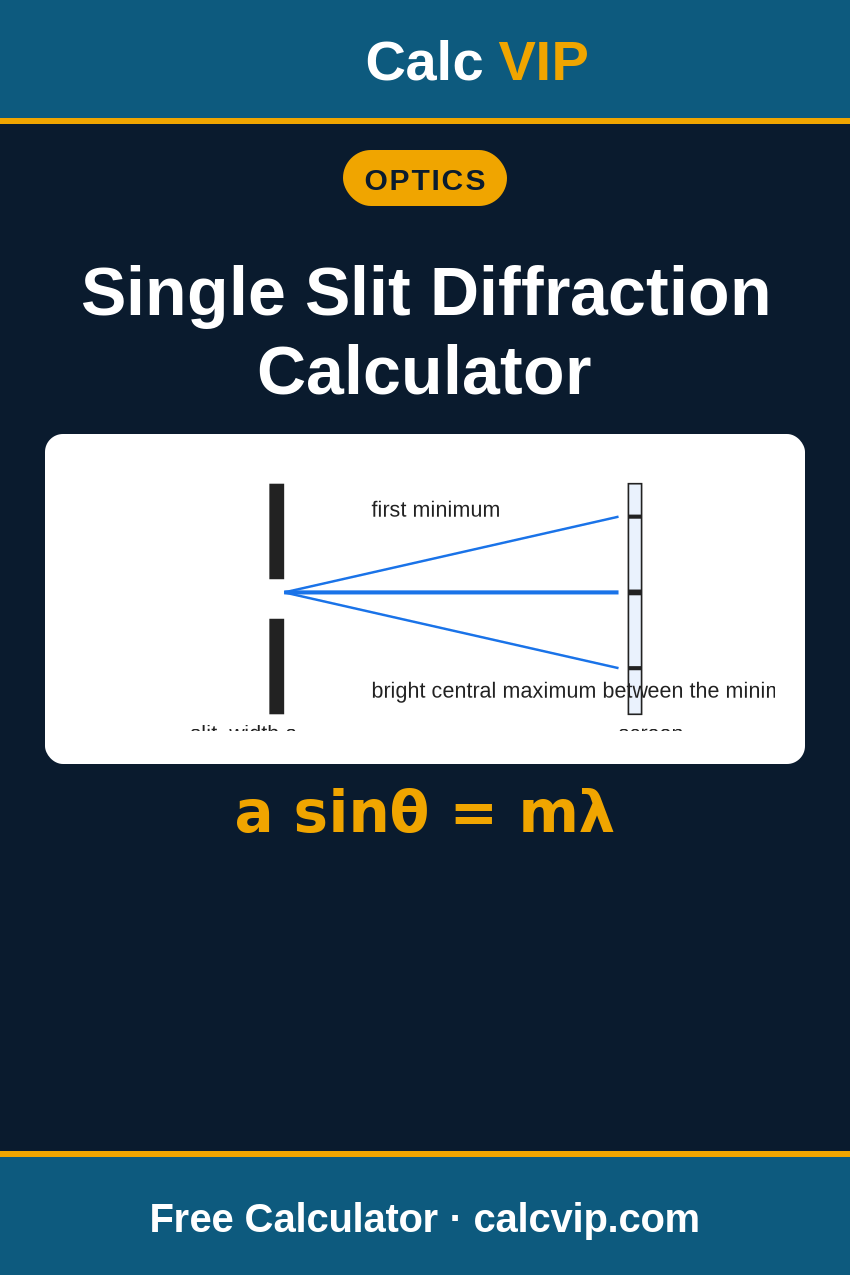
The pattern's geometry is governed by one ratio, λ/a: the wavelength divided by the slit width. The dark fringes — the minima — fall exactly where a sinθ = mλ, and the central bright band stretches between the two first minima, twice as wide as any other band and carrying the great majority of the light. Make the slit narrower and, counterintuitively, the pattern spreads wider: squeeze a wave harder and it protests more loudly. This calculator finds the minimum angles and, with a screen distance, the actual millimetres on the screen.
Single-slit diffraction is more than a laboratory curiosity. The same formula sets the sharpness limit of every camera, telescope and human eye — any aperture of width a blurs detail finer than about λ/a. The sections below derive the minima by a pairing argument you can follow ray by ray, work the standard bench examples, and show the formula at work in photography, astronomy and the resolution of your own vision.
Formula
Minima: a sinθ = mλ, so θ = sin−1(mλ / a) for m = 1, 2, 3… • a is the slit width and θ is measured from the straight-ahead direction
On a screen at distance L, the m-th minimum sits at y = L tanθ from the centre, and the bright central maximum — the band between the two first minima — has width 2λL / a. For the small angles of most setups tanθ ≈ sinθ ≈ θ in radians, so y ≈ mλL/a is an excellent shortcut. Note what the formula does not give: bright-fringe positions. The side maxima lie roughly halfway between minima but not exactly — only the minima are exact, which is why every serious measurement uses them.
| Symbol | Meaning | Units |
|---|---|---|
| a | slit width | m (calculator takes mm) |
| λ | wavelength of the light | m (calculator takes nm) |
| θ | angle of a minimum, from the centre line | degrees |
| m | order of the minimum (1, 2, 3, …) | no units |
| L | slit-to-screen distance | m |
| y | position of the minimum on the screen | m or mm |
Why the minima fall where they do: the pairing argument
Huygens' picture treats every point across the slit as a source of wavelets. Look at the light leaving at some angle θ. Pair each source in the top half of the slit with the source exactly a/2 below it in the bottom half. The lower source's wave travels an extra (a/2) sinθ to reach the screen. Choose θ so that this extra distance is exactly half a wavelength: every pair then arrives in perfect opposition — crest on trough — and cancels. When (a/2) sinθ = λ/2, that is a sinθ = λ, the entire slit cancels itself, pair by pair, and the screen is dark: the first minimum. Double the angle's sine and the same pairing with quarter-slit offsets cancels again at a sinθ = 2λ, and so on for every whole m.
The same argument explains the pattern's two famous features. At θ = 0 no pairing can cancel anything — all wavelets arrive in step, so the centre is brilliantly bright. And between minima, the cancellation is only partial: a modest fraction of the slit escapes pairing, its wavelets are not perfectly in step either, and intensity goes as the square of the surviving amplitude — leaving that band at only about 4.5% of the central brightness. Each successive side band is fainter still. The central maximum hogs the light because it is the one direction where the whole slit cooperates.
Notice the inversion at the heart of the formula: the pattern's scale is set by λ/a, so a narrower slit (smaller a) gives a wider pattern. Diffraction is the wave squeezing through and fanning out; the tighter the squeeze relative to the wavelength, the wider the fan. With a a thousand times λ, the fan is a thousandth of a radian wide and light seems to travel straight — ray optics is just diffraction too small to notice.
How to use
- Enter the slit width a in millimetres (a typical adjustable slit set to a hair's breadth is about 0.05–0.10 mm).
- Enter the wavelength λ in nanometres — 650 for a red laser, 532 for green, 589 for sodium light.
- Enter the minimum order m: 1 for the first dark fringe beside the central band, 2 for the next, and so on.
- Optionally add the screen distance L in metres to get the minimum's position on the screen and the width of the central maximum.
- Click "Calculate Minimum Angle". If the calculator reports that the minimum does not exist, mλ has exceeded a — the slit is too narrow (or the order too high) for that dark fringe to form.
Worked examples
Example 1 — the standard bench setup. Light of wavelength 600 nm passes through a slit 0.10 mm wide.
sinθ = (1 × 600 × 10−9) ÷ (0.10 × 10⁻³) = 0.006
θ = sin−1(0.006) = 0.34° for the first minimum.
With the screen 1.5 m away, that minimum lands y = 1.5 × tan(0.34°) = 9.00 mm from the centre, and the central bright band is 2λL/a = 18.00 mm wide.
Example 2 — halving the slit doubles the pattern. Same light (600 nm) and screen (1.5 m), but a = 0.05 mm.
sinθ = 600 × 10−9 ÷ (0.05 × 10⁻³) = 0.012, so θ = 0.69°.
y = 1.5 × tan(0.69°) = 18.0 mm, and the central maximum is 2λL/a = 36.0 mm wide — every dimension exactly double Example 1's, because a halved. λ/a runs the whole show.
Example 3 — a wider slit, a tighter pattern. a = 0.20 mm, λ = 500 nm, L = 2.0 m.
sinθ = 0.0025, θ = 0.14°; y = 5.0 mm; central width = 2λL/a = 10.0 mm. Doubling the slit width from Example 1 (and shortening λ a touch) shrank the pattern roughly four-fold.
Example 4 — a hair's breadth. a = 0.02 mm — the width of a fine human hair — with red light, λ = 650 nm.
sinθ = 650 × 10−9 ÷ (0.02 × 10⁻³) = 0.0325, θ = 1.86°. When the aperture is only about 30 wavelengths wide, diffraction is no longer a subtlety: the beam fans out by degrees. (By Babinet's principle, a hair itself casts this same pattern — see the applications.)
Example 5 — the second minimum of the standard setup. Example 1's slit and light, but m = 2.
sinθ = 2 × 600 × 10−9 ÷ (0.10 × 10⁻³) = 0.012, θ = 0.69°, landing at y = 18.0 mm on the 1.5 m screen — one full central-width from the centre, marking the outer edge of the first side band.
Example 6 — when diffraction all but vanishes. a = 1.0 mm, λ = 600 nm.
sinθ = 0.0006, θ = 0.034° — about two arc-minutes. A millimetre-wide beam of light spreads so little that for most purposes it travels straight: this is the regime where ray diagrams work and windows don't rainbow. Diffraction never switches off; it just shrinks below notice.
Single-slit diffraction in real life
The diffraction limit of cameras. A lens aperture is a two-dimensional slit, and it blurs every point of the scene into a small disc (the Airy disc, diameter 2.44λ × f-number). At f/8 in green light that disc is about 10.7 µm across — comparable to a few sensor pixels. Stop down to f/16 or f/22 and the disc doubles again, visibly softening photos: the sharpest aperture of most lenses is a compromise between aberration and this page's formula.
Measuring a hair. By Babinet's principle, an opaque fibre produces the same diffraction pattern as a slit of the same width. Shine a laser past a hair, measure the minima on a wall, and the calculator run backwards gives the hair's diameter — a standard school experiment that measures hundredths of a millimetre with a ruler.
Telescope resolution. A telescope's aperture diffracts starlight into discs; two stars closer than about λ/a (in radians) merge into one blob. This is why aperture is king in astronomy: doubling the mirror's width halves the diffraction angle and doubles the resolvable detail, quite apart from gathering more light.
Your own eyes. Daylight pupils of about 2 mm set a diffraction limit near λ/a = 550 nm ÷ 2 mm ≈ 2.8 × 10⁻⁴ rad ≈ 1 arc-minute — which is, not coincidentally, about the finest detail human vision resolves. Evolution sized the pupil's optics to its diffraction limit.
Sound through a doorway. The formula is wave-universal. Sound of wavelength 0.5 m meeting a 1 m doorway has λ/a = 0.5 — an enormous ratio — so it floods the whole next room. Light's λ/a through the same doorway is a billion times smaller, so light casts a clean shadow. One formula, two utterly different behaviours.
Laser pointers and beam spread. A laser's exit aperture is millimetric, so its beam diverges by roughly λ/a — a milliradian or so — no matter how perfect the optics. The spot on a distant wall is diffraction drawn large; narrower beams at the source always spread faster.
The resolution rule: no aperture beats λ/a
Generalise the first minimum and you get optics' most important rule of thumb: an aperture of width a cannot distinguish directions closer than about θ ≈ λ/a (radians). It is the single-slit minimum wearing a different hat — two sources closer than this have diffraction patterns that overlap into one. The rule prices every imaging system: the Hubble telescope's 2.4 m mirror at 550 nm resolves 550 × 10−9 ÷ 2.4 ≈ 2.3 × 10⁻⁷ rad ≈ 0.05 arc-seconds; a 10 m ground telescope is ten times finer in principle (and then the atmosphere interferes). Radio astronomers, cursed with wavelengths a million times longer, answer with apertures kilometres apart, synthesising a giant a. Whenever a specification promises resolution, divide λ by a and check the claim.
Half a slit: diffraction at a straight edge
Cover half the slit with an opaque edge and the pairing argument loses its partners: the pattern becomes a bright region that overshoots at the shadow's edge, rippling with fringes that fade into the lit side while the shadow side falls off smoothly. This straight-edge diffraction is why the shadow of a razor blade under laser light is fringed rather than clean, and why the Moon's shadow during a solar eclipse shows bands sweeping the ground just before totality. It is the same wave bookkeeping as this page's minima, run with half the accounts closed — a useful reminder that diffraction is not a property of slits, but of every boundary light ever meets.
Quick reference: first-minimum angle for 600 nm light
| Slit width a | First minimum θ₁ |
|---|---|
| 1.00 mm | 0.034° |
| 0.50 mm | 0.069° |
| 0.20 mm | 0.17° |
| 0.10 mm | 0.34° |
| 0.05 mm | 0.69° |
| 0.02 mm | 1.72° |
| 0.01 mm | 3.44° |
Every halving of the slit doubles the angle — the table is the λ/a law in its purest form. It also shows why diffraction belongs to the small: by the time a slit is a millimetre wide, a thousand wavelengths across, the effect has shrunk to arc-minutes.
Common mistakes
- Hunting for bright fringes with the minima formula. a sinθ = mλ locates the dark fringes exactly. The bright side bands sit roughly halfway between minima — close enough for sketches, wrong enough to fail a measurement. Measure minima, always.
- Expecting the central band to match the others. The central maximum spans two minimum-steps (−1 to +1) and holds most of the light; side bands are one step wide and start at 4.5% intensity. Drawing the pattern as equal stripes misrepresents both its geometry and its brightness.
- Predicting a narrower pattern from a narrower slit. The relationship is inverse: halve a and the pattern doubles. Intuition trained on shadows ("smaller hole, smaller spot") fails completely once the hole is within a few hundred wavelengths of λ.
- Unit collisions between a and λ. Millimetres and nanometres differ by a factor of a million. Converting both to metres before dividing — 0.10 mm = 1.0 × 10⁻⁴ m, 600 nm = 6.0 × 10⁻⁷ m — keeps sinθ a sensible small number instead of 600 or 0.0000006.
- Using degrees where the small-angle shortcut needs radians. y ≈ mλL/a works because tanθ ≈ θ with θ in radians. Plugging the degree value 0.34 into y = Lθ overstates positions by a factor of 57 — the calculator's exact tanθ route avoids the trap.
FAQ
Why does a narrower slit spread the light more?
The angle is set by λ/a. A narrower slit (smaller a) makes λ/a bigger, so the pattern spreads wider. Diffraction is only noticeable when the slit width is not much bigger than the wavelength.
Why is the central maximum twice as wide as the others?
The side maxima sit between consecutive minima, one "step" of λ/a apart. The central maximum stretches from the m = −1 minimum to the m = +1 minimum — two steps — so it is twice as wide and much brighter.
What if mλ/a is bigger than 1?
Then that minimum does not exist: the slit is so narrow (or the order so high) that the light spreads out smoothly instead. This calculator will tell you when it happens.
What does the pattern look like in white light?
The central maximum is white — all colours peak at θ = 0 together. The side bands are tinted spectra, blue on their inner edge and red on the outer, because each colour's minima sit at its own angle (θ grows with λ). Only the first side band shows the colours cleanly before they wash out.
Why is there no minimum at m = 0?
m = 0 in a sinθ = mλ would mean θ = 0 — but that is the direction where every wavelet arrives in phase and the slit reinforces completely. The centre is the brightest point of the pattern, the exact opposite of a minimum. The formula's minima begin at m = 1.
Can the slit be so narrow that no minimum exists?
Yes. If a < λ, then even m = 1 needs sinθ > 1, and the light spreads smoothly in all forward directions with no dark fringe at all — the slit has become a simple line source. The calculator flags this case instead of inventing an angle.
How can I measure a wavelength with a slit?
Run the formula backwards: λ = a y ÷ (m L) for a minimum measured on a screen. With a = 0.10 mm, L = 1.5 m and the first minimum at y = 9.0 mm, λ = (1.0 × 10−4 × 9.0 × 10−3) ÷ 1.5 = 6.0 × 10⁻⁷ m = 600 nm. It is one of the most accurate school measurements of anything.
Is a circular hole's pattern the same?
Nearly — a round aperture gives a central disc (the Airy disc) ringed by faint circles, with the first dark ring at sinθ = 1.22λ/D instead of λ/a. The 1.22 is the geometry tax for roundness, and it is the version that governs telescopes and cameras.
Why do the side bands fade so fast?
At each side maximum only a shrinking fraction of the slit escapes cancellation, and intensity follows the square of that surviving fraction: roughly 4.5% of the central peak for the first band, 1.6% for the second, and less than 1% beyond. The centre, with nothing cancelled, wins quadratically.
Does diffraction happen with a slit much wider than λ?
Yes, but squeezed into a tiny angle around the straight-through direction — the pattern is still there, just masquerading as a sharp shadow with fringed edges. Shine a laser through a wide slit and look closely at the shadow's edges: the fringes persist at any width.