 Calc
Refractive Index Calculator – Speed of Light in a Material n = c/v
 Created by Rachel Novak · Senior Editor · All Topics · Last updated: November 2026
Use this free Refractive Index Calculator to find how much a material slows light down. Either work out the refractive index n from the speed of light in the material, or find the speed of light in a material when you know its refractive index.
The refractive index is the single most important number in optics. It is a simple ratio — the speed of light in empty space divided by the speed of light in the material — yet from that one ratio flows almost everything light does inside matter: how much it bends at a surface, how shallow a swimming pool appears, why a diamond sparkles and a fibre-optic cable can guide a signal around a corner. Vacuum scores exactly 1, air almost exactly 1, water 1.33, ordinary glass about 1.50, and diamond, the champion of everyday materials, 2.42. The bigger the number, the slower the light and the more violently it changes direction at boundaries.
Nothing in the material grabs the light and drags on it like friction. Between atoms, light still travels at c; but the wave continually drives the material's electrons into oscillation, and those electrons re-radiate the wave with a slight delay. Delay piled on delay, atom by atom, makes the wavefront advance more slowly — the effect this calculator measures. It is a remarkable fact that a number you can look up in a table captures the combined behaviour of trillions of atoms.
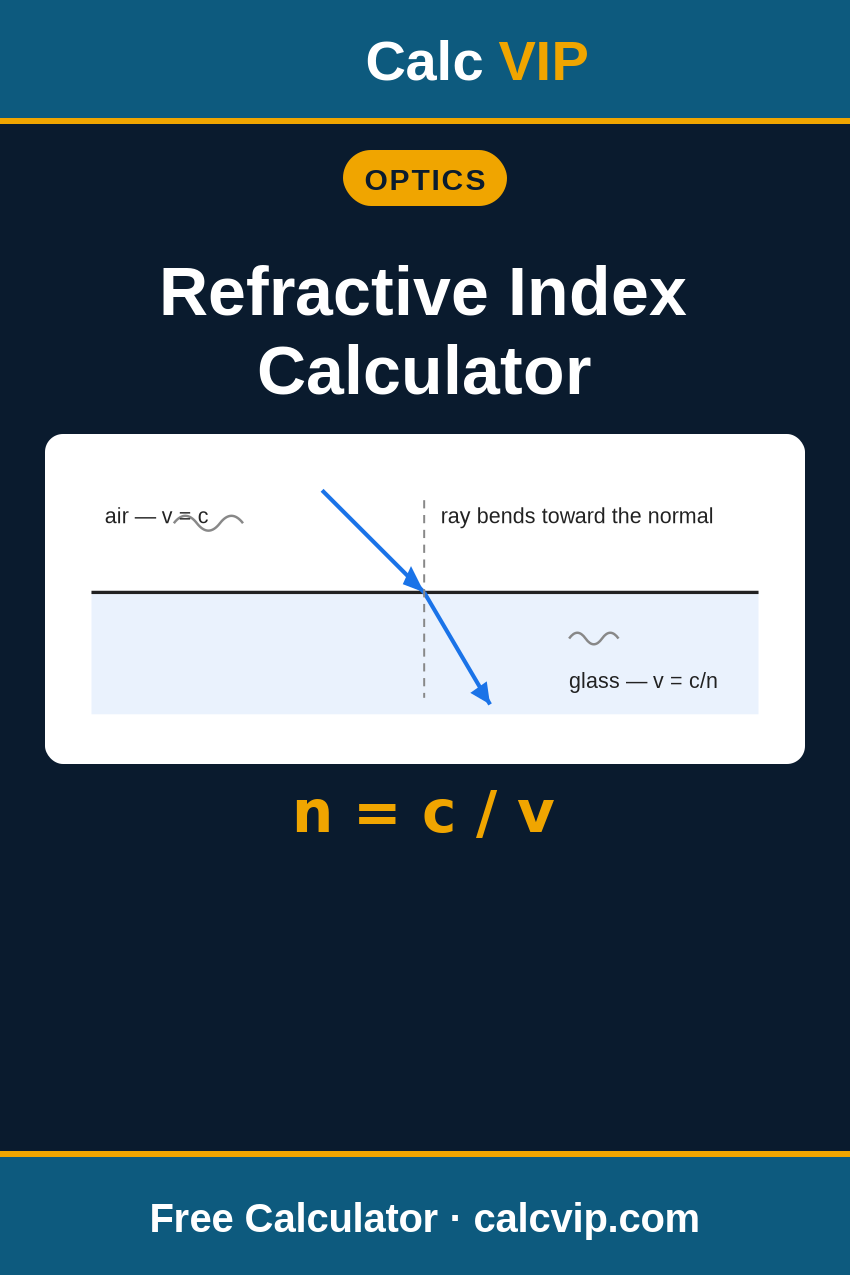
Because n is a ratio of two speeds, it has no units, and because c is the universe's speed limit, n can never drop below 1 for an ordinary material. Every lens, prism, raindrop and eyeball in your life works the way it does because its materials have the indices they do — change n and you redesign the instrument. The sections below show how to use the number, what it does to wavelength, and where it quietly runs everyday technology.
Formula
n = c / v • rearranged: v = c / n • c = 3.00 × 10⁸ m/s is the speed of light in a vacuum
The same index also rescales the wavelength: inside the material the wave slows but its frequency — set by the source — cannot change, so the wavelength is squeezed to λmaterial = λvacuum ÷ n. And n is the engine inside Snell's law, n₁ sinθ₁ = n₂ sinθ₂, which predicts exactly how far a ray bends at a boundary. One more rearrangement is worth memorising: the time light takes to cross a slab of thickness L is t = nL / c — the quantity nL is called the optical path length, and it is what interferometers actually measure. Common values to anchor your intuition: vacuum 1.00, air 1.00, water 1.33, glass 1.50, diamond 2.42.
| Symbol | Meaning | Units |
|---|---|---|
| n | refractive index — how much the material slows light | no units (a ratio) |
| c | speed of light in a vacuum | 3.00 × 10⁸ m/s |
| v | speed of light in the material | m/s |
| λ | wavelength (shrinks by the factor n inside the material) | m or nm |
Why light slows down — and why it bends
The slowdown is not a traffic jam. A light wave passing through glass sets the electrons in each atom oscillating, and oscillating charges radiate their own wave, very slightly delayed relative to the one that drove them. The original wave and the re-radiated waves merge into a single wave whose crests advance at c/n. The photons themselves — if you insist on the particle picture — still travel between atoms at c; it is the wave, the thing that carries direction and colour information, that dawdles.
Bending is the slowdown seen from the side. Imagine a wavefront arriving at a boundary at an angle, like a line of marching soldiers stepping from tarmac onto mud. The soldier who steps into the mud first slows first, while the rest of the line is still marching fast — so the whole line wheels around, changing direction. The denser the "mud" (the bigger n), the stronger the wheel. This is why the bending at a surface is not arbitrary: it is fixed by the ratio of the two speeds, which is exactly the ratio of the two indices in Snell's law.
A practical consequence hides in the wavelength formula. Green light of 530 nm in air keeps its frequency — and therefore its colour — in any material, but its wavelength becomes 530 ÷ 1.33 ≈ 398 nm in water and 530 ÷ 1.50 ≈ 353 nm in glass. Optical instruments are always specified by the vacuum (air) wavelength, even though the light does its real work squeezed inside glass — a convention worth remembering whenever thin films and interferometers enter the story.
How to use
- Choose what you want to find in the dropdown: the refractive index n, or the speed of light v in the material.
- If you chose n, enter the speed of light in the material in metres per second — you can type it in shorthand, for example 2e8 for 2.00 × 10⁸.
- If you chose v, enter the refractive index instead (1.33 for water, about 1.50 for glass, 2.42 for diamond).
- Click "Calculate" to get the other value.
- Sanity-check the result: n must come out at 1 or more, and v must come out at or below 3.00 × 10⁸ m/s — the calculator refuses anything faster than light.
Worked examples
Example 1 — the index of glass, and the speed in water. Light travels through a block of glass at 2.00 × 10⁸ m/s.
n = c ÷ v = (3.00 × 10⁸) ÷ (2.00 × 10⁸) = 1.50 — the standard value for glass.
The other way round: in water (n = 1.33), v = c ÷ n = (3.00 × 10⁸) ÷ 1.33 = 2.26 × 10⁸ m/s.
Example 2 — how slow is light in diamond? Diamond has n = 2.42.
v = c ÷ n = (3.00 × 10⁸) ÷ 2.42 = 1.24 × 10⁸ m/s — barely 41% of its vacuum speed. Light dawdles so much inside diamond that it struggles to escape, which is the secret of the gem's fire (see the critical-angle section below).
Example 3 — identifying a plastic. A pulse of light crosses a clear plastic block at a measured 1.90 × 10⁸ m/s.
n = c ÷ v = (3.00 × 10⁸) ÷ (1.90 × 10⁸) = 1.58 — matching polycarbonate, the plastic of safety glasses and unbreakable bottles. Measuring n is a genuine forensic tool for identifying unknown transparent materials.
Example 4 — light in ice. Ice has n = 1.31.
v = (3.00 × 10⁸) ÷ 1.31 = 2.29 × 10⁸ m/s. Ice is optically almost water's twin — no surprise, since it is the same molecules, only slightly less tightly packed.
Example 5 — the fibre-optic delay. A signal travels 1 km through a fibre core of n = 1.47.
t = nL ÷ c = (1.47 × 1000) ÷ (3.00 × 10⁸) = 4.9 microseconds, against 3.3 microseconds for the same kilometre in vacuum. The extra 1.6 µs per kilometre is real latency that network engineers budget for — refractive index, measured in microseconds, on every long-haul link.
Example 6 — a wavelength squeezed. Green light of wavelength 530 nm enters glass (n = 1.50). Its frequency is unchanged, so λglass = 530 ÷ 1.50 = 353 nm — numerically the wavelength of ultraviolet, yet the light is still green, because colour follows frequency, not wavelength. Inside water (n = 1.33) the same light measures 530 ÷ 1.33 ≈ 398 nm.
Refractive index in real life
Fibre-optic internet. A fibre guides light by total internal reflection, possible only because the core's index (about 1.47) exceeds the cladding's (about 1.46). That deliberate 0.01 difference traps the signal for tens of kilometres — and, as Example 5 showed, also sets the speed limit of your connection at about two-thirds of c.
Diamond's sparkle. Diamond's huge n = 2.42 gives it a critical angle of just 24.4° (worked out below), so light entering a well-cut stone bounces internally two or three times before exiting through the top — the brilliance and fire that cutters have optimised for centuries, all from one ratio.
Refractometers. Winemakers, beekeepers and mechanics all read n to measure concentration: the index of grape juice rises with sugar, of honey falls with water content, and of battery acid and coolant tracks their strength. A drop on a prism and a glance at the critical-angle shadow line gives the answer in seconds.
Microscope immersion oil. At high magnification, light leaving the slide into air bends so much that the finest detail escapes the objective. A drop of oil with n ≈ 1.52 — matched to glass — fills the gap, making slide and lens one optical block and recovering the detail.
Mirages and the lingering Sun. Air's index falls slightly as it warms, so over hot tarmac the air itself becomes a gradient of n that bends light upward — the shimmering "water" on a summer road. The same gentle bending lets you see the Sun for about two minutes after it has geometrically set.
Gem testing. A gemmologist's refractometer reads n directly off a stone's polished face: 1.77 says sapphire or ruby, 2.42 says diamond, 1.50 says glass imitation. Few measurements identify a material so quickly from so little evidence.
Total internal reflection: where the index sets a trap
Going from a dense material toward air, a ray bends away from the normal, and at one special incidence angle — the critical angle — the refracted ray would have to leave at 90°, skimming the surface. Beyond it, escape is impossible: the ray reflects completely back inside. The critical angle is set by n alone: sinθc = 1/n. For water, θc = sin−1(1 ÷ 1.33) = 48.8°; for glass, sin−1(1 ÷ 1.50) = 41.8°; for diamond, sin−1(1 ÷ 2.42) = 24.4°. The bigger the index, the narrower the escape hatch — which is why high-n materials trap light so effectively, and why fibre optics, binocular prisms and diamond cutting all live or die by this one angle.
One number per colour: dispersion
The index is not quite a single number even for one material: it depends slightly on wavelength. In crown glass, red light sees n ≈ 1.51 while violet sees n ≈ 1.53 — a small difference with outsized effects. It is why a prism fans white light into a spectrum (violet, slowed more, bends more), why cheap lenses fringe high-contrast edges with colour, and why the diamond's "fire" throws coloured flashes rather than plain white ones. Precision optics fights dispersion by pairing two glasses whose spreads differ; this page's calculator uses the standard mid-spectrum value, which is the right convention for everyday work.
Finding n from a single bend
You do not need a speed measurement to find n — one bend is enough, through Snell's law. Shine a ray into a semicircular glass block at an incidence angle of 60.0° and it refracts to 35.3° from the normal. Then n = sin(60.0°) ÷ sin(35.3°) = 0.866 ÷ 0.577 = 1.50. School laboratories have measured glass this way for a century, and the method is exactly the speed ratio in disguise: the sines compare how far the wavefront travels on each side of the surface in the same time. It also works in reverse — measure any two of n, incidence and refraction, and the third is fixed.
Quick reference: refractive indices and light speeds
| Material | n | Speed of light in it |
|---|---|---|
| vacuum | 1.000 | 3.00 × 10⁸ m/s |
| air (at sea level) | 1.000 | 3.00 × 10⁸ m/s |
| ice | 1.31 | 2.29 × 10⁸ m/s |
| water | 1.33 | 2.26 × 10⁸ m/s |
| ethanol | 1.36 | 2.21 × 10⁸ m/s |
| crown glass | 1.52 | 1.97 × 10⁸ m/s |
| flint glass | 1.62 | 1.85 × 10⁸ m/s |
| sapphire | 1.77 | 1.69 × 10⁸ m/s |
| diamond | 2.42 | 1.24 × 10⁸ m/s |
Read the table as a league table of light-slowing: every step down the list is a material whose electrons answer the wave a little more strongly — and whose surfaces bend light a little harder.
Common mistakes
- Dividing the wrong way. n = c/v is always the vacuum speed on top. Inverting it gives a number below 1 — an instant tell that the division went backwards, since ordinary materials never have n < 1.
- Using c inside a material. Once light is in glass or water its speed is c/n. Carrying 3.00 × 10⁸ through a glass problem overstates every speed and understates every travel time by the factor n.
- Treating n as a property of the light. The index belongs to the material (and slightly to the colour), not to the ray. The same beam has a different story in every material it crosses; the frequency is what travels with the light.
- Confusing optical density with mass density. The two often rise together but are not the same thing: ice floats on water yet their indices are close (1.31 vs 1.33), and dense flint glass owes its high n to lead atoms' strong response, not merely to its weight.
- Forgetting the wavelength shrinks too. In a medium, λ divides by n along with the speed. Thin-film and interferometer calculations that use the vacuum wavelength inside the material are wrong by exactly that factor.
FAQ
Can the refractive index be less than 1?
Not for ordinary materials. Since light can never travel faster than c in a vacuum, v is always less than or equal to c, so n is always 1 or more. Vacuum and (almost exactly) air have n = 1.
Why does a bigger n mean slower light?
The atoms in a denser material keep absorbing and re-emitting the light as it passes, which delays the wave. The bigger the refractive index, the more the light is delayed — and the more it bends at a boundary.
Does n depend on the colour of the light?
Yes, slightly. Blue light is slowed (and bent) a little more than red light in the same material. This spread of n with wavelength is called dispersion, and it is why a prism splits white light into a rainbow.
What is the refractive index of air?
About 1.0003 at sea level — so close to vacuum's 1.0000 that almost every calculation treats air as n = 1.00. The tiny difference is not always negligible, though: it is enough to bend starlight measurably near the horizon and to make mirages.
Which common material has the highest refractive index?
Diamond, at 2.42, among familiar transparent materials. Some semiconductors go higher in the infrared — germanium reaches about 4.0 — but they are opaque to visible light, so for anything you can see through, diamond leads.
How is refractive index measured in practice?
Usually with a refractometer: the sample contacts a prism of known high index, and the instrument finds the critical angle where light stops escaping — n follows from sinθc. Handheld versions need one drop of liquid and give readings in seconds.
Does temperature change the refractive index?
Yes, slightly. Warm a liquid and it expands, its molecules spread out, and n typically drops by a few ten-thousandths per degree. Precision refractometers are temperature-controlled for exactly this reason — and the same effect in air produces heat shimmer.
Why does the light bend at all when it enters glass?
Because it changes speed. A wavefront hitting the surface at an angle has one edge slowed before the other, so the front swings round — the marching-soldiers-stepping-into-mud picture. Snell's law, built from the two indices, gives the exact angle.
Is refractive index a unitless number?
Yes. It is a ratio of two speeds, so the units cancel. That is why the same table of n values works in any country and any unit system — one of the most portable numbers in physics.
Can light ever travel faster than c in a material?
No signal or energy can. The wave's phase can, in exotic circumstances, appear to move faster than c, but it carries no information at that speed. For every material on this page, v = c/n with n ≥ 1, and the calculator enforces it.