Calc
Pressure Head Calculator – Convert Pressure to Fluid Column Height
 Created by Elena Petrova · Physics Editor · Fluids & Rotation · Last updated: November 2026
Use this free Pressure Head Calculator to turn a pressure into the height of a fluid column that produces it. Enter the pressure and pick the fluid — the calculator works out the pressure head h, the height of liquid whose weight creates exactly that pressure.
Ask a pump engineer how much pressure a machine makes and she will often answer in metres: "thirty metres of head." It sounds like a dodge, but it is one of the most useful habits in fluid engineering. Pressure head restates a pressure as the height of a fluid column whose weight would produce it, h = P/(ρg). The reward for the translation is that head is a property of the energy in the fluid, not of the fluid itself: a pump that lifts water 30 m will lift any liquid 30 m (the pressure it must generate changes with density, but the head does not). Tanks, wells, water towers and barometers all think in head, and this calculator converts between the two languages.
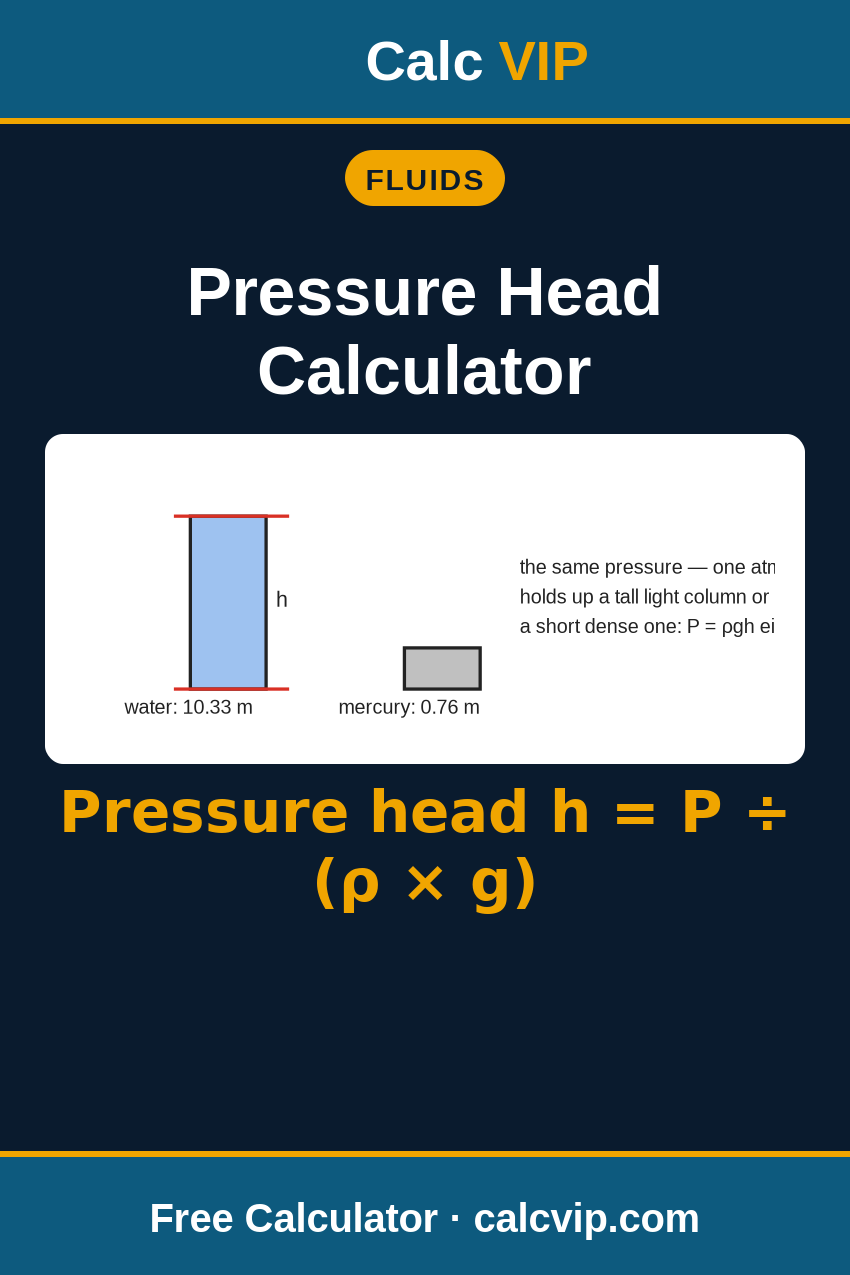
The idea is older than the pascal. Torricelli's barometer of 1643 was a head instrument: the atmosphere's pressure was reported as the height of the mercury column it could hold up — about 760 mm — and weather reports quoted "inches of mercury" for centuries afterwards. The same atmosphere, asked to hold up water instead, needs a column 10.3 m tall, which is why no suction pump on Earth can lift water more than about ten metres, a limit that frustrated well-diggers long before anyone could explain it. Head makes such limits visible at a glance: heights can be compared with the physical world — buildings, hills, the depth of a well — in a way that 101,325 Pa never can.
The calculator takes any pressure and any of four preset fluids — water, sea water, oil, mercury — or a custom density, and returns the head in metres and centimetres. Behind it sits the hydrostatic equation P = ρgh, the same relation that runs the dam, manometer and barometer pages of this site. Every conversion below, from tyre pressures to blood pressure, is that one equation read backwards.
Formula
Pressure head h = P ÷ (ρ × g) • h in metres (m), P in pascals (Pa), ρ in kg/m³, g = 9.81 m/s²
The hydrostatic equation rearranges both ways: P = ρ × g × h finds the pressure at the bottom of a column of known height — the form used for tank bottoms and dam faces — and ρ = P ÷ (g × h) identifies an unknown liquid from the pressure its column produces, which is how hydrometers and some density meters work. Because h = P/(ρg), head is inversely proportional to density: swap water for mercury (13.6 times denser) and the same pressure needs a column 13.6 times shorter — the entire principle of the barometer. A useful mental anchor: for water, 1 m of head is 9,810 Pa ≈ 0.0981 bar, so 10 m of water is almost exactly 1 bar, and 98,100 Pa is the pressure under a 10 m water column.
| Symbol | Meaning | Units |
|---|---|---|
| h | pressure head — equivalent column height | m (also cm) |
| P | pressure (gauge or absolute, matching the column) | Pa |
| ρ | fluid density | kg/m³ |
| g | gravitational acceleration, 9.81 | m/s² |
Head is energy in disguise
Divide the hydrostatic equation by ρg and something elegant appears: every term becomes a height, and each height is an energy per unit weight. Pressure head P/(ρg) is the energy stored by pressure; elevation head is the energy stored by height; velocity head v²/(2g) is the energy of motion. Bernoulli's principle is then one sentence: along a streamline the three heights add to a constant. This is why engineers draw "head" diagrams — a pump adds metres of head, friction subtracts metres of head, a turbine harvests metres of head — and why a pump's performance curve is plotted in metres regardless of the liquid. A centrifugal pump spinning at a given speed imparts the same head to water, petrol or brine; the pressures differ by the density ratio, but the machine neither knows nor cares.
Head also exposes a famous limit. A suction pump works by letting atmospheric pressure push liquid up an evacuated pipe — and the atmosphere's head of water is only 10.33 m. Subtract vapour pressure and friction and the practical limit is nearer 7–8 m, which is why deep wells use submersible pumps that push from below instead of sucking from above, and why tall trees, which pull water far higher, must work by an entirely different mechanism (tension in continuous water columns, not atmospheric push).
How to use
- Enter the pressure P in pascals (convert first if needed: 1 bar = 100,000 Pa; 1 kPa = 1,000 Pa; 1 psi ≈ 6,895 Pa).
- Pick the fluid from the list — water, sea water, oil or mercury — or choose "Custom density" and type ρ in kg/m³.
- Click "Calculate" to see the pressure head in metres and centimetres.
- Benchmark: 101,325 Pa (one atmosphere) in water must return about 10.33 m, and in mercury about 0.76 m. If it does not, the pressure was probably entered in bar or kPa by mistake.
Worked examples
Example 1 — ten metres of water. P = 98,100 Pa in water (ρ = 1000 kg/m³):
h = 98,100 ÷ (1000 × 9.81) = 10 m exactly. This is the pressure at the bottom of a 10 m tank, a 10 m dive, or a ten-metre standpipe — one number, three pictures.
Example 2 — the atmosphere in water. P = 101,325 Pa, water: h = 101,325 ÷ 9,810 = 10.33 m. The whole atmosphere presses on us with the weight of a ten-metre depth of water — and sets the absolute ceiling for every suction pump and drinking straw on the planet.
Example 3 — the atmosphere in mercury. The same P = 101,325 Pa in mercury (ρ = 13,600): h = 101,325 ÷ (13,600 × 9.81) = 0.76 m = 75.95 cm. Thirteen times denser, thirteen times shorter — the barometer fits on a desk because mercury does the atmosphere's bookkeeping in centimetres.
Example 4 — a booster pump. A pump adds 300,000 Pa (3 bar) to a water line: h = 300,000 ÷ 9,810 = 30.58 m. That is the extra height the pump can push water up a building — roughly ten storeys — which is exactly how pump datasheets in metres should be read.
Example 5 — one bar in sea water. P = 100,000 Pa in sea water (ρ = 1025): h = 100,000 ÷ (1025 × 9.81) = 9.95 m. Divers use this constantly: every ~10 m of descent adds about a bar, so at 30 m the absolute pressure is about 4 bar.
Example 6 — oil in a storage tank farm. P = 200,000 Pa in oil (ρ = 900): h = 200,000 ÷ (900 × 9.81) = 22.65 m. The same pressure corresponds to a taller column of the lighter liquid — the reason tank level gauges must be told which liquid they are measuring.
Pressure head in real life
Pump selection. Every centrifugal pump is sold with a head-versus-flow curve in metres. System designers add up the lift height plus friction (also expressed in metres of head) and pick the pump whose curve clears the total — density never enters the conversation until pressures for pipe ratings are needed.
Water towers. A tower 30 m above town supplies about 3 bar at ground level by gravity alone, and its height — not any pump — is what residents experience as "water pressure." The head is the product being stored.
Blood pressure. Medicine still quotes pressure in millimetres of mercury — a head unit from 1643. A reading of 120 mmHg is the pressure that supports a 120 mm mercury column: 120 × 133.3 ≈ 16,000 Pa, or about 1.54 m of blood.
Diving and submarines. Depth ratings are head by another name. Ten metres of sea water ≈ 1 bar, so a watch rated to "100 m" is claiming survival under about 10 bar of gauge pressure.
Manometers and level gauges. A U-tube or a sight glass on a tank reads head directly; converting that reading to pressure for an alarm or a control system is this calculator's division run in reverse.
Municipal water codes. Building codes specify minimum residual pressures at taps, often enforced as metres of head at the highest fixture — a direct survival of head thinking in modern regulation.
Gauge, absolute and the vapour-pressure catch
Head conversions inherit the reference of the pressure you feed them. A gauge pressure of 101,325 Pa in water is a head of 10.33 m above atmospheric; an absolute pressure of the same size is 10.33 m above a perfect vacuum. Tank and pump work is almost all gauge; barometer and cavitation work is absolute. Cavitation is where the distinction bites: a pump inlet must keep the local absolute head above the liquid's vapour-pressure head (0.24 m for cold water, but over 10 m for water near boiling) or the liquid boils into bubbles that collapse and chew the impeller. The "net positive suction head" on every pump datasheet is this calculator's output, compared against exactly that threshold.
Quick reference: familiar pressures as heads of water
| Pressure | In Pa | Head of water |
|---|---|---|
| 0.1 bar | 10,000 | 1.02 m |
| 1 atmosphere | 101,325 | 10.33 m |
| 1 bar | 100,000 | 10.20 m |
| typical home supply (3 bar) | 300,000 | 30.58 m |
| car tyre (2.4 bar gauge) | 240,000 | 24.46 m |
| 10 m under the sea | 100,553 (gauge) | 10 m of sea water |
The pattern to keep: for water, metres of head and tenths of a bar are nearly interchangeable (10 m ≈ 0.98 bar), which is why the two communities — pump people and pressure people — can talk past each other so fluently.
A complete head budget, worked end to end
Watch the three heads trade against each other in one realistic lift. A pump raises water from a well to a tank whose surface is 12 m above the well's; the pipe run wastes 8 m of head to friction at the design flow, and the water enters the tank at 3 m/s, a velocity head of 3² ÷ (2 × 9.81) = 0.46 m. The pump must supply the sum: 12 + 8 + 0.46 = 20.46 m of head. As a pressure at the pump, that is 1000 × 9.81 × 20.46 ≈ 200,700 Pa ≈ 2 bar — but notice that the pump's datasheet only ever promised the 20.46 m; the 2 bar is what that promise happens to be worth in water, and in a denser liquid the same pump would deliver the same 20.46 m at proportionally more pressure. This is the complete grammar of head: elevation spends it, friction taxes it, velocity carries it, and pumps mint it — all in metres, all convertible to pressure through this calculator whenever a gauge insists on pascals.
The units zoo: mmHg, torr, inches and psi as heads
Head thinking survives in disguise across the old unit systems, and this calculator is the translator. The millimetre of mercury is a head by definition: 1 mmHg = 133.322 Pa, so the 120 mmHg of a blood-pressure cuff is 15,999 Pa, a head of 15,999 ÷ 9,810 = 1.63 m of water. The torr is the same unit renamed. Inches of water gauge — the ventilation trade's favourite — prices Example-worthy small pressures: 1 inH₂O = 249 Pa. And the psi converts through pressure first (1 psi = 6,895 Pa) and then through head: a 30 psi tyre is a head of 30 × 6,895 ÷ 9,810 ≈ 21.1 m of water. Every one of these antiques is a column height wearing a name — Torricelli's barometer colonised the unit systems, and head is the native language they all still speak.
One conversion is worth memorising outright: 1 psi ≈ 0.703 m of water head (6,895 ÷ 9,810). A 32 psi car tyre is therefore a 22.5 m head — the pressure at the bottom of a seven-storey standpipe, carried in a rubber ring. Heads make pressures imaginable; that, in the end, is their whole profession.
Common mistakes
- Entering bar or kPa as if they were Pa. The calculator divides whatever you type by ρg. A 3-bar pump pressure typed as "3" returns a third of a millimetre. Convert to pascals first.
- Using the wrong fluid's density. Head depends on which liquid fills the imaginary column. The same pressure is 10.33 m of water but only 0.76 m of mercury — pick the fluid that matches the question.
- Mixing gauge and absolute pressure. A head computed from a gauge pressure is measured from atmospheric level, not from vacuum. For suction and cavitation questions the 10.33 m of atmosphere must be added or subtracted deliberately.
- Believing head depends on the container. It does not — only on depth and density. A standpipe the width of a straw shows the same head as a reservoir of the same depth (the hydrostatic paradox, below in the FAQ).
- Forgetting that pumps are rated in head, not pressure. A pump giving 30 m of head on water gives 30 m on petrol too — but only about 2.2 bar instead of 2.9 bar. Specifying the pump in bar for a different liquid undersizes or oversizes it.
FAQ
What is the difference between pressure and pressure head?
Pressure is force per unit area (Pa). Head is the same energy expressed as a height of fluid (m). Head is convenient for pumps and tanks because it does not depend on which liquid you pump.
How high is atmospheric pressure as a head of mercury?
101,325 ÷ (13,600 × 9.81) ≈ 0.759 m — about 760 mm of mercury, which is why barometers read around 760 mmHg at sea level.
Does the head depend on the shape of the container?
No. Hydrostatic pressure depends only on depth and density, not on the width or shape of the vessel — a narrow tube and a wide tank of the same depth give the same pressure at the bottom.
Why can't a suction pump lift water more than about 10 metres?
Because it is the atmosphere that does the lifting, pushing down on the well's surface — and the atmosphere's pressure is only worth 10.33 m of water head. Friction and vapour pressure cut the practical limit to roughly 7–8 m.
How many pascals is one metre of water head?
ρgh = 1000 × 9.81 × 1 = 9,810 Pa, just under 0.1 bar. Ten metres is 98,100 Pa ≈ 0.981 bar — close enough to 1 bar that the two are often interchanged in rough work.
What is velocity head?
The same bookkeeping applied to motion: v²/(2g), the height a moving fluid would climb if its kinetic energy turned into height. At 2 m/s it is only 0.20 m, but at 10 m/s it is 5.1 m — which is why fast flows carry serious pressure equivalents.
Why do pump curves use metres instead of bar?
Because a given pump at a given speed produces the same head in any liquid, while the pressure varies with density. Metres let one curve serve water, oil and brine; bar would need a new curve per fluid.
What head does a 30 m water tower give?
Thirty metres of head at its base, which as a pressure is 1000 × 9.81 × 30 ≈ 294,300 Pa ≈ 2.94 bar — before subtracting the elevation of the tap it feeds and friction in the pipes.
Is blood pressure really a head?
Yes — mmHg is literally the height of a mercury column the pressure can support. 120 mmHg ≈ 16,000 Pa. Medicine keeps the unit from the sphygmomanometer era, when the column was read off a glass tube by eye.
Does head change on the Moon?
The pressure under a column scales with g, so on the Moon (g ≈ 1.62 m/s²) one atmosphere would support a water column about six times taller — roughly 62 m. Head is a local-gravity concept; the same pump curve would need re-rating.