 Calc
Pressure Solver Calculator – Solve P = F/A for Pressure, Force or Area
 Created by Elena Petrova · Physics Editor · Fluids & Rotation · Last updated: November 2026
Use this free Pressure Solver Calculator to solve the pressure equation P = F/A for any one unknown. Enter any two of pressure, force and area, choose what to solve for, and the third value is calculated for you — handy for pistons, tyres, hydraulics and fluid problems.
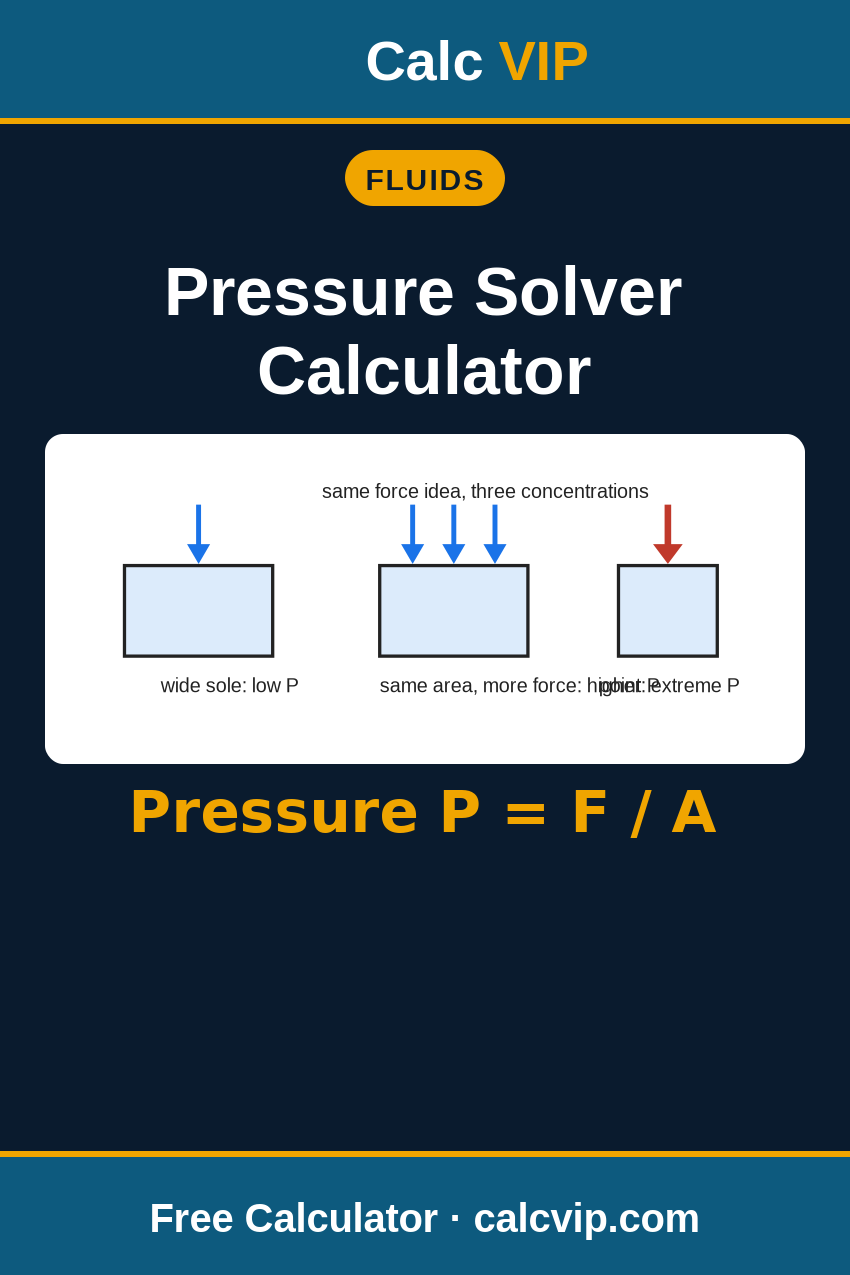
Pressure is what a force becomes when it meets a surface. The same push can be harmless or destructive depending entirely on how much area it is spread over: a person's weight resting on two flat soles barely dents snow, while the identical weight balanced on a stiletto heel punches through it. Pressure is the measure of that concentration — force divided by area — and P = F/A is one of the most heavily used equations in all of engineering, because almost every machine that pushes, lifts, seals, cuts or contains a fluid is, at heart, an arrangement for turning force and area into the pressure it needs.
The three quantities form a closed triangle: know any two and the third is fixed. That is why this page is a solver rather than a one-way calculator. Sometimes the pressure is the goal — how hard will this piston squeeze? Sometimes the force is — what load will this air pressure lift? And sometimes the unknown is the area — how wide must a foundation, a snowshoe or a seal be so that the pressure stays below a safe limit? Each question is the same physics wearing a different hat, and the mode selector above rearranges the equation for whichever hat you are wearing.
One habit separates reliable pressure calculations from wrong ones: unit discipline. The equation only balances when force is in newtons, area in square metres and pressure in pascals — and the world's favourite error is feeding it square centimetres. A square metre holds 10,000 square centimetres, so a cm² slipped into the area slot inflates or deflates the answer by four orders of magnitude while looking perfectly plausible. Convert first, calculate second; the sections below return to this trap more than once, because nearly every wrong pressure answer in homework and industry alike is a unit error in disguise.
Formula
Pressure P = F / A • P in pascals (Pa), F in newtons (N), A in square metres (m²)
The equation rearranges into its three working forms: P = F / A to find the pressure a force creates on an area, F = P × A to find the force a pressure exerts over an area, and A = F / P to find the area a force needs to stay at or below a chosen pressure. One pascal is one newton spread over one square metre — a very small pressure, roughly the weight of a banknote resting on a table — so everyday pressures are usually quoted in kilopascals (1 kPa = 1,000 Pa), bar (1 bar = 100,000 Pa) or megapascals (1 MPa = 1,000,000 Pa). This solver reports pressure in Pa, kPa and bar, and area in m² and cm².
| Symbol | Meaning | Units |
|---|---|---|
| P | pressure — force per unit area | Pa (also kPa, bar, MPa) |
| F | force applied perpendicular to the surface | newtons (N) |
| A | area over which the force is spread | m² (1 m² = 10,000 cm²) |
Pressure is not force — the distinction that designs the world
Force and pressure are casually used as if they were synonyms, and the confusion costs real understanding. Force is the whole push; pressure is how concentrated that push is. A hydraulic press and a child's hand can deliver the same force, but only the press — concentrating it through a small die — can stamp metal. Conversely, a huge force can be gentle: the atmosphere presses on a single square metre of your surroundings with a force of about 101,325 N, the weight of a small truck, yet spread evenly it is simply the pressure you live inside and never notice. Damage, cutting, sinking and sealing all respond to pressure, not force, which is why engineers quote one or the other with great care.
The inverse-square-like leverage of area is the practical heart of the matter. Halving the area doubles the pressure at no cost in force — the entire business model of knives, needles, nails, ice skates and snow plough blades. Doubling the area halves the pressure, which is the business model of snowshoes, tank tracks, wide foundations and the broad soles of camels' feet. Between those two strategies — concentrate to penetrate, spread to support — sits nearly every pressure decision in design, and all of them are this one division, run forwards or backwards.
How to use
- Choose what to solve for — pressure, force or area — from the "Solve for" menu; the two input boxes you need will be shown.
- Enter the two known values: force in newtons, area in square metres (divide cm² by 10,000), pressure in pascals (multiply kPa by 1,000, bar by 100,000).
- Click "Solve" to get the missing quantity, with pressure also expressed in kPa and bar.
- Sanity-check the size: a person standing is tens of kPa underfoot, a car tyre is a few hundred kPa, and anything in MPa involves either machinery or a very sharp point.
Worked examples
Example 1 — the piston (the calculator's reference case). A force of 500 N presses on a piston of area 0.02 m².
P = F / A = 500 ÷ 0.02 = 25,000 Pa = 25 kPa = 0.25 bar. Run backwards, the same numbers close the triangle: 25,000 Pa × 0.02 m² = 500 N, and 500 N ÷ 25,000 Pa = 0.02 m².
Example 2 — the stiletto versus the shoe. A 60 kg person weighs 60 × 9.81 = 588.6 N. Balanced momentarily on one heel tip of 1 cm² (0.0001 m²): P = 588.6 ÷ 0.0001 = 5,886,000 Pa ≈ 5.89 MPa — enough to dent wooden floors. Standing flat on a sole of 150 cm² (0.015 m²): P = 588.6 ÷ 0.015 = 39,240 Pa. Same person, same force, a 150-fold difference in pressure — area did all of it.
Example 3 — solving for force: a pneumatic press. Shop air at 200 kPa (200,000 Pa) drives a cylinder piston of area 0.05 m².
F = P × A = 200,000 × 0.05 = 10,000 N — a tonne of push from ordinary compressed air, which is why pneumatic tools feel so much stronger than the hand that holds them.
Example 4 — solving for area: snowshoes. A walker of weight 700 N needs the pressure on soft snow to stay below about 3,500 Pa or they sink.
A = F / P = 700 ÷ 3,500 = 0.2 m² of total shoe area — roughly two snowshoes of 0.1 m² each, which is exactly the size snowshoes are.
Example 5 — the knife edge. A cook presses a blade with a modest 50 N, but the edge contacts the food over perhaps 2 mm² (2 × 10⁻⁶ m²).
P = 50 ÷ (2 × 10⁻⁶) = 25,000,000 Pa = 25 MPa — comparable to industrial machinery, from one hand. Sharpness is just area made very, very small.
Example 6 — the invisible ocean of air. Atmospheric pressure, 101,325 Pa, acts on every surface. On 1 m² that is a force of 101,325 N — the weight of about 10,330 kg. On an outstretched palm of 0.01 m² it is still 1,013 N. You do not feel crushed because the same pressure pushes outwards from inside your body; pressure harms through differences, not through size alone.
Pressure in real life
Tyres. A car tyre at 220 kPa supports the car on four contact patches; the patch area grows until pressure × area equals the car's weight per wheel. Under-inflation enlarges the patch and flexes the sidewall — the physics behind both the warning light and the wasted fuel.
Hydraulics and pneumatics. Everywhere a fluid pushes a piston, F = P × A is the design equation: brake cylinders, digger arms, aircraft controls and the press that stamped the car's body panels all begin as a pressure and an area chosen to deliver a force.
Cutting and piercing tools. Needles, scalpels, ice skates and chisels are area-minimising machines. A hypodermic needle's tiny tip turns a thumb's gentle push into MPa pressures that part skin with barely a sensation of force.
Foundations and ground pressure. Buildings, tanks and cranes are limited by what soil can bear — often only 100–200 kPa. The area mode of this solver is the foundation engineer's first calculation: spread the load until the pressure fits the ground.
Weather and the body. The barometer's fall from 101 kPa towards 98 kPa is a pressure difference you feel in your ears on a mountain road; divers and pilots live by pressure differences of the same modest size.
Vacuum and packaging. Vacuum packing works because removing air lets the atmosphere's 101 kPa squeeze the bag; a suction cup holds because the pressure difference across its area — even a fraction of an atmosphere over 0.01 m² — is hundreds of newtons.
Gauge pressure and absolute pressure: which zero?
Most pressure gauges read zero in open air — they measure pressure above atmospheric, called gauge pressure. The pressure in the full physical sense, measured from a perfect vacuum, is absolute pressure, and the two differ by exactly one atmosphere: Pabsolute = Pgauge + 101,325 Pa. A tyre at "220 kPa" on the gauge is at about 321 kPa absolute. For P = F/A problems involving pistons open to the air on one side, gauge pressure is usually the right input, because the atmosphere pushes on both sides and cancels. For gas laws, weather and altitude, absolute pressure is the only honest number. Mixing the two is a quiet source of 100 kPa errors — worth a moment's thought before any calculation that involves a sealed gas.
Quick reference: familiar pressures
| Situation | Pressure |
|---|---|
| person standing flat (two soles) | ≈ 20–40 kPa |
| atmospheric pressure at sea level | 101,325 Pa ≈ 101.3 kPa |
| car tyre (gauge) | ≈ 220 kPa |
| bicycle tyre (gauge) | ≈ 400–600 kPa |
| stiletto heel, one foot | ≈ 5.9 MPa |
| pressure washer jet | ≈ 10 MPa |
| sea water 1,000 m down (ρgh) | ≈ 9.81 MPa |
Read as a ladder, the table carries the page's whole lesson: six orders of magnitude separate a standing person from a pressure-washer jet, and almost all of that range is achieved not by making forces bigger but by making areas smaller.
One more scale is worth memorising because it recurs everywhere in fluid work: a column of water 10 m tall presses its base with ρgh = 1,000 × 9.81 × 10 = 98,100 Pa — within 3% of one atmosphere and one bar. Divers, plumbers and pump engineers all carry this equivalence in their heads: 10 m of water ≈ 1 bar ≈ 1 atmosphere. It converts depth to pressure and back at sight, and it is the bridge between this solver and the head and barometer calculators elsewhere on this site.
Only the perpendicular part counts
A subtlety hides inside the letter F: pressure responds only to the component of force pressing straight into the surface, perpendicular to it. Push a box across a floor at a slant and part of your effort drives it forward while only the downward part adds to the pressure between box and floor. Formally, if a force F lands at an angle θ from the perpendicular, the pressing component is F cosθ and the pressure is F cosθ / A. At 45° the pressure falls to about 71% of the head-on value; at 90° — a force sliding exactly along the surface — it contributes no pressure at all, only friction. This is why a chisel struck at a glancing angle skates instead of bites, why rain slanting in a gale stings less per drop on a wall than on a roof, and why engineers analysing inclined dam faces and aircraft wings always resolve the force before they divide by the area.
The same rule explains a fluid's behaviour from the other side. A static fluid cannot sustain any sideways push at all — leave a sideways component unbalanced and the fluid simply flows until it vanishes. What remains is a purely perpendicular push on every surface the fluid touches, equal in all directions at a point. That is why P = F/A works so cleanly for hydraulics and gases: nature has already done the resolving. In solids the sideways component survives as shear stress, a different quantity with its own equations; the normal component divided by area is what this page — and every pressure gauge ever built — is measuring.
Common mistakes
- Feeding in cm² instead of m². The classic. 0.02 m² is 200 cm²; typing 200 into the area box makes the pressure 10,000 times too small. Divide cm² by 10,000 before entering.
- Using mass where force belongs. P = F/A wants newtons. A 60 kg mass presses with 60 × 9.81 = 588.6 N. Skipping the ×9.81 understates every pressure by nearly a factor of ten.
- Dividing by diameter instead of area. For a round piston the area is πD²/4, not D. A 0.2 m piston has area 0.0314 m² — using 0.2 m instead overstates the force six-fold.
- Mixing gauge and absolute pressure. Tyre and boiler gauges ignore the atmosphere; physics formulas for gases do not. Decide which zero your problem uses before typing numbers.
- Expecting pressure to depend on the container's total size. In fluids, pressure at a depth depends on depth and density, not on how wide the tank is — a narrow standpipe and a reservoir at the same level press their bases identically per unit area.
FAQ
What is the SI unit of pressure?
The pascal (Pa). 1 Pa = 1 newton per square metre. Larger pressures are usually quoted in kPa (1,000 Pa) or bar (100,000 Pa).
Why does area matter so much?
Pressure depends on how concentrated the force is. Halving the contact area doubles the pressure for the same force, which is how hydraulic presses and nail points work.
Can this solve for force and area too?
Yes — the mode selector rearranges P = F/A so you can find whichever of the three quantities is missing.
How do I convert between Pa, kPa, bar and psi?
1 kPa = 1,000 Pa; 1 bar = 100,000 Pa = 100 kPa; 1 psi ≈ 6,895 Pa. The solver's pressure mode reports Pa, kPa and bar directly; divide Pa by 6,895 for psi.
What pressure does a car exert on the road?
Roughly its tyre pressure — about 220 kPa — because the contact patch grows or shrinks until patch pressure balances. The car's weight decides the patch's size, not its pressure.
Why don't snowshoes make you lighter?
They change nothing about your weight (force); they spread it over about ten times the area, cutting the pressure below what the snow's surface can bear — Example 4 above is the design calculation.
Is pressure a vector like force?
No. Pressure is a scalar — it has size but no direction of its own. In a fluid it pushes equally in all directions at a point; the force it creates on a surface points perpendicular to that surface, with size P × A.
How much pressure is in a pressure cooker?
Typically about 100 kPa above atmospheric (gauge) — roughly a second atmosphere — which raises water's boiling point to about 120 °C and cooks food faster. The lid's clamps are an F = P × A design problem.
Can pressure be negative?
Absolute pressure cannot go below zero (a vacuum). Gauge pressure can be negative — suction — down to −101 kPa at sea level, a perfect vacuum on the gauge. Liquids under tension are a rare laboratory exception.
Why does a sharp knife go dull-feeling long before it looks worn?
Dulling rounds the edge, multiplying its contact area. Ten times the edge area means a tenth of the pressure for the same push — the knife has not lost force, it has lost concentration.