 Calc
Three Charges Force Calculator – Net Force on the Middle Charge
 Created by Rachel Novak · Senior Editor · All Topics · Last updated: November 2026
Use this free Three Charges Force Calculator to find the net force on the middle charge when three point charges sit on a straight line. The two outer charges each push or pull the middle one, and the calculator adds the two forces with their directions. Charges are tiny, so you can type them in scientific notation — for example 2e-6 means two microcoulombs.
Two charges are a formula; three charges are a story. The moment a third charge joins the line, the question changes from "how strong is the force?" to "which way does the middle charge go — and does it go anywhere at all?" Each outer charge acts on the middle one independently, by Coulomb's law, as if the other were not there: that independence is the superposition principle, and the net force is the honest vector sum of the two private forces. Because the charges are confined to a line, the vectors are one-dimensional — right or left — and the contest is decided by sizes and distances in a tug-of-war you can compute exactly.
The drama is in the inverse square. A charge twice as big but twice as far away does not tie the contest — it loses four-to-one on distance while winning two-to-one on size, for a net loss of two-to-one. Position is power in electrostatics, and the middle charge's fate is usually sealed by whichever neighbour is closest, not whichever is largest. Yet the balance can be exact: there is always a spot between two like charges where the pushes cancel to nothing, and finding it — by sliding the middle charge until the calculator reads zero — is one of the classic exercises of the subject, with the equilibrium's instability as its sting.
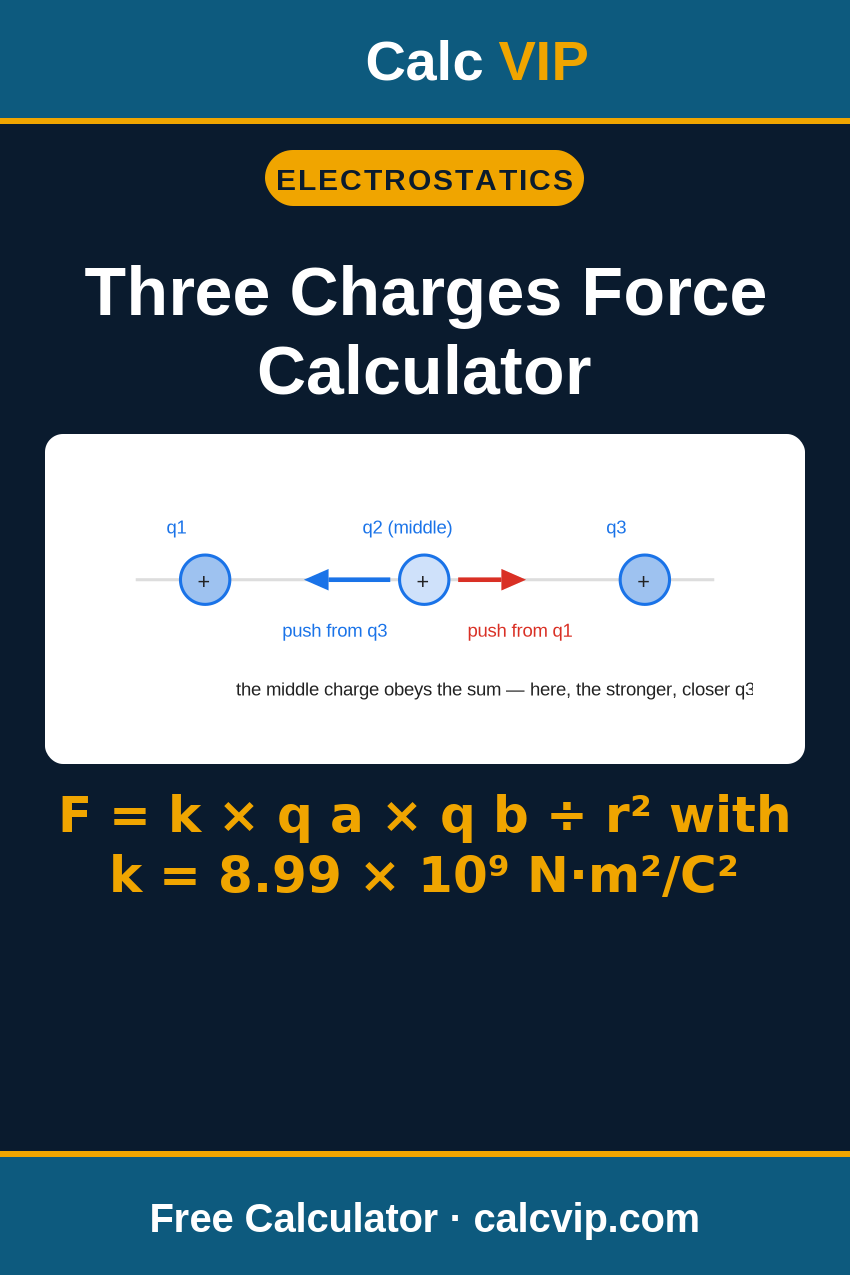
This calculator evaluates both forces on the middle charge separately, with their directions, then the net. It accepts charges and positions in any order and with any signs, so it handles attraction as readily as repulsion, and outer charges of opposite sign — the case where both forces point the same way and reinforce — as readily as the tug-of-war. The sections below build the intuition: superposition, the balance condition, and why an equilibrium found this way can never be a resting place.
Formula
Each force comes from Coulomb's law, F = k × qa × qb ÷ r² with k = 8.99 × 10⁹ N·m²/C², and the two forces on the middle charge add as vectors along the line:
Fnet = F from q1 + F from q3 • F in newtons (N), charges in coulombs (C), positions in metres (m), right taken as positive
Written out with positions, the force on q2 from a charge qa at xa is F = k × qa × q2 × (x2 − xa) ÷ |x2 − xa|³ — a form that looks fussier than Coulomb's law but simply encodes "magnitude kqaq2/r², direction away from qa if the charges' signs match, towards it if they differ". Like charges repel, opposite charges attract, and the signs work the directions out automatically. Two rearrangements earn their keep: the balance condition q1 ÷ (x2 − x1)² = q3 ÷ (x3 − x2)² locates the zero-force point between like charges, and F = q2 × E connects the answer to the field the outer charges create at q2's position — the Midpoint Field calculator's E, when q2 sits centrally, times q2 is this page's force.
| Symbol | Meaning | Units |
|---|---|---|
| Fnet | net force on the middle charge q2 | newtons (N) |
| q1, q2, q3 | the three charges (signs included); q2 is the one acted on | coulombs (C) |
| x1, x2, x3 | their positions on the line | metres (m) |
| k | Coulomb constant, 8.99 × 10⁹ | N·m²/C² |
| r | a pair's separation, |x2 − xa| | metres (m) |
Superposition: each pair minds its own business
The deep fact under this calculator is that the force between q1 and q2 is exactly what it would be if q3 did not exist. Charges do not shield each other, negotiate, or share influence; every pair in the universe runs its own Coulomb calculation and the results simply add. This is why electrostatics scales from three charges to the 10²³ of a real object without new ideas — only more terms. It is also why the calculator can be checked pair by pair: each reported force must match a two-charge Coulomb computation with the correct distance and the direction the signs demand.
The tug-of-war's asymmetry follows from the addition rule for ratios. The middle charge sits still when q1/r1² = q3/r3², i.e. when the charges stand in the ratio of the squared distances. A charge four times larger must be twice as far away to tie; nine times larger, three times as far. Square-root thinking locates every balance point in this subject: x divides the line in the ratio √q1 : √q3, measured from the respective charges. Example 5 puts numbers on it — a 9 µC and a 1 µC balance a test charge three-quarters of the way towards the smaller one.
Notice what the balance condition leaves out: q2 itself. The middle charge's size scales both forces equally, so it cancels — a balance point is a property of the two outer charges and the geometry alone, a null in their combined field. Any test charge placed there, large or small, positive or negative, feels nothing. That is why physicists speak of the null point rather than of balanced charges: the location belongs to the field, and q2 merely reports it. Change q2's sign and both forces flip together, preserving the zero; change its size and both grow together, preserving the ratio.
How to use
- Enter all three charges in coulombs — scientific notation like 2e-6 works fine. Use a minus sign for a negative charge.
- Enter each charge's position on the line in metres. q2 should sit between q1 and q3 (positions may be in any order, but no two charges can share a position).
- Click "Calculate" to see the force from each outer charge and the net force on q2, with its direction.
- Read the two component forces before the net: they show the tug-of-war itself — which neighbour dominates, and whether the forces fight or reinforce.
- To find a balance point, hold q1 and q3 fixed and nudge x2 until the net force reads zero; the ratio rule (distances ∝ √q) predicts where you will land.
Worked examples
Example 1 — the reference tug-of-war. q1 = 2 × 10⁻⁶ C at x = 0, the middle charge q2 = 1 × 10⁻⁶ C at x = 0.3 m, and q3 = 4 × 10⁻⁶ C at x = 0.5 m.
Force from q1 (repels q2 to the right): 8.99 × 10⁹ × 2 × 10⁻⁶ × 1 × 10⁻⁶ ÷ 0.3² = 0.1998 N →
Force from q3 (repels q2 to the left): 8.99 × 10⁹ × 4 × 10⁻⁶ × 1 × 10⁻⁶ ÷ 0.2² = 0.899 N ←
Net force = 0.899 − 0.1998 = 0.699 N to the left — q3 is bigger and closer, so its push wins.
Example 2 — an exact balance. q1 = 1 × 10⁻⁶ C at 0, q2 = 1 × 10⁻⁶ C at 0.2 m, q3 = 4 × 10⁻⁶ C at 0.6 m. From q1: 8.99 × 10⁹ × 10⁻¹² ÷ 0.2² = 0.2248 N right. From q3 (0.4 m away): 8.99 × 10⁹ × 4 × 10⁻¹² ÷ 0.4² = 0.2248 N left. Net = 0 N — the fourfold charge at twice the distance exactly ties, as the square-ratio rule promises.
Example 3 — a negative middle charge flips everything. Repeat Example 1 with q2 = −1 × 10⁻⁶ C. Both outer charges now attract q2 instead of repelling it: q1 pulls it left with 0.1998 N, q3 pulls it right with 0.899 N, and the net is 0.699 N to the right — Example 1's answer with its direction reversed, because flipping q2's sign flips every force it feels.
Example 4 — outer charges of opposite sign reinforce. q1 = +3 × 10⁻⁶ C at 0, q2 = +1 × 10⁻⁶ C at 0.25 m, q3 = −2 × 10⁻⁶ C at 0.75 m. q1 repels q2 rightwards: 8.99 × 10⁹ × 3 × 10⁻¹² ÷ 0.25² = 0.4315 N. q3 attracts q2 — also rightwards: 8.99 × 10⁹ × 2 × 10⁻¹² ÷ 0.5² = 0.0719 N. Net = 0.503 N to the right: when one neighbour pushes and the other pulls, the middle charge gets both.
Example 5 — placing the balance point deliberately. q1 = 9 × 10⁻⁶ C at 0 and q3 = 1 × 10⁻⁶ C at 0.8 m. The balance condition puts q2 where 9/x² = 1/(0.8 − x)², i.e. 3/x = 1/(0.8 − x), giving x = 0.6 m. Set q2 = 1 × 10⁻⁶ C there: from q1, 8.99 × 10⁹ × 9 × 10⁻¹² ÷ 0.6² = 0.2248 N right; from q3 (0.2 m away), 8.99 × 10⁹ × 10⁻¹² ÷ 0.2² = 0.2248 N left; net = 0 N, at distances in the ratio 3:1 = √9:√1.
Example 6 — from force to motion. Give Example 1's middle charge a carrier: a bead of mass 1 g (0.001 kg) holding q2 = 1 µC. Released from rest, it accelerates at a = F/m = 0.699 ÷ 0.001 = 699 m/s² — about 71 times gravity — towards the left. Electrostatic forces on microcoulombs are newtons-scale, and on gram-scale masses that means violent accelerations; this is why charged dust and droplets respond so dramatically in fields.
Three-charge forces in real life
Ion traps. Trapped ions sit in engineered arrangements where electrode charges balance at the centre — this page's zero-force condition, maintained dynamically — holding single ions still enough to serve as atomic clocks and quantum bits.
Electret and MEMS devices. Microscopic charged structures are designed around pairwise force sums; a MEMS mirror's tilt is the net of competing electrostatic pulls, computed pair by pair exactly as here.
Molecular geometry. The forces on an atom in a molecule are the vector sum of pair forces from its neighbours; the tug-of-war along a bond axis — this calculator's one-dimensional case — is the first step of every molecular-dynamics simulation.
Electrostatic separators. Ore and recycling sorters charge particles and let competing fields and charges deflect them by charge-to-mass ratio; the deflection is a net-force contest like Example 6's, run continuously on a conveyor.
Dust and droplet control. In cleanrooms and spray systems, charged particles near charged surfaces feel sums of attractions and repulsions that decide whether they deposit or stay airborne — three-body bookkeeping with industrial consequences.
Teaching the superposition principle. This three-charge line is the canonical first proof that forces add: measure or compute each pair alone, then together, and the sum matches — the empirical bedrock under all of field theory.
Why the balance point cannot hold: Earnshaw's theorem
Examples 2 and 5 find points where the net force is exactly zero — and a released charge placed there would, in a perfect world, stay. The real world nudges. Displace q2 slightly towards q3 and q3's repulsion grows (closer) while q1's shrinks (farther): the imbalance pushes q2 further the same way. The equilibrium is a pencil balanced on its point — a true zero, but an unstable one. Samuel Earnshaw proved in 1842 that this is unavoidable: no arrangement of static charges can hold a charge in stable equilibrium by electrostatics alone. Every ion trap therefore cheats — oscillating fields, magnetic fields, or feedback — and this page's innocent zero is the doorway to that theorem.
Quick reference: Coulomb force between two 1 µC charges
| Separation r | Force F = kq1q2/r² |
|---|---|
| 0.01 m | 89.9 N |
| 0.1 m | 0.899 N |
| 0.3 m | 0.0999 N |
| 0.5 m | 0.0360 N |
| 1 m | 0.00899 N |
Build any component force from this table by scaling: multiply by each charge in µC (so 2 µC × 4 µC means ×8), and read the direction from the signs. The net is then the signed sum — the whole calculator on an index card.
Common mistakes
- Adding magnitudes when the forces oppose. In a tug-of-war the net is the difference. Example 1's answer is 0.699 N, not 1.099 N — directions first, then arithmetic.
- Using the q1–q3 distance for a force on q2. Each component uses its own pair distance: q1–q2 and q3–q2. The outer separation never enters a force on the middle charge.
- Including the q1–q3 force. It acts on q1 and q3, not on q2. The middle charge feels only forces whose one end is q2.
- Assuming the bigger charge always wins. Distance is squared: Example 1's q3 wins on both counts, but a big distant charge routinely loses to a small near one (Example 5's tie needs the big charge three times farther at nine times the size).
- Trusting a zero net force to mean rest forever. The balance is unstable (Earnshaw): any nudge grows. Zero force is an instant's statement, not a trap.
FAQ
FAQ
Can the net force on the middle charge be zero?
Yes — when the two pushes/pulls exactly balance. With all charges positive, that happens when q1/(x2−x1)² = q3/(x3−x2)², so a bigger charge must be proportionally farther away.
Why don't I need the forces between q1 and q3?
They act on q1 and q3, not on the middle charge. Forces are felt by the charge they act on, so for the force on q2 only the two forces touching q2 count.
What if the middle charge is negative?
Every force on it flips direction: charges that repelled a positive q2 now attract a negative one. Enter q2 with its minus sign and the calculator handles the directions for you.
What if q2 is not between the other two?
The calculator still works — the formulas use signed positions. With q2 outside the pair, the two component forces usually reinforce rather than fight, since both neighbours lie in the same direction. One subtlety: for two like outer charges there is also a balance point outside the pair, beyond the smaller charge, where the nearer small charge's push matches the farther big one's — the same √q distance rule, applied on the outside.
How does this relate to the midpoint field calculator?
Force is field times charge: F = q2 × E. When q2 sits exactly midway, the E from the Midpoint Field page, multiplied by q2, reproduces this page's net force — two views of the same superposition.
Why doesn't q2's own charge affect the forces it feels from each neighbour proportionally the same way?
It does — every component is proportional to q2, so doubling q2 doubles both forces and the net. What q2's size cannot change is the balance point: q2 cancels out of the equilibrium condition entirely.
Can the net force point towards the bigger charge?
Yes — when the bigger charge attracts (opposite signs) or when q2 is negative and repulsions become attractions (Example 3). "Towards the bigger charge" is the rule for attraction cases, "away" for repulsion; size alone never sets direction.
What if all three charges are negative?
Every pair product qaqb is positive, so all forces are repulsive — mathematically identical to all-positive with the same magnitudes. Signs matter in pairs, not individually.
How would four or more charges work?
Add a term per additional charge: the force on any chosen charge is the sum of Coulomb terms from every other charge, each with its own distance and direction. The three-charge case is the template; crowds are bookkeeping.
Is the equilibrium point the same as the zero-field point of the outer charges?
Yes — the force on q2 is q2 × Eouter, so F = 0 exactly where the outer charges' field vanishes (for q2 ≠ 0). The balance points of Examples 2 and 5 are the null points of the Midpoint Field discussion, found from the force side.