 Calc
Pump Head Converter Calculator – Head in Metres to Bar, psi & kPa
 Created by Elena Petrova · Physics Editor · Fluids & Rotation · Last updated: November 2026
Use this free Pump Head Converter Calculator to translate between pump head in metres and the pressure it produces. Pump curves are drawn in metres of head, but systems are specified in bar, psi or kPa — this converter switches between the two for any fluid density.
Two tribes describe the same pump in different languages. Pump engineers speak in metres of head — the height to which the machine can lift the fluid — because that is what a centrifugal pump actually delivers, the same height whatever it pumps. Everyone downstream speaks in pressure: bar for the process engineer, psi for the American datasheet, kPa for the system specification. This converter is the translator between the tribes, converting head to pressure and back for any fluid density through P = ρgH, the hydrostatic equation wearing its working clothes.
The density is the whole subtlety. A pump is an energy-per-unit-weight machine: it hands every kilogram of fluid the same lift, so the height it achieves is fluid-independent while the pressure that height represents scales with density. Fill the pump with oil at 850 kg/m³ and the discharge gauge reads 15% less than it did on water at the same duty; fill it with brine and it reads more. Technicians who forget this "lose" pressure that was never lost, or find pressure that was never made. The density box on this converter — pre-filled with water's 1,000 kg/m³, ready for anything else — is where that confusion goes to die.
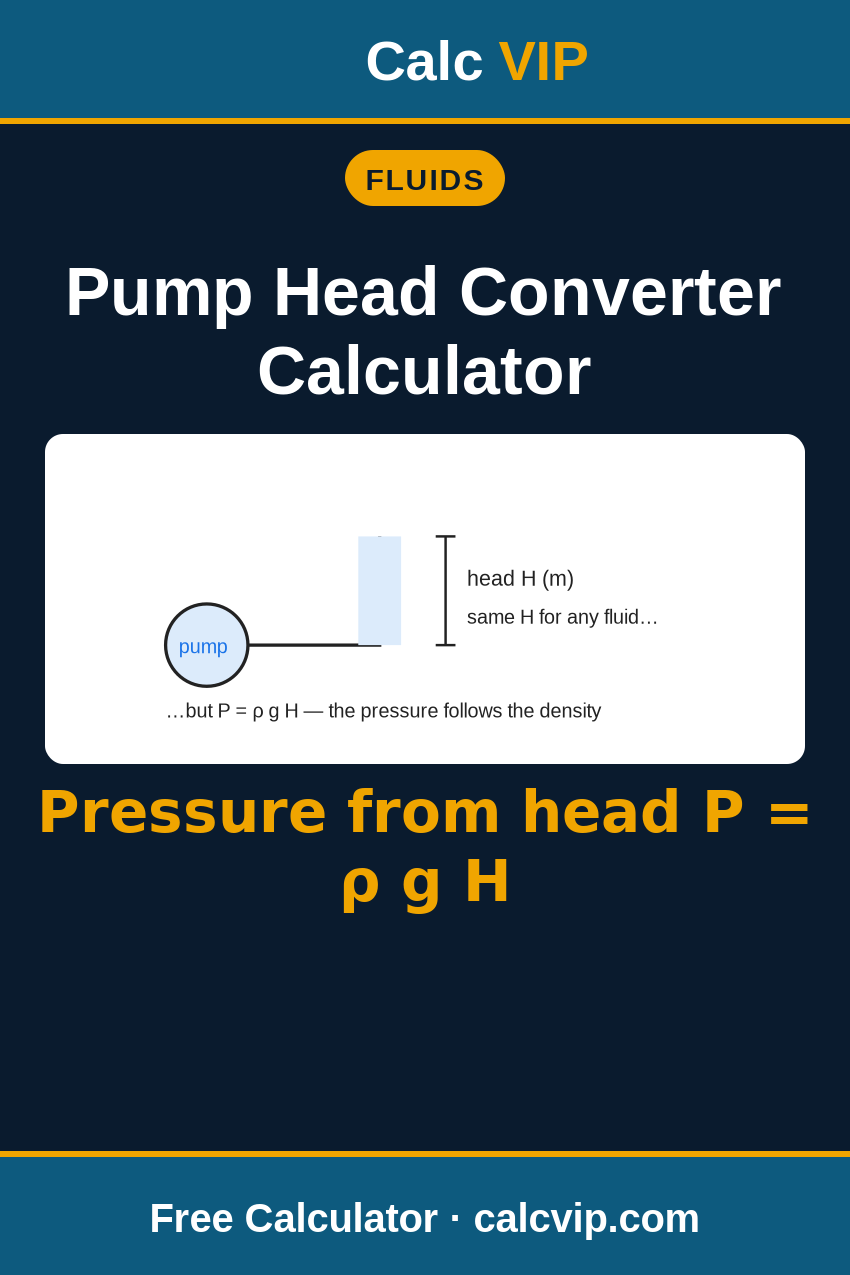
The conversion also runs the daily errands of the pump house: a system specified at 10 bar needs a pump rated above 101.94 m of water head; a datasheet promising 50 m promises 4.905 bar on water and only 4.17 bar on light oil; a pressure gauge at a pump's foot can be read as a head meter with this page as its scale. Underneath every errand sits the same three-symbol equation that sizes the barometer and the dam — density times gravity times height — the hardest-working formula in fluid mechanics.
Formula
Pressure from head P = ρ g H • and H = P / (ρ g); ρ in kg/m³, H in metres, P in pascals (reported in Pa, kPa, bar and psi)
The equation is hydrostatics read at the pump flange: a column of the pumped fluid H metres tall presses its base with ρgH, and the pump must match that pressure to hold the column up. Unit bridges worth memorising: for water, 1 bar = 10.19 m of head, 1 m = 0.0981 bar, and 1 psi = 0.703 m. This converter uses g = 9.81 m/s² and the exact psi of 6,894.76 Pa. Two warnings travel with the formula: the pressure is the pump's differential — discharge minus suction — when the suction is itself pressurised, and the density must be the fluid's at its pumping temperature, since hot fluids are lighter fluids.
| Symbol | Meaning | Units |
|---|---|---|
| H | head — energy per unit weight, as a fluid height | m (of the pumped fluid) |
| P | pressure equivalent of that head | Pa, kPa, bar, psi |
| ρ | density of the pumped fluid at its temperature | kg/m³ (water 1,000; oil ≈ 850; sea water 1,025) |
| g | gravitational acceleration | 9.81 m/s² |
Why pumps think in metres: the physics of the impeller
A centrifugal pump's impeller flings fluid outward, and the energy it imparts is, to first order, set by the impeller's tip speed — a property of the machine's geometry and rotation, not of the fluid passing through. Each kilogram of fluid leaves with the same kinetic inheritance whether it is water, oil or syrup. Expressed per unit weight, that inheritance is a height: the head. Expressed per unit volume — which is what pressure is — the inheritance scales with how much mass each cubic metre carries, hence with density. This is why one pump curve, drawn in metres, honestly serves every fluid the pump can physically move, and why the same pump that makes 4.9 bar on water makes barely 4.2 bar on oil (Example 3) while consuming power in exact proportion to density as well. The metre is the machine's native tongue; pressure is a translation that must be redone for every fluid.
Positive-displacement pumps — gear, piston and peristaltic machines — invert the personality: they deliver a fixed volume per revolution against whatever pressure the system demands, up to their relief valve's mercy. For them the head–pressure conversion is still the dictionary between the system's bar and the pump's capability, but the "curve" is a wall, not a slope. Either way, no pump conversation survives contact with a second fluid without ρ entering the room.
How to use
- Choose the direction: head (m) → pressure, or pressure → head (m).
- Enter the fluid density — 1,000 kg/m³ for water is pre-filled; use about 850 for light oil, 1,025 for sea water, or your fluid's datasheet value at its working temperature.
- Enter the head in metres, or the pressure with its unit (bar, kPa, psi or Pa).
- Click "Convert" to see the equivalent in all common units.
Worked examples
Example 1 — the reference pump. A pump develops 50 m of head on water.
P = 1,000 × 9.81 × 50 = 490,500 Pa = 490.5 kPa = 4.905 bar ≈ 71.14 psi. One number from the datasheet, four dialects of pressure — the conversion this page exists to perform.
Example 2 — the 10-bar system. A process demands 10 bar. On water: H = 1,000,000 ÷ (1,000 × 9.81) = 101.94 m. Any pump rated below roughly 102 m of head cannot even hold the system pressure, let alone flow against it — the first screening question of pump selection, answered in one division.
Example 3 — the same pump on oil. Example 1's pump, moved to oil of 850 kg/m³: the head is still 50 m (the impeller neither knows nor cares), but P = 850 × 9.81 × 50 = 416,925 Pa ≈ 4.17 bar. A gauge that "lost" 0.74 bar between fluids has lost nothing; the translation changed, not the machine.
Example 4 — a seawater pump. A marine pump at 30 m head on sea water (1,025 kg/m³): P = 1,025 × 9.81 × 30 = 301,658 Pa ≈ 3.02 bar ≈ 43.75 psi. The ocean's extra 2.5% of density flows straight through to pressure and to the motor's power bill alike.
Example 5 — one pressure, two heads. A 3 bar duty: on water, H = 300,000 ÷ 9,810 = 30.58 m; on the 850 kg/m³ oil, H = 300,000 ÷ (850 × 9.81) = 35.98 m. The lighter fluid needs a taller column — a bigger pump — to muster the same pressure. Density is not a detail in this conversion; it is the conversion.
Example 6 — the apartment block. A booster pump must lift water to a twelfth-floor tank, about 36 m up: merely standing still against gravity costs P = 1,000 × 9.81 × 36 = 353,160 Pa ≈ 3.53 bar at the pump — before friction in the riser (the head-loss calculator's department) and before any pressure demanded at the top tap. Building services engineering begins with this arithmetic.
Head and pressure in real life
Pump selection and datasheets. The daily commerce of the pump industry is this conversion: European catalogues in metres and bar, American in feet and psi, and every enquiry crossing between them through ρgH with the right density.
Boiler feed and pressure systems. A boiler at 10 bar demands feed pumps rated well above 102 m of head, plus margin for the feed line's friction — Example 2 is the first line of that specification.
Fire pumps. Standards specify both languages at once — a rated pressure at a rated flow — and acceptance tests convert the gauge readings back into head to prove the pump still draws its catalogue curve.
Well and borehole pumps. A submersible's rating in metres is matched against the well's depth plus drawdown plus the pressure tank's demand converted to metres; undersize the head and the tank never fills, however impressive the pressure claim sounded.
Hydraulic power packs. Here the conversion runs at hundreds of bar, but the arithmetic is identical, and the density of the hydraulic oil (≈870 kg/m³) is the number that turns a relief valve's bar into the cylinder's working head.
Medical and laboratory pumps. Infusion and perfusion devices specify pressure in mmHg — the barometer's unit — and the conversion to the pump's head capability in centimetres of water is this same formula at bedside scale.
Total dynamic head: the converter's place in the bigger sum
The head a pump must develop in service is rarely a single lift. Total dynamic head adds three ingredients: the static lift between the two liquid levels, the friction loss of the whole circuit (the head-loss calculator's output), and any pressure difference between the destination and the source — a pressure vessel's bar converted to metres by this page. A pump feeding a 10-bar boiler from an open tank, for instance, owes 101.94 m to the boiler's pressure, plus the feed line's friction, plus the few metres of physical lift — and its datasheet head must clear the sum at the required flow. Conversely, a pressurised suction (a pump fed by another pump, or by a vessel under pressure) contributes negative demand: suction pressure converted to metres is subtracted. This converter is the exchange bureau where the pressure terms of that sum are changed into the head currency the pump curve is drawn in.
Field technicians run the same sum backwards as a diagnostic. Two pressure gauges — one at suction, one at discharge — plus this conversion yield the head the pump is actually producing at that moment; plotting it against the flow and comparing with the catalogue curve exposes worn impellers, clogged passages and wrong speeds without opening the machine. A pump house that keeps a laminated copy of the water table above near its gauges has, in effect, turned this page into an instrument.
Quick reference: water conversions worth memorising
| Given (water) | Equivalent |
|---|---|
| 1 m head | 9,810 Pa = 0.0981 bar = 1.42 psi |
| 10 m head | 0.981 bar ≈ 14.2 psi |
| 1 bar | 10.19 m head |
| 1 psi | 0.703 m head |
| 100 m head | 9.81 bar ≈ 142 psi |
| 1 atmosphere (101.325 kPa) | 10.33 m head |
The rough rule "10 metres ≈ 1 bar" is good to 2% and runs half the pump houses on Earth; this table is its exact form, and the converter above is its generalisation to every other fluid.
Cavitation: the conversion's dangerous edge
Every liquid boils when the local pressure falls to its vapour pressure — and a pump's suction is precisely a place where pressure falls. If the pressure at the impeller's eye drops to vapour pressure, the liquid flashes into bubbles there; carried into the impeller's rising pressure, the bubbles collapse with microscopic violence, hammering metal from the surface grain by grain. The noise is unmistakable — a pump cavitating sounds as if it is pumping gravel — and the damage is swift. The defence is budgeted in this page's currency: the available Net Positive Suction Head, the suction pressure above vapour pressure converted into metres, must exceed the pump's required NPSH with margin. Every term of that budget is a ρgH translation — the tank's level (metres), the atmosphere pressing on it (bar, via this converter), the suction line's friction (the head-loss calculator), and the vapour pressure itself (a pressure that climbs steeply with temperature, which is why hot fluids cavitate pumps that handled them cold).
Cavitation is the sharpest reminder that head and pressure, though convertible, are not interchangeable in meaning. The pump thinks in head; the fluid boils in pressure; the design lives where the two descriptions are kept in honest translation — which is, in the end, the entire purpose of this converter.
Common mistakes
- Converting with water's density for another fluid. The entire point of the density box. A 15% density error is a 15% pressure error — the difference between Example 1 and Example 3 is a real machine misjudged.
- Confusing pump head with lift height. Head is energy per unit weight, which includes pressure and friction terms (see the total dynamic head section). A pump rated 50 m cannot necessarily lift water 50 m through a long thin pipe.
- Forgetting the suction side. The converter translates a head into the pressure difference the pump produces. If the suction is already at 2 bar, the discharge reads 2 bar plus the converted value.
- Using cold density for a hot fluid. Water at 90 °C is about 965 kg/m³, not 1,000 — a 3.5% pressure shortfall that has embarrassed more than one boiler-room calculation.
- Mixing psi conventions. Gauges read psig (above atmosphere); some specifications use psia (absolute). The 14.7 psi of the atmosphere hides inside the difference — decide which zero your number uses.
FAQ
Why do pump datasheets use metres instead of bar?
Because a centrifugal pump imparts a fixed energy per unit weight — a height — regardless of the fluid. Metres of head lets one pump curve serve water, oil and chemicals; the pressure is then density-dependent.
How many metres is 1 bar for water?
About 10.19 m (100,000 / (1,000 × 9.81) = 10.194 m). The rough rule "1 bar ≈ 10 m of water" is accurate to within 2%.
Does head include suction conditions?
Total dynamic head is the difference between discharge and suction head. This converter simply translates a head value into its pressure equivalent for the chosen fluid.
What is NPSH and does this converter cover it?
Net Positive Suction Head is the margin by which the suction pressure exceeds the fluid's vapour pressure, expressed in metres — the pump's protection against cavitation. It is a head, so this page's pressure↔head translation applies to its terms, but the full NPSH budget (vapour pressure, suction friction, level) is a calculation of its own — and one where a metre of margin is cheap insurance against a ruined impeller.
Why does the pump's power depend on density too?
Hydraulic power is ρgQH: the same flow at the same head through a denser fluid moves more mass per second, and the motor pays for every kilogram. It is why a pump tested on water can overload its motor on brine.
Can I convert feet of head the same way?
Yes — convert feet to metres (× 0.3048) and proceed, or remember that for water 1 psi ≈ 2.31 feet of head, the American pump house's favourite constant. The physics is indifferent to the ruler; only the arithmetic changes its clothes, and mixing the two rulers mid-calculation remains the classic imperial–metric accident.
Does altitude change the conversion?
Only trivially, through g (a fraction of a percent between sea level and the mountains). What altitude changes dramatically is the suction condition — the atmosphere pressing on the supply tank is thinner, shrinking the NPSH margin metre by metre — which is an NPSH matter, not a conversion error.
What density should I use for petrol?
About 737 kg/m³ at 15 °C — so a pump making 50 m of head on petrol delivers only about 3.61 bar. Fuel systems are specified with exactly this correction, since petrol's lightness is the largest common departure from water.
Is "head" ever measured in the pressure fluid rather than the pumped one?
Yes — in manometers, in practice. A differential manometer's reading in millimetres of mercury is a head of mercury that must be converted through both fluids' densities; the barometer calculator on this site handles the mercury side of that family.
Why do some pumps list both metres and bar on the nameplate?
Because the bar figure assumes water at a stated temperature, while the metre figure is the machine's truth. When the two disagree with your conversion, the density assumption is the first suspect. The same caution applies to catalogue curves republished for other fluids: a curve "corrected" by a salesman should always be re-derivable from the metre curve and ρ — and now you have the tool to check it.