 Calc
Reynolds Number Calculator – Laminar or Turbulent Flow
 Created by Elena Petrova · Physics Editor · Fluids & Rotation · Last updated: November 2026
Use this free Reynolds Number Calculator to predict whether a fluid flow will be smooth (laminar) or chaotic (turbulent). Enter the fluid density, speed, pipe diameter and viscosity — the calculator gives the Reynolds number and the flow type.
Every flowing fluid lives in one of two temperaments. In laminar flow it glides in smooth, parallel layers, predictable as clockwork — honey off a spoon, oil in a bearing. In turbulent flow it tumbles in eddies and whorls, mixing violently and resisting prediction in detail — white-water rapids, storm clouds, the wake of a boat. The Reynolds number is the single dimensionless score that predicts which temperament a given flow will adopt, and it has been doing so since Osborne Reynolds demonstrated the transition with a dye filament in a glass tube in 1883. This calculator computes that score and names the regime.
The score is a ratio of two instincts inside the fluid: inertia, which wants a moving parcel to keep its momentum and amplify any wobble, against viscosity, the fluid's internal stickiness, which smothers wobbles and irons the flow flat. Density, speed and size feed the numerator — all three make inertia stronger. Viscosity alone staffs the denominator. When the ratio is small, stickiness wins and the flow is laminar; when it is large, inertia wins and turbulence takes over. Between the two lies a transitional band where the flow flickers, indecisive, between the temperaments.
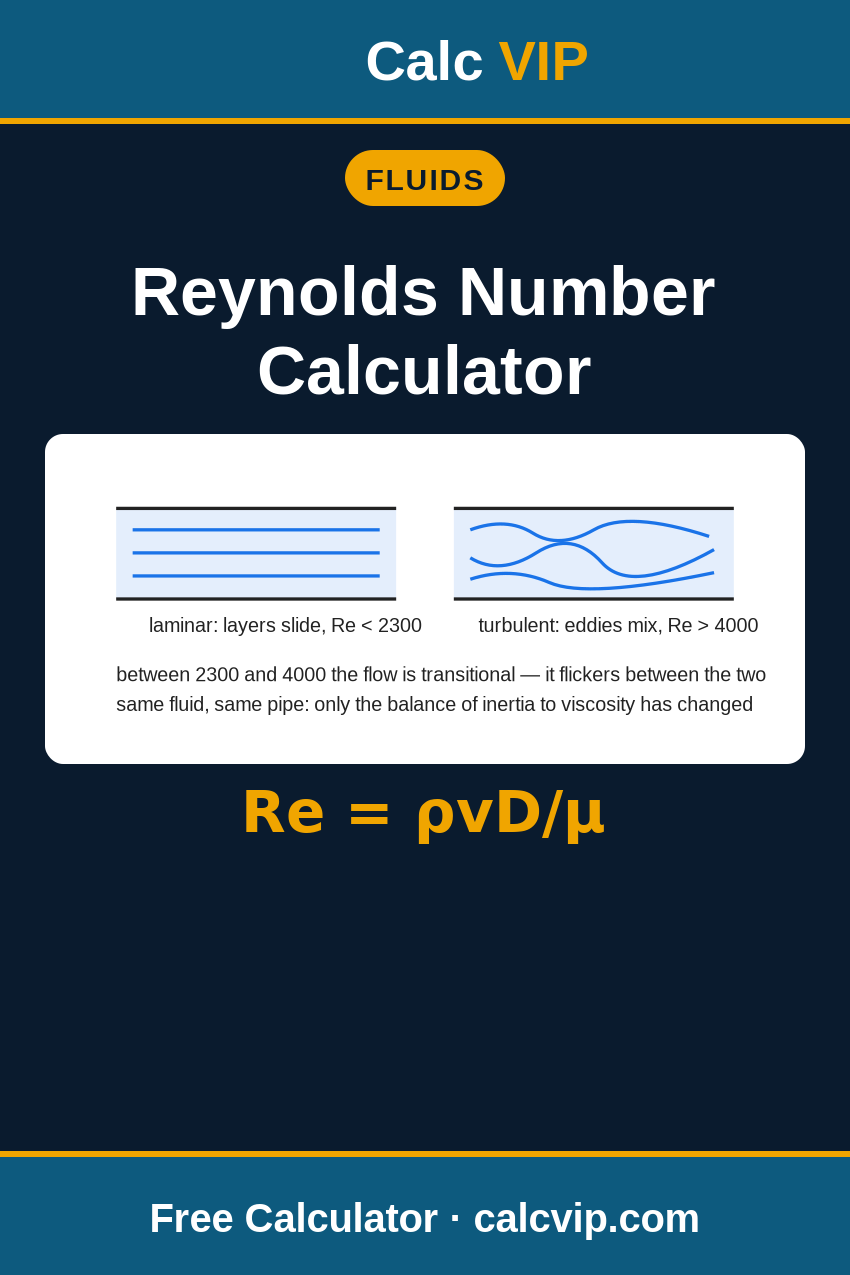
Enter a fluid (the presets load water, air, olive oil and glycerin with their densities and viscosities), a speed and a pipe diameter, and the calculator returns Re together with its verdict. The verdict is not academic: it changes which friction formulas apply, how much pressure a pump must supply, how well a heat exchanger works, and whether a pipeline hums quietly or erodes itself noisy and thin. Reynolds' number is small enough to compute on an envelope and large enough to organise an entire engineering discipline around itself.
Formula
Reynolds number = (ρ × v × D) ÷ μ → Re = ρvD/μ
where ρ is density (kg/m³), v is flow speed (m/s), D is pipe diameter (m) and μ is dynamic viscosity (Pa·s). The Reynolds number has no units — it compares the fluid's inertia with its stickiness (viscosity).
Flow types: Re below 2300 → laminar; 2300–4000 → transitional; above 4000 → turbulent.
An equivalent form uses the kinematic viscosity ν = μ/ρ (viscosity per unit density): Re = vD/ν. For water ν ≈ 1.0 × 10⁻⁶ m²/s, a conveniently memorable value. Rearranged, the formula also answers design questions: the speed at which a given pipe of water turns transitional is v = 2300μ/(ρD), and the diameter at which a given flow changes character is D = Re × μ/(ρv). Outside pipes, D is replaced by whatever length defines the problem — a wing's chord, a ship's length, a sphere's diameter — with thresholds adjusted to the geometry, a flexibility explored in the depth section below.
| Symbol | Meaning | Units |
|---|---|---|
| Re | Reynolds number — inertia ÷ viscosity score | none (dimensionless) |
| ρ | density of the fluid | kg/m³ |
| v | average flow speed | m/s |
| D | pipe inside diameter (characteristic length) | m |
| μ | dynamic viscosity | Pa·s |
Reynolds' dye thread: the experiment behind the number
In 1883 Osborne Reynolds published one of the most reproduced experiments in physics. Water flowed through a horizontal glass tube; a filament of dye was injected along its centre. At low speed the dye drew a perfectly straight, unbroken thread the length of the tube — laminar flow made visible. As the speed rose, the thread began to waver; faster still, it burst suddenly into a coloured cloud filling the tube — turbulence, switching on almost at a threshold. Reynolds varied speed, tube size, temperature (which changes viscosity) and fluid, and found the switch always flipped at the same value of the same combination: ρvD/μ. That a single dimensionless group governs flows from blood capillaries to oil pipelines is the reason scale models work: match the Reynolds number between a wind-tunnel model and the real aircraft, and the flows are dynamically similar — the small flow rehearses the large one's behaviour faithfully.
Why a threshold at all? A laminar flow is a stack of layers sliding past each other; any small disturbance — a bump, a vibration — tries to grow into an eddy. Viscosity is the editor that deletes disturbances, diffusing their energy away as heat. Inertia is the amplifier that feeds them. Below Re ≈ 2300 in a pipe, the editor always wins eventually; above ≈ 4000 the amplifier overwhelms it almost immediately. The transitional band between is genuinely undecidable in detail: with obsessive care (polished pipes, vibration isolation, still reservoirs) experimenters have kept pipe flow laminar to Re of 100,000, while a rough, shaken pipe trips turbulent near the bottom of the band. The thresholds on this page are the engineer's working values for ordinary pipes in an ordinary world.
How to use
- Pick a fluid to fill in its density and viscosity, or type your own values (choose "Custom values").
- Enter the flow speed and the inside diameter of the pipe.
- Click "Calculate Reynolds Number" to see Re and whether the flow is laminar, transitional or turbulent.
- To explore a design, vary one input at a time — doubling speed or diameter doubles Re; doubling viscosity halves it.
Worked examples
Example 1 — tap water in a household pipe. Water (ρ = 1000 kg/m³, μ = 0.001 Pa·s) flows at 1.5 m/s through a pipe of diameter 0.05 m. Re = (1000 × 1.5 × 0.05) ÷ 0.001 = 75 ÷ 0.001 = 75,000. Because 75,000 is far above 4000, the flow is turbulent — as most fast water flows in pipes are.
Example 2 — the same water, barely moving. Slow the water to 0.05 m/s in a 20 mm pipe: Re = (1000 × 0.05 × 0.02) ÷ 0.001 = 1,000 — comfortably laminar. Nothing about the fluid changed; speed and size alone moved the flow across two regimes, which is why a dripping tap's stream is glassy smooth and a full-open tap's is white and chaotic.
Example 3 — air in a ventilation duct. Air (ρ = 1.225 kg/m³, μ = 0.0000181 Pa·s) at 5 m/s in a 0.3 m duct: Re = (1.225 × 5 × 0.3) ÷ 0.0000181 ≈ 101,500 — deeply turbulent. Duct flows almost always are, which is good news for mixing fresh air and bad news for noise: turbulent flow is why ducts hum.
Example 4 — olive oil in a bottling line. Olive oil (ρ = 910 kg/m³, μ = 0.056 Pa·s) at 0.5 m/s in a 50 mm pipe: Re = (910 × 0.5 × 0.05) ÷ 0.056 = 22.75 ÷ 0.056 ≈ 406 — laminar, gliding in layers. Food and cosmetics lines live in this regime: gentle, predictable, and kind to the product, at the price of slow heat transfer.
Example 5 — glycerin, the laminar extreme. Glycerin (ρ = 1260 kg/m³, μ = 1.41 Pa·s) at 0.1 m/s in a 20 mm tube: Re = (1260 × 0.1 × 0.02) ÷ 1.41 = 2.52 ÷ 1.41 ≈ 1.79. A Reynolds number under 2 — the flow is so dominated by viscosity that inertia barely exists; stop pushing and the flow stops dead, with no coasting at all. This is the regime of the Stokes' Law Calculator, where spheres settle at a stately, calculable pace.
Example 6 — blood in the aorta. Blood (ρ ≈ 1060 kg/m³, μ ≈ 0.0035 Pa·s) at an average 0.2 m/s in a 25 mm aorta: Re = (1060 × 0.2 × 0.025) ÷ 0.0035 ≈ 1,514 — laminar on average, though the heartbeat's pulse pushes peak speeds several times higher and briefly flirts with transition. A healthy circulation runs mostly laminar; the whooshing murmur of a narrowed valve is turbulence announcing disease, audible through a stethoscope.
The Reynolds number in real life
Pipeline and pump engineering. Friction losses — the pressure a pump must supply — follow different laws in the two regimes, and the jump between them is steep. Every pipeline design begins with Re to learn which friction chart (the famous Moody diagram) and which roughness corrections apply; get the regime wrong and the pump arrives undersized.
Heat exchangers. Turbulence is a superb mixer, scrubbing the insulating boundary layer off hot surfaces, so exchangers are usually designed to run turbulent despite the extra pumping cost. Laminar designs appear where the fluid is delicate or the pressure budget tiny — the trade is always priced through Re first.
Aircraft and wind tunnels. A cruising airliner's wing works at Re in the tens of millions (air at 250 m/s over a 2 m chord gives Re ≈ 3.4 × 10⁷). Wind-tunnel models, being smaller, must run faster or in pressurised or cryogenic tunnels to match that number — Reynolds matching is the whole science of making small tests predict big aircraft.
Ships and submarines. Hull friction, the dominant drag at cruising speed, depends on whether the boundary layer along the hull is laminar or turbulent — and on a full-size ship it is turbulent over nearly the whole length. Model basins tow small hulls and correct the results with Reynolds-number scaling laws.
Weather and ocean. The atmosphere and oceans are so vast that their Reynolds numbers are astronomical and their flows are turbulent essentially everywhere — every cloud eddy and ocean gyre is high-Re physics. Laminar flow, on this planet, is a small-scale, indoor phenomenon.
The microfluidic world. In channels thinner than a hair, Re collapses below 1 and flow becomes perfectly reversible and layer-bound — wonderful for precise chemistry, terrible for mixing, which is why lab-on-a-chip designers carve zigzags and herringbone grooves to stir fluids that refuse to stir themselves.
One number, many lengths: Re beyond pipes
The formula's D is really "the length that matters here", and swapping it opens the whole of fluid mechanics. For flow over a wing, D becomes the chord; for a ship, the hull length; for a settling sphere, its diameter — where Re below about 1 is the entry ticket for Stokes' law (the Stokes' Law Calculator checks this for its worked example: Re ≈ 0.018, deeply in the safe zone). Thresholds move with geometry — a flat plate's boundary layer turns turbulent around Re ≈ 5 × 10⁵ — but the logic never changes: inertia over viscosity, amplifier over editor. Even the weather obeys the pattern language: a cumulus cloud's Re is around 10⁹, and no one has ever seen a laminar cloud. Learn to estimate Re for whatever is flowing and you hold a first diagnosis of its behaviour before any other calculation begins.
Quick reference: when does water in a pipe turn transitional?
| Pipe diameter | Speed at Re = 2300 | Everyday comparison |
|---|---|---|
| 10 mm | 0.23 m/s | a slow trickle already transitions |
| 25 mm | 0.092 m/s | 9 cm/s — barely a flow at all |
| 50 mm | 0.046 m/s | under 5 cm/s stays laminar |
| 100 mm | 0.023 m/s | 2.3 cm/s — laminar water is slow water |
The table delivers an honest surprise: in pipes of household size, laminar water flow requires speeds of a few centimetres per second. Almost every water flow you have ever seen in a pipe was turbulent — laminar flow belongs to the slow, the small and the sticky.
The drag crisis: when turbulence becomes the hero
One of fluid mechanics' favourite plot twists lives at Re ≈ 2 × 10⁵ for a smooth sphere. Below it, the boundary layer is laminar and separates early, leaving a wide turbulent wake and high drag. Just above it, the boundary layer itself turns turbulent — and, paradoxically, drag plummets, because a turbulent boundary layer carries more momentum near the surface and clings on longer before separating, shrinking the wake. Golf balls are dimpled precisely to trip the boundary layer turbulent early and harvest this drag crisis at ordinary swing speeds; smooth balls would fly barely half as far. Cricket and baseball seamers exploit the same transition asymmetrically to swing the ball. The Reynolds number is not merely a label for regimes — at this particular value, it is a switch that redesigns the flow around the object, and sports equipment is engineered to flip it.
Common mistakes
- Entering viscosity in the wrong units. μ must be in Pa·s. Water is 0.001 Pa·s (equivalently 1 mPa·s or 1 centipoise). Typing "1" for water inflates the denominator a thousandfold and buries Re at 75 instead of 75,000.
- Using radius instead of diameter. The pipe convention is D. Halving the length by using r halves Re — enough to mislabel a transitional flow as safely laminar.
- Applying pipe thresholds to other geometries. 2300 and 4000 are pipe-flow numbers. A wing, a sphere and a river each carry their own transition values; the formula travels, the thresholds must be re-checked.
- Ignoring temperature. Viscosity is temperature-sensitive — water at 60 °C is about half as viscous as at 20 °C, doubling Re — and oils change far more dramatically. A flow laminar when cold may be turbulent when the process heats up.
- Treating the transitional band as a clean answer. Between 2300 and 4000 the honest answer is "it depends" — on roughness, vibration and history. Designs that must behave predictably keep a clear margin from the band on one side or the other.
FAQ
Why does the flow type matter?
Turbulent flow mixes fluids and transfers heat much better, but it also causes more friction, noise and pressure loss in pipes. Engineers choose pipe sizes and pumps based on the expected flow type.
Why is honey's flow always laminar?
Honey is extremely viscous (large μ), so its Reynolds number stays tiny even at noticeable speeds. High viscosity keeps the flow smooth and orderly.
Is the Reynolds number the same for open channels and aeroplanes?
The formula is the same idea, but the "D" becomes a characteristic length for the situation — for a wing it is the wing chord, and for a river the hydraulic depth. The laminar/turbulent limits also differ slightly by situation; 2300 and 4000 are the standard pipe-flow values.
Can a flow be turbulent at very low speed?
Yes — if the fluid is thin enough or the passage large enough. Air at walking pace in a wide hall is turbulent; a river creeping at centimetres per second is turbulent because its depth (its D) is measured in metres. Speed alone never decides; the whole ratio does.
Why do engineers sometimes want turbulence?
For mixing and heat transfer nothing beats it: turbulent eddies haul hot fluid to cold walls and blend reactants in seconds. Chemical reactors, heat exchangers and combustion chambers are designed turbulent on purpose, and pay the friction bill gladly.
What is the transitional regime like in practice?
Unsteady and patchy: bursts of turbulence appear, grow, decay and reappear, and pressure losses fluctuate. In a water pipe you can sometimes hear it as an intermittent roughness in the flow noise around the critical speeds in the table above.
How does roughness affect the transition?
Rough walls seed disturbances, tripping turbulence near the bottom of the transitional band, while mirror-smooth pipes with careful inlets can delay it far beyond 4000. Roughness also raises friction strongly once the flow is turbulent — the reason old, scaled pipes cost more to pump through.
What Reynolds numbers do bacteria live at?
A swimming bacterium works at Re around 10−5 — a world where inertia is extinct, coasting is impossible, and water feels as thick as honey feels to us. Micro-swimmers need entirely different propulsion (corkscrew flagella) because reciprocal strokes, which work for fish, achieve nothing at zero Re.
Is there a Reynolds number for the whole atmosphere?
Formally yes, and it is colossal — of order 10¹² or more for planet-scale winds — which is why weather is turbulent, chaotic and forecast-limited. The same dimensionless logic that organises a laboratory pipe organises the sky, at the far end of its range.
How do I lower Re if I need laminar flow?
Slow the fluid, shrink the passage, or use a more viscous fluid — cooling most liquids thickens them, which helps. Laboratory laminar-flow benches and viscometers combine all three: slow, small, and smooth-walled.