 Calc
Potential Energy Calculator – PE = mgh (Gravitational)
 Created by Priya Sharma · Physics Editor · Energy & Gravity · Last updated: November 2026
Use this free Potential Energy Calculator to find the gravitational energy stored in a raised object. Enter the mass and the height above the ground, and the calculator gives you the potential energy in joules (J), using g = 9.81 m/s².
Potential energy is stored energy — energy an object holds because of where it is, ready to be released. A book on a high shelf, water behind a dam, a drawn bow and a roller-coaster car paused at the top of its first hill all hold potential energy. Nothing is moving yet, and that is exactly the point: the energy is potential, waiting. Let go, and it turns into motion, heat or sound. The word "potential" is doing honest work in the name.
This calculator deals with the most familiar kind: gravitational potential energy, the energy stored by lifting something against gravity. Gravity pulls every mass downward, so raising an object means doing work against that pull — and the work you do does not vanish. It is banked in the object, joule for joule, and the object can hand it all back by falling. The higher you lift it and the heavier it is, the bigger the deposit.
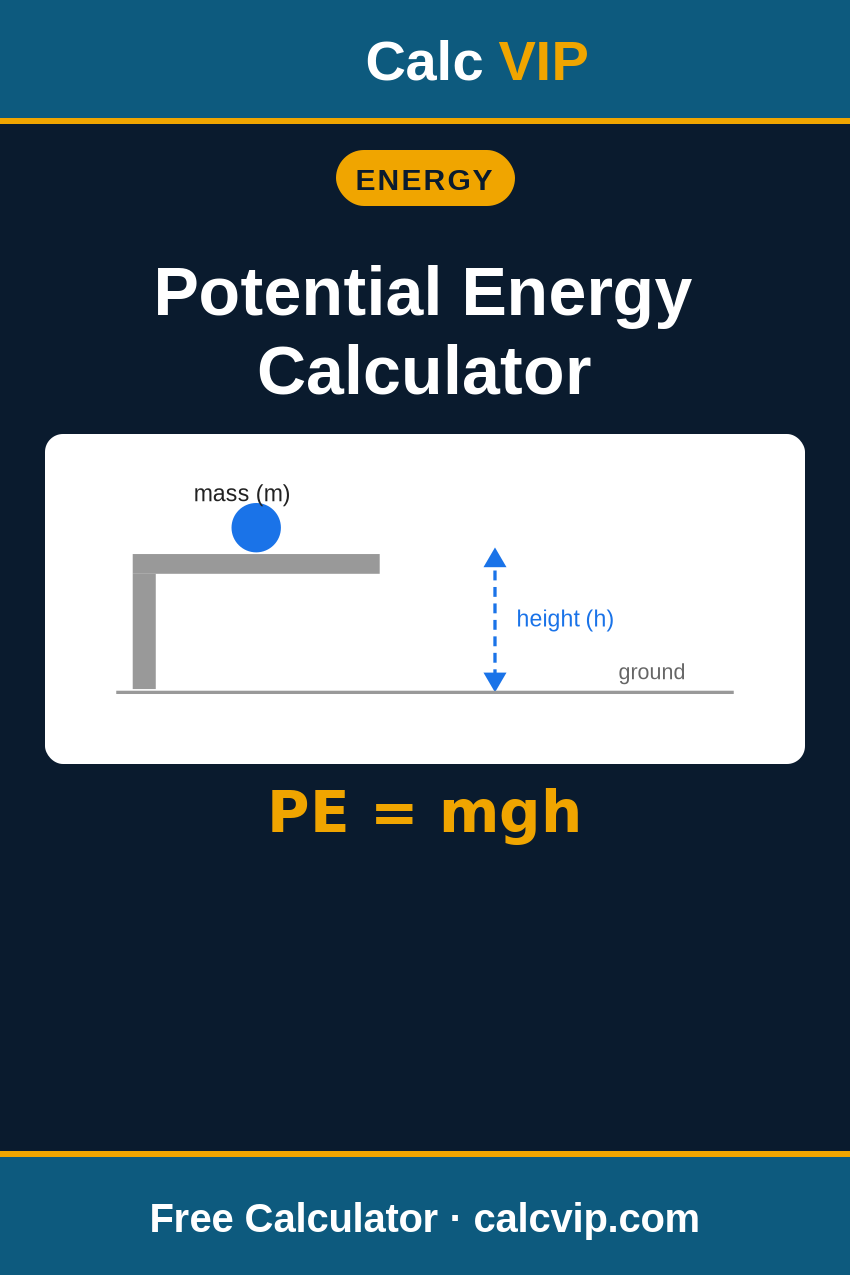
One subtlety matters from the start: potential energy is measured relative to a level you choose. A book on a table has potential energy relative to the floor below, more relative to the basement, and none relative to the tabletop itself. Physicists pick whichever reference level makes the problem simplest — usually the ground, or the lowest point the object can reach. What never changes is the difference in potential energy between two heights, and differences are what drive everything that happens next.
Formula
Potential Energy = Mass × Gravity × Height → PE = mgh
On Earth, g = 9.81 m/s². The higher or heavier the object, the more gravitational potential energy it stores. The formula rearranges cleanly. Height from energy: h = PE ÷ (m × g) — a 10 kg box holding 490.5 J sits at 490.5 ÷ (10 × 9.81) = 490.5 ÷ 98.1 = 5 m. Mass from energy: m = PE ÷ (g × h) — 490.5 ÷ (9.81 × 5) = 490.5 ÷ 49.05 = 10 kg, the same box identified from its energy alone.
Read the formula as a recipe with three independent ingredients. Doubling any one of them — mass, gravity or height — exactly doubles the stored energy. There are no squares here (unlike kinetic energy), which makes gravitational potential energy the most predictable energy in physics: lift it twice as high, store twice as much.
| Symbol | Meaning | Units |
|---|---|---|
| PE | gravitational potential energy | joules (J) |
| m | mass | kilograms (kg) |
| g | gravitational field strength | 9.81 m/s² on Earth |
| h | height above the chosen zero level | metres (m) |
Where the energy goes: falling objects
Drop the object and the bank empties in an orderly way. At every moment of the fall, the potential energy lost equals the kinetic energy gained (ignoring air resistance), so the total stays constant. Halfway down, the object holds half its original potential energy and has converted the other half into speed. Just before it lands, essentially all of it is kinetic. This gives a beautiful shortcut for the landing speed: since mgh = ½mv², the mass cancels and v = √(2gh). Anything falling 5 m — a feather-weight bolt or a heavy box, air resistance aside — arrives at √(2 × 9.81 × 5) = √98.1 ≈ 9.9 m/s. Galileo's insight that falling speed does not depend on mass is hiding inside the potential energy formula.
How to use
- Enter the mass of the object in kilograms (kg).
- Enter its height above the ground in metres (m).
- Click "Calculate Potential Energy" to see the result in joules.
- Measure the height from wherever the object would land or stop — that surface is your zero level.
Worked examples
Example 1 — a box on a platform. A 10 kg box is raised 5 m above the ground. PE = 10 × 9.81 × 5 = 490.5 J.
Example 2 — climbing the stairs. A person of mass 60 kg climbs to a landing 3 m higher. PE gained = 60 × 9.81 × 3 = 1765.8 J. Their muscles supplied every joule of it, which is why the same climb feels trivial once and exhausting the tenth time.
Example 3 — a rooftop water tank. A tank holds 500 kg of water raised 20 m above the taps below. PE = 500 × 9.81 × 20 = 98,100 J. That stored energy is precisely what gives the building its water pressure: gravity, banked in advance, does the pushing for free.
Example 5 — the crane's load, held high. A crane holds a 200 kg panel 15 m above the site. PE = 200 × 9.81 × 15 = 29,430 J. That is the energy the panel will hand back, all at once, if the sling fails — which is why site rules forbid walking under a suspended load: you would be standing inside a stored-energy figure this page can compute to the joule.
Example 6 — the reservoir, per tonne. One kilogram of water held 50 m up in a mountain reservoir stores 1 × 9.81 × 50 = 490.5 J. Scale to a tonne (1000 kg) and the figure is 490,500 J — about half a megajoule per tonne, waiting behind the dam wall. Multiply by the millions of tonnes a real reservoir holds and hydroelectric power stops looking modest.
Potential energy in real life
Hydroelectric power. A dam is a potential-energy warehouse. Water held 100 m up in a reservoir carries 9.81 × 100 = 981 J per kilogram, and a large reservoir releases millions of kilograms per minute through its turbines. Pumped-storage stations go further: they spend spare electricity pumping water uphill at night, banking it as potential energy to release at peak demand — a giant rechargeable battery made of water and height.
Roller coasters. The chain lift on the first hill is the only place a typical coaster receives energy. Everything after — every loop, drop and corkscrew — is a negotiation between potential and kinetic energy, with friction slowly taxing the total. Designers make the first hill the tallest for a reason: no later hill can rise higher than the energy bank allows.
Clocks and pile drivers. A grandfather clock runs for a week on the potential energy of slowly descending weights. A pile driver does the opposite trade in a fraction of a second: a heavy mass is raised to bank energy, then dropped so the bank empties into a single devastating blow.
Example 4 — a book on a shelf. A book of mass 1.5 kg rests on a shelf 2 m above the floor. PE = 1.5 × 9.81 × 2 = 29.43 J. Small — but if the book slips off, all 29.43 J becomes kinetic energy on the way down, and it lands on your toe at √(2 × 9.81 × 2) ≈ 6.3 m/s, which is quite fast enough to be felt.
Pumped storage: a battery made of hills. When electricity is cheap at night, some power stations pump water uphill into a high reservoir; when demand peaks, the water falls back through turbines. It is Example 6 industrialised — potential energy as a rechargeable battery, with round-trip efficiency around 75–80% and a capacity no chemical battery yet matches.
Ski lifts and funiculars. Every passenger a ski lift carries up the mountain is handed mgh of potential energy by the lift motor — a 70 kg skier raised 500 m receives 70 × 9.81 × 500 = 343,350 J — and then spends the whole descent trading it back for speed, warmth and (ideally) graceful turns rather than a single abrupt stop.
Choosing the zero level, and negative potential energy
Because potential energy is relative, it can legitimately be negative. Put your zero level at a tabletop and a book on the floor below it has negative potential energy relative to the table — it sits lower than your reference. Nothing is broken: physics only ever uses changes in potential energy, and the change in falling from table to floor is the same whatever zero you picked. This freedom feels like cheating the first time you meet it, but it is really a bookkeeping convenience, like measuring altitude from sea level rather than from the centre of the Earth.
Other kinds of potential energy
Gravity is not the only bank. A stretched spring stores elastic potential energy (½kx²), a battery stores chemical potential energy, and two attracting or repelling electric charges store electric potential energy. The pattern is always the same: work is done to push something into a configuration it would rather leave — lifted against gravity, stretched against stiffness, forced against a field — and the configuration holds the energy until it is allowed to escape. Gravitational potential energy is simply the version you can see with your own eyes, one shelf at a time.
Potential energy beyond Earth
The formula travels well. On the Moon, where g = 1.62 m/s\u00b2, the same 10 kg box at 5 m stores only 10 \u00d7 1.62 \u00d7 5 = 81 J \u2014 about one-sixth of its Earth value \u2014 which is one reason lunar astronauts could hop around in bulky suits that would have been exhausting back home. Far from any planet, the simple mgh formula stops working, because g itself weakens with distance from the planet's centre; engineers then switch to the fuller gravitational formula built on the inverse-square law. But for anything lifted within a few kilometres of Earth's surface \u2014 every shelf, crane, dam and staircase in your life \u2014 g is constant to excellent accuracy, and PE = mgh is all you will ever need.
Beyond mgh: the potential energy of planets
The mgh formula is a local approximation — it assumes g is constant, true near a planet's surface and false on the scale of orbits. The exact expression, PE = −GMm/r, is negative, shrinks towards zero at infinite distance, and explains a fact mgh cannot: that a satellite needs a definite total energy to escape entirely. For surface problems the two agree to extraordinary precision, because over a few hundred metres g barely changes — mgh is the exact formula's first, excellent guess.
The negative sign in the exact version is not a nuisance; it is the bookkeeping of bound systems. An orbiting satellite's total energy (kinetic plus potential) is negative, and only adding enough energy to reach zero frees it. The humble shelf-and-book formula on this page is the ground floor of that same structure: choose your zero, count honestly, and the energy ledger balances from bookshelves to black holes.
Quick reference: stored energy by the lift
The pattern is pure proportionality — double any of m, g or h and the stored energy doubles — so the table can be extended in your head: a 20 kg box at 5 m is twice Example 1's 10 kg figure, and a tonne of water at 50 m is a thousand times the per-kilogram row of Example 6.
| Lift | Potential energy |
|---|---|
| 1 kg raised 1 m | 9.81 J |
| book, 1.5 kg at 2 m (Ex. 4) | 29.43 J |
| box, 10 kg at 5 m (Ex. 1) | 490.5 J |
| person, 60 kg up 3 m of stairs (Ex. 2) | 1765.8 J |
| crane load, 200 kg at 15 m (Ex. 5) | 29,430 J |
| water tank, 500 kg at 20 m (Ex. 3) | 98,100 J |
A reservoir's ledger, totalled
Example 6 priced a tonne of raised water at 490,500 J. Scale that to a modest pumped-storage reservoir holding a million tonnes (10⁹ kg) at 50 m of head, and the stored energy is 10⁹ × 9.81 × 50 = 4.905 × 10¹¹ J — divide by 3.6 × 10⁶ to change currency and it is 136,250 kWh, about 136 MWh: a town's evening of electricity, held in place by a dam and a hillside.
Real schemes run larger — the biggest store several thousand MWh — yet the arithmetic never changes character: mass × 9.81 × height, with the height doing the persuading. It is also why such schemes live in mountains. Doubling the head doubles the store without a single extra litre, and geography, unlike chemistry, does not degrade with charge cycles.
A comparison with food puts the scale in the kitchen. The stair climb of Example 2 stored 1765.8 J — divide by 4184 J per food Calorie and it is 0.42 Calories, a bite of biscuit. Muscles are only about a quarter efficient, so the climb cost the climber nearer two Calories of food — still a trivial sum, which is why taking the stairs is excellent exercise for the heart but a hopeless strategy for using up a feast.
Common mistakes
- Measuring height from the wrong place. Height is measured from the level the object will fall to or rest at — not from the centre of the Earth, and not from wherever you happen to be standing.
- Using centimetres. The formula needs metres. A shelf 200 cm up is h = 2 m; feeding in 200 inflates the answer a hundredfold.
- Thinking the path matters. Carrying a box up a ramp, stairs or a lift to the same shelf stores exactly the same potential energy — only the height change counts, not the route.
- Mixing up g. This calculator uses Earth's g = 9.81 m/s². Some textbooks round to 10 for mental arithmetic, which gives slightly different answers — fine for estimates, but know which value a question expects.
- Entering the weight where the mass belongs. The m in mgh is mass in kilograms. If you are given a weight in newtons, divide by 9.81 first — otherwise gravity is counted twice and the energy comes out nearly ten times too large.
FAQ
From where is the height measured?
Height is measured from a chosen reference level, usually the ground or the floor. An object at the reference level has zero potential energy.
What happens to potential energy when the object falls?
It changes into kinetic energy. Just before the object hits the ground, almost all of its potential energy has become kinetic energy (ignoring air resistance).
Is g the same everywhere?
No. On Earth g ≈ 9.81 m/s², but on the Moon it is only about 1.62 m/s², so the same object stores much less potential energy at the same height. This calculator uses Earth's g.
How much potential energy does 1 kg at 1 m have?
PE = 1 × 9.81 × 1 = 9.81 J. This little benchmark is handy: roughly 10 J for every kilogram raised every metre.
Can potential energy be negative?
Yes, if the object sits below your chosen zero level. Only changes in potential energy have physical meaning, so a negative value is perfectly healthy bookkeeping.
Does potential energy depend on the path taken to lift the object?
No. Lifting straight up, carrying up stairs or winching up a slope to the same final height all store identical potential energy. Gravity is a "conservative" force, which is the technical name for exactly this path-independence.
Is potential energy a vector or a scalar?
A scalar — it has size only, no direction. The object does not store "downward energy"; it simply stores energy, and gravity decides the direction when it is released.
How much potential energy does a litre of water on a 10 m shelf hold?
A litre of water has a mass of 1 kg, so PE = 1 × 9.81 × 10 = 98.1 J — enough to make a noticeable splash and a small dent, which is why high shelves in warehouses are treated with respect.
How much less potential energy does the same lift store on the Moon?
The Moon's g is 1.62 m/s² against Earth's 9.81, a ratio of about 0.165 — so the same mass raised the same height stores barely a sixth as much. Lunar cranes would lift six times the mass for the same energy budget.
Is the potential energy of a stretched spring the same kind of thing?
It is a sibling, not a twin: elastic potential energy, ½kx², stored by deforming a material rather than by lifting against gravity. Both are "energy of position or arrangement", both convert cleanly into kinetic energy, and the spring calculator keeps that side of the family's accounts.