 Calc
Power Solver Calculator – Solve P = W/t for Power, Work or Time
 Created by Priya Sharma · Physics Editor · Energy & Gravity · Last updated: November 2026
Use this free Power Solver Calculator to rearrange the power equation P = W ÷ t and solve for any one of the three quantities. Choose what you want to find — power, work or time — enter the other two values, and get the answer instantly.
Power is the physics of "how fast". Work and energy tell you how much was done in total; power tells you the rate at which it was done, and that rate is usually what you actually feel. Two people can climb the same staircase and do exactly the same work against gravity, yet the one who runs arrives breathless — same joules, delivered in fewer seconds, so more watts. A car engine, a kettle, a weightlifter and a phone charger are all rated in watts for the same reason: the total energy matters less than how quickly it flows. This solver handles all three directions of the one equation that ties the quantities together, P = W ÷ t.
The equation is a triangle with three corners. Cover the quantity you want and the other two tell you how to combine them: work divided by time gives power; power multiplied by time gives work; work divided by power gives time. Every problem in this corner of physics — sizing a motor, timing a battery, pricing a machine's running cost, comparing two athletes — is one of those three moves. The skill is not the arithmetic; it is recognising which two quantities a situation hands you and which one it is really asking about.
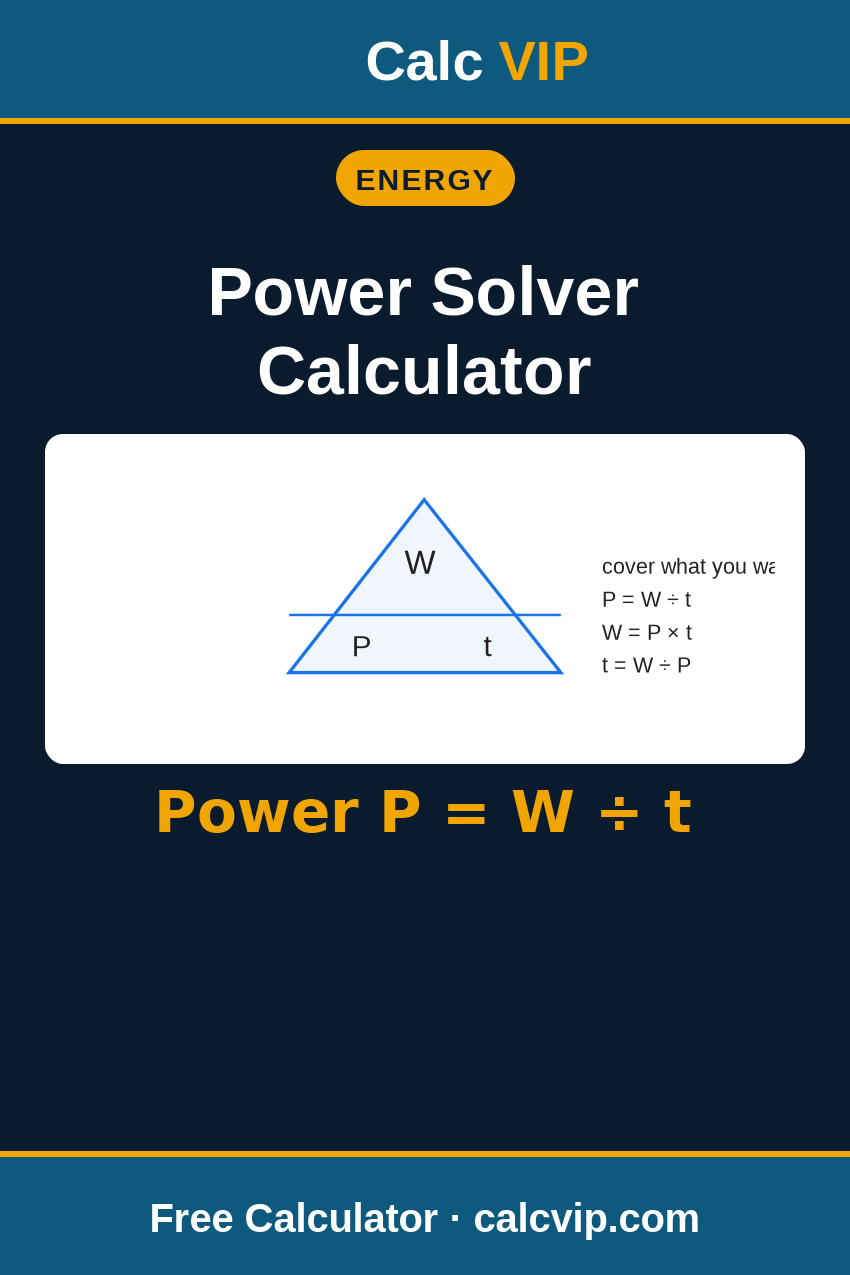
Units carry the logic. Power is measured in watts, and one watt is exactly one joule per second: a 30 W device is a device that moves 30 joules every second it runs. Work (and energy in all its forms) is measured in joules, and time in seconds. Keep everything in those three units and the equation cannot go wrong. The traps — minutes instead of seconds, kilowatt-hours mistaken for kilowatts — are all unit traps, and the sections below call out each one.
Formula
Power P = W ÷ t • P in watts (W), W in joules (J), t in seconds (s)
The equation rearranges into all three forms: P = W ÷ t when you know the work and the time, W = P × t when you know the power and how long it acts, and t = W ÷ P when you know the work and the rate. Because a watt is a joule per second, the three forms are guaranteed consistent: multiply watts by seconds and the seconds cancel, leaving joules; divide joules by watts and you are left with seconds. Larger power units slot straight in — 1 kilowatt = 1,000 W and 1 megawatt = 1,000,000 W — and the energy unit of electricity bills, the kilowatt-hour, is just the W = P × t form with power in kilowatts and time in hours: 1 kWh = 3.6 million joules. This calculator works in watts, joules and seconds throughout; convert into them first and convert the answer afterwards if you need another unit.
| Symbol | Meaning | Units |
|---|---|---|
| P | power — the rate of doing work or transferring energy | watts (W) = joules per second |
| W | work done / energy transferred | joules (J) |
| t | time over which the work is done | seconds (s) |
Average power, peak power — and why the rate is what you feel
The P in this equation is almost always an average: total work divided by total time. Real processes rarely run at a steady rate. A weightlifter's power spikes enormously during the half-second of the lift and is zero while they rest between attempts; a kettle draws a steady 2,000 W until it clicks off, then nothing. Averaging hides those peaks, and sometimes the peak is the number that matters — a fuse, a muscle and a motor winding all care about the highest rate they must survive, not the average. When a problem gives you a single work and a single time, the average is the honest answer; just remember it is a summary, not a moment-by-moment record.
Rate is also what separates machines that look equal on paper. Two hoists that each lift a load through the same height do identical work; the one that finishes in half the time is a motor of twice the power, and it will be built — and priced — accordingly. This is why power, not work, is the headline specification on engines, motors, heaters and chargers: it measures capability per second. A 30 W phone charger and a 10 W charger store the same energy in the phone eventually; the 30 W unit simply delivers each joule three times as fast, which is the entire selling point.
How to use
- Choose what you want to find from the dropdown: power, work or time. The two input boxes you need appear automatically.
- Enter the two values you know — work in joules, power in watts, time in seconds. Convert minutes to seconds (× 60) and kilowatt-hours to joules (× 3,600,000) before entering.
- Click "Solve" to get the missing quantity.
- Sanity-check the size: a few watts is a phone charger, tens of watts a laptop, around 100 W a bright old bulb or a resting human's total energy output, thousands of watts a kettle or heater, and 100,000 W (100 kW) a family car engine. An answer far outside the expected band usually means a minutes-versus-seconds slip.
Worked examples
Example 1 — solving for power, then checking both reverses. A machine does 600 J of work in 20 s.
P = W ÷ t = 600 ÷ 20 = 30 W. Run the triangle backwards to confirm: W = P × t = 30 × 20 = 600 J, and t = W ÷ P = 600 ÷ 30 = 20 s. All three forms agree, as they must — they are one equation wearing three hats.
Example 2 — a kettle's energy. A 2,000 W kettle boils for 3 minutes (180 s).
W = P × t = 2,000 × 180 = 360,000 J (360 kJ). In bill units that is 360,000 ÷ 3,600,000 = 0.1 kWh — one boil costs a tenth of a unit of electricity, which is why kettles are expensive per minute but cheap per use.
Example 3 — a motor's power. A motor lifts a crate, doing 45,000 J of work in 90 s.
P = 45,000 ÷ 90 = 500 W — about 0.67 horsepower, a respectable small motor. Halve the time to 45 s and the same job would demand 1,000 W: the work is fixed by the load, the power is set by your impatience.
Example 4 — how long will the battery last? A battery pack stores 54,000 J (15 Wh) and a device draws 30 W.
t = W ÷ P = 54,000 ÷ 30 = 1,800 s = 30 minutes. This is the runtime calculation behind every "hours of use" claim on every battery product — energy divided by rate.
Example 5 — timing a climb. A climber's muscles must do 12,000 J of work against gravity, and she can sustain 150 W.
t = 12,000 ÷ 150 = 80 s. Push the power to 300 W — a hard, short effort — and the same climb takes 40 s. The work never changes; only the rate, and therefore the time, moves.
Example 6 — a hoist over a full lift. A 250 W hoist runs for 40 s.
W = 250 × 40 = 10,000 J of work delivered — enough to lift a 100 kg load about 10 m against gravity, or a 50 kg load about 20 m. Ten kilojoules sounds modest until you picture the load at the top.
Power in real life
Chargers and "fast charging". A phone charging at 30 W instead of 10 W takes roughly a third of the time to store the same energy — the marketing phrase "fast charge" is literally this solver's time mode with a bigger P.
Engines and horsepower. Car engines are sold on power (kilowatts or horsepower, 1 hp ≈ 746 W) because buyers care about the rate: how quickly the car can gain speed or climb. A 100 kW engine does 100,000 J of work every second at full throttle.
Electricity bills. Your bill multiplies power by time: appliances in kilowatts, hours of use, giving kilowatt-hours. Every line of an energy audit is the W = P × t form of this equation.
Solar panels and generation. A power station's rating — megawatts — is its rate of energy delivery. A 500 MW station produces 500 million joules each second; over a day that is a work figure in the tens of trillions of joules.
Athletes as engines. A trained cyclist sustains about 250–400 W for an hour; a sprinting human briefly exceeds 1,000 W. Sports science measures performance in watts precisely because work alone ignores the rate that wins races.
Data centres and cooling. Every watt of computing becomes a watt of heat, so a server hall drawing 1 MW needs a megawatt of cooling power too. Facility design is this equation applied twice.
The kilowatt-hour: power × time wearing a disguise
There is a practical reason electricity is sold this way. Joules are inconveniently small for household bookkeeping — a kettle's single boil is 360,000 of them — while the kilowatt-hour is sized to daily life: a home uses perhaps 10–30 kWh a day, a readable number on a bill. The physics is unchanged; only the packaging differs. Engineers make the same choice in the other direction for very large systems, quoting power-station output in megawatts and national consumption in terawatt-hours, each step just a factor of a thousand applied to the same P × t product.
The kilowatt-hour confuses more people than any other unit in everyday physics, because it sounds like a rate and is actually an amount. It is the work done when a power of 1 kW acts for 1 hour: W = P × t = 1,000 W × 3,600 s = 3,600,000 J. So a kWh is simply 3.6 million joules with a friendlier name. The confusion bites in sentences like "the heater uses 2 kWh per hour" — what is meant is that the 2 kW heater, run for one hour, uses 2 kWh. Whenever you meet kWh, translate it back through this solver: divide the energy by the time to recover the power, or by the power to recover the time. Example 2 above did exactly this in reverse, turning a kettle's 360,000 J into 0.1 kWh.
Horsepower and other power units
Watt's definition was deliberately generous to horses — he measured a strong horse's output and padded the figure so no customer could claim his engine underperformed the animal it replaced. The unit's survival three centuries later, long after the comparison stopped mattering, is a lesson in how specifications stick: buyers understood "50 horsepower" viscerally in a way "37 kilowatts" still struggles to match, so brochures print both.
James Watt coined the horsepower to sell steam engines against the horses they replaced, defining it as 550 foot-pounds per second — in modern units, about 746 W. It survives on car specifications and motor plates: a 500 W motor (Example 3) is 500 ÷ 746 ≈ 0.67 hp, and the 30 W of Example 1 is barely 0.04 hp — a reminder that one horse is a genuinely powerful animal, sustaining roughly ten times a human's output. Other units you may meet: the British thermal unit per hour for heating systems, and calories per day for human metabolism (a 2,000 kcal/day diet is an average power of about 100 W — you are, thermally speaking, a bright light bulb). Whatever the unit, convert to watts and this solver's three forms apply unchanged.
Quick reference: familiar powers
| Device / source | Power | Work in 1 hour |
|---|---|---|
| LED bulb | 10 W | 36,000 J |
| laptop | 65 W | 234,000 J |
| resting human (heat) | 100 W | 360,000 J |
| electric kettle | 2,000 W | 7,200,000 J = 2 kWh |
| family car engine | 100,000 W (100 kW) | 360,000,000 J = 100 kWh |
Read the table through the solver's eyes: the right-hand column is just the middle column multiplied by 3,600 s, and dividing any right-hand figure by its power returns exactly one hour. Power is the rate; work is what the rate accumulates. Notice too how the table spans seven orders of magnitude, from a 10 W bulb to a 100,000 W engine — one reason the watt needs its kilo- and mega- prefixes so often.
Common mistakes
- Using minutes instead of seconds. The equation demands seconds. Three minutes is 180 s; entering "3" shrinks the work sixty-fold (Example 2's 360,000 J would collapse to 6,000 J). Convert time first, always.
- Confusing kilowatts with kilowatt-hours. A kilowatt is a rate; a kilowatt-hour is an amount of energy (3.6 million joules). A "2 kWh heater" almost always means a 2 kW heater — check which quantity the sentence is really giving you before choosing a mode.
- Treating average power as the whole story. P = W ÷ t gives the average rate. A machine that pulses — a lift, a press, a sprinter — has peaks far above its average, and motors, fuses and muscles must be sized for the peak.
- Dividing in the wrong direction. Power is work ÷ time, not time ÷ work. If your "power" comes out as a small decimal for a kettle, you have inverted the fraction — watts should feel like joules-per-second, a rate, not seconds-per-joule.
- Forgetting that time must be positive. Zero or negative times have no physical meaning here: no finite power does work in no time. If a problem seems to need t = 0, it is asking about an idealised instant, not a solvable rate.
FAQ
How do I find work if I only know power and time?
Multiply them: W = P × t. A 100 W bulb left on for 60 s uses W = 100 × 60 = 6000 J of energy.
Can time be zero?
No. Dividing by zero is impossible — power is the rate of doing work over some time interval, so the time must be greater than zero.
What is the difference between power and work?
Work is the total energy transferred (joules); power is how fast it is transferred (watts = joules per second).
What is a watt, exactly?
One watt is one joule of energy transferred per second. A 30 W device moves 30 joules every second it operates — the unit is named after James Watt, of steam-engine fame.
How do I convert horsepower to watts?
Multiply by about 746. A 2 hp motor is roughly 1,492 W, and a 100 hp car engine is about 74,600 W (74.6 kW). To go the other way, divide watts by 746.
Why does a bigger charger charge a phone faster?
Because the energy the battery must store is fixed, and time = energy ÷ power. Doubling the charger's watts halves the charging time (ignoring real-world losses and tapering near full charge).
Is a kilowatt-hour a unit of power or energy?
Energy. It is power (kW) multiplied by time (h): 1 kWh = 3.6 million joules. Your electricity bill charges for energy, and the kilowatt-hour is just its convenient packaging.
Can power be negative?
In richer physics, yes — a braking force or a battery being charged can be described with negative power, meaning energy flows the other way. This solver deals with magnitudes: how much work, how fast, how long.
What power can a human produce?
About 100 W sustained as useful mechanical work for an untrained person, 250–400 W for a trained cyclist over an hour, and over 1,000 W for a few seconds in a sprint or a lift. As heat, a resting human radiates roughly 100 W continuously.
How does power relate to force and speed?
For a force pushing something along at a steady speed, P = F × v. A 500 N force moving its object at 2 m/s delivers 1,000 W. It is the same equation in disguise: force × distance is work, and distance ÷ time is speed.