 Calc
Pump Power Calculator – P = ρgQh with Efficiency
 Created by Priya Sharma · Physics Editor · Energy & Gravity · Last updated: November 2026
Use this free Pump Power Calculator to find the power needed to lift a liquid to a given height. Enter the density, flow rate and lift height (head), and optionally the pump efficiency to find the electrical input power the motor must supply.
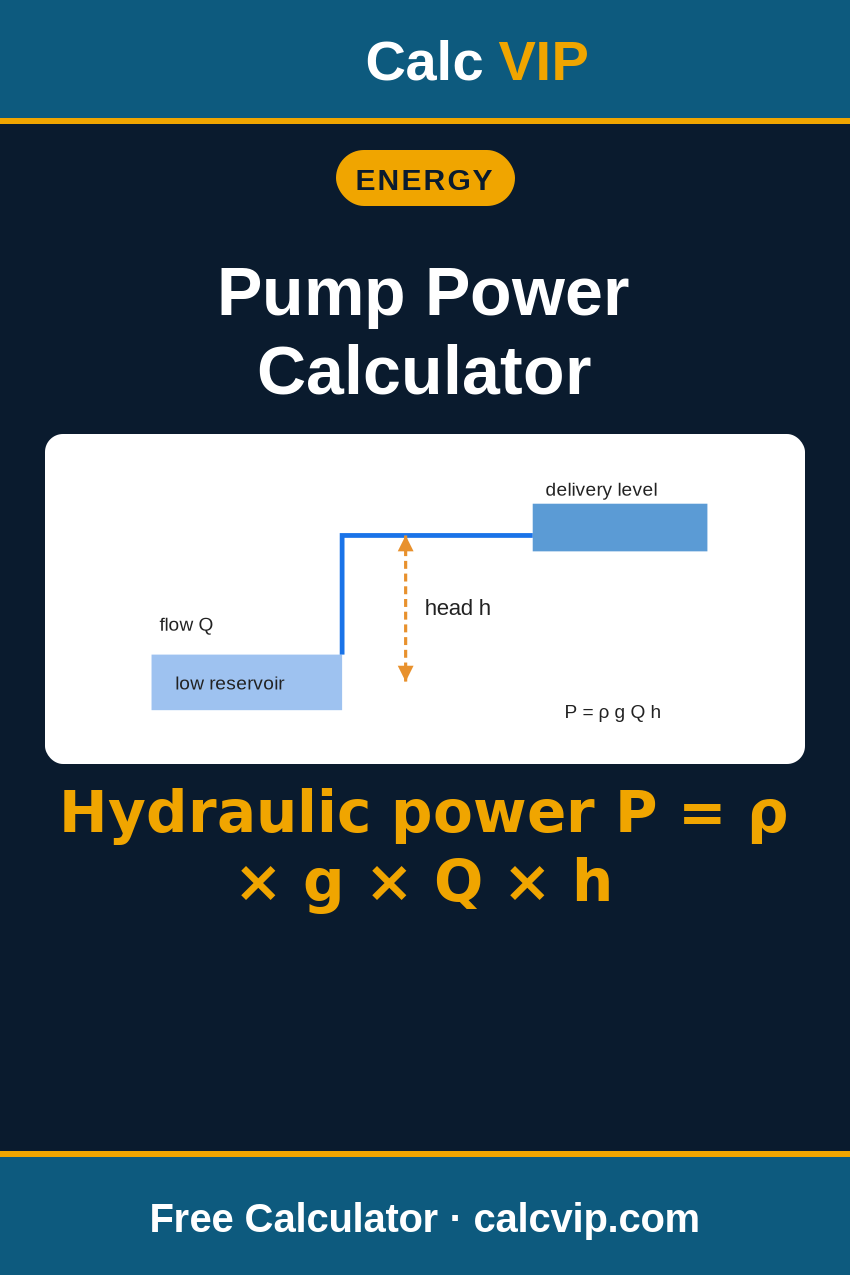
Every pump is a machine for giving liquid potential energy. Water sitting in a well, a sump or a tanker has to be raised — against gravity, metre by metre — and the power required to do it at a given flow rate follows one compact formula: P = ρgQh. Density, gravity, flow rate and head, multiplied together, give the hydraulic power — the rate at which the liquid gains energy. This calculator computes that power and, when you supply an efficiency, works backwards to the larger electrical input power the motor must actually draw.
The formula rewards a second look, because each factor has a physical voice. Density ρ says how heavy each cubic metre is. Flow rate Q says how many cubic metres per second are on the move. Their product, ρQ, is a mass flow — kilograms per second being lifted. Multiply by g and you have a weight flow, newtons per second; multiply by the head h and each newton is raised h metres, giving joules per second: watts. A pump calculation is bookkeeping on a river of weight, and P = ρgQh is its ledger line.
The efficiency correction is where honest engineering begins. No pump converts all its input into lifting: turbulence, friction in the casing, recirculation and motor losses all take a cut, typically leaving 60–80% of the input as useful hydraulic power. The calculator's optional efficiency field therefore matters — the hydraulic power sizes the job, but the input power sizes the motor, the cable and the electricity bill. Confusing the two is the classic way to buy a pump that stalls.
Formula
Hydraulic power P = ρ × g × Q × h • Input power = P ÷ efficiency • g = 9.81 m/s²
Read the formula as a sentence: ρ × Q is the mass lifted per second (kg/s); multiplying by g converts mass to weight (N/s); multiplying by h raises that weight through the head, giving joules per second — watts. Every factor is directly proportional to the power: double the flow, double the power; double the head, double the power; pump seawater (ρ = 1,025 kg/m³) instead of fresh water and the power rises 2.5%. The efficiency enters as a divisor on the input side: input power = hydraulic power ÷ (efficiency ÷ 100). At 75% efficiency the motor must draw a third more than the hydraulic figure — 1,962 W of lifting needs 2,616 W of electricity. The calculator uses g = 9.81 m/s² and reports both powers in watts and kilowatts, rounded to two decimal places.
| Symbol | Meaning | Units |
|---|---|---|
| P | hydraulic power delivered to the liquid | watts (W) |
| ρ | liquid density | kg/m³ (water: 1,000) |
| Q | volume flow rate | m³/s |
| h | head — vertical lift height | metres (m) |
| η | pump efficiency (fraction of input that becomes lifting) | % (0–100) |
Head: the height that matters is not just the height you see
The h in this formula is the total head: the vertical distance between the surface of the source liquid and the point of delivery — not the height of the pump, not the length of the pipe. A pump sitting halfway up a hill still lifts water the full distance from the well's surface to the tank's inlet. Engineers then add a second, invisible contribution: friction head. Water dragging through pipes, elbows and valves resists motion exactly as if the lift were taller, and at high flow rates through narrow pipes this friction head can rival the real one. The calculator's h should therefore be the static lift plus an allowance for friction whenever the pipe run is long or thin — underestimate h and the real pump falls short in exact proportion.
The same head idea explains why priming matters and why pumps are rated in metres at all. Manufacturers quote head rather than pressure because head is liquid-independent: a pump that generates 30 m of head lifts water 30 m, petrol about 40 m (the lighter liquid climbs higher for the same pressure) and brine a little less than 30 m. Pressure depends on the liquid; head describes the machine. When you shop for a pump, its head rating is the promise; this formula is how you check whether the promise covers your hill, your well or your tank — with the density of your liquid doing the translation.
Head also explains a pump's personality. A given pump trades flow against head along its performance curve: ask it to lift higher and it delivers less; open the discharge wide and the flow surges while the head collapses. The formula P = ρgQh sits at the centre of that trade — the product Q × h is what the power buys, and the pump's design decides how the product splits. When you use this calculator to size a motor, you are really choosing a point on that curve: the duty point where your required flow meets your required head, with power to spare for friction's quiet tax.
How to use
- Enter the liquid's density in kg/m³ — 1,000 for fresh water (pre-filled), 1,025 for seawater, about 750 for petrol, 870 for many oils.
- Enter the flow rate Q in cubic metres per second. Convert from litres per second by dividing by 1,000 (20 L/s = 0.02 m³/s); from litres per minute, divide by 60,000.
- Enter the head h in metres: the vertical lift from source surface to delivery point, plus a friction allowance for long or narrow pipes.
- Optionally enter the pump efficiency in percent to get the electrical input power. Click "Calculate Pump Power" and note both figures — hydraulic for the job, input for the motor and the bill.
Worked examples
Example 1 — the manifest check, with efficiency. Water (ρ = 1,000) flows at Q = 0.02 m³/s (20 L/s) lifted through h = 10 m.
P = 1,000 × 9.81 × 0.02 × 10 = 1,962 W (1.96 kW) of hydraulic power. At 75% efficiency the motor must draw 1,962 ÷ 0.75 = 2,616 W — the figure that sizes the motor, not the 1,962.
Example 2 — a bigger lift. Water at Q = 0.05 m³/s (50 L/s) raised 20 m.
P = 1,000 × 9.81 × 0.05 × 20 = 9,810 W (9.81 kW). Doubling both the flow and the head of Example 1 multiplied the power fivefold between the two examples' combined changes — each factor pulls its own weight.
Example 3 — a garden pump. Water at Q = 0.001 m³/s (1 L/s) lifted 5 m to a raised bed.
P = 1,000 × 9.81 × 0.001 × 5 = 49.05 W of hydraulic power — a small pump indeed, though at a realistic 60% efficiency the motor still draws about 82 W. Small jobs stay small; the formula scales down as gracefully as up.
Example 4 — a deep well at modest efficiency. Water at Q = 0.01 m³/s lifted 50 m from a borehole, pump efficiency 60%.
Hydraulic power = 1,000 × 9.81 × 0.01 × 50 = 4,905 W; input = 4,905 ÷ 0.60 = 8,175 W. Depth is expensive twice over: the head multiplies the power, and deep-well pumps are rarely the most efficient.
Example 5 — seawater. Seawater (ρ = 1,025) at Q = 0.03 m³/s lifted 15 m into a marina tank.
P = 1,025 × 9.81 × 0.03 × 15 = 4,524.86 W. The salt adds only 2.5% over fresh water — density is the gentlest of the four factors, which is why the same pumps serve both with minor derating.
Example 6 — pumping petrol. Petrol (ρ = 750) at Q = 0.01 m³/s raised 8 m into a storage tank.
P = 750 × 9.81 × 0.01 × 8 = 588.6 W. A lighter liquid needs less power for the same flow and lift — one reason fuel transfer pumps are modest machines despite the valuable cargo.
Pump power in real life
Domestic water supply. Homes on wells and booster systems live inside Example 1's territory: a couple of kilowatts lifts a household's water from a borehole or to a rooftop tank, and the efficiency figure decides the quarterly cost of every shower.
Irrigation. Farms move serious water: tens of litres per second through tens of metres of head. Example 2's arithmetic, scaled by a growing season's hours, becomes one of agriculture's largest energy costs — and the strongest argument for efficient pumps.
Building services. Tall buildings are pumped in stages, each stage a ρgQh calculation with its own head. The total energy of lifting a city's water to its taps is a quiet, enormous line in urban energy use.
Flood and drainage pumping. Storm pumps trade head for flow: low lift, enormous Q. The formula shows why they still need megawatts — flow is a full multiplier, and a river's worth of kilograms per second is heavy at any height.
Aquariums, pools and water features. Small pumps, small numbers — Example 3's tens of watts — but they run all day, every day. Power × hours turns the modest pump into a real annual cost, worth calculating before buying the oversized model.
Industrial transfer. Refineries and chemical plants pump everything from petrol (Example 6) to syrups far denser than water. Density stops being a footnote when the liquid is brine, slurry or oil, and the formula's ρ earns its place.
Efficiency: where the missing watts go
The gap between input and hydraulic power is not bookkeeping fiction; it is heat, noise and wear. In the pump itself, water recirculates through clearances, churns against the casing and shears in turbulence — all converting shaft work into warm water. In the motor, electrical resistance and magnetic losses take their own share before the shaft even turns. A 75%-efficient system (Example 1) discards 654 W continuously — a small fan heater's worth, warming the pump room around the clock. Efficiency also moves: a pump is most efficient at one duty point (its best efficiency point) and falls away on either side, which is why matching the pump to the job — not oversizing it "for safety" — is the professional's refrain. Oversized pumps throttled back by a valve burn the surplus as friction head, paying full price for power deliberately thrown away.
Series, parallel and the shape of systems
One more real-world correction deserves mention: suction conditions. A pump can only push water up its discharge if water reaches it reliably from below. Lift water too far on the suction side — beyond about 7–8 metres at sea level in practice — and the pressure at the pump inlet falls so low that the water boils at room temperature, forming vapour bubbles whose collapse (cavitation) chews impellers apart and destroys performance. This is why deep wells use submersible pumps that sit in the water and push rather than pull: the head formula is unchanged, but the pump's position respects the suction limit. When a surface pump rattles like gravel and delivers poorly, cavitation from excessive suction lift is the first diagnosis.
Real installations combine pumps, and the combinations follow the formula's logic. Two identical pumps in series — one's discharge feeding the other's suction — add their heads at the same flow: the pair lifts twice as high, and the total power is the sum, exactly as ρgQ(2h) predicts. In parallel, they share the flow at the same head: ρg(2Q)h. Buildings use series stages to climb; waterworks use parallel sets to follow demand, switching pumps in as flow rises. Either way the accounting never changes: every kilogram per second must be paid its g × h joules, and this calculator is the meter that reads the bill before the system is built.
Quick reference: the cost of lifting water
| Job | Flow | Head | Hydraulic power |
|---|---|---|---|
| rule of thumb: 1 L/s up 1 m | 0.001 m³/s | 1 m | 9.81 W |
| garden pump | 0.001 m³/s | 5 m | 49.05 W |
| household well pump | 0.02 m³/s | 10 m | 1,962 W |
| oil transfer (ρ = 870) | 0.01 m³/s | 10 m | 853.47 W |
| irrigation set | 0.05 m³/s | 20 m | 9,810 W |
The first row is the one to memorise: lifting one litre of water per second through one metre costs about 9.81 W — call it 10 W. Scale any job from that atom and you can estimate a pump's appetite in your head before ever opening this page.
Common mistakes
- Entering flow in litres per second. The formula needs m³/s. 20 L/s is 0.02 m³/s; entering "20" inflates the power a thousandfold, turning a 2 kW pump into a fictional 2 MW one. Divide litres per second by 1,000 first.
- Measuring head to the pump instead of through it. Head is source surface to delivery point — the full vertical journey of the water. A pump halfway up the hill does not halve the head; the water still climbs all of it.
- Sizing the motor from the hydraulic power. The motor must supply the input power — hydraulic divided by efficiency. A motor matched to the hydraulic figure alone will run overloaded by exactly the efficiency gap (a third more at 75%).
- Ignoring friction head on long pipe runs. Static lift is only part of h. Long, narrow or rough pipes add friction head that grows steeply with flow; leaving it out undersizes the pump in direct proportion.
- Using water's density for every liquid. Petrol needs 25% less power than water at the same duty; brine and slurries need more. The density box exists because ρ is a genuine variable, not a constant in disguise.
FAQ
Why does the input power come out bigger than the hydraulic power?
No pump is perfect. Friction and turbulence waste energy, so at 75% efficiency only 75% of the electrical input becomes useful lifting power — the motor must draw 1962 ÷ 0.75 = 2616 W in the example above.
What happens if I double the height?
The power doubles too, because P is directly proportional to h. Doubling the flow rate Q has exactly the same effect.
How do I convert litres per second to m³/s?
Divide by 1000. For example, 20 L/s = 0.02 m³/s and 1 L/s = 0.001 m³/s.
What is head, in plain words?
The total vertical height the liquid must be raised, measured from the surface of the source to the delivery point — plus, in real systems, an allowance for friction in the pipes, which behaves like extra height.
What efficiency should I enter?
Small domestic pumps often manage 50–70%; good centrifugal pumps at their best duty point reach 75–85%. If the manufacturer's curve is available, read the efficiency at your flow and head — efficiency is not one number for a pump, it is a landscape with a peak.
Does the pipe diameter matter?
Not in the ideal formula — but strongly in reality, through friction head. A wider pipe slashes friction losses at a given flow. If your calculated power looks fine yet the installed pump struggles, undersized pipework inflating the true head is the usual suspect.
Can this calculator size a pump for a well?
Yes — that is Example 4's territory. Measure the head from the water level in the well (not the ground surface) to the delivery tank, estimate your flow, add friction allowance, and apply a realistic efficiency. The input power is your motor size, with a sensible margin.
Why does the formula use g = 9.81?
Because the pump is doing work against Earth's gravity: lifting a kilogram through a metre costs g joules. On another planet the same pump job would scale with the local g — on the Moon, one sixth the power for the same flow and head.
What is the difference between power and pressure here?
Head and pressure are cousins: a head of h metres corresponds to a pressure ρgh at the bottom of the column. Power adds the flow — pressure tells you how hard the water pushes, power tells you how fast energy is being spent to keep it pushing.
How much power lifts 1 litre per second by 10 metres?
P = 1,000 × 9.81 × 0.001 × 10 = 98.1 W of hydraulic power — about 131 W of input at 75% efficiency. The 10-watts-per-litre-per-metre rule of thumb makes such estimates instant.