 Calc
Potential Energy Solver – Find Mass or Height from PE = mgh
 Created by Priya Sharma · Physics Editor · Energy & Gravity · Last updated: November 2026
Use this free Potential Energy Solver Calculator when you know the gravitational potential energy and need the missing mass or height. Rearranging PE = mgh gives m = PE ÷ (gh) and h = PE ÷ (mg) — just pick a mode and enter the values you know.
Gravitational potential energy is stored motion-that-hasn't-happened-yet: the energy an object holds by virtue of being lifted against gravity, ready to be released the moment it is allowed to fall. Usually PE is the answer and mass and height are given. But the reverse questions are just as natural. A dam engineer knows the energy a reservoir must store and the mass of water available, and needs the height. A warehouse designer knows the energy a falling load must not exceed and its mass, and needs the safe shelf height. A planetary scientist compares the same object's stored energy on Earth and the Moon. In each case PE is the known and mass or height is the unknown — the direction this solver works.
Both rearrangements are plain divisions, with none of the square roots of the kinetic-energy world, because PE = mgh is a purely proportional formula: double the mass, double the energy; double the height, double the energy. That simplicity hides one genuinely subtle ingredient — the g. Gravitational field strength is not a universal constant like the speed of light; it is a property of the planet you are standing on, 9.81 m/s² on Earth, 1.62 on the Moon, 3.71 on Mars. This solver therefore lets you enter g yourself, which quietly turns it into a tool for every world in the solar system, not just this one.
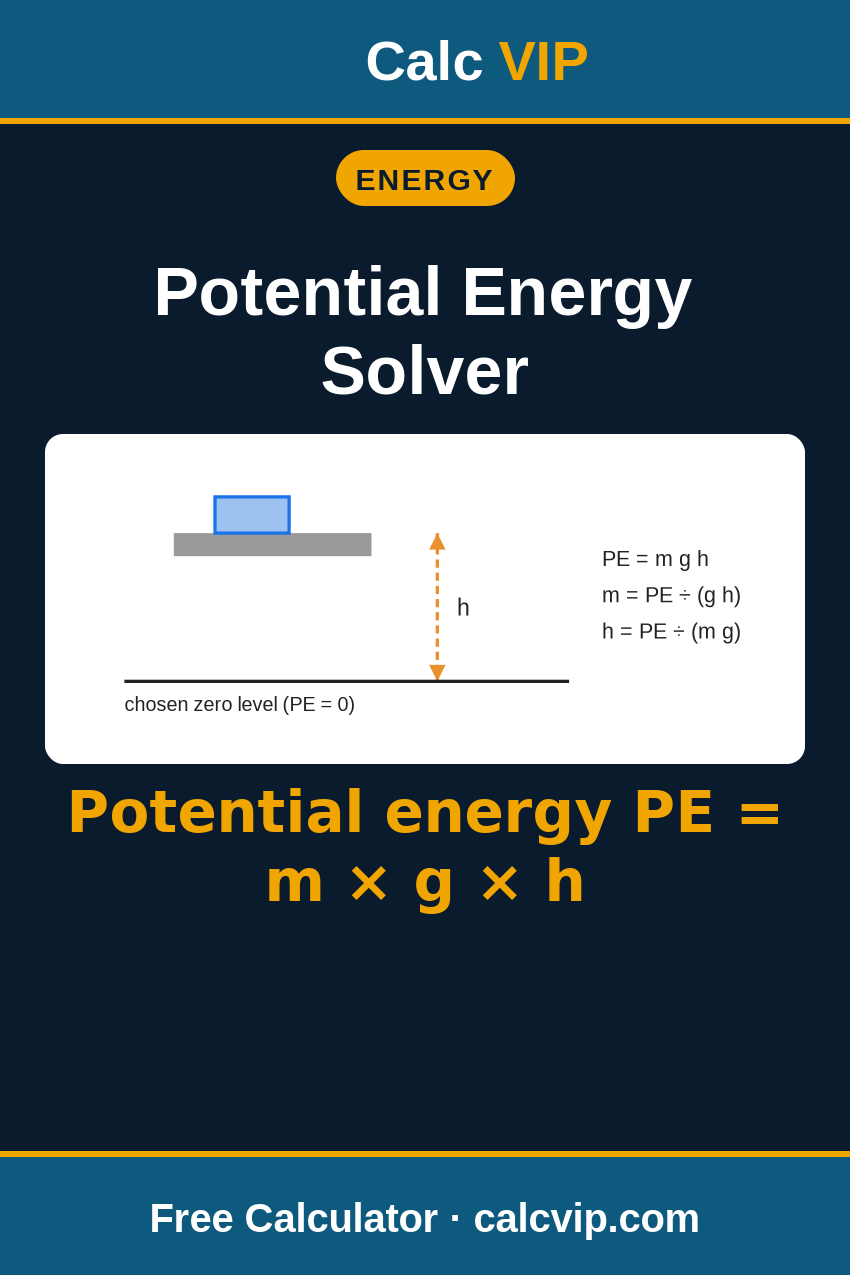
One more idea matters before the numbers mean anything: potential energy is measured from a chosen zero level. The same book on the same shelf has different PE values depending on whether you measure from the desk, the floor or the street below — and all of them are correct, because only changes in height, and so changes in PE, drive what happens next. The solver assumes your height is measured from whatever level you have chosen as zero; keep that choice consistent and the mass and height it returns are exact.
Formula
Potential energy PE = m × g × h • PE in joules (J), m in kilograms (kg), g in m/s², h in metres (m)
The solver uses the two rearrangements: m = PE ÷ (g × h) to recover the mass from the energy and height, and h = PE ÷ (m × g) to recover the height from the energy and mass. Because the formula is a straight product, every variable is directly proportional to PE: at fixed height, an object with twice the potential energy has twice the mass; at fixed mass, twice the energy means twice the height. The value of g is the one judgement call: 9.81 m/s² on Earth's surface (the calculator's default), 1.62 m/s² on the Moon, 3.71 m/s² on Mars, 24.79 m/s² on Jupiter. Use the local g and every result — energy, mass or height — belongs to that world. The calculator reports mass in kilograms and height in metres, rounded to two decimal places.
| Symbol | Meaning | Units |
|---|---|---|
| PE | gravitational potential energy | joules (J) |
| m | mass of the object | kilograms (kg) |
| g | gravitational field strength (planet-dependent) | m/s² (Earth: 9.81) |
| h | height above the chosen zero level | metres (m) |
The zero level is yours to choose — and that is a feature
New students often hunt for the "true" height of an object, as if PE were written somewhere in nature. It is not. Potential energy is defined only relative to a reference level where you declare PE = 0, and the declaration is free: the floor of the room, the ground outside, sea level, the bottom of the cliff. Physics works with every choice because nothing physical ever depends on the absolute value — only on how much PE is gained or lost when the height changes, and that difference is identical under every choice. A 10 kg mass lowered 5 m loses 490.5 J on Earth whether it descends from a shelf to a desk or from a balcony to the pavement.
Choosing a zero is not pedantry — it changes real engineering answers. A lift engineer measuring from the ground floor and a miner measuring from the shaft collar will quote different PE values for the same cage at the same moment, and both will compute identical forces, speeds and stopping distances when it moves, because those depend on differences. Textbooks that print a single PE for an object have always chosen a zero quietly; this page simply makes the choice visible.
The freedom has one discipline: consistency. Measure both heights in a problem from the same zero, and never mix. It also has one surprise — PE can be negative. Put your zero at the top of a well and everything down the shaft has negative potential energy; the mathematics handles it gracefully, and the solver's mirror-image restriction (it asks for PE of 0 or more) is a classroom simplification, not a law of nature. For the everyday problems this page serves — shelves, cranes, dams, dives — measuring from the ground keeps every number positive and every intuition intact.
How to use
- Choose what you want to find from the dropdown: mass or height. The input row you need appears automatically.
- Enter the potential energy in joules, then the value you know — height in metres for mass mode, or mass in kilograms for height mode.
- Check the g value: 9.81 m/s² is pre-filled for Earth. Change it for other worlds (Moon 1.62, Mars 3.71) or for precision work.
- Click "Solve" to get the missing quantity, and sanity-check it: on Earth, each kilogram raised each metre stores about 9.81 J, so PE ÷ 9.81 ≈ mass × height — a product your two numbers should reproduce.
Worked examples
Example 1 — the manifest check, both directions. An object stores 490.5 J at a height of 5 m on Earth (g = 9.81).
m = PE ÷ (g × h) = 490.5 ÷ (9.81 × 5) = 490.5 ÷ 49.05 = 10 kg. Reverse it: h = PE ÷ (m × g) = 490.5 ÷ (10 × 9.81) = 490.5 ÷ 98.1 = 5 m. The two modes are exact inverses.
Example 2 — a crate on a rack. A stored crate holds 1,962 J of potential energy on a rack 10 m up.
m = 1,962 ÷ (9.81 × 10) = 1,962 ÷ 98.1 = 20 kg — a two-person lift, which is exactly the kind of thing a warehouse safety officer wants to know from an energy audit.
Example 3 — how high is the shelf? A 2 kg instrument case stores 98.1 J.
h = 98.1 ÷ (2 × 9.81) = 98.1 ÷ 19.62 = 5 m — higher than a room, so the "case on a shelf" in the storeroom report must actually be on the mezzanine.
Example 4 — a crane load. A load raised by a tower crane gains 294,300 J of potential energy at a height of 30 m.
m = 294,300 ÷ (9.81 × 30) = 294,300 ÷ 294.3 = 1,000 kg — a tonne, neatly confirming the lift plan's paperwork from the energy figure alone.
Example 5 — the same object on the Moon. An astronaut's 10 kg sample case stores 81 J on the Moon (g = 1.62). How high is it?
h = 81 ÷ (10 × 1.62) = 81 ÷ 16.2 = 5 m — the same shelf height as Example 1, but storing barely a sixth of the energy. Weak gravity is a genuine safety feature: dropped tools on the Moon arrive gently.
Example 6 — a rooftop water tank. A tank's water stores 49,050 J relative to the ground-floor taps, and the water mass is 500 kg.
h = 49,050 ÷ (500 × 9.81) = 49,050 ÷ 4,905 = 10 m — three storeys up, which is exactly the head of pressure the building's plumbing enjoys for free.
Potential energy in real life
Hydroelectric storage. A reservoir is a giant PE store: energy = mgh for millions of tonnes of water. Pumped-storage stations run this solver at national scale, choosing dam heights from the energy they must bank.
Crane and lifting safety. The energy a suspended load would release in a fall is its PE. Site rules about exclusion zones under loads are, at heart, potential-energy calculations with consequences attached.
Roller coasters. The first lift hill sets the entire ride's energy budget: every later drop, loop and climb trades against the PE banked at the top. Designers solve h = PE ÷ (mg) for the hill before anything else is drawn.
Diving and falls. A diver's entry speed is fixed by the PE at the board: mgh converts to ½mv², so height alone sets the impact. Safety standards for playgrounds and work platforms are written in exactly these terms.
Spacecraft and re-entry. A satellite's orbital energy includes a huge gravitational PE term. Mission planners budget it as carefully as fuel — because, via the rocket equation, it effectively is fuel.
Grandfather clocks and weights. A weight-driven clock stores PE in its raised weights and spends it slowly through the escapement. The mass mode of this solver is, quite literally, the clockmaker's calculation for how heavy the weights must be.
One object, many worlds: the g table
Because g is an input rather than a constant, this solver doubles as a comparative planetology tool. Take the same 10 kg object at the same 5 m height and only the gravity changes: on Earth it stores 490.5 J; on the Moon, 81 J; on Mars, 185.5 J; on Jupiter, 1,239.5 J. Run any of those energies through the height mode with the local g and you recover 5 m every time — the solver is consistent across worlds because the physics is. The practical moral runs the other way: structures, landers and astronauts designed around Earth's g carry hidden assumptions. A shelf that is safe on Earth is over-engineered for the Moon and dangerously weak for Jupiter — not that anything shelves books on Jupiter.
Where PE goes: the fall and the trade with KE
The exchange also runs uphill, and it is how the stored side gets measured in practice. Nobody weighs a reservoir's potential energy directly; engineers measure the water mass and the height and multiply, exactly as this page does. Drop tests work the same way in miniature: raise a known mass to a known height, release it, and the impact energy is known before anything breaks — mgh is a promise the fall must keep. Even the humble pendulum is a PE instrument: raise the bob, and the height you gave it dictates, through this formula, the fastest speed it can possibly reach at the bottom of its swing.
Potential energy earns its name when it converts. Release the object and, metre by metre, PE drains away as kinetic energy fills up: mgh at the top becomes ½mv² at the bottom, with the total constant if friction stays out of the story. This is why Example 5's Moon case matters beyond arithmetic — the same 5 m drop that delivers 490.5 J of impact energy on Earth delivers only 81 J on the Moon, and the landing speed differs by the square root of that ratio. Divers, coaster designers and drop-test engineers all live inside this exchange rate. The solver gives you the stored side of the ledger; the kinetic-energy solver on this site reads the spent side, and the two pages are designed to be used as a pair.
Quick reference: g and stored energy across worlds
| World | g (m/s²) | PE of 10 kg at 5 m | Energy per kg per metre |
|---|---|---|---|
| Moon | 1.62 | 81 J | 1.62 J |
| Mars | 3.71 | 185.5 J | 3.71 J |
| Earth | 9.81 | 490.5 J | 9.81 J |
| Jupiter | 24.79 | 1,239.5 J | 24.79 J |
The right-hand column is the quickest sanity check in this whole topic: on Earth, every kilogram raised every metre banks about 9.81 J — call it 10 J for mental arithmetic — and any answer that strays far from mass × height × 10 deserves a second look.
Common mistakes
- Using g = 10 silently, then quoting three significant figures. g = 10 m/s² is a fine mental shortcut (it turns 490.5 J into 500 J), but it is a 2% approximation. If your inputs carry three or four significant figures, use 9.81 — the calculator's default — so the answer deserves its precision.
- Measuring height from the wrong zero. Height is measured from your chosen PE = 0 level, consistently. Mixing a height-from-the-desk with a height-from-the-floor inside one problem corrupts everything downstream.
- Forgetting that g is local. Energies computed with Earth's g do not transfer to the Moon or Mars. If the problem changes planets, change g — the solver's editable g box exists for exactly this.
- Confusing mass and weight. The m in mgh is mass in kilograms, not the reading on a scale in newtons. A "70 kg person" has mass 70 kg and weight about 687 N on Earth; the formula wants the 70.
- Expecting PE to be an absolute property of the object. The same object at the same place has different PE values under different zero choices. Only differences matter — if a question asks for "the" potential energy without a reference level, it has silently assumed the ground.
FAQ
How much potential energy would the same object have on the Moon?
Much less, because g is smaller. A 10 kg object at 5 m on the Moon (g = 1.62 m/s²) stores PE = 10 × 1.62 × 5 = 81 J, compared with 490.5 J on Earth.
From where is the height measured?
Height is measured from the level you choose as PE = 0 — usually the ground or the lowest point the object can fall to. Only the change in height matters.
Can potential energy be negative?
It can be if the object is below your chosen zero level, but for everyday problems PE is measured from the ground and is zero or positive.
Why does the calculator let me change g?
Because g is a property of the planet, not a universal constant: 9.81 m/s² on Earth, 1.62 on the Moon, 3.71 on Mars, 24.79 on Jupiter. The same mass at the same height stores very different energies on different worlds, and the editable g makes those comparisons exact.
What is the difference between potential energy and kinetic energy?
Potential energy is stored by position — being raised against gravity. Kinetic energy is held by motion. A falling object trades the first for the second, metre by metre, keeping the total constant when friction is negligible.
How much energy does 1 kg gain per metre lifted on Earth?
g joules: 9.81 J per kilogram per metre. It is the handiest rule of thumb in this topic — a 10 kg bag lifted 2 m gains about 196 J, which you can check exactly in height or mass mode.
Does PE depend on the path taken to lift the object?
No — only on the vertical height gained. Carrying a box up a ramp, a lift or a spiral stair to the same floor stores identical PE; the paths differ in effort and time, not in the energy banked.
Can this solver find the potential energy itself?
Multiply the three quantities directly: PE = m × g × h. This solver is for the reverse problems, when PE is already known and the mass or height is missing.
Why does the solver refuse a height of zero in mass mode?
At h = 0 the potential energy is zero whatever the mass, so no mass can be recovered from "0 m and some joules" — the information is not there. Any positive height, however small, makes the problem solvable.
Is gravitational PE the only kind of potential energy?
No. Springs store elastic potential energy (½kx²), charges store electric potential energy, and chemical bonds store chemical potential energy. This page covers the gravitational kind — the one that depends on height.