 Calc
Roller Coaster Calculator – Speed at a Lower Height
 Created by Priya Sharma · Physics Editor · Energy & Gravity · Last updated: November 2026
Use this free Roller Coaster Energy Calculator to find a car's speed at a lower point of the track. As the car drops, potential energy turns into kinetic energy — enter the start height, the lower height and the starting speed.
A roller coaster is the conservation of energy with seats attached. The only hard work of the whole ride happens in the first minute, when the chain lift (or a launch motor) hauls the train up the tallest hill, banking energy into it as height. From that moment the ride is an exchange: height is spent to buy speed on every descent, and speed is spent to buy height back on every climb, with friction quietly taxing each transaction. This calculator performs one such exchange — give it the height where the car starts, the height of a lower point, and the starting speed, and it returns the speed at the lower point.
The governing equation has a liberating consequence: the mass cancels. A full train and an empty one, a heavy car and a light one, all reach the same speed after the same drop, because doubling the mass doubles both the potential energy available and the kinetic energy needed. It also means the shape of the track between the two points is irrelevant — a vertical plunge and a long, swooping descent between the same two heights deliver the same speed at the bottom. Only the vertical drop is spent; the route is free.
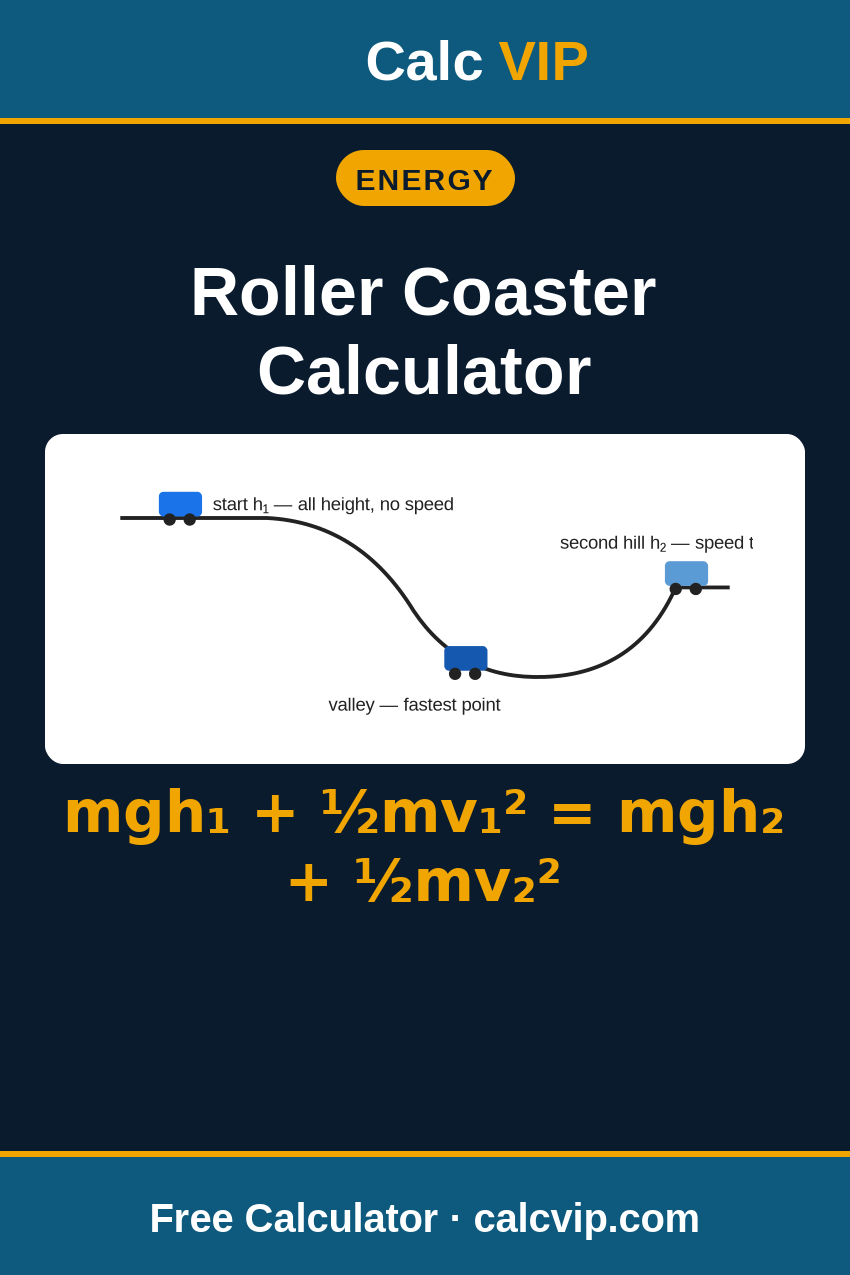
Designers think in exactly these terms, budgeting height like money. The first hill must be the tallest because every later element — hills, loops, helices — has to be bought out of the original deposit, minus friction's steady withdrawals. When a proposed hill would cost more height than the train has left, the design fails on paper before it can fail in steel. Enter any two heights below and you are doing the same audit the engineers do, one drop at a time.
Formula
mgh₁ + ½mv₁² = mgh₂ + ½mv₂²
The mass cancels, giving v₂ = √(v₁² + 2g(h₁ − h₂)), with g = 9.81 m/s². Read it as an audit: the speed at the lower point is built from the speed you already had (v₁²) plus the speed the drop itself buys (2g × height lost). The same equation rearranges to find the height a car can reach: it coasts upward until v₂ = 0, at a height of h₁ + v₁²/(2g) — its starting height plus the "height value" of its speed. If the target point is higher than that ceiling, the quantity inside the square root goes negative and the calculator reports, correctly, that the car cannot get there: it stops and rolls back first. Heights are vertical metres, speeds are m/s (the calculator also reports km/h), and the answers are the frictionless ideal — real trains arrive a few percent slower, as the mistakes section discusses.
| Symbol | Meaning | Units |
|---|---|---|
| h₁ | height of the starting point | metres (m) |
| h₂ | height of the lower point | metres (m) |
| v₁ | speed at the starting point | m/s |
| v₂ | speed at the lower point | m/s |
| g | gravitational field strength | 9.81 m/s² |
| m | mass of the car (cancels out) | kilograms (kg) |
The track is a bank: height is money, speed is change
Picture the train's total energy as a fixed sum of money held in two pockets: height (potential energy) and speed (kinetic energy). Descending moves money from the height pocket to the speed pocket; climbing moves it back. The exchange rate is set by gravity and never fluctuates: each metre of height is worth exactly g joules per kilogram, and speed is bought at the square-law price of ½v² joules per kilogram. This is why the calculator needs only the two heights and the starting speed — the balance in the pockets at any point is fully determined by how much height has been spent, and the path taken between the points neither earns nor costs anything in the ideal accounting.
Friction is the bank's fee, and it explains every difference between this page and a real ride. Rolling resistance, bearing friction and air drag all convert mechanical energy into heat, a little on every metre of track. A real train cresting the second hill is therefore always slightly poorer than the ideal audit says — which is why designers build in margin, why the first hill towers over everything after it, and why a coaster on a cold, windy morning (thicker grease, denser air) can feel a touch more sluggish than the same ride in July. The ideal formula is not wrong; it is the budget before fees, and engineers design to the budget after fees.
The bank picture also explains the ride's emotional script. The slowest moment is the crest of the first hill — all height, no speed, a held breath. The fastest is the valley floor, where the account is briefly all speed. Airtime hills are shaped so the train arrives with speed to spare, briefly unloading the seats; brake runs at the end are where the remaining balance is deliberately burned off as heat in the brake fins. Every sensation on the ride corresponds to a line in the ledger this calculator keeps.
How to use
- Enter the height where the car starts, in metres (m).
- Enter the height of the lower point, in metres (m) — measure both from the same ground level.
- Enter the starting speed (leave 0 if the car starts from rest, as at the top of a lift hill).
- Click "Calculate Speed at Lower Height" to see the height dropped, the speed in m/s, and the same speed in km/h.
- To test whether the car can climb to a higher point, enter that higher height as h₂: if the starting speed cannot pay for the climb, the calculator tells you the car would stop and roll back.
Worked examples
Example 1 — the headline drop. A car starts from rest at a height of 20 m. At a lower point of 5 m it has dropped 15 m, so v₂ = √(0 + 2 × 9.81 × 15) = √294.3 = 17.16 m/s (61.76 km/h). Fifteen metres of height bought over 60 km/h — the standard exchange that makes a modest-looking coaster feel fast.
Example 2 — all the way to the ground. The same car continuing to the very bottom, h₂ = 0: v₂ = √(2 × 9.81 × 20) = √392.4 = 19.81 m/s (71.31 km/h). The last 5 m of drop added only 2.65 m/s, while the first 5 m (from 20 m down to 15 m) would have bought 9.90 m/s from rest. Speed gets more expensive the faster you already are — the square law collecting its tax at the bottom of every hill.
Example 3 — arriving with speed. A launched coaster enters a drop at 5 m/s, from 30 m down to 10 m: v₂ = √(5² + 2 × 9.81 × 20) = √(25 + 392.4) = √417.4 = 20.43 m/s. The starting speed contributed its square, 25, to the total — worth barely 0.6 m/s on top of the drop's own contribution. Height is the senior partner in this equation; a running start is small change.
Example 4 — over the loop. A train crests the lift hill at 25 m from rest and reaches the top of a loop whose highest point is 12 m: v₂ = √(2 × 9.81 × 13) = √255.06 = 15.97 m/s at the top of the loop. Whether that is enough to stay on the track is a separate question — answered in the depth section below — but energy alone guarantees the speed is there to be spent.
Example 5 — the hill it cannot climb. A car at 15 m moving at 4 m/s approaches an 18 m hill. Its maximum reachable height is h₁ + v₁²/(2g) = 15 + 16 ÷ 19.62 = 15.82 m — more than 2 m short. The car would stall on the slope and roll back, which is why real coasters are designed so this never happens outside a breakdown: a train "valleying" between hills is an operations team's whole afternoon.
Example 6 — a world-class drop. A hypercoaster's first drop of 45 m, taken from rest: v₂ = √(2 × 9.81 × 45) = √882.9 = 29.71 m/s = 106.97 km/h at the bottom. Real trains record a little less — friction and air resistance collect their fee — but the ideal figure is the one the structure, restraints and brakes are all designed around.
Roller-coaster energy in real life
Why the first hill is always the tallest. The lift hill is the ride's only deposit. Every later hill, loop and turn must be bought from it, with friction skimming each transaction, so each successive element must be lower than the last. A coaster whose third hill matched its first would stall on it — the audit in Example 5, written in steel.
Bobsled and luge tracks. A bobsled run is a roller coaster on ice with the same ledger: start height is spent on speed, and the sled that wastes least on friction and skidding wide wins. Runners polish runners and drivers memorise lines because the energy budget is fixed at the start gate — there is no engine to top it up.
Ski jumping. The jumper's in-run converts the height of the ramp into takeoff speed; the flight and landing slope are shaped so the jumper lands moving along the hill, not into it. Judges' distance marks are, at bottom, a measurement of how well height was converted to speed and then to flight.
Marble runs and toy tracks. Every marble run and toy-car loop obeys this page exactly: the marble must start high enough to pay for every rise in the track, plus friction's fee, or it stalls and rolls back. Children debugging a marble run are doing coaster engineering — lowering a hill here, raising the start there — with the same equation.
Pirate ship and pendulum rides. A swinging ship is a coaster folded into an arc: height at the extremes trades for speed at the bottom of the swing, over and over, while the motor merely replaces what friction steals each pass. The biggest ships swing high enough that the bottom speed passes 70 km/h — from a standing start, bought entirely with height.
Downhill cycling. A cyclist descending a mountain pass is a one-person coaster: the drop buys speed at √(2g × drop) before air resistance caps it. The cap arrives when drag spends energy as fast as height supplies it — terminal velocity for a rider is around 50–70 km/h depending on tuck, which is why descenders obsess over aerodynamics rather than pedalling.
Loops: energy is necessary but not sufficient
Arriving at the top of a loop with speed is only half the requirement — the car must also stay pressed to the track. At the top of a circular loop of radius r, gravity alone can provide the centripetal acceleration for speeds up to √(gr); go slower than v = √(gr) and the car would fall away from the rail (modern coasters have up-stopper wheels that prevent disaster, but the ride would be ruined). For a loop of radius 6 m — 12 m tall — the minimum top speed is √(9.81 × 6) = 7.67 m/s. Example 4's train arrives at 15.97 m/s, more than double the minimum, so it presses hard into the track and riders feel heavy, not floaty. Real loops are clothoid-shaped — tighter at the top, gentler at the bottom — precisely to manage this: the smaller radius at the top lowers the required speed where the train is slowest, while the wider bottom keeps forces bearable where the train is fastest. Energy decides the speed at every height; geometry decides whether that speed is enough.
Quick reference: speed at the bottom of a drop (from rest)
| Height of drop | Speed at bottom (m/s) | Speed (km/h) |
|---|---|---|
| 5 m | 9.90 | 35.6 |
| 10 m | 14.01 | 50.4 |
| 20 m | 19.81 | 71.3 |
| 30 m | 24.26 | 87.3 |
| 50 m | 31.32 | 112.8 |
| 80 m | 39.62 | 142.6 |
Two lessons hide in the table. First, even theme-park-scale heights produce motorway speeds — gravity is a generous engine. Second, the square root flattens the rewards: quadrupling the drop from 20 m to 80 m only doubles the speed, which is why record-breaking coasters gain height in diminishing returns and why launch systems, which add energy directly, have taken over the speed records.
Common mistakes
- Measuring the drop along the track. Only the vertical height difference counts. A 100 m long swooping descent that drops 15 m buys the speed of 15 m, not 100 m — the length of the ride is scenery, the drop is the budget.
- Forgetting the starting speed — or double-counting it. v₁ enters as its square, added to the drop's contribution. Setting v₁ = 0 for a launched coaster understates the answer; adding v₁ itself (rather than v₁² inside the root) overstates it wildly.
- Expecting heavier trains to be faster. Mass cancels exactly in the ideal physics. A loaded train and an empty one post the same ideal speeds — any real difference comes from friction and air resistance, not from the energy equation.
- Assuming steeper means faster. A vertical drop and a gentle slope between the same heights give the same final speed. Steepness changes the acceleration and the thrill, not the outcome — Galileo's insight, still surprising on every ride.
- Trusting the ideal figure for a real train. Friction, bearing losses and air resistance typically cost a real coaster 5–10% of its speed by the end of a long layout, and more on windy days. Designers use this calculator's number as the ceiling and then engineer downwards from it.
FAQ
Does the mass of the car matter?
No. Mass appears in both the potential and kinetic energy terms and cancels out — a heavy car and a light car reach the same speed after the same drop (ignoring friction).
Why doesn't the track shape matter?
Gravity only cares about the vertical height lost. A steep drop and a gentle slope between the same two heights give the same final speed.
How fast would the car be at the very bottom (h₂ = 0)?
With the example numbers, v = √(2 × 9.81 × 20) = 19.81 m/s. Real coasters are a bit slower because of friction and air resistance.
Why is the first hill always the tallest?
Because it is the ride's only energy deposit. The lift (or launch) puts the train at the top with a full account of potential energy, and everything afterwards — every hill, loop and turn — is bought from that account, with friction taking a fee on every transaction. Any later element as tall as the first would cost more than the account holds by the time the train reaches it, so each successive hill is designed lower.
How does the train get up the first hill?
Usually a chain lift: a motor-driven chain engages a hook under the train and hauls it up slowly, doing the one big piece of work the ride requires. Some modern coasters use linear motors or hydraulics to launch the train to speed on the flat instead — the energy bookkeeping afterwards is identical, with the launch speed's ½mv² playing the role of the hill's mgh.
What happens if the second point is higher than the start?
The car can only climb as high as its total energy allows: h₁ + v₁²/(2g). Enter a higher h₂ than that and the calculator reports the car cannot reach it — in reality it would slow to a stop on the slope and roll back. This is a genuine design constraint, not a calculator limitation.
Why do riders feel weightless at the top of a hill?
Because of how the speed is spent on curvature. Cresting a hill, the track curves away beneath the train; if the train's speed over the crest is high enough, the seat needs to exert almost no upward force to keep the rider following the curve — and that missing push is the floating sensation. Energy sets the speed; the hill's shape turns that speed into airtime.
How fast would a car falling 100 m be going?
v = √(2 × 9.81 × 100) = 44.29 m/s, about 159 km/h — in the ideal case. No operating coaster drops a full 100 m vertically from rest, but the figure explains why the tallest drops on Earth (around 80–90 m on strata-coasters) produce speeds near 140 km/h even after friction takes its share.
Do the riders' weights change the speed?
No. Mass cancels from the energy equation, so a train of heavy riders and a train of light ones reach the same ideal speed after the same drop. Operators' jokes about loading heavy passengers for speed are just jokes — the physics is strictly democratic.
Where does all the energy go at the end of the ride?
Into the brakes, as heat. The brake run must dispose of the train's entire remaining kinetic energy — the last of the lift hill's deposit — in a few metres of brake fins, which is why those fins are built like radiators and why the final stop is the one part of the ride where the energy account is deliberately emptied rather than exchanged.