 Calc
Specific Heat of a Metal Calculator – Method of Mixtures
 Created by Anna Kowalski · Physics Editor · Heat & Atoms · Last updated: November 2026
Use this free Specific Heat of a Metal Calculator to identify an unknown metal by the method of mixtures. Heat the metal, drop it into cool water in a calorimeter, and enter the masses and temperatures — the calculator solves for the metal's specific heat capacity from the heat it gives up to the water.
Drop a hot metal into cold water and the two negotiate a truce temperature. The metal pays out heat; the water collects it; where they meet is dictated by one property of the metal — its specific heat capacity, the energy needed to raise one kilogram of it by one degree. The method of mixtures turns that negotiation into a measuring instrument: weigh both, thermometer both before and after, and the metal's specific heat falls out of the energy balance. This calculator performs the method's arithmetic — the same experiment that has identified unknown metals in school laboratories for a century and a half.
The physics is a single sentence: heat lost by the metal = heat gained by the water. Everything else is bookkeeping — masses, temperature changes, and water's known specific heat (4,186 J/kg·°C) as the currency of the exchange. The metal's identity hides in the answer: around 900 J/kg·°C suggests aluminium, 450 iron or steel, 385 copper, 130 lead. Generations of students have held an unlabelled grey block, run this experiment, and announced "lead" with the satisfaction of a forensic verdict — which, in miniature, is exactly what it is.
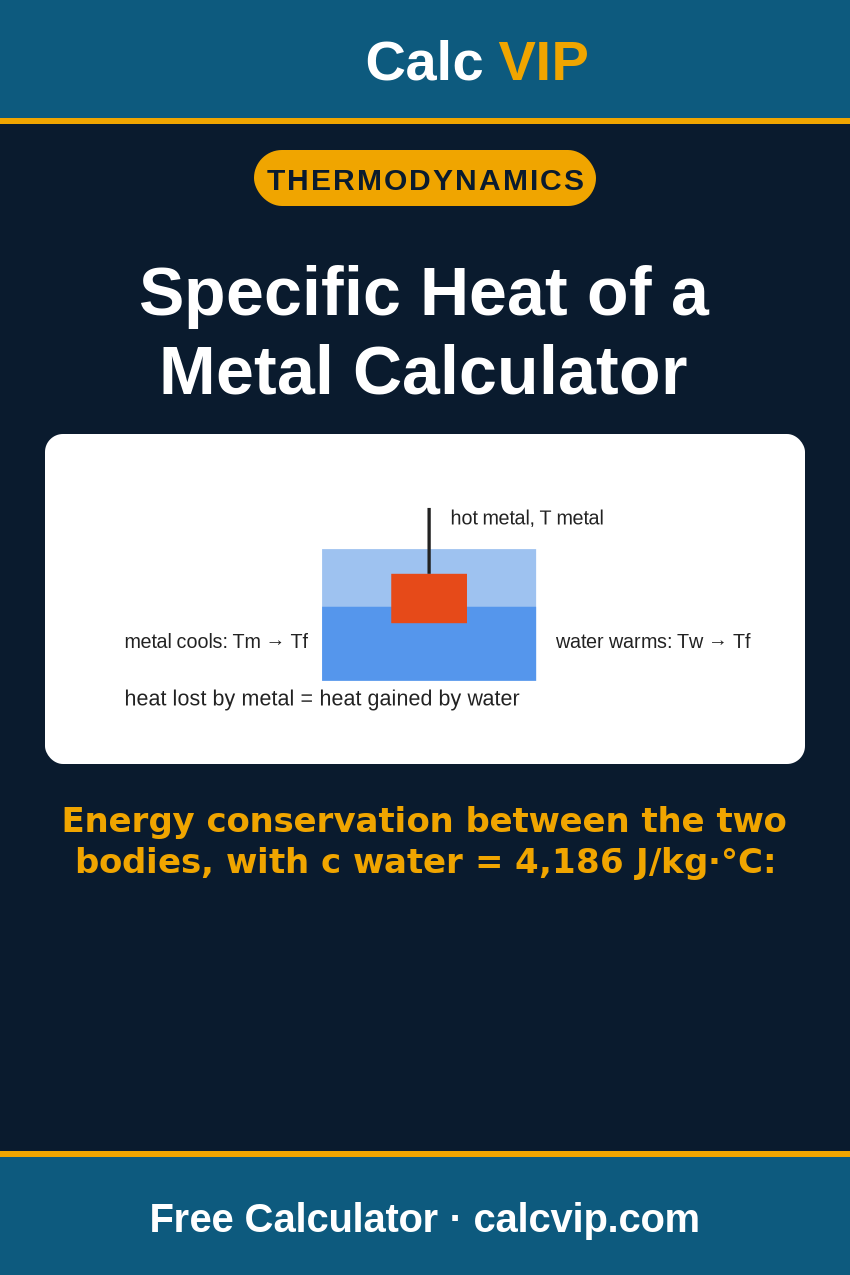
The idealisation is that no heat escapes to the container, the thermometer or the room. Real calorimeters fight that leak with insulation, lids and speed, and refined versions correct for the container's own heat capacity (the "water equivalent"). The method's honesty is that its errors are visible and one-directional: leaked heat always makes the water's gain look smaller than the metal's loss, so a careless experiment underestimates the specific heat. Knowing which way your errors lean is the beginning of experimental wisdom, and this humble experiment teaches it early.
Formula
Energy conservation between the two bodies, with cwater = 4,186 J/kg·°C:
mmetal × cmetal × (Tmetal − Tfinal) = mwater × 4,186 × (Tfinal − Twater)
Solved for the unknown:
cmetal = mwater × 4,186 × (Tfinal − Twater) ÷ [ mmetal × (Tmetal − Tfinal) ]
Notice the design levers the formula exposes. The water's temperature rise (Tfinal − Twater) is the signal — make it large (less water, hotter metal) and thermometer errors shrink in proportion; but too little water leaves the metal barely cooled and its temperature drop, the other bracket, becomes the sloppy one. Balanced experiments aim for both brackets to be comfortably large. The calculator reports the heat the water gained (in joules) alongside c, so you can audit the exchange itself, and it prints the reference values of the four commonest metals for instant comparison.
| Symbol | Meaning | Units |
|---|---|---|
| cmetal | specific heat capacity of the metal — the unknown | J/kg·°C |
| mmetal, mwater | masses of metal and water | kg |
| Tmetal, Twater, Tfinal | starting temperatures and the equilibrium (final) temperature | °C |
| 4,186 | specific heat of water — the reference standard | J/kg·°C |
Why metals differ — and why water is the referee
Specific heat is, at heart, a count of places a material can hide energy. In a metal, added heat becomes the vibration of a lattice of atoms; the heavier the atoms, the fewer of them a kilogram contains, and the less heat the kilogram can absorb per degree. That is the deep pattern behind the table: lead (heavy atoms) 130, copper 385, iron 450, aluminium (light atoms) 900 — an almost perfect inverse procession by atomic mass, known since 1819 as the Dulong–Petit law: per atom, nearly all solids store the same heat (about 3R per mole); per kilogram, light atoms win because there are more of them. The method of mixtures is quietly measuring atomic weight with a kettle and a thermometer.
Water referees the exchange because its specific heat is both enormous and precisely known — 4,186 J/kg·°C, larger than almost any common liquid, a consequence of its hydrogen bonds soaking up energy. Water's thermal greed is why it dominates the experiment's bookkeeping (a modest mass of it absorbs thousands of joules for a few degrees), why it is the working fluid of calorimeters and cooling systems alike, and why coastal climates are mild: the sea is a method-of-mixtures experiment the size of an ocean, buffering the land's temperature swings exactly as the water in the calorimeter buffers the metal's heat.
How to use
- Weigh the metal and the water (kilograms) — the water's mass is most easily found by weighing the calorimeter empty and full.
- Heat the metal to a known temperature (a boiling-water bath gives a trustworthy 100 °C) and record the water's starting temperature.
- Transfer the metal quickly into the water, stir gently, and record the highest temperature the mixture settles at — that is Tfinal.
- Enter the five numbers and click "Find Specific Heat" to see the heat the water gained and the metal's specific heat.
- Compare the answer with the reference values (aluminium ≈ 900, iron ≈ 450, copper ≈ 385, lead ≈ 130) to identify the metal — and treat a result far below all of them as a sign of heat lost on the way.
Worked examples
Example 1 — the reference experiment. 0.1 kg of metal at 100 °C into 0.3 kg of water at 20 °C; the mixture settles at 25 °C.
Heat gained by water = 0.3 × 4,186 × 5 = 6,279 J. c = 6,279 ÷ (0.1 × 75) = 837.2 J/kg·°C — close to aluminium's 900 (the small shortfall is the classic signature of a little heat lost to the cup and air on the way).
Example 2 — identifying copper. 0.2 kg of metal at 100 °C into 0.25 kg of water at 20 °C; final temperature 25.48 °C.
Heat gained = 0.25 × 4,186 × 5.48 = 5,734.8 J. c = 5,734.8 ÷ (0.2 × 74.52) = 384.8 J/kg·°C — copper, to within a joule of its tabulated 385.
Example 3 — identifying lead. 0.5 kg of metal at 100 °C into 0.2 kg of water at 15 °C; final temperature 21.1 °C.
Heat gained = 0.2 × 4,186 × 6.1 = 5,106.9 J. c = 5,106.9 ÷ (0.5 × 78.9) = 129.5 J/kg·°C — lead (130). Note how a hefty half-kilogram of it, near boiling, warms a teacup of water by only six degrees: heavy atoms, shallow pockets.
Example 4 — iron from a hotter start. 0.15 kg of metal at 150 °C (heated in oil or a furnace) into 0.4 kg of water at 25 °C; final 29.8 °C.
Heat gained = 0.4 × 4,186 × 4.8 = 8,037.1 J. c = 8,037.1 ÷ (0.15 × 120.2) = 445.8 J/kg·°C — iron/steel territory (450), the small deficit again pointing to transfer losses.
Example 5 — a small, precious sample. Just 0.05 kg of metal at 100 °C into 0.1 kg of water at 20 °C; final 22.4 °C.
Heat gained = 0.1 × 4,186 × 2.4 = 1,004.6 J. c = 1,004.6 ÷ (0.05 × 77.6) = 258.9 J/kg·°C — above both tin (227) and silver (235), which in practice would send the experimenter back to check the thermometer: small samples make small temperature rises, and small rises make large percentage errors. The example is the honest face of the method's limit.
Example 6 — running the method forwards. Predict the final temperature when 0.3 kg of aluminium (c = 900) at 100 °C meets 0.5 kg of water at 20 °C.
Balance: 0.3 × 900 × (100 − T) = 0.5 × 4,186 × (T − 20), so 270 × (100 − T) = 2,093 × (T − 20), giving T = 29.14 °C. The same balance the calculator inverts is the one engineers use to predict quenching baths and cooling curves before any metal gets wet.
The method of mixtures in real life
Identifying scrap and alloys. A non-destructive, pennies-cheap assay: recyclers and school labs alike sort unknown metals by specific heat when a magnet and a colour chart cannot decide between, say, aluminium and zinc alloys.
Quenching and heat treatment. Blacksmiths and heat-treaters quench hot steel in water or oil baths whose temperature rise must be predicted and controlled — Example 6's forward balance, run at industrial scale, with the bath sized so its temperature stays in the working window.
Calorimetry of foods and fuels. The bomb calorimeter that prints "calories" on food labels is the method of mixtures in armour plate: burn the sample, let water absorb the energy, and read the temperature rise. Every nutritional label descends from this experiment.
Cooking. A cast-iron pan (c ≈ 450) holds its heat into a steak where a thin aluminium pan (900, but feather-light) cannot — chefs are manipulating m × c, the heat capacity, which is why pan weight matters as much as pan material.
Climate and oceanography. Water's 4,186 against rock's ~800 is why land heats and cools five times faster than the sea beside it — sea breezes, monsoons and the mildness of islands are the method of mixtures written across weather maps.
Thermal storage design. Engineers choosing a storage medium — water tanks, molten salts, phase-change bricks — compare exactly this page's quantity per kilogram and per rupee. Water's freakishly high c is why, two centuries on, it still wins most of those comparisons.
The calorimeter constant: paying the container its due
Serious calorimetry adds one term to the balance: the container, stirrer and thermometer also warm up, drinking a share of the metal's heat. Their combined appetite is measured once — by a calibration mixing of known warm and cool water — and expressed as a water equivalent W (grams of water that would absorb the same heat). The corrected balance reads: heat lost by metal = (mwater + W) × 4,186 × (Tfinal − Twater). A typical school calorimeter's W is 10–30 g — against 300 g of water, a 3–10 percent correction, which is most of the shortfall seen in Examples 1 and 4. Radiation losses get the same treatment in Regnault's correction, which tracks the mixture's temperature before and after the transfer and extrapolates the true peak. None of this changes the method; it merely pays every participant in the exchange, which is all that accuracy ever is.
Latent heat: the mixture that does not warm
The method has a famous sibling for the heat that hides in change of state. Drop ice at 0 °C into warm water and part of the water's heat is spent not on warming the ice but on melting it — at 334,000 J/kg, with no temperature change at all to show for it. The balance gains a term (mice × L) and otherwise reads identically, and the experiment measures the latent heat of fusion the same way this page measures specific heat. Black discovered both quantities with essentially this apparatus, and the pair of them — the heat that moves thermometers and the heat that does not — reorganised eighteenth-century physics. A student who has run both experiments has handled the complete accounting of heat in matter: stored in temperature, stored in state, and nowhere else to hide.
Quick reference: specific heats of common materials
| Material | c (J/kg·°C) | Note |
|---|---|---|
| lead | 130 | heaviest common metal — lowest c |
| tin | 227 | |
| silver | 235 | |
| copper | 385 | |
| iron / steel | 450 | |
| glass | ≈ 840 | why Example 1's 837 needs a second look |
| aluminium | 900 | lightest common metal — highest metal c |
| water | 4,186 | the referee — higher than everything else here |
The glass row is a cautionary tale: an answer near 840 may be aluminium measured carelessly — or a sample that was never metal at all. Identification by one number is a hypothesis, and density (a quick weigh-and-dunk) is the standard second witness.
Common mistakes
- Letting the metal cool during transfer. Every second in the air between bath and calorimeter bleeds heat that the water never sees, biasing c low. Move fast, move once, and keep the metal dry — clinging hot water smuggles uncounted heat and mass into the experiment.
- Reading the final temperature too early or too late. Too early and the mixture has not equilibrated; too late and the room has begun reclaiming heat. Stir, watch for the peak plateau, and take that as Tfinal.
- Ignoring the container. An uninsulated metal can can absorb a tenth of the heat. Either calibrate its water equivalent or use a foam cup, whose appetite is negligible — the cheapest accuracy in the whole experiment.
- Using grams in a kilograms formula. The formula is consistent in any one mass unit only if both masses share it — grams with grams cancel, but mixing 0.1 kg of metal with 300 g of water unconverted inflates c a thousandfold.
- Assuming the bath temperature is exactly 100 °C. At altitude, water boils below 100 °C (about 95 °C at 1,500 m), and a metal "at 100" that was really at 95 hands the calculator a 5-degree fiction that lands entirely in the answer.
FAQ
Why is the experimental value often lower than the table value?
Some heat escapes to the calorimeter cup, the thermometer and the air while you transfer the metal, so the water receives less heat than the metal really lost. A lid, quick transfer and insulation all improve the result.
Does the calorimeter itself absorb heat?
Yes, a little. Careful experiments add the cup's "water equivalent" to the water mass. This calculator ignores it, which is standard for school experiments and typically costs only a few percent.
Why use water as the reference liquid?
Water's specific heat (4186 J/kg·°C) is accurately known and unusually large, so it warms up slowly and gives an easy-to-measure temperature rise. It is the historical basis of the calorie unit.
Why does the final temperature have to lie between the two starting temperatures?
Because heat flows from hot to cold until both agree — the equilibrium must sit between the metal's start and the water's start. A "final" temperature outside that range means a misread thermometer or a swapped entry, which is why the calculator refuses it.
How accurate is the school version of this experiment?
Typically within 5–10 percent of the tabulated value, almost always low, for the reasons in the mistakes list. With a foam cup, fast transfer and a calibrated water equivalent, 2–3 percent is achievable — remarkable for apparatus that costs less than the textbook describing it.
Can this method measure a liquid's specific heat instead?
Yes — swap the roles: mix the unknown liquid with a known mass of water (or use a heated metal of known c as the donor). The balance is unchanged; only the label on the unknown moves.
Why is water's specific heat so much higher than any metal's?
Two multipliers stack: water's molecules are very light (18 g per mole against iron's 56 or lead's 207), so a kilogram holds far more particles; and its hydrogen-bond network offers extra ways to store energy beyond simple vibration. Light particles plus extra storage equals the champion of the table.
What is the difference between specific heat and heat capacity?
Heat capacity belongs to an object (this pan: 450 J/°C); specific heat belongs to a material (iron: 450 J/kg·°C) — the object's figure divided by its mass. Cooks care about the first; this page measures the second.
Does specific heat change with temperature?
Mildly, for most solids at room conditions — a few percent across a hundred degrees — which the method averages over the cooling range. At cryogenic temperatures the values collapse towards zero (a pillar of the third law of thermodynamics), and near melting they spike; the school experiment lives safely in the flat middle.
Who invented the method of mixtures?
It grew up with calorimetry itself in the late 1700s — Joseph Black's Edinburgh lectures established specific and latent heat with mixture experiments, and Lavoisier and Laplace built the ice calorimeter on the same principle. The school version is a direct descendant, apparatus and all.